Table of Contents
Parts of Gears Key Components That Impact Performance
Modern industrial systems rarely fail because of one dramatic event. More often, performance erosion begins quietly: a marginal tooth profile, an overlooked bore tolerance, an under-specified heat treatment, or a procurement shortcut taken to hit quarterly cost targets.
Gears sit at the center of motion transmission across manufacturing lines, robotics, mining systems, automotive platforms, agricultural equipment, aerospace assemblies, packaging machines, and countless other applications.
For additional background on gear fundamentals and terminology, see: Wikipedia – Gear, American Gear Manufacturers Association, and NASA Engineering Resources.
Understanding the parts of gears is not simply an academic exercise for design engineers. For procurement professionals, sourcing managers, and OEM decision makers, gear anatomy directly influences uptime, maintenance intervals, lifecycle costs, and customer satisfaction.
When buyers understand how each component affects torque transfer, meshing efficiency, thermal behavior, vibration characteristics, and durability, procurement evolves from transactional purchasing into strategic performance management.
1. Introduction: Why Understanding Gear Parts Matters
1.1 The Role of Gear Components in System Efficiency
Every component of a gear participates in energy transmission. Even microscopic deviations in geometry can create cascading inefficiencies.
The tooth profile determines how force is transferred between mating gears. The hub maintains concentricity and torque continuity. The bore governs mounting precision. Surface finish influences friction coefficients. Root geometry affects stress propagation. Collectively, these factors determine how effectively rotational energy converts into usable mechanical work.
Efficiency losses inside gear systems typically manifest as:
- Excess heat generation
- Increased vibration
- Elevated acoustic emissions
- Accelerated lubricant degradation
- Higher power consumption
- Reduced operating lifespan
Mechanical engineers often describe poorly specified gears as systems that slowly eat themselves. That phrase may sound colloquial, but it captures reality surprisingly well.
High-performing gears create stable rolling contact instead of excessive sliding interaction. They minimize parasitic energy loss and sustain predictable load transfer over prolonged operating cycles.
1.2 Why Procurement Teams Evaluate More Than Price
Experienced procurement teams understand that the cheapest component frequently becomes the most expensive decision.
Evaluating gears exclusively through piece price creates exposure to hidden operational costs:
- Emergency maintenance
- Equipment downtime
- Inventory shortages
- Warranty claims
- Production interruptions
- Increased energy consumption
A mature procurement methodology evaluates:
- Material certifications
- Manufacturing repeatability
- Statistical process control
- Heat treatment consistency
- Inspection capability
- Supplier responsiveness
- Long-term scalability
Procurement professionals operating in OEM and ODM environments increasingly adopt total cost of ownership models rather than unit-cost optimization.
That approach shifts the conversation from:
How much does this gear cost?
to:
What will this gear cost after five million cycles?
That distinction changes everything.
1.3 How Gear Part Quality Influences Long-Term Performance
Long-term performance is built one feature at a time.
High-quality gears maintain:
- Stable contact patterns
- Reduced backlash variation
- Controlled thermal expansion
- Lower wear progression
- Consistent transmission efficiency
Inferior component execution often introduces failure mechanisms long before visible damage appears.
Typical early warning indicators include:
- Tooth micro-pitting
- Edge loading
- Elevated gearbox temperature
- Lubrication contamination
- Resonance amplification
Premium gear manufacturing focuses on dimensional repeatability, microgeometry refinement, metallurgical consistency, and process validation.
In industrial environments where uptime equals revenue, reliability becomes currency.
2. Gear Anatomy Overview: Understanding the Complete Structure
A gear is more than a wheel with teeth.
Each section serves a mechanical purpose and contributes to overall transmission behavior. Understanding the complete structure enables buyers and engineers to align technical specifications with operational objectives.
2.1 Main Functional Areas of a Gear
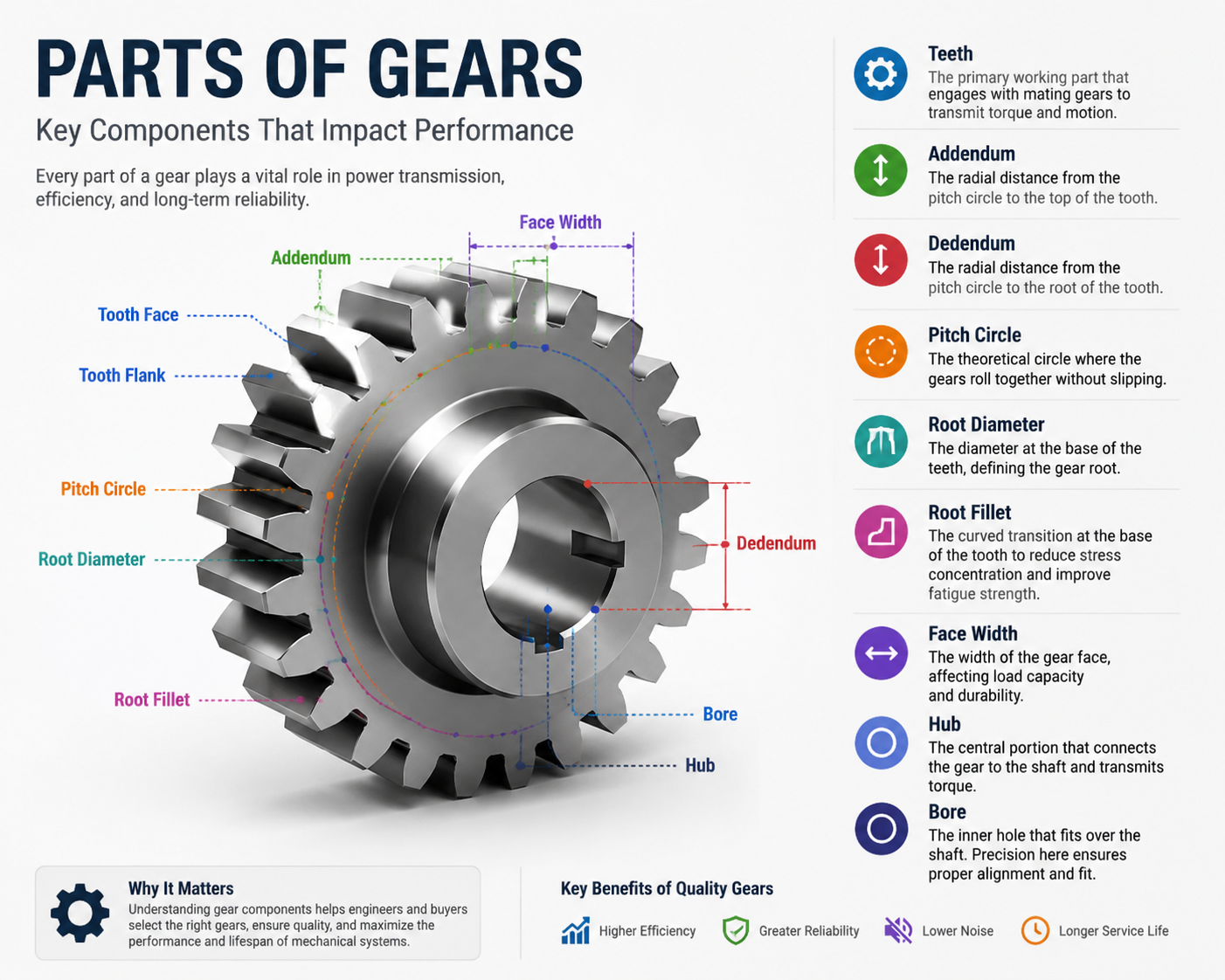
Core gear regions generally include:
- Teeth
- Tooth face
- Tooth flank
- Addendum
- Dedendum
- Pitch circle
- Root diameter
- Root fillet
- Hub
- Bore
- Face width
- Mounting interfaces
Each area governs different aspects of mechanical performance.
For example:
- The teeth transmit motion
- The hub carries torque
- The bore controls positioning
- The root absorbs stress
Ignoring one section while optimizing another usually creates performance asymmetry.
2.2 How Individual Parts Work Together
Gear systems operate as integrated mechanisms.
- A refined tooth profile cannot compensate for poor hub concentricity
- Excellent material cannot rescue inaccurate backlash
- Perfect machining loses value when heat treatment distorts geometry
Every component contributes to:
- Load sharing
- Thermal behavior
- Contact stability
- Dynamic balance
- Lubrication performance
Procurement teams evaluating suppliers should therefore assess process integration rather than isolated specifications.
2.3 Common Terminology Every Buyer Should Know
Procurement professionals who understand technical vocabulary gain substantial leverage during supplier discussions.
Essential terms include:
- Module
- Diametral pitch
- Pressure angle
- Backlash
- Face width
- Pitch diameter
- Runout
- Concentricity
- AGMA grade
- Tooth profile error
- Lead deviation
Technical literacy shortens approval cycles and reduces specification ambiguity.
3. Gear Teeth: The Core Element of Power Transmission
3.1 Tooth Profile and Load Distribution
The tooth profile determines force transmission behavior.
Most industrial gears rely on involute geometry because it maintains stable velocity ratios despite minor alignment variations.
Well-designed profiles:
- Reduce localized pressure
- Promote rolling contact
- Improve load sharing
- Minimize friction
Profile deviations increase concentrated stresses that eventually become fatigue failures.
3.2 Tooth Count and Speed Ratio Effects
Tooth quantity directly influences transmission characteristics.
- Lower tooth counts typically provide higher torque multiplication
- Higher counts generally deliver smoother engagement
- Higher counts reduce vibration and improve positioning precision
Procurement teams should verify that tooth count aligns with actual application loads rather than inherited legacy designs.
3.3 How Tooth Quality Impacts Wear and Noise
Tooth quality affects far more than aesthetics.
Critical variables include:
- Profile accuracy
- Surface roughness
- Pitch consistency
- Edge geometry
Poor teeth generate excessive contact stress, vibration harmonics, audible noise, and lubricant breakdown.
On busy production floors, unusual gear noise is often the machine’s way of saying something expensive is coming.
4. Tooth Face and Tooth Flank: Contact Areas That Define Efficiency
4.1 Understanding Tooth Face Geometry
The tooth face extends above the pitch circle and engages during power transmission.
Its geometry influences contact ratio, load distribution, friction behavior, and operational efficiency.
4.2 The Function of the Tooth Flank Under Load
The flank experiences direct operational contact.
Under load it must withstand compression, sliding, thermal accumulation, and surface fatigue.
Controlled flank geometry improves efficiency and suppresses contact stress concentration.
4.3 Surface Finish Requirements for Smooth Operation
Surface finish strongly influences operational behavior.
- Reduced friction
- Better lubricant retention
- Lower acoustic output
- Improved durability
Excessively rough surfaces behave like microscopic grinding systems.
Smooth does not simply mean attractive. Smooth means controlled.
5. Addendum and Dedendum: Critical Dimensions for Gear Engagement
At first glance, addendum and dedendum appear to be modest geometric values hidden inside technical drawings.
In practice, these dimensions profoundly influence meshing quality, contact stability, torque capacity, and operating life.
5.1 What the Addendum Controls
The addendum is the radial distance from the pitch circle to the top of the tooth.
- Contact ratio
- Engagement duration
- Transmission efficiency
- Dynamic loading characteristics
Well-optimized addendum dimensions allow multiple teeth to share load progressively instead of creating abrupt force transitions.
5.2 Why Dedendum Influences Clearance
Dedendum controls tooth root clearance, lubrication pathways, thermal expansion allowance, and engagement reliability.
Industrial environments rarely operate under textbook conditions.
5.3 Design Trade-Offs Between Strength and Contact
Gear engineering continuously balances opposing objectives.
- Efficiency
- Durability
- Manufacturability
- Cost
- Noise control
Experienced OEM teams rarely optimize one metric in isolation.
Pitch diameter represents the theoretical diameter at which gears roll together without slipping.
It determines rotational speed, torque multiplication, center distance, and velocity ratio.
Errors in pitch diameter introduce meshing irregularities, excessive backlash, noise, and uneven wear.
Pitch diameter connects directly to transmission ratios using number of teeth, module, diametral pitch, and center distance.
Understanding these relationships allows procurement teams to validate supplier proposals independently.
Dimensional precision influences downstream performance. Procurement reviews should include:
During operation, teeth behave like cantilever beams. Maximum bending stress accumulates near the root. Sharp transitions increase local stress intensity.
Optimized root geometry improves fatigue resistance, crack suppression, load capacity, and impact tolerance. Advanced manufacturers employ profile modifications and controlled machining paths to minimize stress risers.
Root inspection includes visual examination, magnetic particle testing, dye penetrant inspection, radius verification, and surface roughness measurement.
The hub connects rotational force between shaft and gear body, affecting torque transmission, concentricity, structural stiffness, and installation reliability.
Common approaches include keyed connections, splined interfaces, press fits, shrink fits, and clamping assemblies. Each has trade-offs in torque capacity, alignment, and ease of maintenance.
Hub-related failures frequently trace back to installation. Critical controls include shaft straightness, bore concentricity, surface preparation, assembly sequence, and torque procedures.
Common bore configurations include straight, taper, keyed, splined, and custom profiles. Selection depends on torque requirements, service conditions, assembly preferences, and maintenance accessibility.
Bore tolerance controls fit quality. Poor control introduces eccentric rotation, excess vibration, shaft wear, and reduced life expectancy. Typical fits include interference, transition, and clearance.
Recurring sourcing errors include omitting tolerance requirements, ignoring thermal expansion, assuming standard shaft dimensions, overlooking coating thickness, and failing to validate inspection methods.
Keyways remain widely used because of simplicity and maintainability. Common designs include parallel keys, Woodruff keys, and taper keys.
Splines distribute load across multiple contact surfaces for higher torque capacity and better centering, while keyways are simpler and easier to maintain.
Best practices include cleaning mating surfaces, confirming dimensional compatibility, applying controlled assembly force, monitoring alignment, and recording installation parameters.
Face width determines how much surface area contacts the mating gear. Wider faces distribute load more evenly, reduce localized stress, and improve durability, but increase material cost and weight.
Optimizing face width requires balancing tooth bending strength with material efficiency. Overly wide gears waste material, while narrow gears risk overload and premature wear.
Procurement and engineering teams must evaluate load, speed, lubrication, and packaging constraints to select face width that ensures reliability without unnecessary cost.
Pressure angle is the angle between the line of action and the tangent to the pitch circle. It governs how force moves from one tooth to another. Common standards include 14.5°, 20°, and 25°.
Lower angles provide smoother meshing and quieter operation, while higher angles increase tooth strength and load capacity. Proper selection aligns with application requirements.
Pressure angle affects radial and tangential forces, sliding velocity, contact ratio, load sharing, friction, and overall efficiency. Small adjustments can yield measurable performance improvements.
Standard angles simplify supplier compatibility, tooling, and replacement sourcing. Custom angles can improve packaging, load handling, and product differentiation but require stronger supplier controls.
Backlash creates intentional clearance between teeth to accommodate thermal expansion, lubrication, and manufacturing variation. Proper backlash ensures smooth operation and prevents binding.
Excessive backlash causes positioning errors, noise, and accelerated wear. Insufficient backlash leads to interference, overheating, and surface damage.
Backlash management uses dial indicators, contact pattern verification, controlled assembly procedures, shims, center distance correction, and selective assembly to maintain optimal clearance.
Steel is versatile, durable, and heat-treatable. Carbon, alloy, case-hardened, and stainless steels offer different combinations of fatigue strength, wear resistance, and corrosion resistance.
Modern engineering plastics (Nylon, POM, PEEK) provide weight reduction, noise reduction, and corrosion resistance. Designers must consider creep, thermal expansion, and moisture absorption.
Procurement should evaluate mechanical properties, certification, supply stability, cost, and regional availability to ensure material supports performance and supply chain reliability.
Heat treatments include carburizing (hard surface, tough core), nitriding (surface hardness with minimal distortion), induction hardening (localized strengthening), and through hardening (uniform hardness). Each method balances wear resistance and dimensional control.
High surface hardness resists wear, while a tough core absorbs shock. Successful gears balance case depth, hardness gradient, residual stress, and microstructure stability.
Verification requires hardness testing, metallography, distortion checks, and case depth validation. Procurement teams should require objective evidence, not just process declarations.
Gear quality classifications evaluate tooth profile, lead variation, pitch error, runout, and concentricity. Higher precision grades reduce vibration, improve efficiency, and enhance positioning accuracy.
Dimensional variations affect meshing quality, contact stress, acoustic behavior, and lubrication performance. Even small errors become amplified at higher rotational speeds.
Evaluate suppliers for process repeatability, calibration practices, inspection infrastructure, statistical controls, and continuous improvement systems. Mature suppliers consistently produce accurate, reliable components.
Dimensional evaluation uses coordinate measuring machines, gear measuring centers, optical systems, and roundness instruments. Measurements include pitch deviation, tooth geometry, bore dimensions, and runout.
Surface and material testing includes roughness testing, hardness measurement, metallography, and residual stress analysis. These assessments reveal conditions invisible to dimensional inspection alone.
Documentation ensures quality assurance, warranty defense, continuous improvement, and regulatory compliance. Records should include material certificates, inspection reports, heat treatment records, and lot identification.
Wear mechanisms include abrasive wear, adhesive wear, and surface fatigue. Contributing factors include contamination, misalignment, poor lubrication, and surface defects. Pitting often begins microscopically.
Structural failures result from excess loading, geometry defects, material limitations, and thermal effects. Root cracks are particularly common and require thorough failure analysis.
Installation mistakes, including improper fit, shaft deflection, housing distortion, and contamination, can cause significant failure even in high-quality gears. Proper assembly is critical.
Verify material grade, heat treatment, tooth geometry, bore and hub tolerances, face width, pressure angle, and backlash to ensure the gear meets functional requirements.
Assess production capacity, inspection infrastructure, traceability, certifications (ISO, AGMA), and track record with similar applications to ensure supplier reliability.
Consider component cost, expected operational life, maintenance frequency, risk of downtime, and supply chain reliability to optimize total cost of ownership rather than initial price alone.
Communicate detailed technical specifications, quality acceptance criteria, application context, and conduct regular engineering reviews to minimize ambiguity and align expectations.
Custom designs, including optimized tooth geometry, material selection, surface treatments, and hub/bore configurations, can enhance performance and product differentiation but require strong supplier control.
Implement multi-supplier strategies, supplier development programs, periodic audits, lifecycle planning, and clear contractual performance warranties to ensure long-term gear reliability.
Develop a standardized approach with a comprehensive checklist, alignment of procurement, engineering, and quality teams, regular supplier audits, and performance tracking to transform gear procurement into a strategic advantage.
Additional references and technical resources for in-depth study:6. Pitch Circle and Pitch Diameter: The Foundation of Gear Performance
6.1 How Pitch Diameter Determines Motion
6.2 Calculating Gear Relationships
6.3 Procurement Considerations for Dimensional Accuracy
7. Root Diameter and Root Fillet: Hidden Factors Behind Gear Strength
7.1 Stress Concentration at the Root Area
7.2 Root Geometry and Fatigue Resistance
7.3 Inspection Standards for Root Integrity
8. Gear Hub: The Connection Point That Carries Torque
8.1 Hub Structure and Mechanical Stability
8.2 Hub-to-Shaft Connection Methods
8.3 Preventing Alignment and Fitment Issues
9. Gear Bore: Precision Requirements for Installation Accuracy
9.1 Bore Types and Application Scenarios
9.2 Tolerance Classes and Assembly Performance
9.3 Common Procurement Mistakes in Bore Specifications
10. Keyway and Mounting Features: Securing Reliable Transmission
10.1 Standard Keyway Designs
10.2 Splines vs Keyways for Torque Transfer
10.3 Installation Challenges and Best Practices
11. Gear Face Width: Balancing Load Capacity and Cost
11.1 How Face Width Affects Load Distribution
11.2 Design Limits and Material Utilization
11.3 Selecting the Right Width for Applications
12. Pressure Angle: A Small Detail with Major Impact
12.1 Understanding Pressure Angle Fundamentals
12.2 Efficiency and Force Distribution Effects
12.3 Standard vs Custom Pressure Angles
13. Backlash: Managing Clearance for Reliable Operation
13.1 Why Backlash Exists
13.2 Performance Risks of Improper Backlash
13.3 Inspection and Adjustment Strategies
14. Gear Materials: Matching Components to Performance Goals
14.1 Steel, Stainless Steel, and Alloy Options
14.2 Plastic and Composite Gear Applications
14.3 Material Selection from a Procurement Perspective
15. Heat Treatment and Surface Engineering of Gear Parts
15.1 Carburizing, Nitriding, and Hardening Methods
15.2 Surface Hardness vs Core Toughness
15.3 Quality Control Requirements for Treated Parts
16. Manufacturing Tolerances and Precision Grades
16.1 Understanding Gear Accuracy Standards
16.2 Tolerance Effects on Efficiency and Noise
16.3 Supplier Capability Assessment
17. Inspection Methods for Critical Gear Components
17.1 Dimensional Inspection Techniques
17.2 Surface and Material Testing
17.3 Documentation and Traceability Requirements
18. Common Gear Component Failures and Root Causes
18.1 Tooth Wear and Pitting
18.2 Cracking, Chipping, and Breakage
18.3 Misalignment and Installation Errors
19. Procurement Checklist for Evaluating Gear Components
19.1 Technical Specifications to Verify
19.2 Supplier Qualification Criteria
19.3 Cost, Quality, and Lead Time Balancing
20. How OEM and ODM Buyers Can Improve Gear Performance Outcomes
20.1 Building Better Supplier Communication
20.2 Customization Opportunities for Competitive Advantage
20.3 Long-Term Strategies for Reliable Gear Sourcing
21. Conclusion: Turning Component Knowledge into Better Purchasing Decisions
21.1 Key Takeaways for Engineering Teams
21.2 Questions Buyers Should Ask Before Ordering
21.3 Creating a Repeatable Gear Evaluation Process