Table of Contents
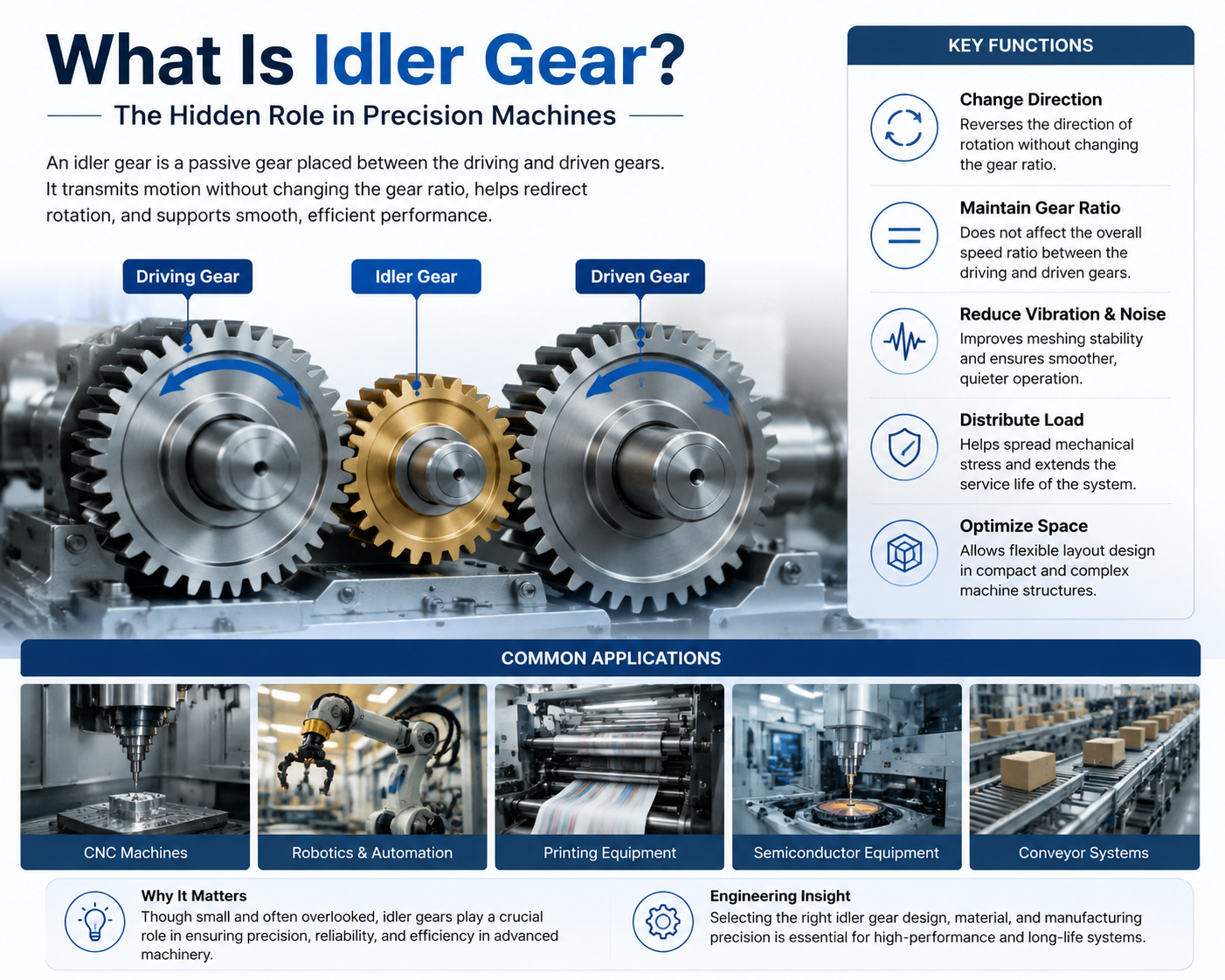
1. Introduction: what is idler gear in precision machines
Purpose in modern mechanical systems
Idler gears are used in precision mechanical systems to transmit motion between gears without altering the overall gear ratio. Their primary purpose is to bridge spatial gaps, redirect motion, and stabilize gear engagement in tightly engineered assemblies such as CNC machines, robotics, and automated production lines. In modern systems where efficiency and compact design are critical, idler gears help engineers achieve layout flexibility without compromising performance.
Why precision machines rely on hidden components
Precision machines often depend on components that do not directly contribute to torque multiplication but are essential for system integrity. Idler gears fall into this category, acting as silent enablers that ensure smooth motion transfer and correct gear alignment. Their “hidden” nature means they are often overlooked during procurement, yet they play a decisive role in reducing mechanical stress, improving alignment accuracy, and ensuring long-term reliability.
Overview of functional importance
The functional importance of idler gears lies in their ability to stabilize mechanical systems under dynamic loads. They help maintain consistent motion paths, reduce vibration, and support directional changes in gear trains.
Reference concepts: Gear Systems | Idler Gear
For procurement professionals and mechanical engineers, understanding this hidden role is essential when evaluating system reliability and total cost of ownership in precision equipment sourcing.
2. Fundamental definition of an idler gear
Basic mechanical role in gear trains
An idler gear is a gear placed between the driving and driven gears to transmit motion without affecting the speed ratio. It serves as an intermediate transmission element, ensuring that rotational motion is passed efficiently even when gears are spaced apart or require directional adjustment within the system architecture.
Difference from driving and driven gears
Unlike driving gears that initiate motion and driven gears that receive torque, idler gears do not contribute to torque amplification or reduction. Instead, they act as neutral transmitters of motion.
Core operating principle
The operating principle of an idler gear is based on meshing continuity. As it engages with adjacent gears, it transfers rotational motion through direct tooth contact while maintaining angular velocity relationships dictated by the driving system.
3. How an idler gear functions in gear assemblies
Torque transmission behavior
Idler gears transmit torque through meshing contact but do not amplify or reduce it. Instead, they carry the same torque level from one gear to another, making them essential for maintaining force continuity in extended gear trains.
Direction control without ratio change
One of the most important functions of idler gears is reversing rotational direction without changing speed ratio. When an idler gear is inserted between two gears, it changes the direction of rotation while preserving the gear ratio.
Interaction with adjacent gears
Idler gears interact simultaneously with multiple gears, ensuring synchronized motion transfer. This interaction requires precise meshing alignment to avoid backlash, noise, or wear issues.
4. Positioning of idler gears in machine design
Typical placement in gear trains
Idler gears are typically positioned between two non-contacting gears to bridge distance or adjust layout geometry.
Multi-gear system configurations
In complex systems, multiple idler gears may be used to create extended transmission paths.
Design constraints affecting placement
The placement of idler gears is constrained by factors such as shaft alignment, load distribution, lubrication access, and housing geometry.
5. Why precision machines require idler gears
Motion synchronization needs
Precision machines require exact synchronization between multiple moving components. Idler gears help maintain consistent timing and phase alignment in gear trains.
Space optimization in compact systems
In compact mechanical systems, direct gear meshing is not always possible due to spatial limitations.
Load distribution benefits
Idler gears help distribute mechanical loads across multiple contact points, reducing localized stress on individual gears.
6. Idler gear impact on rotational direction control
Reversing output direction
Idler gears are widely used to reverse the direction of rotation between input and output shafts.
Maintaining input-output alignment
By introducing idler gears, designers can maintain parallel or aligned input-output shaft configurations.
Applications in directional systems
Directional control using idler gears is essential in conveyor systems, printing machinery, and robotic arms.
7. Role of idler gears in maintaining gear ratios
Why idler gears do not affect ratio
Idler gears do not influence gear ratios because they do not change the number of teeth engaged between the driving and driven gears.
Transmission path extension logic
By extending the physical distance between gears, idler gears allow flexible layout design while preserving the mathematical relationship of gear ratios.
Engineering implications for design accuracy
This property allows predictable system behavior even in complex gear trains.
8. Vibration reduction and noise control function
Smoother meshing engagement
Idler gears help distribute engagement forces across multiple contact points, resulting in smoother meshing transitions.
Reduction of backlash impact
By stabilizing gear engagement, idler gears can reduce the perceptible effects of backlash in gear systems.
Noise suppression in high-speed systems
In high-speed applications, idler gears contribute to quieter operation by minimizing direct gear impact forces.
9. Load balancing advantages in precision equipment
Even distribution of mechanical stress
Idler gears distribute mechanical stress across a broader gear train.
Reduction of localized wear
By sharing contact loads, idler gears reduce localized tooth wear.
Improved system longevity
The combined effect leads to significantly improved system longevity.
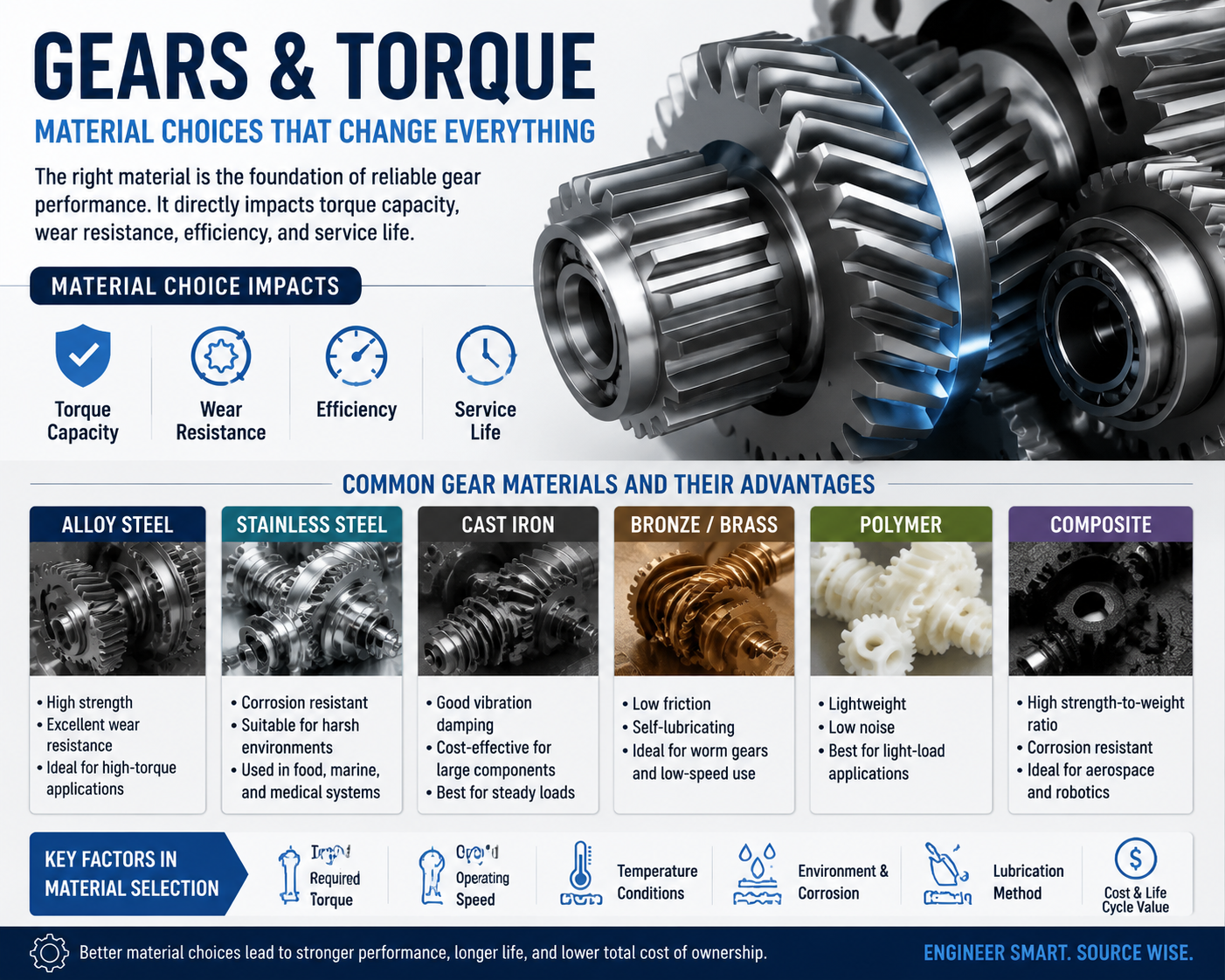
10. Material selection for idler gears in OEM production
Common industrial materials used
Idler gears are commonly manufactured from alloy steels, carbon steels, engineering plastics, or sintered metals.
Trade-offs between strength and cost
High-strength materials offer better durability but increase production cost.
Surface treatment considerations
Surface treatments such as carburizing and nitriding improve wear resistance.
11. Manufacturing tolerances and precision requirements
Machining accuracy standards
Idler gears used in precision machines require tight machining tolerances.
Impact of tolerances on performance
Even minor tolerance variations can significantly affect system smoothness and alignment.
Quality control in OEM/ODM production
OEM manufacturing processes implement strict quality control measures including gear inspection.
12. Common applications in precision machinery
CNC machines and automation systems
Idler gears are used in CNC machines to ensure smooth motion transfer.
Robotics and motion control units
Robotic systems rely on idler gears for compact motion routing.
Printing and semiconductor equipment
High-precision printing and semiconductor equipment use idler gears for synchronization.
13. Idler gear vs driving gear vs driven gear
Functional comparison of roles
Driving gears initiate motion, driven gears receive motion, while idler gears simply transmit motion.
Force transmission differences
Driving and driven gears handle torque transfer, while idler gears act as passive transmitters.
Design dependency relationships
Idler gears depend on system layout rather than performance output requirements.
14. Design challenges in integrating idler gears
Space limitation issues
Integrating idler gears into compact systems can be challenging due to spatial constraints.
Alignment sensitivity problems
Misalignment can cause uneven wear and increased noise.
Lubrication and wear concerns
Proper lubrication is essential to minimize friction and wear.
15. Failure modes and maintenance considerations
Wear patterns and fatigue issues
Idler gears can experience tooth wear, surface fatigue, and pitting over time.
Misalignment consequences
Misalignment leads to uneven load distribution and accelerated failure.
Preventive maintenance strategies
Regular lubrication and vibration monitoring extend service life.
16. Procurement considerations for idler gears in OEM supply chains
Cost-performance optimization factors
Procurement decisions must balance cost against durability and precision requirements.
Supplier capability evaluation criteria
Suppliers must be evaluated based on machining capability and quality control systems.
Consistency in mass production quality
Consistency in batch production is critical for OEM system stability.