Table of Contents
Introduction to Industrial Gears: Functions, Types, and Applications
1. Introduction to Industrial Gears
Definition of Industrial Gears
Industrial gears are mechanical components meticulously engineered to transmit torque and rotational motion from one shaft to another, often with a specific reduction or amplification in speed. Unlike casual hobbyist gears you might see in a school project or toy, industrial gears are subjected to rigorous design standards, stress analyses, and precise tolerances, often operating in environments where reliability and efficiency are non-negotiable. They are the unsung heroes in factories, automotive drivetrains, aerospace assemblies, and countless other heavy-duty applications.
Importance of Gears in Mechanical Systems
The backbone of any mechanical system is often a set of gears; they serve as the translators of raw power into usable motion, converting rotational energy into force where and when it is needed. Without gears, machinery would be unable to perform controlled movements, sustain high loads, or achieve the precision required in modern industrial processes. They not only amplify or reduce speed but also manage torque, align rotational axes, and ensure synchronization across complex mechanisms. In essence, gears are the silent engineers that keep the mechanical world spinning smoothly.
Overview of Applications in Various Industries
Gears find ubiquitous use across industries: automotive transmissions, robotics, heavy-duty manufacturing equipment, aerospace propulsion systems, wind turbines, and even consumer electronics. Each application demands gears with tailored characteristics—some requiring corrosion-resistant alloys, others precision-machined helical designs for quiet operation. From conveyor belts in factories to planetary gearsets in electric vehicles, their role is both foundational and transformative. Learn more on Wikipedia.
2. History of Gear Development
Early Mechanical Gears and Their Origins
The concept of gears traces back thousands of years, with rudimentary examples found in ancient China, Greece, and Egypt. Early artisans used wooden gears to drive waterwheels, clocks, and milling machines, relying on empirical knowledge rather than precise engineering calculations. These proto-gears were often handcrafted, showcasing ingenuity in solving fundamental motion-transmission problems without the aid of modern metallurgy or CAD software.
Evolution During the Industrial Revolution
The Industrial Revolution marked a turning point, introducing metal gears, standardized modules, and systematic manufacturing processes. The advent of lathes, hobbing machines, and milling techniques allowed engineers to mass-produce gears with unprecedented consistency. This period also saw the birth of gear trains in steam engines, textile machines, and early automotive systems, highlighting the increasing reliance on gears for high-power applications.
Modern Advancements in Gear Technology
Today, gears benefit from high-precision CNC machining, advanced surface treatments, finite element analysis, and even 3D printing for rapid prototyping. Materials science breakthroughs have enabled gears to withstand extreme temperatures, pressures, and corrosive environments. Additionally, smart condition monitoring allows predictive maintenance, extending operational life and preventing costly downtime—a far cry from the trial-and-error methods of yesteryear. Read more on ScienceDirect.
3. Basic Gear Terminology
Pitch, Module, and Diameter
Pitch refers to the distance between corresponding points on adjacent teeth, while the module is a standardized metric representing tooth size relative to pitch diameter. Diameter, both pitch and outside, directly influences gear ratios and the torque transmitted. Understanding these dimensions is crucial for mechanical engineers when designing interlocking systems, as even a minor miscalculation can lead to premature wear or catastrophic failure.
Teeth Profiles and Pressure Angles
Tooth profile—the geometric shape of the gear teeth—dictates how smoothly gears engage and transmit force. Pressure angle defines the angle at which load is transferred between mating teeth. In industrial applications, common angles are 20° or 25°, but specialized machinery may require custom configurations to optimize efficiency, reduce noise, or accommodate extreme torque loads.
Gear Ratio and Its Significance
Gear ratio is the relationship between the number of teeth on meshing gears, directly affecting speed and torque. A higher gear ratio can amplify torque at the cost of speed, while a lower ratio prioritizes velocity over force. This simple yet powerful concept is fundamental in automotive gearboxes, robotic actuators, and any mechanical system where precision and performance must coexist. More on gear basics.
4. Functions of Industrial Gears
Torque Transmission and Speed Adjustment
Gears are the primary medium for converting torque and adjusting rotational speed in mechanical systems. By carefully selecting gear ratios, engineers can ensure that motors, engines, or turbines operate within optimal RPM ranges while delivering the necessary torque to the load—whether it’s lifting a massive steel plate or driving a precision assembly line.
Directional Changes in Motion
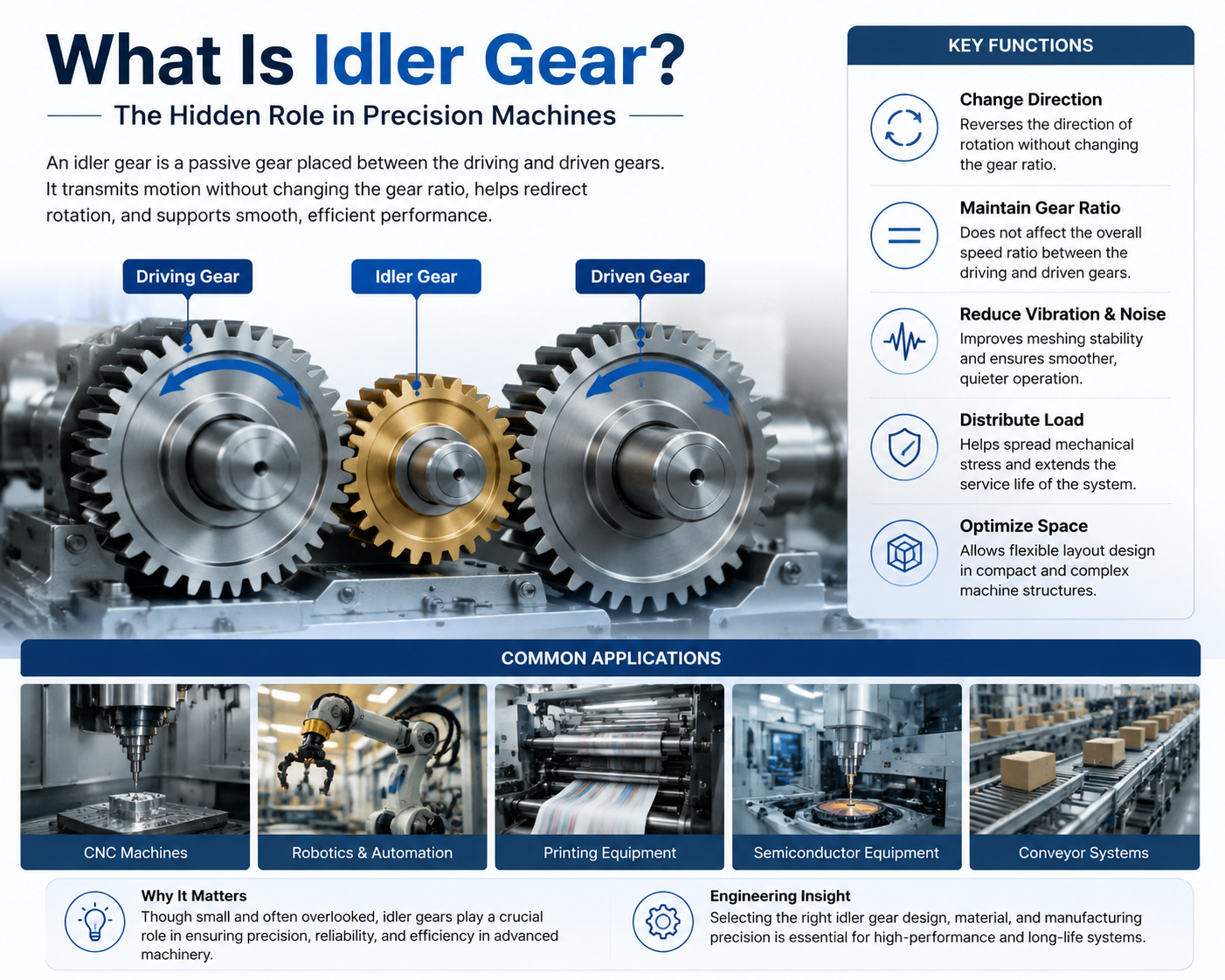
Beyond speed modulation, gears also enable directional changes in rotational motion. Bevel and worm gears, for example, allow torque to be transmitted at right angles, while planetary systems distribute motion across multiple axes. This flexibility is crucial in compact machinery where linear and rotational paths intersect, or in automotive differentials where wheels must rotate at different speeds while sharing torque.
Load Distribution and Efficiency Improvement
Advanced gear designs ensure that forces are evenly distributed across teeth, minimizing localized stress and reducing the risk of fatigue. Helical and herringbone gears, for instance, provide smoother engagement, lower vibration, and higher load capacity. Optimized gear engagement not only prolongs service life but also improves overall system efficiency, cutting energy losses and operational costs.
5. Material Selection for Gears
Common Metals and Alloys Used
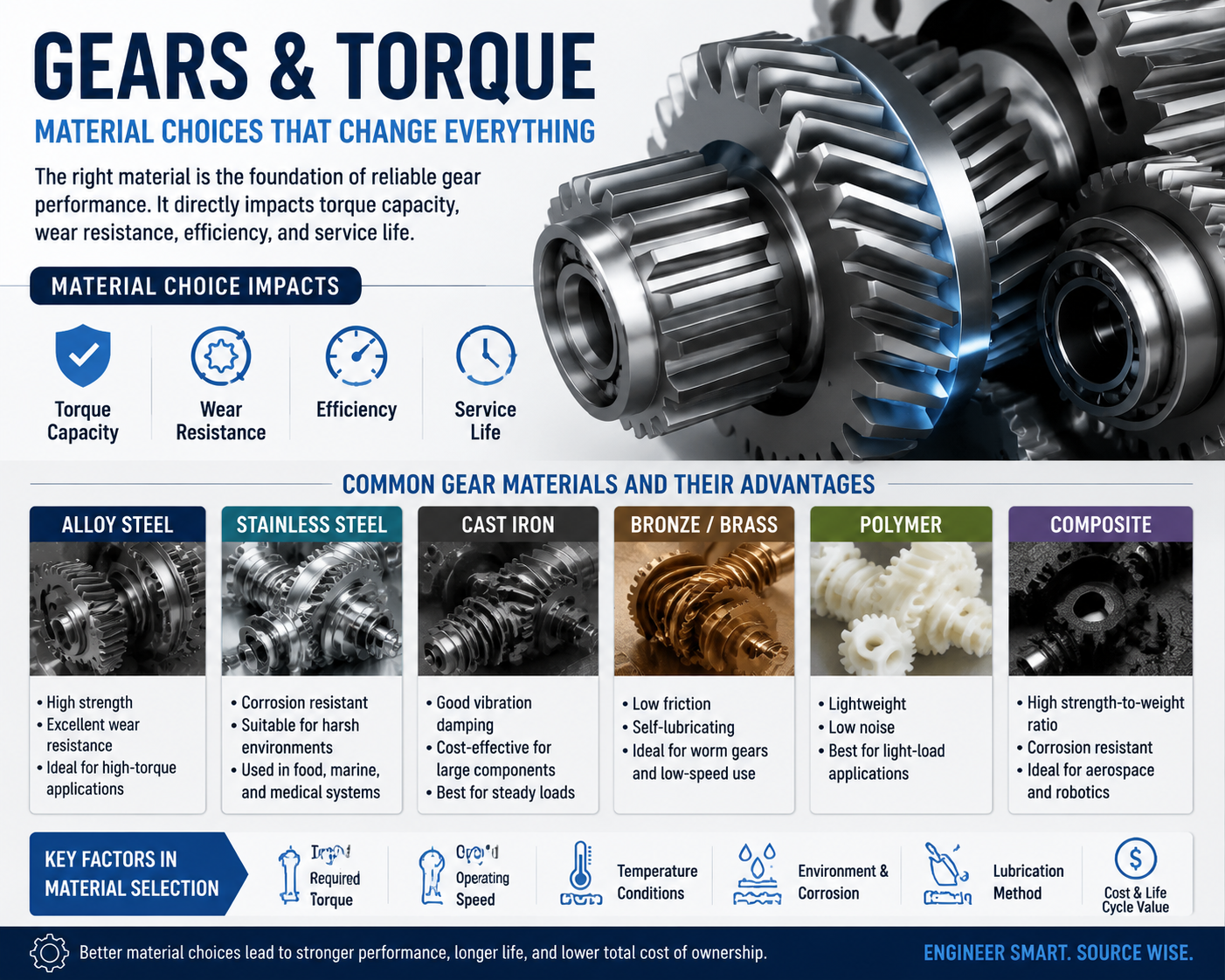
Industrial gears are predominantly manufactured from steels, cast iron, and bronze alloys. Steel variants—such as carburized, nitrided, or alloy steels—offer excellent wear resistance and fatigue strength. Bronze is favored for worm gears due to its low friction against steel, while cast iron remains popular in heavy-duty, low-speed applications. Material choice hinges on operating load, environment, and expected service life.
Plastic and Composite Gear Options
High-performance polymers and fiber-reinforced composites have become increasingly viable for low- to medium-load applications. They offer benefits such as reduced weight, noise dampening, and resistance to corrosion or chemicals. While they can’t replace steel in heavy-duty applications, plastics are widely used in robotics, medical devices, and packaging machinery where quieter, lighter systems are preferred.
Factors Influencing Material Choice
Selecting the right gear material is a multidimensional decision encompassing load capacity, operating temperature, lubrication availability, noise constraints, and cost considerations. Engineers must balance mechanical performance with manufacturing feasibility, environmental conditions, and lifecycle expectations, ensuring the gear performs reliably without over-engineering or unnecessary expense.
6. Gear Manufacturing Processes
Casting and Forging Methods
Casting allows complex shapes to be produced at relatively low cost, while forging improves mechanical properties by aligning the metal’s grain structure. Both methods are foundational in gear manufacturing, particularly for large industrial gears such as those used in wind turbines or heavy machinery. Forged gears often exhibit superior fatigue resistance, a key consideration for high-stress applications.
Machining and Cutting Techniques
Precision gears are often produced via hobbing, shaping, or milling. Hobbing uses a rotating cutting tool to gradually form teeth, while shaping relies on reciprocating cutters to engrave the desired profile. Grinding and finishing processes further refine tooth surfaces, reducing backlash and improving meshing efficiency. CNC technology has revolutionized this stage, enabling high-accuracy production even for complex gear geometries.
Heat Treatment and Surface Finishing
After shaping, gears undergo heat treatments such as carburizing, quenching, or induction hardening to enhance surface hardness while maintaining core toughness. Surface finishing techniques—like shot peening, polishing, or coating—further reduce friction, prevent wear, and improve corrosion resistance. Together, these steps ensure that gears endure millions of operational cycles without catastrophic failure.
7. Classification of Gears by Shape
Spur Gears and Their Uses
Spur gears are the simplest form, featuring straight teeth aligned parallel to the axis. They are highly efficient for transmitting moderate speeds and torques but can generate significant noise at high RPMs. Commonly used in conveyor systems, machine tools, and low-speed industrial machinery, they remain a staple due to their simplicity and reliability.
Helical Gears and Advantages
Helical gears feature angled teeth, enabling smoother and quieter operation compared to spur gears. The gradual engagement reduces impact stress, increases load capacity, and improves efficiency. These gears are widely deployed in automotive transmissions, high-speed industrial machinery, and any application where noise reduction is critical.
Bevel, Worm, and Other Specialized Shapes
Bevel gears transmit motion between intersecting axes, while hypoid gears provide offset arrangements in automotive differentials. Worm gears allow right-angle torque transfer with self-locking capabilities, ideal for lifts or conveyors. Each specialized shape addresses specific engineering challenges, offering solutions that straight or helical gears cannot.
8. Classification of Gears by Function
Speed-Increasing and Speed-Reducing Gears
Gears can modify rotational speed to suit mechanical requirements. Speed-reducing gears amplify torque while lowering RPM, whereas speed-increasing gears prioritize velocity over torque. These configurations are essential in machinery ranging from industrial presses to drone rotors, where precise power transmission is paramount.
Torque-Amplifying Gears
Torque multiplication is critical in applications like heavy-lift equipment, winches, and industrial presses. Gear trains can increase output torque without enlarging the motor or compromising control, a design principle that often separates functional machinery from underpowered systems prone to failure.
Synchronizing and Differential Gears
Synchronizers and differentials ensure that multiple gears or wheels operate harmoniously. In vehicles, differentials allow wheels to rotate at different speeds during turns, while synchronizers facilitate smooth gear shifts in manual transmissions. Both improve efficiency, reduce wear, and enhance the operator’s experience.
9. Spur Gears
Characteristics and Design Features
Spur gears are characterized by straight teeth, uniform tooth spacing, and simplicity in design. They are relatively easy to manufacture and require minimal axial alignment, making them ideal for straightforward torque transmission applications. Their predictable geometry also simplifies load calculations and stress analyses.
Advantages and Limitations
The main advantages of spur gears include high efficiency, ease of manufacturing, and robustness for moderate loads. Limitations include noise at high rotational speeds and the inability to accommodate misalignment, which can lead to accelerated wear or tooth damage.
Typical Industrial Applications
Spur gears are widely used in conveyor systems, printing presses, and packaging machinery where high precision is not compromised by operational noise. They also feature in small electric motors and basic gearboxes where durability and simplicity trump noise concerns.
10. Helical Gears
Tooth Design and Load Distribution
Helical gears have angled teeth that engage gradually, distributing loads more evenly across the tooth surface. This reduces localized stress and extends gear lifespan. The helical angle also allows for overlap in tooth engagement, increasing torque capacity without enlarging the gear size.
Noise Reduction and Efficiency Benefits
The gradual engagement of helical teeth significantly reduces noise and vibration compared to spur gears. Additionally, the improved load distribution enhances mechanical efficiency, making helical gears ideal for high-speed applications where energy losses must be minimized.
Applications in High-Speed Machinery
Helical gears dominate automotive gearboxes, high-speed milling machines, and industrial compressors. Their ability to handle high torque quietly and efficiently makes them the go-to choice for engineers designing precision machinery where operational smoothness is critical.
11. Bevel and Hypoid Gears
Angular Gear Arrangements
Bevel gears transmit motion between intersecting shafts, typically at 90°, while hypoid gears allow offset axes. These arrangements are essential in automotive differentials, industrial mixers, and right-angle drives, enabling complex power transmission in constrained spaces.
Torque Transfer at Different Axes
By changing the rotational plane, bevel and hypoid gears allow torque to reach areas inaccessible by parallel-axis gears. This flexibility makes them indispensable in aerospace actuators, marine propulsion, and heavy-duty industrial drives.
Automotive and Industrial Uses
Bevel gears are standard in vehicle axles, while hypoid designs dominate rear-wheel-drive differentials. In industrial applications, they facilitate angular conveyor drives, rotary kilns, and other heavy machinery requiring robust, angled power transmission.
12. Worm Gears
Design and Operation Principles
Worm gears consist of a screw-like worm meshing with a helical wheel. Their unique engagement converts rotational motion by 90° while providing significant torque multiplication in a compact footprint.
Self-Locking Properties
One of the worm gear’s most valued features is its self-locking ability; the worm can drive the gear, but the gear cannot turn the worm in reverse. This makes them ideal for hoists, lifts, and safety-critical applications where back-driving is undesirable.
Applications in Lifting and Conveyor Systems
Worm gears are commonly found in elevator mechanisms, conveyor belts, and precision positioning devices. Their torque multiplication and self-locking traits ensure safe, controlled, and efficient operation under heavy loads.
13. Planetary and Epicyclic Gears
Structure and Motion Patterns
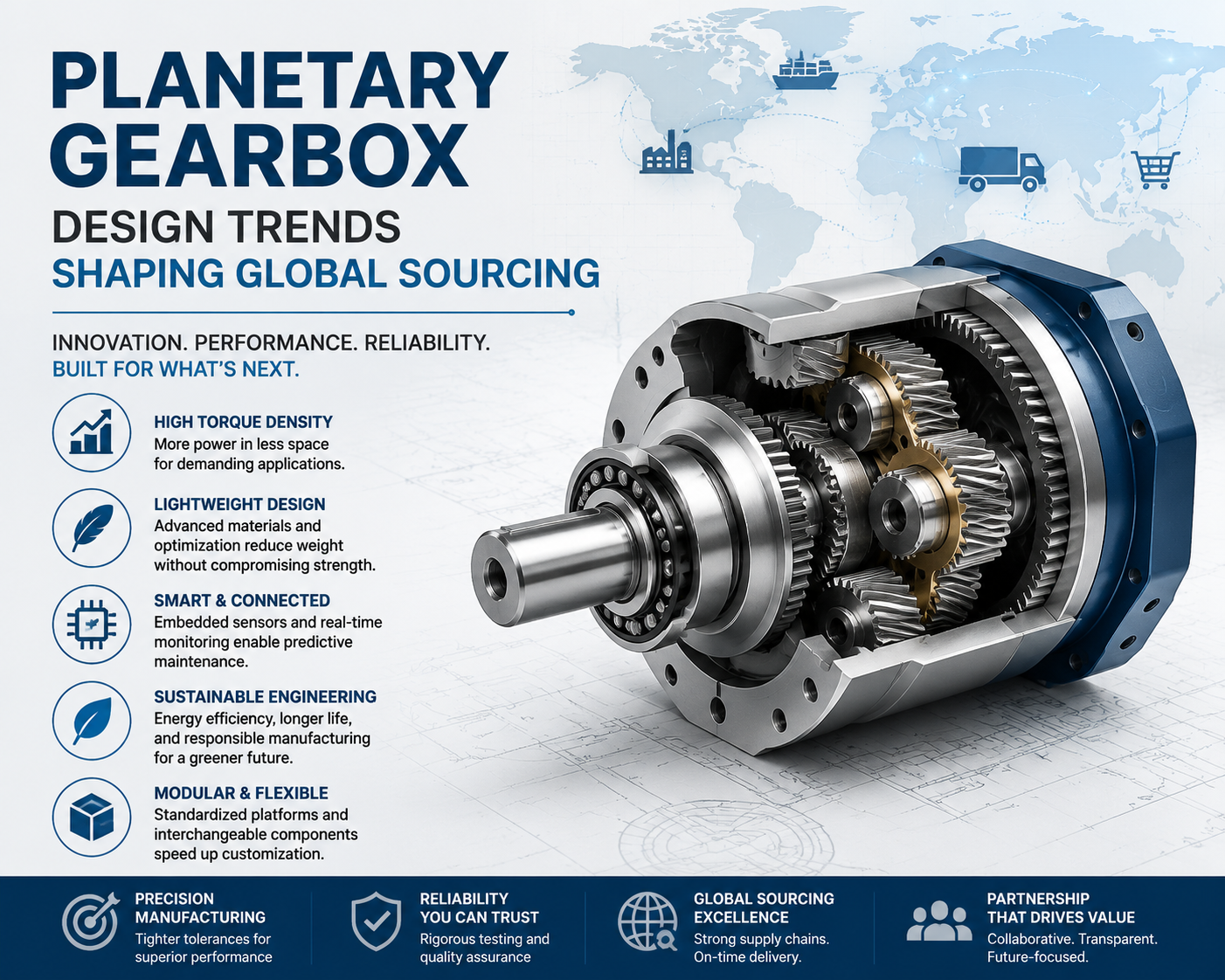
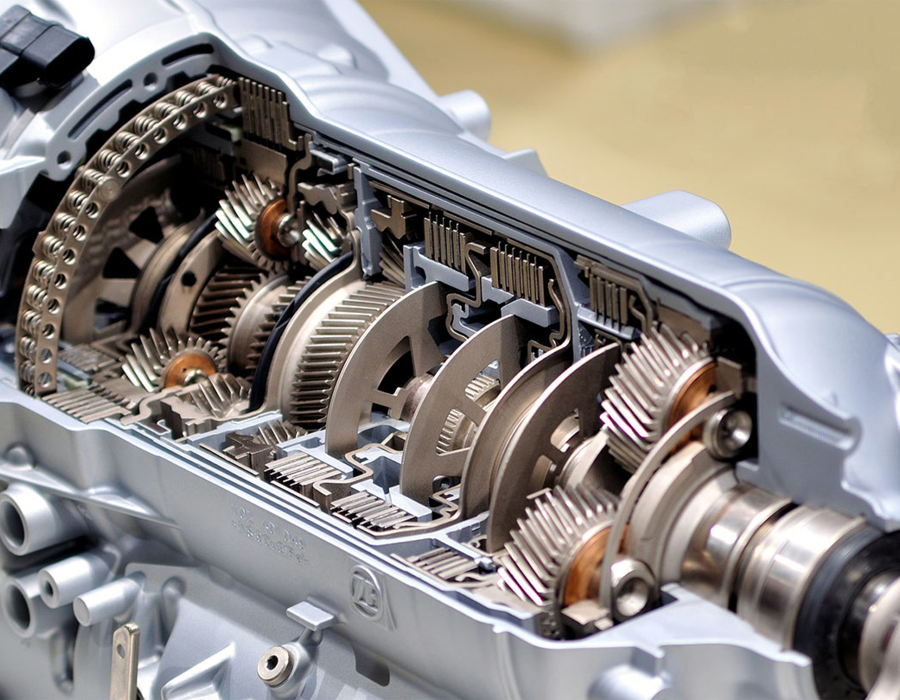
Planetary gears consist of a central sun gear, multiple planet gears, and a ring gear, creating a compact system capable of distributing torque across multiple axes. The intricate motion patterns allow for simultaneous speed reduction, torque multiplication, and direction change.
Torque Multiplication and Compact Design
The architecture of planetary systems enables high torque output in a relatively small package, which is crucial for applications with spatial constraints like robotics, aerospace actuators, and automotive transmissions.
Uses in Robotics and Heavy Machinery
Planetary gears are prevalent in robotic arms, electric vehicle drivetrains, and industrial milling machines. Their compact design and torque-handling capabilities make them essential wherever precision and power density are non-negotiable.
14. Gear Maintenance and Troubleshooting
Common Wear and Failure Modes
Gears are prone to pitting, scuffing, tooth breakage, and misalignment-induced wear. Understanding these failure modes allows engineers to predict maintenance needs and prevent catastrophic downtime.
Lubrication and Alignment Practices
Proper lubrication reduces friction and dissipates heat, extending gear life. Alignment ensures even load distribution across teeth, preventing premature failure and operational inefficiency. Engineers often rely on high-performance oils, greases, and synthetic lubricants to maintain optimal gear performance.
Inspection Techniques and Predictive Maintenance
Modern maintenance relies on vibration analysis, thermography, and oil debris monitoring to detect early signs of wear. Predictive maintenance strategies allow downtime to be scheduled proactively, minimizing operational disruptions and maximizing equipment lifespan.
15. Emerging Trends in Gear Technology
Additive Manufacturing of Gears
3D printing allows rapid prototyping and complex geometries that were previously impossible or cost-prohibitive. This technology is especially useful for low-volume, high-precision gears in aerospace, robotics, and specialized machinery.
Lightweight and High-Strength Materials
Engineers are increasingly employing titanium, carbon-fiber composites, and high-performance polymers to reduce weight without sacrificing strength. These materials improve efficiency, reduce inertia, and expand application possibilities.
Smart Sensors and Condition Monitoring
Integration of sensors enables real-time monitoring of gear performance, detecting anomalies in vibration, temperature, and torque. This facilitates predictive maintenance and reduces operational risk, ushering in the era of “intelligent” mechanical systems.
16. Applications of Industrial Gears Across Industries
Automotive and Transportation Sector
Gears are pivotal in vehicle transmissions, steering mechanisms, and differential systems. They allow cars, trucks, and trains to achieve optimal performance while maintaining efficiency and durability over countless miles.
Manufacturing and Automation Systems
In factories, gears drive conveyor belts, robotic arms, CNC machines, and presses. Their reliability ensures consistent production quality, reduces downtime, and allows for complex automation sequences.
Renewable Energy and Aerospace Applications
Wind turbines, helicopter rotors, and jet engines rely on precision gears to transfer power efficiently. Their ability to handle high torque and rotational speeds under extreme conditions is critical for both energy production and flight safety. Learn more about wind turbines
17. Design Considerations for Industrial Gears
Load Capacity and Stress Analysis
Accurate calculation of load capacity and stress distribution is essential to prevent gear failure. Engineers use finite element analysis (FEA), dynamic simulation, and fatigue modeling to ensure that gears can withstand operational demands under variable loads and high-cycle conditions. This precision is critical in applications such as wind turbines, heavy machinery, and automotive gearboxes.
Space and Weight Constraints
Gears are often integrated into systems with limited spatial allowances. Compact design and weight optimization are necessary for robotics, aerospace, and electric vehicles, where excess mass or bulk can compromise efficiency, fuel economy, or payload capacity. Engineers must balance mechanical performance with physical constraints without over-engineering components.
Cost and Production Feasibility
Designers must consider manufacturing complexity, material costs, and production methods alongside mechanical performance. Optimizing between standardization, custom features, and production volume ensures cost-effective gear solutions that meet quality and operational requirements.
18. Gear Efficiency and Performance Optimization
Minimizing Friction and Energy Loss
Friction reduction is a primary factor in gear efficiency. Through optimized tooth geometry, high-quality lubricants, and advanced surface finishing, engineers can minimize energy loss, reduce heat generation, and improve system performance. Even minor efficiency improvements can translate into substantial operational cost savings in high-duty industrial applications.
Enhancing Durability and Lifespan
Durability depends on proper material selection, surface treatment, alignment, and load management. Gears subjected to extreme stress cycles require precision engineering, specialized coatings, and periodic maintenance to prolong life and prevent unexpected failure. Longevity is especially critical in mission-critical systems like aerospace actuators and heavy industrial machinery.
Performance Testing and Standards
Gears undergo rigorous testing for load tolerance, thermal endurance, and operational noise. Compliance with international standards, including AGMA, ISO, and DIN, ensures reliability, safety, and consistent performance across diverse industrial applications. Engineers rely on testing protocols to validate design assumptions and predict service life.
19. Safety Standards and Regulations
ISO and AGMA Standards for Gears
ISO and AGMA standards provide critical guidelines for gear geometry, strength, performance, and testing. Adherence ensures reliability, interchangeability, and safe operation across different industries and international markets.
Industry-Specific Compliance Requirements
Different sectors, such as automotive, aerospace, and energy, impose unique regulatory frameworks. Compliance with these requirements minimizes risk, ensures legal operation, and maintains consumer and operator safety. Following these standards is integral to both production and operational planning.
Safety Precautions in Gear Operation
Operational safety involves proper guarding, emergency stops, and maintenance protocols. Engineers must integrate these measures into both the design and operational stages to protect personnel from injury, reduce downtime, and ensure consistent performance. Proper training and documentation complement these precautions.
20. Future Outlook of Industrial Gears
Integration with AI and Smart Machinery
Artificial intelligence and machine learning are transforming gear performance monitoring and predictive maintenance. Smart gear systems can adapt to load changes, detect anomalies in real-time, and optimize torque distribution, enhancing reliability and operational efficiency in manufacturing and automotive applications.
Sustainability and Eco-Friendly Materials
Future gear designs emphasize sustainability, including the use of recycled metals, energy-efficient manufacturing methods, and biodegradable lubricants. Lightweight, high-strength materials reduce energy consumption and carbon footprint, aligning mechanical engineering practices with environmental responsibility.
Innovations in Precision Engineering
Advances in precision machining, nanostructured coatings, and computational design techniques are pushing the limits of gear performance. These innovations enable extreme durability, high torque density, and performance in harsh environments, supporting next-generation machinery in aerospace, energy, and robotics. Read more about future gear technology