Table of Contents
1. Introduction to Gear Crowning
Gear systems sit quietly inside industrial ecosystems, yet they determine whether an entire machine behaves like a precision instrument or a costly maintenance event waiting to happen. In procurement meetings and engineering reviews alike, discussions often gravitate toward material grades, heat treatment protocols, and cost per unit; however, one subtle geometric refinement repeatedly demonstrates outsized influence on operational reliability—gear crowning.
Unlike dramatic redesign initiatives that require tooling replacement, housing modifications, and prolonged validation cycles, gear crowning represents a highly strategic micro-geometry optimization. It introduces controlled alterations to tooth surfaces that fundamentally improve how forces are distributed during engagement.
For OEM purchasing teams operating under increasing pressure to reduce lifecycle costs while maintaining quality consistency across global supply chains, gear crowning offers something unusually attractive: measurable performance enhancement without rewriting an entire product architecture.
1.1 Definition of Gear Crowning
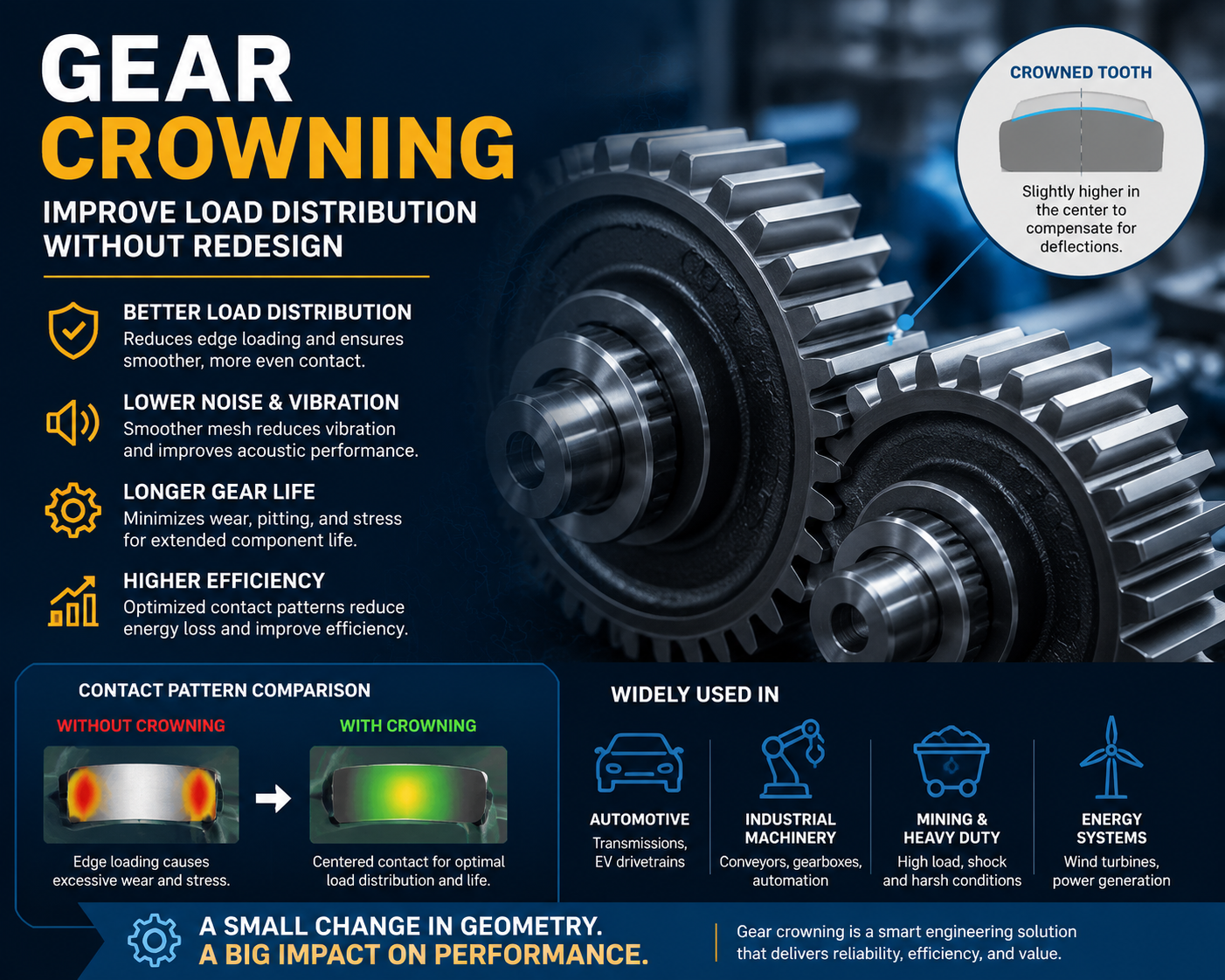
Gear crowning is a deliberate modification applied to the widthwise profile of a gear tooth where a slight convex curvature is introduced across the face width. Rather than maintaining perfectly flat tooth surfaces from edge to edge, the central portion is manufactured marginally higher than the extremities.
The modification may appear microscopic under standard visual inspection, yet under operating loads it dramatically changes contact mechanics.
When gears rotate under real-world conditions, shafts deflect, housings expand thermally, bearings experience compliance, and manufacturing tolerances accumulate. The theoretical line contact assumed in CAD environments rarely survives production realities. Gear crowning compensates for these inevitable deviations.
The objective is not to reduce contact area indiscriminately.
Instead, the objective is controlled contact concentration that transitions naturally into optimal load sharing during operation.
Mechanical engineers often describe this as allowing the gear pair to find its own center.
Procurement professionals may view it differently:
It is an inexpensive insurance policy against field failures.
Typical crowning methods include:
- Longitudinal crowning
- Profile crowning
- End relief crowning
- Modified parabolic crowning
- Compound crowning strategies
Each variation targets different operational conditions and performance objectives.
Additional reading: Gear Fundamentals – Wikipedia
1.2 Importance in Mechanical Systems
Mechanical systems rarely operate under laboratory-perfect alignment.
Industrial gearboxes encounter:
- Shaft deflection
- Bearing clearance variation
- Thermal gradients
- Structural deformation
- Dynamic loading fluctuations
- Installation inconsistencies
Without compensation mechanisms, load migrates toward localized areas of gear teeth.
Localized stress concentration becomes the first domino.
Soon afterward come:
- Micropitting
- Scuffing
- Surface fatigue
- Elevated operating temperature
- Acoustic degradation
- Unexpected shutdowns
Gear crowning addresses these realities directly.
In high-throughput environments such as automated production lines, mining equipment, robotics assemblies, and heavy-duty transmissions, even marginal improvements in contact uniformity generate disproportionate operational benefits.
Seasoned procurement engineers understand an uncomfortable truth:
Buying cheaper gears often becomes the most expensive decision in the building.
A properly crowned gear frequently extends system durability without requiring additional structural mass or expensive redesign activities.
Reference: American Gear Manufacturers Association
1.3 Benefits for Load Distribution
Load distribution determines whether a gear system ages gracefully or deteriorates prematurely.
Ideally, transmitted forces should spread evenly across the entire working tooth surface.
Reality behaves differently.
Minute assembly deviations shift loading toward edges.
Edge loading accelerates:
- Surface distress
- Material deformation
- Lubrication breakdown
- Contact temperature spikes
Gear crowning redistributes contact pressure.
Rather than allowing abrupt force accumulation, crowning promotes progressive engagement across the tooth face.
Benefits include:
- Improved Pressure Uniformity
- Higher Operational Reliability
- Extended Maintenance Intervals
- Lower Warranty Exposure
- Enhanced Dynamic Stability
For procurement teams evaluating total cost of ownership rather than initial acquisition price, these outcomes often justify crowning specifications many times over.
2. Common Gear Design Challenges
Even highly engineered gear systems encounter recurring obstacles.
The challenge rarely originates from theoretical geometry.
The challenge emerges where manufacturing, assembly, and operating conditions collide.
Gear crowning evolved precisely because conventional gear design assumptions frequently break down in real industrial environments.
2.1 Uneven Load Distribution Issues
Uniform loading exists mostly in textbooks.
Operational machinery introduces multiple variables:
- Assembly tolerance stack-up
- Housing distortion
- Dynamic shaft bending
- Bearing displacement
- Thermal expansion
As these variables interact, contact shifts toward one edge.
Consequences emerge quickly:
- Localized overheating
- Accelerated pitting
- Premature lubricant failure
- Surface plastic deformation
- Reduced transmission efficiency
One overloaded millimeter can determine the lifespan of an entire gearbox.
Engineers sometimes discover that less than twenty percent of the theoretical contact zone carries most transmitted torque.
That is a rough deal for any mechanical system.
Crowning acts as a corrective geometry that recenters load pathways.
2.2 Noise and Vibration Concerns
Noise is often treated as a comfort issue.
In reality, it is diagnostic data.
Gear noise frequently signals:
- Contact instability
- Misalignment
- Surface defects
- Resonance amplification
Uneven loading changes mesh stiffness.
Changing mesh stiffness introduces vibration.
Vibration generates airborne noise.
Noise indicates energy loss.
High-frequency gear whine may seem harmless initially.
Long term, it often reveals deeper mechanical inefficiencies.
Crowned gears smooth force transitions.
This reduces:
- Dynamic excitation
- Transmission error
- Structural resonance
Lower vibration translates into improved product perception, reduced maintenance burden, and better operator conditions.
Further reading: NASA Engineering Resources
2.3 Costly Redesigns and Downtime
Full redesign projects consume enormous resources.
A typical redesign sequence includes:
- Geometry modification
- Prototype creation
- Validation testing
- Supplier requalification
- Tooling updates
- Documentation revision
Costs escalate rapidly.
Meanwhile production schedules continue moving.
Gear crowning offers a more surgical intervention.
Instead of replacing major architecture, manufacturers optimize micro-geometry.
Benefits include:
- Faster implementation
- Minimal tooling disruption
- Lower engineering labor
- Shorter validation cycles
For OEM procurement organizations balancing performance with purchasing discipline, this approach often delivers a remarkably favorable return profile.
3. Principles of Gear Crowning
Gear crowning succeeds because it manipulates how contact evolves under real load conditions rather than theoretical ideal conditions.
Understanding these principles transforms crowning from a manufacturing specification into a strategic engineering lever.
3.1 How Crowning Alters Tooth Geometry
Traditional teeth maintain near-uniform face profiles.
Crowned teeth intentionally remove microscopic material near edges.
The resulting shape encourages central engagement during initial loading.
As operational forces increase:
- Deflection occurs
- Contact expands
- Pressure equalizes
This geometric compensation creates more resilient load behavior.
Engineers frequently optimize:
- Crown height
- Crown curvature
- Transition smoothness
- Face width relationships
Too little modification produces negligible improvement.
Too much modification reduces usable contact area.
Balance matters.
3.2 Effects on Contact Patterns
Contact patterns reveal mechanical truth.
Under inspection compounds and load testing, crowned gears display centralized and symmetrical contact regions.
Proper patterns indicate:
- Efficient load transfer
- Reduced stress gradients
- Controlled deformation
Improper patterns suggest:
- Alignment issues
- Manufacturing inconsistency
- Incorrect crown depth
Contact evaluation remains one of the most practical verification tools in production quality systems.
3.3 Interaction with Gear Alignment
Crowning does not eliminate alignment requirements.
It improves tolerance to alignment variation.
This distinction matters.
Properly crowned gears absorb moderate deviations while preserving acceptable contact quality.
Combined with:
- Accurate shaft positioning
- Controlled bearing preload
- Structural rigidity
Gear crowning becomes exceptionally effective.
Alignment and crowning should operate as partners, not substitutes.
Reference: Massachusetts Institute of Technology Engineering Resources
4. Types of Gear Crowning
Different operational requirements and manufacturing capabilities necessitate various crowning geometries. Selecting the correct type requires understanding both the mechanical environment and performance objectives.
4.1 Convex Crowning
Convex crowning features a gentle outward curvature toward the tooth center.
It is particularly effective at compensating for:
- Shaft bending under load
- Minor bearing misalignment
- Thermal expansion discrepancies
Convex shapes encourage early central engagement and progressively spread contact across the tooth face.
This design is often preferred in high-torque applications, where edge loading could otherwise precipitate localized pitting or accelerated wear.
4.2 Concave Crowning
Concave crowning is less common but strategically valuable in niche scenarios.
Its inward curvature mitigates edge interference in:
- Long slender shafts
- Gears with exceptionally high face widths
- Configurations prone to lateral runout
By subtly reducing pressure near tooth edges, concave crowning prevents premature edge failure while maintaining central contact integrity.
4.3 Barrel and Parabolic Crowning
Barrel and parabolic profiles introduce a variable curvature across the tooth face.
Unlike simple convex or concave geometries, these shapes are mathematically defined to optimize stress distribution over the full range of operational deflections.
- Barrel crowning emphasizes a rounded central zone tapering toward edges
- Parabolic crowning distributes pressure according to a parabolic curve
Both approaches are particularly effective in applications where thermal growth, shaft deflection, and load variation interact simultaneously.
5. Materials and Manufacturing Considerations
Crowning is not merely a design specification—it intersects deeply with material science and manufacturing processes.
5.1 Material Selection for Crowning
Material properties influence how effectively a crown will perform under stress:
- Alloy steels with high core toughness resist micropitting
- Case-hardened surfaces improve edge durability
- Powder metallurgy and advanced sintered materials support precision shaping
Procurement engineers must ensure selected materials remain compatible with intended crowning processes.
5.2 Heat Treatment Impacts
Heat treatment introduces microstructural changes that interact with crowning geometry.
- Carburization increases surface hardness
- Induction hardening may amplify edge stress if poorly controlled
- Tempering balances mechanical properties
Attention to heat treatment protocols ensures crowned geometry performs as intended.
5.3 Machining and Grinding Techniques
Crowning can be introduced through multiple production methods:
- Form grinding
- Hobbing with crown allowances
- CNC machining
Manufacturing precision is critical because even minor deviations can alter contact behavior.
Additional reading: National Institute of Standards and Technology
6. Measuring Gear Crowning Accuracy
6.1 Contact Pattern Inspection
Traditional contact pattern inspection involves applying marking compounds to gear teeth and observing engagement under load.
Patterns should indicate centered pressure, symmetrical load distribution, and absence of edge concentration.
Discrepancies highlight manufacturing errors or misalignment that require corrective action.
6.2 Surface Profilometry Methods
Advanced profilometers provide precise measurement of crown curvature across the tooth face:
- 3D optical profilometry captures micro-topography
- Laser scanning provides high-resolution deviation maps
- Coordinate measuring machines (CMMs) quantify geometric compliance
Profilometry ensures consistency between production lots, critical for OEM supply chains.
6.3 Tolerances and Acceptable Deviations
Clear tolerance ranges prevent guesswork:
- Crown height deviation within microns
- Edge relief consistency
- Face width conformity
Procurement and quality teams define inspection protocols to guarantee all parts meet specifications.
7. Impact on Load Distribution
7.1 Reducing Edge Loading
Edge loading accelerates wear and contributes to noise.
Crowning redistributes load toward the tooth center, mitigating stress spikes, early pitting, and micropitting progression.
7.2 Improving Torque Transmission
Even pressure distribution ensures torque is transmitted efficiently:
- Reduces local deformation
- Lowers frictional losses
- Prevents heat accumulation
7.3 Extending Component Life
Addressing failure points preemptively, crowned gears improve durability:
- Extended bearing life
- Reduced lubricant degradation
- Longer service intervals
For OEM procurement engineers, these benefits directly impact total cost of ownership.
8. Effect on Noise and Vibration
8.1 Minimizing Gear Whine
Gear whine arises from uneven contact. Crowning mitigates fluctuations, producing smoother engagement and lower acoustic emissions.
8.2 Reducing Vibrational Harmonics
Crowning reduces vibration that propagates through housing structures:
- Less resonant amplification
- Lower high-frequency excitation
- Reduced fatigue in connected components
8.3 Case Studies of Noise Reduction
Industrial case studies show measurable noise reductions after crowning retrofits:
- Automotive transmissions: 2–3 dB reduction
- High-speed industrial gearboxes: smoother start-stop transitions
- Robotics: quieter operation, reduced vibration-induced errors
9. Gear Crowning for OEMs
9.1 Specifying Crowning in Procurement
OEM engineers must define exact crown geometry, material compatibility, and inspection criteria to prevent default flat-faced gears.
9.2 Supplier Verification Techniques
Verification involves sample inspection, functional testing, and periodic in-line audits to ensure consistency across production.
9.3 Cost vs. Performance Analysis
Although per-unit cost may be higher, total cost of ownership favors crowned gears due to lower maintenance, reduced downtime, and improved reliability.
10. Crowning and Gear Alignment
10.1 Compensation for Shaft Misalignment
Crowning provides tolerance to angular and parallel shaft misalignments, ensuring smoother engagement under deflection.
10.2 Interaction with Bearing Loads
Bearings’ elastic deformation influences meshing forces. Crowning redistributes load, preventing premature tooth or bearing failure.
10.3 Alignment Best Practices
Best practices include:
- Proper shaft preloading
- Maintaining parallelism within tolerances
- Using crowned geometry to buffer residual misalignment
11. Crowning in Different Gear Types
11.1 Spur Gears
Spur gears benefit from centralized contact patterns, noise suppression, and compatibility with simple manufacturing processes.
11.2 Helical Gears
Helical gears introduce axial loads. Crowning distributes thrust evenly, reduces bearing stress, and improves torque transmission efficiency.
11.3 Bevel and Worm Gears
For bevel and worm gears, crowning compensates for angular misalignment, enhances load sharing, and reduces chatter in high-speed applications.
12. Simulation and Modeling
12.1 FEA Analysis for Crowning
Finite Element Analysis simulates stress distribution, deformation, and contact pressure variations, providing quantitative assurance that crowns perform under operational loads.
12.2 Predicting Contact Patterns
Advanced modeling predicts initial engagement zones, load migration, and peak pressure locations, guiding manufacturing and inspection.
12.3 Load Distribution Simulations
Dynamic simulations evaluate gear behavior over full torque and speed cycles, thermal expansion effects, shaft deflection, and fatigue implications.
Procurement engineers use simulation results to justify crowning specifications and ensure cost-effective supplier compliance.
13. Maintenance and Inspection
13.1 Routine Wear Monitoring
Routine wear monitoring creates visibility before damage escalates into unplanned downtime. Key inspection areas include tooth flank appearance, surface roughness evolution, lubricant condition, contact zone migration, and temperature trends.
Maintenance teams often use visual inspections, oil debris analysis, infrared thermal monitoring, vibration trend measurements, and endoscopic tools to detect early signs of abnormal wear.
13.2 Detecting Crowning Failures
Crowning rarely fails independently; surrounding operating conditions typically overwhelm the geometry. Indicators include excessive edge contact, accelerated surface fatigue, uneven temperature distribution, and abnormal acoustic signatures. Common root causes are shaft deflection, improper installation, overload, inconsistent manufacturing, or heat-treatment distortion.
13.3 Maintenance Scheduling Tips
Effective scheduling reduces emergency intervention. Recommended principles include condition-based intervals, inspection during load transitions, historical trend analysis, and coordinated gear and bearing maintenance. Proactive maintenance ensures that crowned gears deliver the expected lifespan and performance benefits.
14. Case Studies of Successful Crowning
14.1 Automotive Gear Applications
Automotive transmissions benefit from optimized crowning, improving shift smoothness, reducing noise, lowering tooth flank stress, and extending durability, especially in electric drivetrains where mechanical sound is more noticeable.
14.2 Industrial Machinery Use Cases
Industrial gearboxes with continuous loading and exposure to contamination demonstrate that retrofitting crowned gears can eliminate chronic edge wear without a full redesign. Outcomes include reduced maintenance, lower lubricant consumption, and higher uptime.
14.3 High-Performance Engineering Examples
High-performance applications such as aerospace transmissions, precision robotics, high-speed machine tools, and performance mobility platforms use crowning to stabilize mesh dynamics, support high rotational speeds, reduce excitation forces, and maintain repeatable performance.
15. Common Mistakes to Avoid
15.1 Overcrowning or Undercrowning
Excessive crowning reduces contact area, increases pressure density, and accelerates wear. Insufficient crowning fails to prevent edge loading and vibration. Optimal crown dimensions balance load conditions, material properties, shaft behavior, and manufacturing capabilities.
15.2 Ignoring Material Hardness
Material selection is critical. Insufficient hardness leads to plastic deformation and premature pitting; excessive hardness may cause brittle cracking. Core hardness, surface hardness, residual stress, and heat-treatment repeatability must be considered together with crown geometry.
15.3 Poor Supplier Communication
Vague specifications create risk. Common failures include undefined measurement methods, missing tolerances, incomplete inspection expectations, and ambiguous drawings. Clear communication and aligned acceptance criteria with suppliers ensure consistent quality and performance.
16. Future Trends in Gear Crowning
16.1 Advanced Manufacturing Techniques
Modern production technologies, including multi-axis CNC grinding, adaptive machining, high-resolution metrology, and digital correction loops, reduce variation and improve crown consistency across production volumes.
16.2 Integration with Smart Sensors
Embedded sensors allow real-time vibration, thermal, and wear monitoring, enabling predictive maintenance and adaptive performance optimization. Mechanical engineering increasingly intersects with data intelligence.
16.3 Sustainable and Cost-Effective Solutions
Sustainability considerations drive adoption. Crowning improves energy efficiency, extends service life, and reduces material consumption, achieving performance gains with less environmental impact.
Conclusion
Gear crowning is a strategic micro-geometry refinement that improves load distribution, reduces edge stress, suppresses vibration, lowers acoustic output, and extends gear life without costly redesign. For mechanical engineers, it enhances operational reliability; for procurement professionals, it lowers total cost of ownership, strengthens supplier accountability, and mitigates field risk.
With precision manufacturing and predictive monitoring, crowned gears are increasingly moving from specialized optimization to standard expectation in high-performance gear design, demonstrating that sometimes the smartest engineering decision is not rebuilding the machine, but refining the geometry that quietly carries the load every day.