Table of Contents
Straight Bevel Gear Material Choices That Boost Longevity
1. Introduction to Straight Bevel Gear Material Selection
Selecting the appropriate material for a straight bevel gear is one of the most important decisions engineers and procurement professionals make during product development and sourcing. Material selection directly influences gear performance, durability, maintenance requirements, and total lifecycle cost. Whether a gear is used in industrial machinery, automotive drivetrains, agricultural equipment, or specialized automation systems, choosing the right material can significantly increase operational longevity and reliability.
Understanding how different materials behave under load, temperature fluctuations, environmental exposure, and continuous duty cycles allows manufacturers and buyers to make informed decisions that optimize both performance and cost efficiency.
1.1 Why Material Choice Determines Gear Longevity
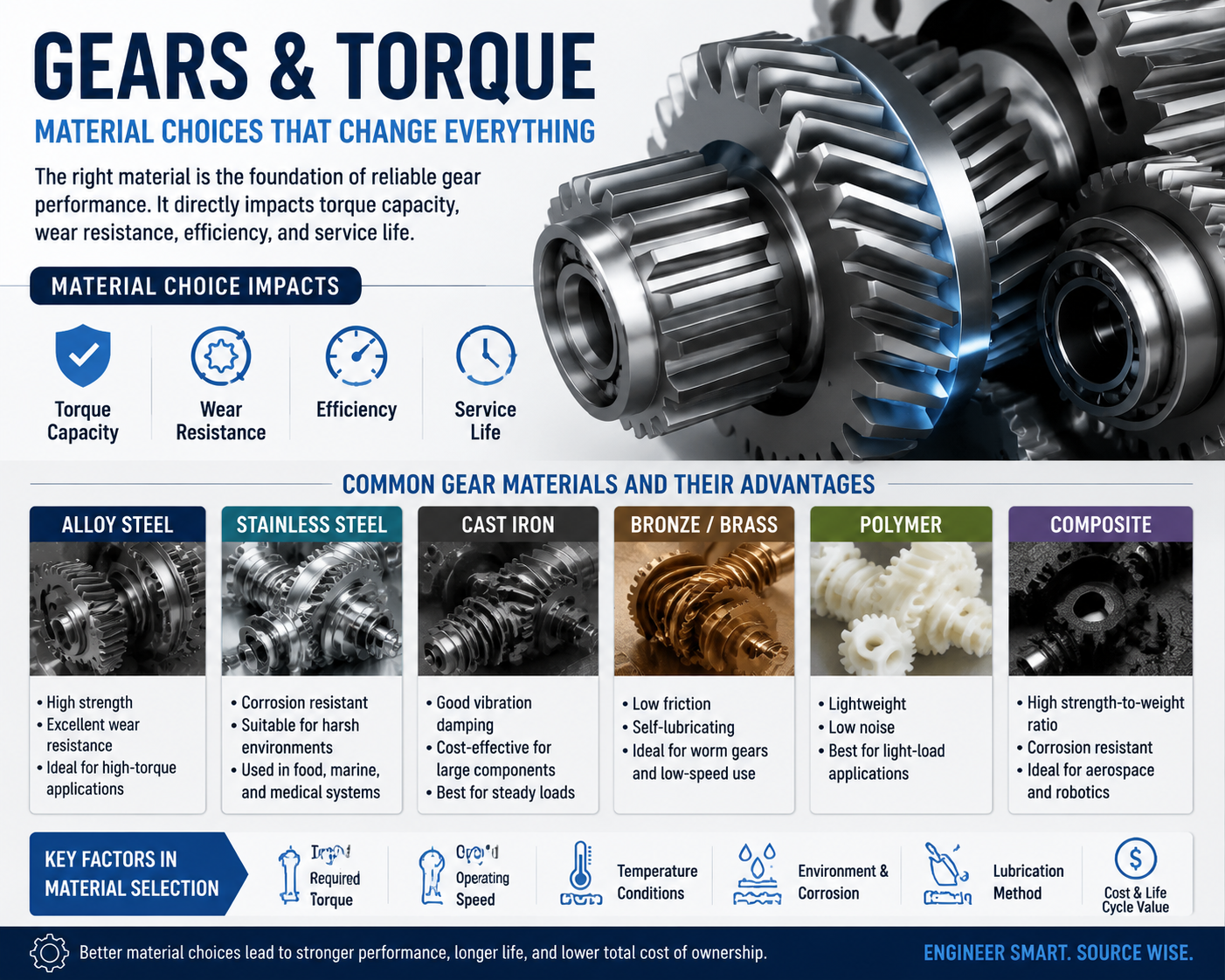
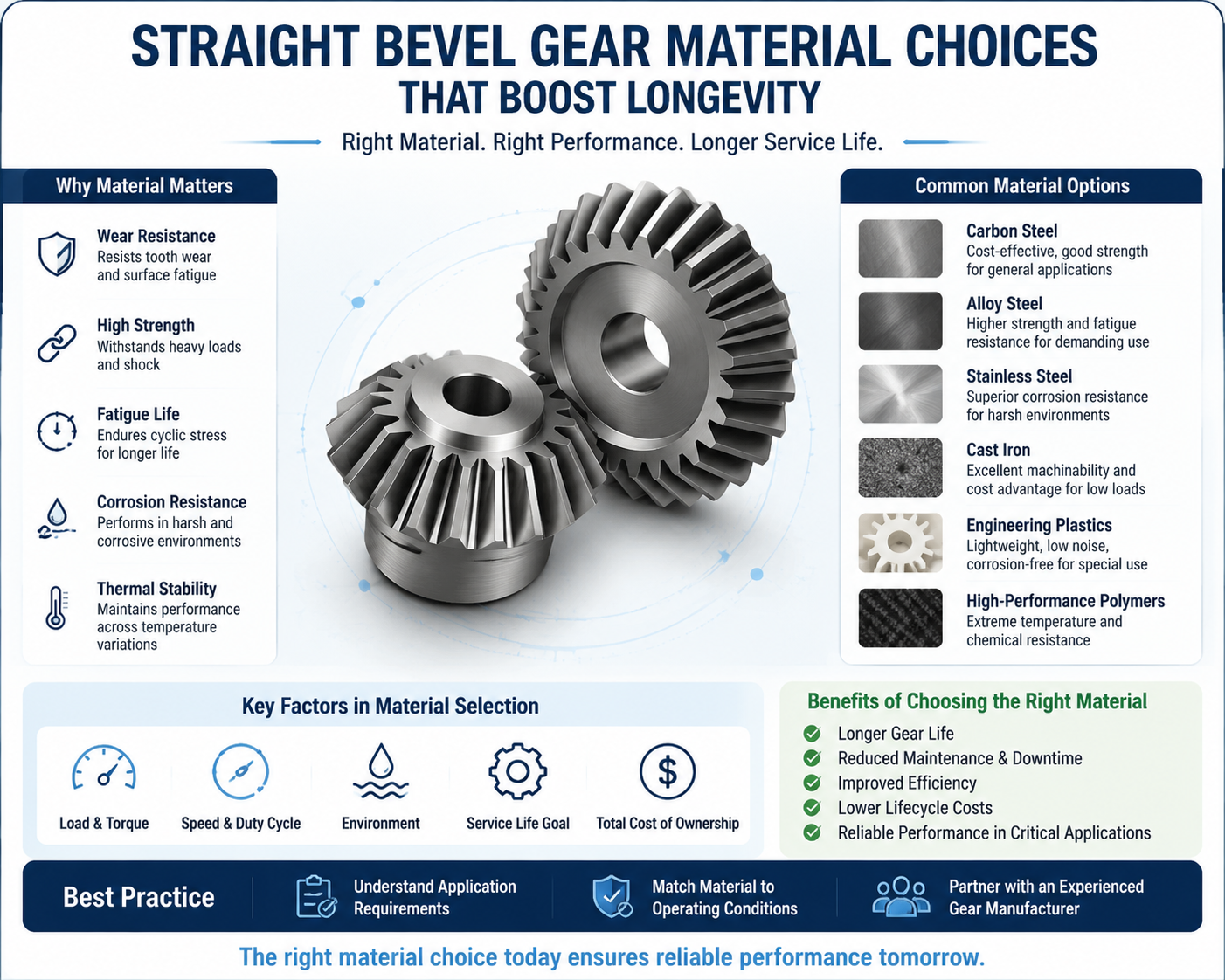
The backbone of any high-performing straight bevel gear is its material composition, because the wrong choice is like trying to run a marathon in flip-flops—it simply will not last. Material selection directly affects wear resistance, load handling, fatigue life, and the overall reliability of the gear, influencing not just operational longevity but also maintenance intervals and total cost of ownership.
In high-stakes industrial applications, even minor miscalculations in material choice can cascade into catastrophic failures. The selected material must withstand repeated mechanical stresses while maintaining dimensional stability and structural integrity throughout its service life.
1.2 The Relationship Between Material and Performance
Material properties dictate how a gear responds to mechanical stress, thermal loads, and environmental conditions. High-strength alloys absorb torque more efficiently, while certain polymers provide damping properties that reduce vibration and noise.
The performance envelope of a gear is essentially written in its metallurgical makeup, meaning that the better the material matches the operating environment, the closer an organization gets to a reliable and predictable operating scenario during heavy-duty service.
For additional information about gear fundamentals, engineers may reference: https://en.wikipedia.org/wiki/Gear
1.3 Common Failure Modes Linked to Poor Material Selection
Gears can fail in numerous ways, ranging from surface pitting and abrasive wear to scuffing, tooth cracking, and complete tooth breakage. Choosing a material with insufficient hardness may accelerate wear, while materials lacking toughness can fracture under shock loading conditions.
Corrosion-prone materials operating in aggressive environments can gradually lose structural integrity, ultimately leading to premature failures, increased maintenance costs, and costly downtime.
2. Understanding Straight Bevel Gear Operating Conditions
2.1 Load and Torque Requirements
Before selecting any material, engineers must thoroughly understand the load profile the gear will experience. High-torque applications require materials with exceptional tensile strength, shear resistance, and fatigue endurance.
Failure to account for peak loading conditions remains one of the most common causes of premature gear failure. Even when average operating loads appear manageable, occasional overload conditions can dramatically reduce service life if material capabilities are exceeded.
2.2 Speed and Duty Cycle Considerations
Gear performance is influenced not only by load magnitude but also by operational speed and duty cycle. High rotational speeds increase frictional heat generation and wear rates, while continuous-duty applications expose materials to millions of stress cycles throughout their operational lifespan.
Selecting a material with the appropriate balance of strength, wear resistance, and thermal stability ensures reliable performance under extended operating conditions.
2.3 Environmental and Application Factors
Environmental conditions significantly influence material performance. Factors such as humidity, corrosive chemicals, dust contamination, abrasive particles, and extreme temperatures can accelerate wear and degradation.
Marine environments typically require corrosion-resistant alloys, while mining and construction equipment often demand highly wear-resistant materials capable of surviving abrasive operating conditions.
Additional engineering resources regarding material performance can be found through: https://www.nist.gov
3. Key Material Properties That Influence Gear Life
3.1 Hardness and Wear Resistance
Hardness serves as a critical defense against abrasive wear, surface deformation, and scuffing. Materials with higher hardness values generally exhibit improved resistance to surface damage and longer operational life.
However, excessive hardness may reduce toughness, making material balance essential. Engineers frequently utilize surface hardening treatments to increase hardness while preserving a tougher core structure.
3.2 Toughness and Impact Strength
Toughness enables a gear to absorb sudden impact loads without fracturing. Applications involving shock loading, abrupt starts and stops, or variable operating conditions require materials capable of dissipating energy without catastrophic failure.
A gear with insufficient toughness may develop cracks that rapidly propagate under repeated loading cycles.
3.3 Fatigue Resistance and Durability
Straight bevel gears rarely experience a single load event. Instead, they operate under repeated cyclic loading conditions that gradually create microscopic cracks.
Materials possessing superior fatigue resistance delay crack initiation and propagation, enabling gears to survive millions of operational cycles while maintaining structural integrity and performance consistency.
4. Carbon Steel for Straight Bevel Gears
4.1 Advantages of Carbon Steel
Carbon steel remains one of the most widely used materials in gear manufacturing due to its affordability, machinability, and reliable mechanical properties. It offers a practical balance between performance and cost, making it suitable for numerous industrial applications.
Manufacturers appreciate carbon steel because it is readily available, easy to machine, and responsive to various heat treatment processes.
4.2 Suitable Industrial Applications
Carbon steel straight bevel gears are commonly used in:
- Conveyor systems
- Agricultural machinery
- Material handling equipment
- General industrial machinery
- Mechanical power transmission systems
These applications often require dependable performance without the premium cost associated with specialized alloys.
4.3 Limitations and Maintenance Considerations
Although carbon steel offers numerous advantages, it is susceptible to corrosion and may exhibit reduced wear resistance compared to alloy steels.
Routine lubrication, periodic inspections, and appropriate protective coatings are often necessary to maximize service life, particularly in humid or chemically aggressive environments.
5. Alloy Steel as a Premium Gear Material
5.1 Popular Alloy Steel Grades
Alloy steels are frequently selected for demanding gear applications because they offer enhanced mechanical properties compared to standard carbon steels.
Popular grades include:
- AISI 4140
- AISI 4340
- AISI 8620
- AISI 9310
- 20MnCr5
These materials contain carefully controlled additions of chromium, molybdenum, nickel, and other alloying elements that improve hardenability and strength.
5.2 Enhanced Strength and Fatigue Life
The addition of alloying elements significantly improves fatigue resistance, impact strength, and wear characteristics. As a result, alloy steel gears often demonstrate superior performance under high loads and continuous-duty applications.
Many automotive and industrial transmission systems depend on alloy steel gears because of their exceptional ability to withstand repeated stress cycles over extended periods.
5.3 Cost Versus Performance Analysis
While alloy steel typically carries a higher acquisition cost than carbon steel, the extended service life and reduced maintenance requirements frequently offset the initial investment.
Procurement professionals often evaluate total lifecycle cost rather than simply focusing on purchase price. In many cases, alloy steel delivers the most favorable long-term economic outcome.
For further reading regarding steel metallurgy: https://www.asminternational.org
6. Stainless Steel Straight Bevel Gears
6.1 Corrosion Resistance Benefits
Stainless steel provides exceptional resistance to oxidation and corrosion due to the presence of chromium, which forms a protective passive layer on the material surface.
This characteristic makes stainless steel an ideal choice for applications exposed to moisture, chemicals, and harsh environmental conditions.
6.2 Common Stainless Steel Grades
Frequently used stainless steel grades for straight bevel gears include:
- 304 Stainless Steel
- 316 Stainless Steel
- 17-4 PH Stainless Steel
- 420 Stainless Steel
Each grade offers a unique balance of corrosion resistance, strength, machinability, and heat treatment capability.
6.3 Best Applications for Stainless Steel Gears
Stainless steel gears are widely used in:
- Food processing equipment
- Marine systems
- Chemical processing plants
- Medical equipment
- Water treatment facilities
These industries require materials that maintain both performance and cleanliness under challenging environmental conditions.
7. Cast Iron Materials for Bevel Gear Manufacturing
7.1 Mechanical Characteristics of Cast Iron
Cast iron offers excellent compressive strength, vibration damping capabilities, and dimensional stability. Its natural damping characteristics help reduce noise and vibration in heavy machinery applications.
Because of its rigidity, cast iron can maintain alignment effectively under substantial compressive loading conditions.
7.2 Cost Advantages in Large-Scale Production
One of the major advantages of cast iron is its cost efficiency. Cast iron components can be produced economically through casting processes that allow complex geometries to be manufactured with minimal machining.
This makes cast iron particularly attractive for high-volume production environments where manufacturing efficiency is critical.
7.3 Application Limitations and Risks
Despite its advantages, cast iron possesses relatively low tensile strength and limited impact resistance compared to steel alloys.
Under shock loading conditions, cast iron gears may crack or chip, making them less suitable for high-speed or highly dynamic applications where toughness is essential.
For additional information on engineering materials and mechanical properties: https://www.engineeringtoolbox.com
8. Plastic Straight Bevel Gears for Specialized Applications
8.1 Nylon Gear Performance Characteristics
Nylon gears have become increasingly popular in applications where low weight, reduced noise, and self-lubricating characteristics are desirable. Compared to metallic gears, nylon exhibits excellent shock absorption capabilities and can operate with minimal lubrication.
The material's natural flexibility helps distribute loads more evenly across gear teeth, reducing localized stress concentrations. Additionally, nylon gears offer good resistance to many chemicals and can perform effectively in moderate operating environments.
Common advantages include:
- Lightweight construction
- Low friction characteristics
- Noise reduction capabilities
- Corrosion resistance
- Reduced maintenance requirements
8.2 Acetal and Engineering Plastics
Acetal, often referred to as POM (Polyoxymethylene), is another widely used engineering plastic for straight bevel gears. It offers superior dimensional stability, low moisture absorption, and excellent wear resistance compared to many other polymer materials.
Engineering plastics are frequently utilized in applications requiring:
- Precision motion control
- Low operating noise
- Lightweight assemblies
- Resistance to corrosion
- Reduced lubrication dependency
These materials provide a practical alternative to metal gears in low-to-medium load applications where minimizing weight and maintenance is a priority.
8.3 Noise Reduction and Lightweight Benefits
One of the primary reasons manufacturers select plastic straight bevel gears is their ability to operate quietly. The inherent damping properties of polymer materials absorb vibrations that would otherwise generate operational noise.
The lightweight nature of plastic gears also reduces rotational inertia, contributing to improved energy efficiency and faster acceleration in dynamic systems. These characteristics make them particularly attractive in office equipment, consumer products, medical devices, and automated machinery.
9. High-Performance Polymer Materials
9.1 PEEK Straight Bevel Gears
Polyether Ether Ketone (PEEK) represents one of the most advanced engineering polymers available for gear manufacturing. This high-performance thermoplastic combines exceptional mechanical strength with outstanding chemical and thermal resistance.
PEEK gears can operate in environments where conventional plastics would rapidly deteriorate. Their ability to maintain structural integrity under elevated temperatures makes them suitable for highly specialized applications.
Key benefits include:
- Excellent wear resistance
- High temperature stability
- Superior chemical resistance
- Outstanding dimensional stability
- Reduced lubrication requirements
9.2 Reinforced Composite Materials
Composite materials reinforced with glass fibers, carbon fibers, or other strengthening agents provide enhanced mechanical properties compared to standard polymers. These materials combine lightweight construction with significantly improved stiffness and strength.
Composite straight bevel gears are increasingly being adopted in advanced industrial systems where reducing component weight without sacrificing performance is critical.
Industries utilizing reinforced composites include:
- Aerospace
- Robotics
- Automation systems
- Electric vehicles
- Precision instrumentation
9.3 Extreme Environment Applications
High-performance polymers excel in environments characterized by aggressive chemicals, high temperatures, moisture exposure, or stringent cleanliness requirements.
Applications such as semiconductor manufacturing equipment, aerospace systems, medical devices, and chemical processing machinery increasingly utilize advanced polymers because of their unique ability to maintain performance under challenging operating conditions.
For additional information regarding engineering polymers: https://en.wikipedia.org/wiki/Polyether_ether_ketone
10. Material Hardening Methods That Extend Service Life
10.1 Through Hardening Processes
Through hardening involves heat treating the entire gear cross-section to achieve a uniform hardness level throughout the material. This method increases overall strength and wear resistance while maintaining consistent mechanical properties across the component.
Through-hardened gears are often selected for applications experiencing relatively uniform stress distributions where deep hardness penetration is beneficial.
Advantages include:
- Uniform hardness throughout the gear
- Improved wear resistance
- Enhanced strength characteristics
- Simplified manufacturing processes
10.2 Case Hardening Techniques
Case hardening selectively hardens the outer surface while preserving a tough and ductile core. This approach provides excellent resistance to surface wear while maintaining the impact resistance needed to withstand dynamic loading.
Common case hardening methods include:
- Carburizing
- Carbonitriding
- Nitriding
- Cyaniding
The hardened surface protects against abrasive wear, while the softer core absorbs shocks and resists fracture.
10.3 Comparing Hardening Methods for Longevity
Selecting the appropriate hardening method depends on application requirements, material type, load conditions, and budget considerations.
Case-hardened gears generally provide superior performance under heavy contact stress conditions because the hardened surface resists wear while the tough core prevents catastrophic failure. Through-hardened gears, on the other hand, often perform well where uniform stress distribution exists throughout the gear body.
Understanding these differences allows engineers to optimize service life and maximize return on investment.
11. Heat Treatment and Its Impact on Gear Durability
11.1 Carburizing and Carbon Enrichment
Carburizing is one of the most widely used heat treatment methods for straight bevel gears. During this process, carbon atoms diffuse into the surface of low-carbon steel at elevated temperatures, creating a hardened outer layer while maintaining a tough core.
The resulting microstructure provides exceptional wear resistance and fatigue strength, making carburized gears ideal for demanding power transmission applications.
Benefits include:
- Improved surface hardness
- Enhanced fatigue resistance
- Excellent wear characteristics
- Strong core toughness
11.2 Quenching and Tempering Procedures
Following heat treatment, gears are often quenched to rapidly cool the material and achieve the desired hardness. However, quenching alone can leave the material excessively brittle.
Tempering is subsequently performed to relieve internal stresses and improve toughness while retaining much of the hardness achieved during quenching. The combination of quenching and tempering produces a balanced microstructure suitable for long-term service.
11.3 Optimizing Heat Treatment Parameters
Factors such as heating temperature, soak time, atmosphere control, quenching medium, and cooling rate all influence the final microstructure of a straight bevel gear. Even a slight deviation during heat treatment can create undesirable grain growth, distortion, or residual stresses that reduce service life.
Experienced manufacturers employ advanced process controls, metallurgical testing, and statistical quality management systems to ensure consistency across production batches.
For procurement engineers evaluating suppliers, heat treatment capability is often a hidden differentiator. Two gears may appear identical on paper, yet significant variations in hardness profile, core strength, and fatigue performance can exist due to differences in heat treatment expertise.
12. Surface Engineering for Enhanced Wear Resistance
12.1 Induction Hardening Benefits
Induction hardening is a localized heat treatment process that rapidly heats the gear tooth surface using electromagnetic induction before quenching. This creates a hardened outer layer while preserving a tough and ductile core.
One of the primary advantages of induction hardening is its ability to increase wear resistance without affecting the entire gear structure. This process is particularly effective for medium-carbon and alloy steels used in industrial power transmission systems.
Induction-hardened straight bevel gears frequently provide an excellent balance between durability and manufacturing cost.
12.2 Nitriding and Surface Strengthening
Nitriding introduces nitrogen atoms into the surface of steel at relatively low temperatures, creating an exceptionally hard outer layer without substantial dimensional distortion.
Unlike carburizing, nitriding does not require quenching, which minimizes the risk of warping. This characteristic makes it particularly suitable for precision straight bevel gears where dimensional accuracy is critical.
The resulting nitrided layer offers:
- Exceptional wear resistance
- Improved fatigue strength
- Enhanced corrosion resistance
- Reduced friction coefficients
- Excellent dimensional stability
12.3 Advanced Coating Technologies
Modern surface engineering extends beyond traditional heat treatment methods. Advanced coatings can dramatically improve gear performance under challenging operating conditions.
Common coating technologies include:
- Titanium Nitride (TiN)
- Titanium Carbonitride (TiCN)
- Diamond-Like Carbon (DLC)
- Chromium Nitride (CrN)
- Tungsten Carbide Coatings
These coatings reduce friction, improve wear resistance, and provide additional protection against corrosion and surface degradation.
For additional information regarding surface engineering technologies: https://www.asminternational.org/materials-resources
13. Material Selection Based on Industry Applications
13.1 Automotive Power Transmission Systems
Automotive applications place extraordinary demands on straight bevel gears. Components must withstand continuous cyclic loading, temperature fluctuations, varying torque levels, and extended service intervals.
Common materials include:
- 8620 Alloy Steel
- 9310 Alloy Steel
- 4140 Alloy Steel
- 4320 Alloy Steel
These materials provide the strength and fatigue resistance necessary for differentials, transfer cases, and drivetrain systems.
13.2 Industrial Machinery and Automation
Industrial automation systems demand precision, reliability, and long service life. Straight bevel gears used in manufacturing equipment often operate continuously for thousands of hours each year.
Material selection priorities typically include:
- Wear resistance
- Dimensional stability
- Noise reduction
- Maintenance minimization
- Operational efficiency
13.3 Agricultural and Construction Equipment
Agricultural and construction equipment operate in harsh environments characterized by dust, mud, moisture, vibration, and impact loading.
Suitable materials often include hardened carbon steels, alloy steels, and induction-hardened steel components capable of surviving demanding field conditions while maintaining reliability.
14. Balancing Material Cost and Gear Lifespan
14.1 Initial Material Investment
The acquisition cost of a straight bevel gear is only one component of the overall financial equation. Different materials offer varying levels of performance, durability, and maintenance requirements.
| Material Category | Initial Cost | Expected Service Life |
|---|---|---|
| Carbon Steel | Low | Moderate |
| Alloy Steel | Medium | High |
| Stainless Steel | High | High |
| Advanced Polymers | High | Application Dependent |
14.2 Total Cost of Ownership Analysis
Experienced procurement professionals evaluate total cost of ownership rather than focusing solely on purchase price.
Key considerations include:
- Maintenance expenses
- Downtime costs
- Replacement frequency
- Energy efficiency
- Inventory requirements
- Labor costs
A gear with a higher initial price but substantially longer service life frequently delivers superior economic value.
14.3 Long-Term ROI for Procurement Teams
Return on investment calculations should include both direct and indirect operational benefits.
Long-life gear materials can provide:
- Reduced maintenance requirements
- Lower inventory levels
- Improved equipment availability
- Higher production output
- Reduced warranty claims
For global OEM manufacturers, minimizing unexpected gear failures can generate substantial cost savings throughout the lifecycle of an entire product platform.
15. Common Material Selection Mistakes Buyers Make
15.1 Choosing Based Solely on Price
The lowest-priced straight bevel gear is rarely the most economical choice when viewed through the lens of total lifecycle cost. While low acquisition costs may initially appear attractive, inferior materials often lead to premature wear, increased maintenance requirements, and unplanned downtime.
Many procurement professionals have encountered situations where selecting the least expensive option ultimately resulted in significantly higher operating costs. A gear that requires frequent replacement can quickly erase any initial savings achieved during procurement.
Material selection should always consider:
- Mechanical performance requirements
- Expected service life
- Maintenance frequency
- Supplier quality systems
- Application-specific operating conditions
A successful procurement strategy balances cost with reliability rather than focusing exclusively on purchase price.
15.2 Ignoring Application-Specific Requirements
Every straight bevel gear application presents a unique combination of load, speed, environmental exposure, and operational demands. Selecting a material without fully understanding these requirements can lead to underperformance or premature failure.
For example, using standard carbon steel in a highly corrosive marine environment may result in rapid degradation, while selecting premium stainless steel for a low-risk indoor application may unnecessarily increase project costs.
Successful material selection requires careful evaluation of:
- Torque requirements
- Operating speed
- Environmental exposure
- Duty cycle expectations
- Maintenance accessibility
- Regulatory requirements
15.3 Overengineering the Gear Material
While insufficient material performance creates obvious risks, overengineering can also negatively impact profitability. Specifying aerospace-grade alloys or advanced composite materials for relatively simple industrial applications often increases manufacturing costs without delivering proportional benefits.
The objective should be optimization rather than maximization. The most effective material is not necessarily the strongest or most expensive option, but rather the one that delivers the required performance at the lowest total lifecycle cost.
16. Evaluating Suppliers for Material Quality
16.1 Material Certification Requirements
Material certifications provide documented verification that raw materials meet specified chemical composition and mechanical property requirements. These certifications are essential for ensuring consistency and reducing procurement risk.
Common certification documents include:
- Mill Test Certificates (MTC)
- Material Test Reports (MTR)
- Chemical Composition Reports
- Mechanical Property Reports
- Heat Treatment Documentation
Reviewing these records helps procurement teams verify compliance with customer specifications and industry standards.
16.2 Traceability and Quality Control Systems
A robust traceability system allows manufacturers to track materials throughout the entire production process. This capability is particularly important for industries with strict quality and regulatory requirements.
Effective traceability systems typically monitor:
- Raw material batches
- Heat treatment records
- Machining operations
- Inspection results
- Final quality verification
Comprehensive traceability improves accountability, supports root-cause analysis, and enhances overall product reliability.
16.3 OEM and ODM Manufacturing Capabilities
Beyond manufacturing capacity, suppliers should possess strong engineering expertise and application knowledge. An experienced OEM or ODM partner can assist with material selection, design optimization, prototype development, and performance validation.
Valuable supplier capabilities include:
- Custom gear design support
- Material engineering consultation
- Advanced manufacturing technologies
- Heat treatment expertise
- Comprehensive testing services
Strong supplier partnerships often contribute significantly to long-term project success and product reliability.
17. Material Testing and Verification Methods
17.1 Hardness and Strength Testing
Hardness testing is one of the most commonly used methods for verifying gear material quality. It provides critical information regarding wear resistance and the effectiveness of heat treatment processes.
Frequently used hardness testing methods include:
- Rockwell Hardness Testing
- Brinell Hardness Testing
- Vickers Hardness Testing
- Microhardness Evaluation
Strength testing may also be conducted to verify tensile properties, yield strength, and other key performance indicators.
17.2 Metallurgical Inspection Techniques
Metallurgical analysis provides insight into the internal structure of a material and helps verify that manufacturing processes have produced the desired microstructure.
Common metallurgical inspection procedures include:
- Grain structure analysis
- Microstructure examination
- Inclusion assessment
- Decarburization evaluation
- Case depth measurement
These inspections help identify defects that may compromise long-term gear performance.
17.3 Wear and Fatigue Performance Testing
Performance testing simulates real-world operating conditions and helps validate material suitability before full-scale production.
Common evaluation methods include:
- Fatigue cycling tests
- Contact stress testing
- Wear resistance testing
- Impact resistance testing
- Endurance performance evaluations
The results provide valuable data regarding expected service life and long-term reliability.
Additional engineering testing information is available through: https://www.astm.org
18. Global Standards for Straight Bevel Gear Materials
18.1 ISO Material Standards
International Organization for Standardization (ISO) standards provide globally recognized frameworks for evaluating gear materials, manufacturing quality, and performance expectations.
Standards such as ISO 6336 help engineers calculate load capacity and verify gear durability. Adherence to ISO requirements improves consistency across international supply chains and facilitates global sourcing initiatives.
Additional information regarding ISO standards can be found at: https://www.iso.org
18.2 AGMA and Industry Specifications
The American Gear Manufacturers Association (AGMA) establishes detailed specifications related to gear design, materials, manufacturing processes, and performance ratings.
AGMA standards assist engineers in selecting appropriate materials while ensuring gears meet expected operational requirements under specified load conditions.
Compliance with AGMA standards frequently improves reliability, reduces design uncertainty, and supports quality assurance efforts throughout the supply chain.
18.3 Customer-Specific Compliance Requirements
Many OEMs supplement international standards with proprietary specifications tailored to their products and operating environments.
Customer-specific requirements may include:
- Special alloy compositions
- Enhanced heat treatment requirements
- Additional inspection procedures
- Advanced coating specifications
- Extended testing protocols
Suppliers must demonstrate the ability to consistently meet these requirements while maintaining full documentation and traceability.
19. Future Trends in Straight Bevel Gear Materials
19.1 Advanced Alloy Development
Ongoing advancements in metallurgy continue to produce alloy systems with improved strength, fatigue resistance, and thermal stability. Researchers are developing materials capable of handling higher loads while reducing overall component size and weight.
These innovations enable engineers to create more compact and efficient power transmission systems without sacrificing durability.
19.2 Lightweight High-Strength Materials
Industries such as aerospace, robotics, and electric vehicles increasingly demand materials that provide exceptional strength while minimizing mass.
Advanced composites, hybrid materials, and next-generation alloys are helping manufacturers meet these objectives by delivering improved performance-to-weight ratios and enhanced energy efficiency.
19.3 Sustainable and Recyclable Material Solutions
Environmental sustainability is becoming an increasingly important factor in material selection decisions. Manufacturers are exploring recyclable metals, environmentally responsible polymers, and production processes designed to reduce carbon emissions.
Sustainable material solutions not only support regulatory compliance but also align with broader corporate environmental initiatives and customer expectations.
20. Straight Bevel Gear Material Selection Checklist
20.1 Defining Performance Requirements
The first step in material selection is establishing clear performance objectives. Engineers should carefully define operating conditions, expected loads, environmental exposure, maintenance expectations, and target service life.
Critical considerations include:
- Maximum torque levels
- Operating speed ranges
- Duty cycle requirements
- Temperature exposure
- Corrosion risks
- Noise limitations
20.2 Matching Material to Operating Conditions
Once operational requirements are understood, engineers can compare candidate materials based on hardness, toughness, fatigue resistance, corrosion resistance, and manufacturability.
Additional considerations may include:
- Heat treatment options
- Surface engineering requirements
- Machining complexity
- Supply chain availability
- Lifecycle cost projections
Matching material properties to actual operating conditions helps maximize reliability while controlling costs.
20.3 Building a Long-Term Procurement Strategy
A successful procurement strategy extends beyond a single purchase order. Long-term planning should include supplier evaluation, quality assurance procedures, inventory management, and continuous performance monitoring.
Strategic sourcing initiatives help organizations secure consistent quality, improve supply chain stability, and reduce overall operational risk.
21. Conclusion: Choosing Materials That Maximize Straight Bevel Gear Longevity
21.1 Key Material Selection Takeaways
Material selection serves as the foundation of straight bevel gear performance. The correct material improves wear resistance, fatigue life, corrosion resistance, and overall reliability while supporting long-term operational efficiency.
Successful selection requires balancing performance requirements, environmental conditions, manufacturing considerations, and total lifecycle cost.
21.2 Best Practices for Engineers and Buyers
Engineers and procurement professionals should adopt a systematic evaluation process when selecting gear materials.
Recommended best practices include:
- Clearly defining application requirements
- Evaluating total lifecycle cost
- Reviewing supplier capabilities
- Verifying certifications and testing results
- Considering future maintenance requirements
- Assessing long-term reliability objectives
A disciplined approach reduces risk and increases the likelihood of achieving optimal performance outcomes.
21.3 Partnering With the Right Gear Manufacturer for Long-Term Success
Selecting a knowledgeable and experienced gear manufacturing partner is just as important as selecting the right material. Suppliers with strong expertise in metallurgy, heat treatment, machining, inspection, and application engineering provide substantial value throughout the product lifecycle.
Long-term partnerships often lead to improved product performance, lower total ownership costs, enhanced supply chain reliability, and continuous innovation opportunities.
By combining appropriate material selection with a capable manufacturing partner, organizations can maximize straight bevel gear longevity while achieving superior operational and financial results.