Table of Contents
Gears Shapes: Precision Without Price Hikes
1. Understanding the Core Trade-Off in Gear Manufacturing
Why precision engineering is non-negotiable for modern machinery
Let us be brutally honest here for a moment, because nobody in this trade has time for fluff: when a gear train fails on a high-speed spindle or a servo-driven indexing table, the resulting cascade of broken teeth, stripped shafts, and overheated bearings tends to land squarely on the procurement desk, which is precisely why precision in gear geometry—not just the macro envelope but the micro-topography of the involute flank—remains the single unassailable baseline for any rotating assembly that values uptime over excuses. The harsh reality is that modern machinery now operates at power densities and rotational velocities that would have been laughable two decades ago, and a gear shape deviating by even a few arc-minutes from its specified profile will convert kinetic energy into vibration, heat, and acoustic noise faster than a poorly lubricated clutch on a dyno pull. Procurement engineers who cut corners on precision end up eating warranty costs, field service dispatches, and the kind of internal blame-storming that makes quarterly reviews feel like depositions, so the smart money says treat dimensional accuracy as a non-negotiable threshold rather than a luxury line item.
How small shape deviations lead to efficiency losses and noise
You would be genuinely astonished at how little it takes to turn a whisper-quiet helical drive into a howling mess, because a mere three to five microns of profile error on the tooth flank can elevate gear mesh noise by six to eight decibels while simultaneously shaving two to three percent off your mechanical efficiency through parasitic friction and impact loading. That gnarly chattering sound you hear during ramp-up? That is the sound of tooth-to-tooth composite error turning your beautifully engineered gearbox into an expensive rattle trap, and the real kicker is that those tiny deviations cause load concentration on only a fraction of the tooth width, which then accelerates pitting, scuffing, and eventually tooth fracture. From a procurement standpoint, chasing a slightly lower per-unit price from a supplier with sloppy hob set-up or tired cutting tools is the equivalent of saving ten bucks on parachute cord—technically a cost reduction, practically a disaster waiting to unfold at the worst possible moment.
The hidden costs of over-engineering gear shapes
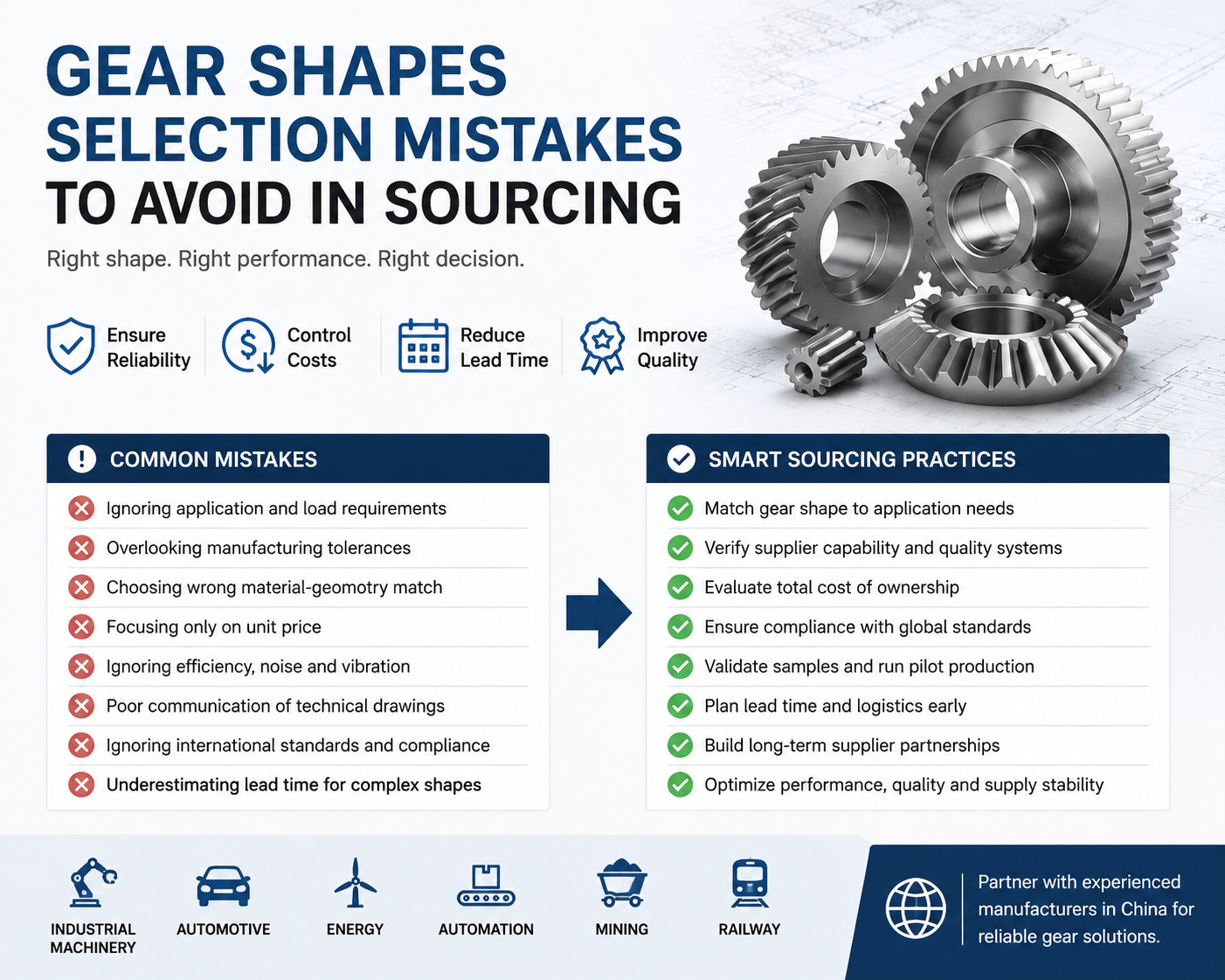
On the flip side of that coin, there exists a whole other flavor of expensive mistake, namely the tendency among well-meaning design engineers to spec AGMA Q12 or DIN 5 tolerances for an idler gear in a low-speed auger drive where Q9 would run perfectly fine for a hundred thousand cycles. Over-engineering gear shapes means you are paying for grinding operations instead of hobbing, for superfinished flanks instead of as-cut profiles, and for 100% CMM inspection instead of statistical sampling, all of which add lead time and unit cost without delivering any functional benefit whatsoever. The procurement professional who learns to ask the simple question—what is the actual torque, speed, and duty cycle here, and do we genuinely need that level of flank modification?—becomes the hero who slashes spend without sacrificing reliability, because knowing when to dial back precision is just as valuable as knowing when to demand it.
2. Common Gear Shapes and Their Industrial Applications
Spur gears: straight teeth for high-torque, low-speed drives
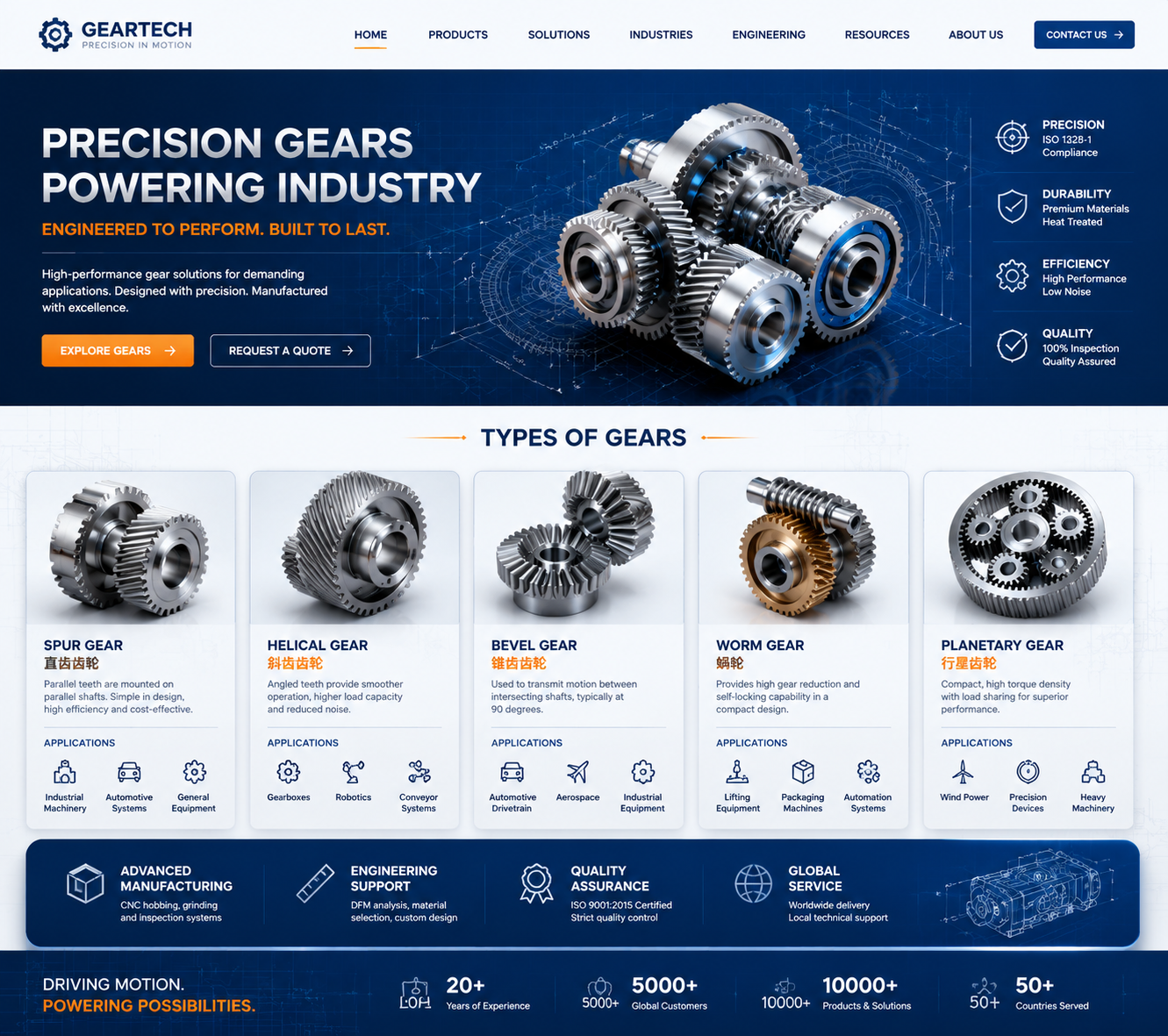
The humble spur gear with its dead-straight teeth cut parallel to the axis of rotation is the workhorse of the mechanical world, and for good reason: no axial thrust, simple manufacturing geometry, and an almost shocking ability to transfer monstrous torque loads in applications like heavy-duty winches, punch presses, and conveyor drives where speed takes a back seat to raw grunt. You will find these no-nonsense shapes in everything from agricultural tillers to industrial rolling mills, and their straightforward design means tooling costs stay low, setup times shrink, and any half-competent shop with a hobbing machine can crank them out by the thousand without breaking a sweat. The trade-off, of course, is that spur gears sing like a buzzsaw at high RPMs due to the sudden whole-tooth engagement, so they belong in places where noise regulations are more suggestion than mandate and where simplicity trumps refinement every single time.
Helical gears: angled teeth for smooth, high-speed operation
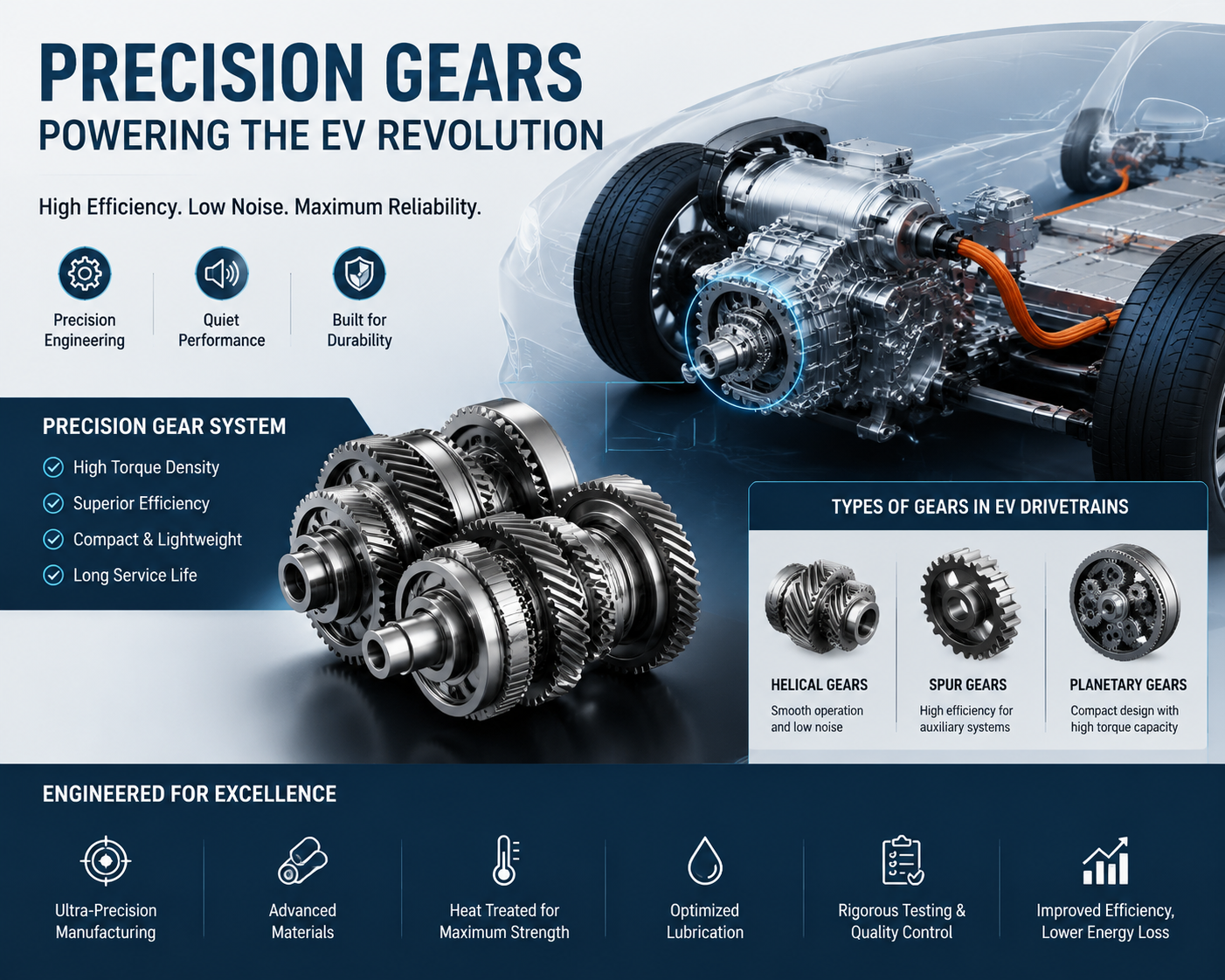
When you need to move serious power at serious speed without waking the neighbors three blocks away, helical gears with their elegantly twisted teeth deliver the goods by engaging gradually and progressively rather than all at once, which slashes vibration and noise while enabling far higher rotational velocities than any spur gear could ever hope to achieve. The helix angle introduces axial thrust—which means you will need thrust bearings or herringbone arrangements to keep shafts from walking out of the housing—but the payoff in load distribution, contact ratio, and sheer buttery smoothness makes helical sets the default choice for automotive transmissions, high-speed compressors, and practically any gearbox where human beings have to work nearby without developing eye twitches. Procurement folks should note that helicals cost more than spurs due to the need for specialized hobs and sometimes grinding, but that premium buys you an order-of-magnitude reduction in dynamic loading and acoustic emissions.
Bevel and worm gears: directional changes in compact assemblies
There comes a moment in every mechanical engineer's life when the input shaft and output shaft refuse to play nice on parallel axes, and that is when bevel gears—with their conical blanks and intersecting axes—ride to the rescue by turning power through ninety degrees in applications like differentials, hand drills, and right-angle drives where packaging constraints leave no room for crossed-axis belts or chains. Worm gears take a different tack entirely, using a threaded worm to drive a helical wheel and achieving massive reduction ratios in a single stage while inherently resisting back-driving, which makes them indispensable for hoists, elevators, and any mechanism where gravity would otherwise spin the load backward the moment you let go of the crank. The procurement reality check here is that bevel gears, especially spiral bevels, demand serious machining capability and coordination, while worm sets require precise lead control and often bronze wheels that drive material costs upward, so do not expect bargain-bin pricing for these specialty shapes.
3. Where Procurement Professionals See Price Inflation
Markups from middlemen in custom gear orders
Anybody who has been in this game for more than six months has seen the classic shell game: you send an RFQ for a modest batch of helical gears to what you thought was a manufacturer, only to discover six weeks later that you have actually been dealing with a glorified broker who took your drawings, outsourced the cutting to a third-tier shop in another province, and slapped a thirty-five percent markup on the whole transaction just for answering emails slowly. These middlemen add zero metallurgical knowledge, zero process control, and exactly zero value to the supply chain, yet they manage to embed themselves between you and the actual cutting machines by trading on polished websites and smooth-talking sales engineers who cannot tell a hob from a shaper cutter if their lives depended on it. The cure is ruthlessly simple: ask for plant photos, request a video call walking through the shop floor, or better yet, demand a list of their hobbing machines by model and serial number—real manufacturers will rattle off that information without hesitation, while middlemen will suddenly develop memory lapses and scheduling conflicts.
Unnecessary certification layers without added value
There exists a peculiar species of supplier that seems to believe that burying you in paperwork is a viable substitute for actually making good gears, and they will happily provide EN 10204 3.2 certifications for raw material, ISO 17025 calibration reports for every caliper in the building, and a thirty-page inspection dossier complete with color-coded charts and fancy letterhead—all of which costs you real money and delivers exactly zero improvement in tooth flank integrity. The hard truth is that for ninety percent of industrial gear applications, a straightforward material cert, a basic gear roll test report, and a handful of critical dimension checks will tell you everything you need to know, while all those extra layers of certification exist primarily to justify higher prices and make procurement feel like they are doing something sophisticated. Call the bluff: specify exactly which certs you require and refuse to pay for the decorative ones, because a supplier who insists on charging for the full symphony of documentation when a simple tune will do is either incompetent or running a scam.
Premium pricing for standard metric gear shapes
You would think that something as ubiquitous as a Module 2 spur gear with twenty teeth and a twenty-degree pressure angle would be priced like the commodity it is, yet some suppliers will quote you custom-tooling prices for these off-the-shelf shapes as if Herr Maag himself had to rise from the grave to grind each tooth by hand. The reality is that any properly equipped gear shop has drawers full of standard hobs, standard shaper cutters, and standard inspection masters for common metric modules, so when a vendor claims they need to make special tooling for a M2x20T spur gear, they are either lying to your face or admitting they do not own basic equipment. Procurement professionals who maintain a small reference library of common gear standards—DIN 867, ISO 54, AGMA 2015—can smoke out these pricing games by simply asking which hob they plan to use; if they hesitate, walk away and find a supplier who treats standards as exactly what they say on the tin.
4. The Real Drivers of Gear Manufacturing Costs
Tooling amortization across different batch sizes
Here is the piece of arithmetic that separates the novices from the greybeards: a high-quality hob for a specialized gear shape might cost eight hundred to two thousand dollars, and that tool has a finite life measured in meters of cut before it dulls and starts producing garbage parts, so the question of how you spread that tooling cost across your batch size is literally the difference between a sensible unit price and a laughably uncompetitive quote. For a run of fifty pieces, that hob amortization slams into each gear like a freight train, whereas for five thousand pieces, the per-unit tooling cost shrinks to noise level, which is why smart procurement engineers bundle demand, consolidate orders, and negotiate blanket tooling ownership agreements that let them reuse the same hobs across multiple purchase orders over several years. The savvy buyer also asks whether the supplier owns the hob outright or will charge a separate tooling fee for every single order; the former is a partner, the latter is a parasite.
Material selection: steel grades vs. cost per unit
Do not let anyone tell you that gear steel is just gear steel, because the difference between a through-hardened 1045 carbon steel and a case-carburized 20MnCr5 alloy is the difference between a gear that lasts six months in moderate service and one that outlives the machine it was installed in, and that performance gap comes with a corresponding price gap that can swing twenty to forty percent depending on market conditions and mill contracts. The procurement professional who knows when to spec 16MnCr5 for its combination of core toughness and case hardenability, versus when to drop down to 8620 or even a simple 4140, can shave serious money off a bill of materials without creating a reliability nightmare down the road. Have the hard conversation with your design team: does this application genuinely need the full alloy suite with nickel and molybdenum, or are we just specifying it because the last guy did and nobody ever asked why?
Post-processing: heat treatment, grinding, and coating
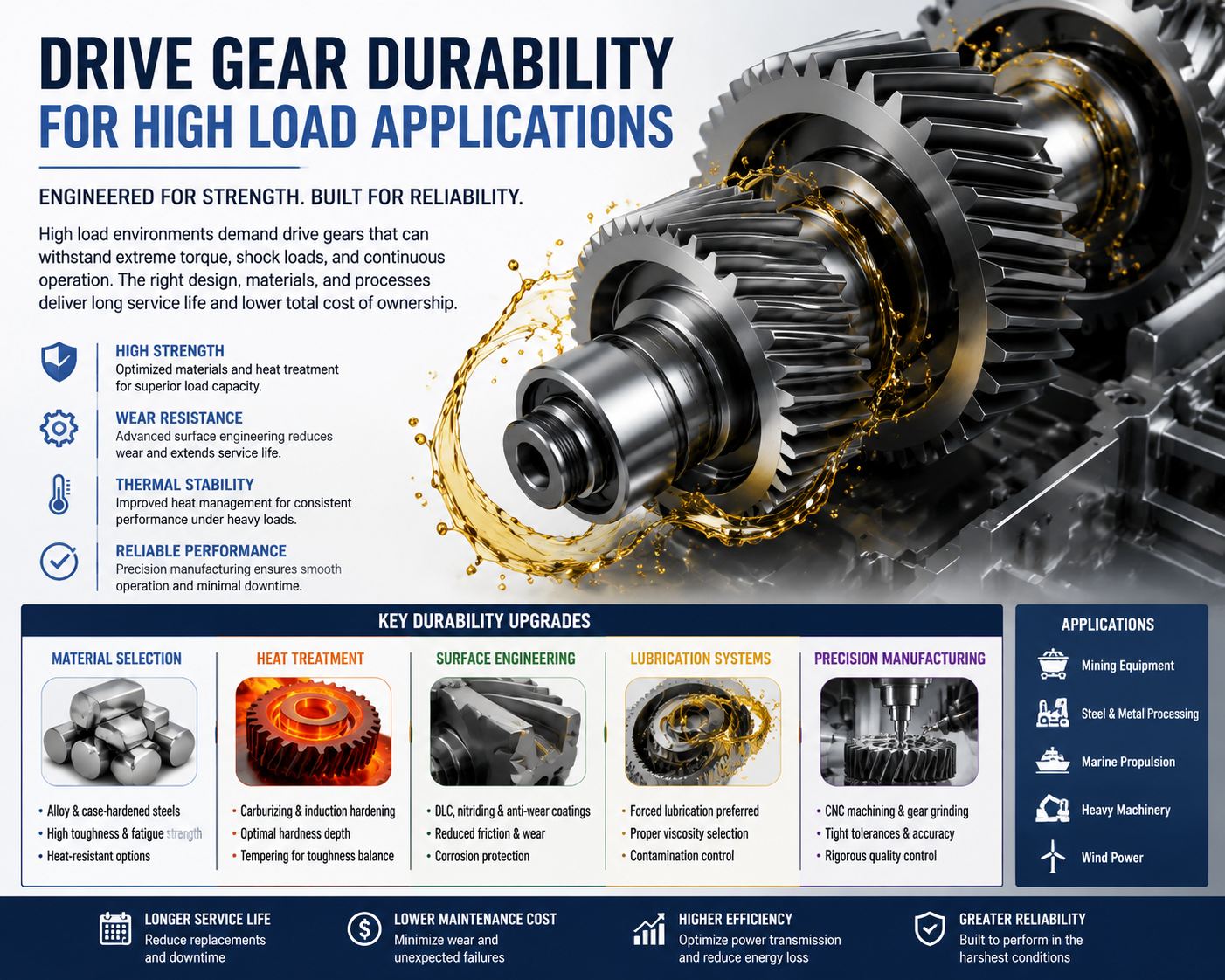
The raw cut gear coming off the hob is rarely the finished product, because subsequent operations like carburizing, quenching, tempering, grinding, shot peening, and phosphate coating can easily double or triple the base machining cost while adding weeks to the lead time, which is why procurement engineers must scrutinize every post-processing step as a potential cost driver rather than an assumed necessity. Through-hardening is cheap and cheerful but leaves the gear vulnerable to core fracture under impact loads; case hardening is more expensive but provides that beautiful hard shell over a tough core; grinding adds precision but removes material and time; and exotic coatings like DLC or manganese phosphate are wonderful for specific edge cases but complete overkill for standard industrial drives. The winning move is to challenge each post-processing step with the same question: what failure mode are we preventing, and is there a lower-cost process that prevents it just as well?
5. How OEM/ODM Factories Achieve Precision Without Premium Pricing
In-house hobbing and shaping machines reducing subcontracting fees
The factory that owns its own CNC hobbing machines, gear shapers, and inspection equipment can control quality, schedule, and cost in ways that an assembly-and-outsource operation can only dream of, because every time a job goes to a subcontractor, somebody adds a markup, somebody adds a logistics delay, and somebody introduces a new opportunity for miscommunication to turn your gear shape into an expensive paperweight. In-house capability means the setup technician who cut the first piece is the same person who can adjust the process for the five hundredth piece, and it means the procurement manager gets a single throat to choke when things go sideways rather than a daisy chain of finger-pointing vendors each blaming the other. For the buyer, the practical implication is that you should always ask about vertical integration: what percentage of the manufacturing steps happen under the supplier's own roof, and what gets sent out? The higher the in-house percentage, the fewer hands reach into your wallet.
Batch optimization for common gear shapes across multiple clients
An intelligent OEM manufacturer looks across their entire customer portfolio and sees opportunities to combine multiple orders for similar gear shapes into marathon production runs that keep machines spinning and hobs cutting for days at a time, dramatically lowering the per-unit overhead compared to stopping and restarting for every small batch. This approach—sometimes called gang running or family production—allows the factory to treat your modest order of five hundred helical gears as part of a five-thousand-piece campaign that includes three other customers' similar parts, passing the efficiency savings back to you in the form of lower pricing and faster delivery. Procurement professionals can facilitate this by offering flexible delivery schedules, agreeing to batch releases, and providing rolling forecasts that let the supplier plan their production queue without constantly firefighting urgent purchase orders.
Digital metrology lowering inspection waste and rework
Gone are the days when gear inspection meant a manual double-flank roll tester and a lot of thumb-sucking, because modern digital metrology systems using laser scanners, coordinate measuring machines with dedicated gear software, and even in-process sensors mounted directly on the hobbling machine can catch profile deviations in real time and automatically adjust cutting parameters before a single bad part makes it to the shipping dock. This real-time feedback loop slashes the scrap rate dramatically, reduces the need for costly 100% post-process inspection, and enables the factory to hold tight tolerances without the traditional brute-force approach of cutting everything oversize and then grinding down to final dimensions at great expense. When a supplier invests in this kind of smart metrology, they are essentially buying down your risk and their rework cost simultaneously, so look for vendors who talk about statistical process control, closed-loop correction, and in-line gauging rather than just promising to inspect everything at the end and hope for the best.
6. Specifying Gear Shapes to Avoid Costly Ambiguity
Clear module, pressure angle, and tooth count definitions
The single fastest way to turn a straightforward gear order into a cross-continental game of telephone is to submit a drawing with incomplete or ambiguous gear data, because if you do not explicitly state the module, pressure angle, and number of teeth in a clear, unambiguous format—preferably with a proper gear data block following AGMA or ISO conventions—you are essentially inviting the supplier to make assumptions that will inevitably be wrong and expensive to correct. Specify the module in millimeters, the pressure angle in degrees (20° being the industry standard but 14.5° and 25° still floating around out there), and the tooth count as an integer, and while you are at it, throw in the outside diameter, root diameter, and pitch diameter as cross-checks so the machinist can verify their setup before cutting metal. Procurement engineers who learn to spot a gear drawing missing these basics can save their companies thousands of dollars in rework by simply kicking the drawing back to design with a polite note that says, please finish your homework before we try to buy this.
Tolerance bands that balance performance with yield rates
Specifying a gear to AGMA Q10 means something very different from AGMA Q12, and the difference is not just a line on a chart but a tangible impact on manufacturing yield, inspection cost, and ultimately the price you pay, because tighter tolerances inevitably throw more parts into the rework or scrap bin, and somebody has to pay for those losses. The procurement professional's job is to push back on tolerances that feel like aesthetic preferences rather than functional necessities, asking the design team to demonstrate with actual calculations why that profile tolerance needs to be four microns instead of eight given the operating speed and load. When you find that sweet spot—the tolerance band that delivers reliable performance without demanding aerospace-level precision for a conveyor gear—you have just earned your keep for the quarter.
Drawing notes that eliminate secondary finishing assumptions
Ambiguity in drawing notes is the breeding ground for costly change orders, because a phrase like break sharp edges could mean anything from a quick deburring pass to a full radiused edge with a specific chamfer dimension, and the supplier's interpretation of that phrase will almost never align perfectly with your unspoken expectation. Get specific: define chamfer sizes, specify surface finish in Ra or Rz, call out any requirement for grinding stock or final lapping, and explicitly state which features are critical for function versus which are merely for reference. A drawing with exhaustive, unambiguous notes might take an extra hour to prepare, but it will save weeks of back-and-forth emails, disputed nonconformances, and angry phone calls when the delivered gears do not match the mental picture you had but never actually wrote down.
7. The Role of Material Sourcing in Controlling Price
Direct mill contracts for 20MnCr5 and 16MnCr5 steels
The difference between buying gear steel through a distributor and buying it through a direct mill agreement is often a spread of fifteen to twenty-five percent on the raw material cost, which matters enormously when you are talking about multi-ton orders of case-hardening alloys like 20MnCr5 or 16MnCr5 that form the backbone of precision gear manufacturing. An OEM factory with enough volume to negotiate direct mill pricing can pass those savings along to you, while a small job shop buying from a local steel service center will inevitably quote higher prices just to cover their own material markup. Procurement engineers should ask any serious gear supplier about their material sourcing strategy: do they buy from mills directly, do they have a stocking agreement with a major distributor, or do they simply call around for spot quotes every time an order comes in? The answer tells you a lot about their cost structure and their ability to give you a competitive price consistently.
Alternatives like sintered metals for non-critical applications
Not every gear in your machine needs to be forged from bar stock and case-carburized to sixty Rockwell, because for low-speed, low-torque applications like adjustment mechanisms, indexing dials, or light-duty cam drives, powder metal sintered gears can do the job at a fraction of the cost and with net-shape precision that eliminates most post-processing entirely. Sintered gears have come a long way from the crumbly, low-density parts of decades past, and modern powder metallurgy can achieve respectable densities and mechanical properties that rival machined gears in less demanding roles, all while producing complex shapes with integrated features that would be expensive to machine conventionally. The procurement engineer who knows when to spec powder metal instead of wrought steel can unlock serious cost savings without compromising reliability, but only if they have the technical confidence to distinguish between applications where sintered is sufficient and where it absolutely is not.
Avoiding over-specification of exotic alloys
There is a strange and wonderful tendency among some design engineers to reach for exotic alloys like Nitralloy 135M or VascoMax maraging steel for gear applications that would be perfectly well served by 4340 or even 4140, perhaps because they read a fascinating white paper once or because they secretly enjoy watching procurement struggle to find suppliers who can even source those materials. The problem with exotic alloys is not just the eye-watering material cost—which can be five to ten times that of standard gear steels—but also the limited number of heat treaters who know how to process them properly, the extended lead times for mill production, and the general reluctance of most gear shops to touch them with a ten-foot pole. Before you approve a specification for an exotic gear material, demand a justification in writing: what specific performance requirement forces this choice, and why cannot a conventional alloy with appropriate heat treatment meet the same need?
8. Quality Assurance Methods That Protect Without Inflating Costs
In-process gear roll testing instead of full CMM every piece
The obsession with inspecting every single gear on a coordinate measuring machine is a beautiful thing if you have unlimited time and an open checkbook, but for the rest of us living in the real world, a well-implemented in-process gear roll test using a double-flank roll checker can detect tooth-to-tooth composite error and total composite error on every single part at a fraction of the time and cost of full CMM inspection. The roll test does not give you the detailed profile and lead measurements of a CMM, but it catches the killers—eccentricity, pitch error, tooth thickness variation—quickly enough to pull a bad tool or adjust a misbehaving machine before an entire batch goes down the drain. A sensible quality plan uses roll testing for 100% in-process screening and then samples a statistically significant subset for full CMM characterization, giving you the confidence of complete inspection without the absurd cost of measuring every flank on every gear.
Statistical sampling plans aligned with ISO 1328 grades
Nobody ever went broke by inspecting too many gears, but plenty of companies have gone broke by paying for 100% inspection on parts that only needed AQL sampling per ISO 2859 or ANSI/ASQ Z1.4, because the relationship between gear accuracy grade and required inspection intensity is not linear—a Q9 gear in a non-safety application does not need the same scrutiny as a Q5 gear in a helicopter transmission. The smart procurement engineer specifies the sampling plan alongside the gear grade, saying something like per ISO 1328-1, inspect according to normal level II, AQL 1.5 for major characteristics, rather than leaving the supplier to assume they must measure everything. This kind of clarity keeps quality high and costs reasonable, and it signals to the supplier that you understand gear metrology well enough to be dangerous but not so well that you become insufferable about it.
Real-time feedback loops to adjust cutting parameters
The state-of-the-art in gear manufacturing has moved beyond measure-then-sort to measure-while-cutting-and-adjust, using sensors embedded in the machine tool to monitor spindle load, vibration signatures, acoustic emissions, and even thermal growth of the hob to detect deviations from nominal before they become nonconforming parts. When the control system sees the tooth profile drifting toward the upper tolerance limit, it can tweak the infeed rate or adjust the hob shift schedule on the fly, keeping the process centered and capable without requiring human intervention or producing scrap that someone has to explain to the quality manager. Factories with this level of automation can hold tighter tolerances more consistently than shops relying on end-of-line inspection alone, which means they can offer you higher precision without the traditional price premium—exactly the sweet spot this whole article is about.
9. Minimum Order Quantities and Shape Complexity
How tooth profile complexity affects setup time and MOQ
There is a world of difference between a standard spur gear with straight teeth and a double-helical herringbone gear with a central relief groove, because the former takes a competent setup technician about fifteen minutes to dial in while the latter might require an entire shift of tweaking tool paths, verifying lead angles, and praying to the machine tool gods that the left-hand and right-hand helices meet cleanly in the middle. Complexity drives setup time drives cost drives MOQ, which is a fancy way of saying that if you want a small batch of a very weird gear shape, you are going to pay through the nose because the supplier has to amortize that setup across very few parts. Procurement engineers who can consolidate small orders of similar complexity into larger releases, or who can redesign to simpler shapes without sacrificing function, can dramatically reduce both MOQ constraints and per-unit pricing.
Combining multiple gear shapes into one production run
The shrewd procurement professional recognizes that a gear supplier's setup cost is largely fixed regardless of whether you run one gear shape or five, provided those shapes can be cut using the same machine, the same hob family, and similar material stock, which opens up the possibility of combining multiple part numbers into a single production run to spread that fixed cost across a larger total quantity. This approach requires coordination with your planning team—you need to release orders for those five shapes simultaneously rather than trickling them out one by one—but the payoff in reduced per-unit pricing and consolidated logistics can be substantial. Have the conversation with your preferred supplier: if we bundle these three gear shapes into one blanket order with a single setup campaign, what kind of pricing break can you offer? The answer might surprise you.
Blanking and rough-cutting strategies for small batches
When the batch size is too small to justify a dedicated hob and the gear shape is too simple to demand advanced tooling, a clever supplier might turn to blanking—using a laser or plasma cutter to produce rough blanks from plate—followed by a simple shaper or even a wire EDM for the tooth forms, a brute-force approach that bypasses traditional hobbing economics entirely for those awkward low-volume situations. Wire EDM in particular has become a secret weapon for prototype and short-run gear production, because it cuts any tooth profile perfectly without any tooling investment whatsoever, albeit at a slower cycle time that makes it uneconomical for production volumes. For procurement engineers dealing with small batches of weird shapes, EDM is your friend: the per-part price will be higher than hobbing would be at volume, but the absence of tooling amortization and setup charges makes it surprisingly competitive for runs under, say, fifty pieces.
10. Lead Time Reduction Through Smart Shape Standardization
Keeping helix angles and pressure angles consistent across SKUs
One of the simplest yet most overlooked strategies for collapsing gear lead times is to standardize helix angles and pressure angles across as many of your part numbers as possible, because a supplier who only has to stock hobs for 20° pressure angle and 15° helix angle can set up and run any of your helical gears without waiting for special tooling orders that add four to six weeks to every project. The design team will occasionally whine about the constraint—oh, but this application really wants a 25° pressure angle for greater contact ratio—but the procurement engineer can counter with a simple trade-off analysis: is that theoretical performance improvement worth adding five weeks to every future order for that part, plus the cost of a dedicated hob that we might use once a year? The answer, more often than not, is a resounding no.
Using modular hob sets for families of gear shapes
The concept of modular hobbing involves using a single hob to cut a range of gear modules by adjusting machine parameters, which sounds like magic but is actually just clever engineering: a hob designed for a specific module range can cut any module within that range by varying the feed rate and index ratio, meaning one tool can cover many part numbers. Not every gear shape is compatible with this approach—you lose some efficiency and precision compared to a dedicated hob—but for non-critical applications or for prototyping, modular hobs can be a lifesaver for reducing tooling inventory and changeover time. Procurement engineers should ask their gear suppliers which of their standard hobs are modular versus dedicated, and then design their gear families to align with those modular tools whenever possible.
Reducing changeover time between similar profiles
The clock starts ticking the moment one production run ends and the next one begins, and every minute spent swapping hobs, recalibrating sensors, adjusting coolant nozzles, and verifying first-piece dimensions is a minute that your gears are not being cut and your lead time is stretching longer than a rubber band in a tensile tester. Suppliers who have invested in quick-change tooling systems, automated setup routines, and standardized work instructions can change over between similar gear shapes in twenty minutes rather than two hours, and those savings flow directly to you in the form of shorter quoted lead times and greater scheduling flexibility. When evaluating potential gear suppliers, ask for their average changeover time between family parts, and watch their eyes: if they hesitate or give a vague answer, they probably have not optimized their process, and you will pay for that inefficiency one way or another.
11. Case Examples: Price Hikes Avoided in Real RFQs
Replacing a helical with a double-helical without added cost
Here is a real-world example that actually happened: a procurement engineer received a quote for a double-helical herringbone gear that came back at nearly triple the price of a standard helical with comparable torque capacity, so they asked the simple question why, and discovered that the price premium was driven entirely by the perceived complexity of synchronizing left and right helix cuts rather than any actual material or performance difference. By working with a supplier who had a CNC gear grinder capable of cutting both helices in a single clamping operation, the engineer obtained double-helical performance for essentially the same price as a single helical, because the machine did not care about the complexity and neither did the tooling. The lesson here is that old assumptions about what costs more become obsolete when new machine tools enter the market, so always challenge premium pricing with a question: has the technology changed since this assumption was last validated?
Combining internal and external gear shapes in one blank
Another memorable victory came when a buyer for a planetary drive system realized they were purchasing internal ring gears and external sun gears from two different suppliers, paying two separate tooling amortizations, two separate shipping costs, and two separate markup layers, all for parts that could theoretically be cut from the same steel blank on the same machine in the same setup. By consolidating both parts with a single OEM manufacturer that had a gear shaper capable of cutting internal teeth and a hobber for external teeth on the same plant floor, the buyer eliminated one complete supply chain and shaved nearly thirty percent off the combined cost. The supplier was happy because they got more volume, and the buyer looked like a genius—which, in procurement terms, is the best possible outcome.
Switching from ground to hobbed finish where permissible
In a third case, a cost-conscious engineer reviewed a long-running gear order and noticed that the drawing specified grinding after hobbing for a gear that operated at a modest two hundred RPM in a lubricated bath, conditions under which a well-hobbed finish with proper profile and lead would perform indistinguishably from a ground finish at a fraction of the cost. After running a quick validation test—fifty hobbed-only gears versus fifty ground gears on a life cycle test stand—the data showed no difference in wear pattern, no difference in noise, and no difference in failure mode, so the specification was changed and the per-unit price dropped by twenty-two percent overnight. The takeaway for procurement is simple: never assume that grinding is necessary just because the drawing has said so for ten years, because a little bit of testing might prove otherwise and save you a bundle.
12. Common Supplier Excuses for High Pricing on Gear Shapes
Claiming complex shapes require new tooling each time
The classic excuse we hear constantly is the vendor who insists that your particular gear shape—despite being a standard involute profile with no unusual modifications—requires a brand new custom hob, a new shaper cutter, and possibly a blood sacrifice to the machine tool gods, all of which must be paid for upfront in the form of a tooling fee that suspiciously resembles the price of a used car. The truth is that a well-stocked gear shop has hobs covering the full range of standard modules and pressure angles, and if your gear falls within those ranges, no new tooling is required, period. Procurement engineers should call this bluff by asking for the specific hob data: what is the hob part number, what is its module range, and when was it last sharpened? If the supplier cannot answer these basic questions, they are probably padding the quote.
Charging extra for flank modifications as premium service
Another perennial favorite among price-inflating suppliers is the notion that any flank modification—tip relief, root fillet optimization, crowning, or end relief—constitutes a premium service requiring exotic tooling, extensive programming time, and a special surcharge that magically doubles the unit price. The reality is that modern CNC hobbing and grinding machines come standard with software that can apply virtually any flank modification profile as a simple parameter change, requiring no special tooling and very little additional cycle time. When a supplier tries to charge you extra for a standard tip relief to avoid edge loading, smile politely and find another vendor who understands that flank modifications are part of good gear design, not a luxury add-on.
Marking up standard shapes as custom due to poor CAD data
The most frustrating excuse of all is when a supplier quotes a standard gear shape as if it were a one-off custom part simply because your CAD export had a slightly unusual file name or because they could not be bothered to look up the standard dimensions in their reference tables, hoping you will not notice the price discrepancy. This happens more often than anyone cares to admit, and the fix is simple: before sending an RFQ, verify that your gear data matches a recognized standard specification, and then ask the supplier directly—this appears to be a standard Module 3 spur gear with 30 teeth, is that correct? Once you have them on the record acknowledging the standard nature of the part, any attempt to charge custom pricing becomes obviously indefensible.
13. Procurement Checklist for Comparing Gear Shape Quotes
Verifying if quoted price includes deburring and chamfering
Burrs on gear teeth are like paper cuts on your fingers—small, irritating, and capable of causing disproportionate damage if ignored, yet many suppliers quote a base price that assumes the gears will ship as-cut with sharp, burred edges, then add a separate line item for deburring and chamfering as if they were doing you a favor rather than delivering a usable part. The procurement checklist must explicitly ask: does this quoted price include removal of all cutting burrs from tooth tips, root fillets, and end faces, and does it include chamfering of any external corners where assembly personnel might slice their gloves (or their fingers)? Getting this in writing upfront prevents the unpleasant surprise of receiving a box of razor-sharp gears and then fighting over who pays to finish them properly.
Checking whether gear measurement report is included
A quote that looks wonderfully cheap might reveal its hidden flaw when you realize that the supplier plans to ship every single gear without any inspection documentation whatsoever, leaving you to discover quality problems on your own assembly line after the fact, at which point the cost of return shipping, rework, and lost production time dwarfs whatever you saved on the initial purchase. Always confirm what level of inspection reporting is included in the quoted price: is it a simple certificate of conformance, a first-article inspection report, a full lot inspection summary, or a detailed CMM report for each batch? If the supplier offers to provide measurement reports only as a paid extra, factor that cost into your comparison, because flying blind on gear quality is a fool's errand.
Confirming if sample approval cost is separate or absorbed
The sample approval process—where the supplier makes a small batch, you inspect and approve, and only then does full production commence—is a standard and necessary step for custom gear shapes, but some suppliers will charge for those samples as if they were a separate production run rather than amortizing the cost across the eventual full order quantity. The checklist must ask: are sample pieces included as part of the quoted tooling and setup, or will we be invoiced separately for sample production and inspection? A supplier who absorbs sample costs into the overall quote is signaling confidence that you will place the full order; a supplier who charges separately for samples may be less committed to the long-term relationship, or simply more short-sighted in their pricing model.
14. Negotiating Leverage When Buying Multiple Gear Shapes
Bundling dissimilar shapes into one master order
The fundamental law of manufacturing negotiation is that volume talks and scarcity whispers, which means that when you walk into a conversation with five different gear shapes totaling ten thousand pieces rather than five separate conversations about two thousand pieces each, you instantly transform from a small buyer to a substantial customer worth courting with better pricing and priority scheduling. Bundling does not require all the gears to be identical; it only requires that you consolidate your purchase orders, coordinate your release schedules, and present a single face to the supplier who would much rather process one large order than five small ones. Procurement professionals who master the art of bundling can often secure price reductions in the range of ten to twenty percent simply by reducing the supplier's administrative overhead and production scheduling complexity.
Offering forecast visibility for better production planning
Suppliers love predictability the way machinists love sharp inserts, because a clear twelve-month rolling forecast allows them to reserve machine time, schedule tool maintenance, order raw material in economical quantities, and plan their labor allocation without constantly scrambling to respond to last-minute emergencies. When you share your forecast—even a rough one with quarterly buckets rather than exact weekly numbers—you give the supplier the gift of foresight, and in return they can offer you firmer pricing, shorter lead times, and better protection against capacity crunches. The buyer who treats forecasts as a strategic tool rather than a burdensome paperwork exercise will consistently get better treatment and better pricing than the buyer who drops a surprise purchase order every few weeks and wonders why nobody wants to cut them a deal.
Requesting tiered pricing based on annual volume tiers
Instead of negotiating a single price for a single order, the savvy procurement engineer asks for a tiered pricing schedule that defines the unit price at multiple annual volume thresholds: so much per piece for one to five hundred pieces, a lower price for five hundred to two thousand, and a still lower price for two thousand and above. This approach gives you clear targets to aim for when consolidating demand and gives the supplier a rational basis for offering better pricing on larger volumes without having to renegotiate from scratch every time an order size changes. Tiered pricing also protects you from the awkward situation where your actual volume exceeds your initial estimate and you suddenly want a retroactive price break; with tiers defined upfront, the supplier has already agreed to the discount structure, so you simply pay the lower rate on the higher volume without re-trading the deal.
15. Long-Term Partnership Indicators Beyond Per-Unit Price
Supplier investment in CNC gear shaping centers
Any supplier can claim to be a long-term partner, but the proof lives on the shop floor in the form of capital investment—specifically, modern CNC gear shaping centers with automatic hob shift, in-process gauging, and real-time data acquisition rather than manual machines from the Reagan administration held together with hope and duct tape. When a supplier has recently invested in new equipment, they are signaling that they intend to remain in the gear business for the foreseeable future, which means they will be responsive to your needs, capable of adopting new technologies, and less likely to go belly-up and leave you scrambling for a replacement source. Procurement professionals should ask not just what machines a supplier has, but when they were purchased, and whether the supplier has a planned capital replacement schedule that keeps them current with industry best practices.
Willingness to stock pre-cut blanks for repeat shapes
A supplier who truly values your long-term business will offer to stock pre-cut gear blanks—rough-machined discs in your preferred material, ready for final tooth cutting on short notice—so that your lead time for repeat orders collapses from weeks to days, and your exposure to material price volatility diminishes because the steel was purchased when the market was favorable rather than whenever you happen to place an order. This kind of vendor-managed inventory arrangement requires trust and a predictable consumption pattern, but the payoff in reduced lead time and administrative hassle is immense for both parties. When evaluating potential long-term partners, ask directly: would you be willing to hold a safety stock of blanks for our top five gear part numbers, and what volume commitment would justify that arrangement?
Transparent cost breakdown for tooling and materials
Opacity is the enemy of trust, so a supplier who provides a detailed, line-by-line cost breakdown—showing material cost per blank, tooling amortization, machine time per piece, labor cost per batch, inspection charges, and a reasonable profit margin—is demonstrating a level of transparency that signals genuine partnership rather than transactional opportunism. You do not need to audit every line item, but seeing the breakdown allows you to understand where the money goes, identify opportunities for joint cost reduction, and verify that the supplier is not hiding absurd markups in vague categories like administrative fees or quality surcharges. A supplier who refuses to provide any cost detail, instead insisting that the price is the price and you should just trust them, is probably not the kind of partner you want for the long haul.
16. Final Checklist Before Approving a Gear Shape Supplier
Confirming ISO 9001 with gear-specific scope
ISO 9001 certification is table stakes, not a differentiator, but what matters is the scope of that certification: does it explicitly include gear cutting, heat treating, and inspection, or is it a generic scope that could cover anything from paper clips to pet food while saying nothing about tooth geometry? A supplier whose ISO scope mentions machining of power transmission components is far more credible than one with a vague certification that a semi-competent auditor would have issued to a lemonade stand. Before approving any supplier, request a copy of their ISO scope sheet and read the fine print; if gear manufacturing is not explicitly listed, assume their quality system has never been audited for the specific challenges of involute profiles, runout control, or hardness pattern verification.
Reviewing sample run reject rate and corrective action speed
The best predictor of future quality is past quality, so ask any supplier for their first-article reject rate and their production lot reject rate over the past twelve months, then ask for their average corrective action response time—meaning, when a nonconformance is identified, how many hours or days elapse before they issue a root cause analysis and implement a fix? A supplier with low reject rates and fast corrective action is a supplier who has their process under control and takes quality seriously; a supplier with high reject rates or glacial response times will cost you more in expediting, rework, and frustration than any per-unit price saving could ever justify. Do not be shy about asking for these numbers, because a serious supplier tracks them internally anyway and will be proud to share them.
Verifying delivery performance on past multi-shape orders
On-time delivery for single-part orders is one thing, but the real test is how a supplier performs on complex, multi-shape orders where they must coordinate multiple work centers, multiple tooling setups, and multiple inspection reports to ship a complete kit of different gears all at the same time. Ask for delivery performance metrics specifically on orders that included three or more distinct part numbers, and ask how often those orders shipped complete versus how often they shipped in partial lots with missing items following weeks later. A supplier who consistently delivers multi-shape orders on time, complete, and with proper documentation has earned the right to be called a partner; everyone else is still auditioning.