Table of Contents
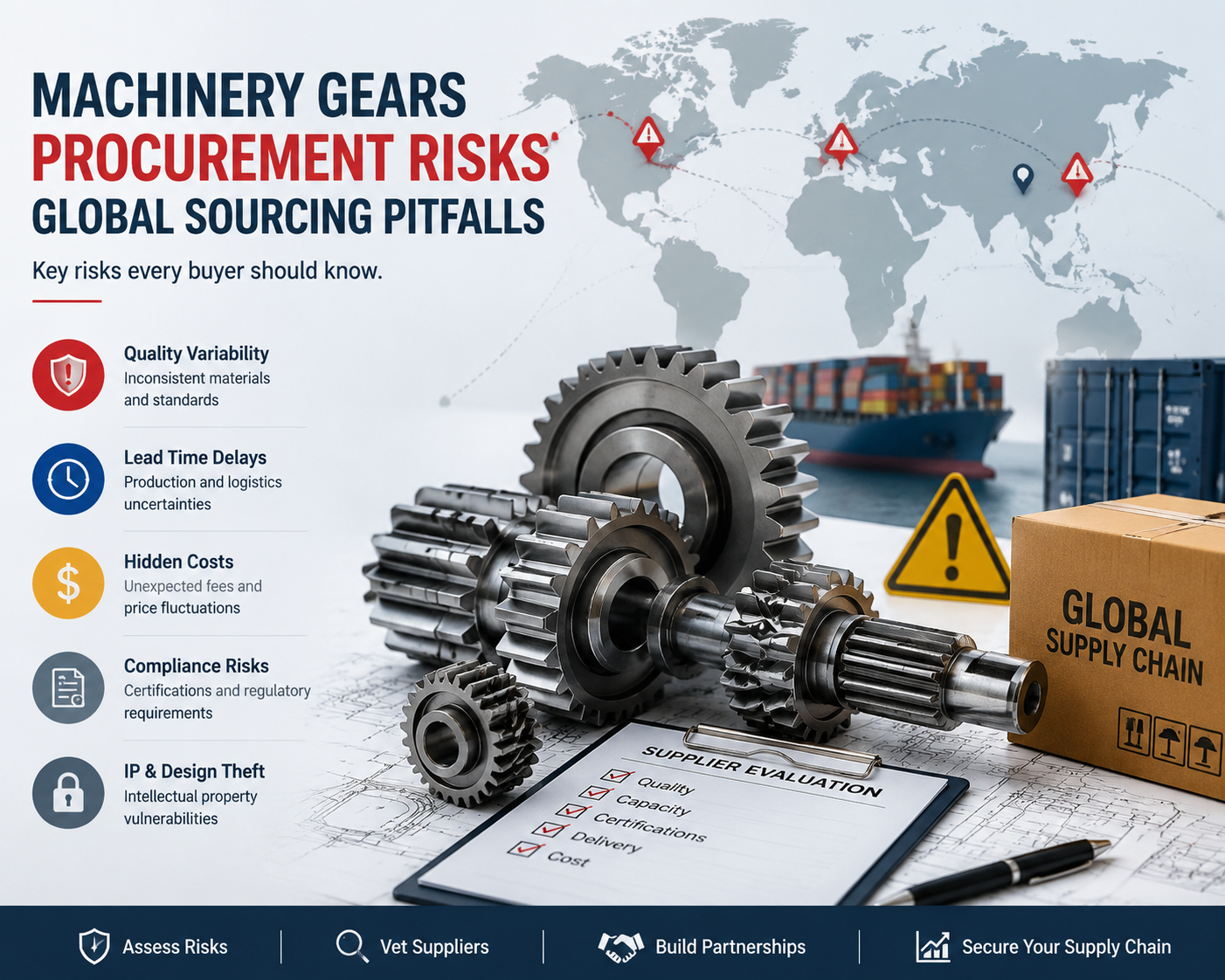
The Gears of Peril: Navigating Procurement Pitfalls in Global Machinery Sourcing
Introduction to Machinery Gears Procurement Risks
The global manufacturing landscape is currently experiencing an insatiable appetite for precision-machined gears, driven by the relentless march of industrial automation and the electrification of everything from automotive powertrains to wind turbines. As corporations scour the globe for cost-effective yet high-fidelity gear solutions, the labyrinthine nature of international procurement has morphed into a veritable minefield, replete with complexities that can ensnare even the most battle-hardened purchasing engineer. The stakes have never been higher, for a single substandard gear train can bring an entire assembly line to a screeching halt, causing cascading delays and hemorrhaging capital.
This escalation in procurement complexity is not merely a function of increased demand but is intricately tied to the fragmentation of global supply chains and the geopolitical volatility that impacts raw material availability and trade routes. When sourcing across borders, one must contend with a cacophony of variables, ranging from fluctuating exchange rates to divergent national quality frameworks, making the simple act of acquiring a commodity like a helical gear a high-stakes strategic gambit. The key challenges manifest as a tripartite monster: verifying the veracity of supplier claims, navigating the treacherous waters of international logistics, and bridging the yawning chasm of cultural and technical communication. We are no longer just buying metal; we are buying into a global system fraught with hidden risks.
Understanding Global Machinery Gear Supply Chains
The typical supply chain structure that ferries a gear from a foundry in the developing world to an Original Equipment Manufacturer (OEM) in a Western industrial hub is a convoluted tapestry of tiered manufacturing and logistical hand-offs. At its inception, raw steel billets are cast and forged, subsequently moving to specialized gear hobbing or shaping facilities, before being subjected to intricate heat treatment and grinding processes. These components then often pass through a gauntlet of secondary operators, who may perform final honing or surface finishing, before being funnelled into inventory hubs that service the final assembly lines.
The role of intermediaries and trading companies in this ecosystem cannot be overstated; they often act as the fulcrum upon which the entire transaction balances, providing linguistic, financial, and logistical lubrication for the deal. While these third parties can offer access to a network of vetted production floors and facilitate smoother customs navigation, they simultaneously introduce another layer of opacity and potential margin erosion, making it difficult to discern the true source of manufacturing value. Furthermore, the impact of global logistics networks, particularly the chokepoints in maritime shipping and air freight, adds a stochastic element to the supply chain, where port congestion or a shortage of shipping containers can render the most meticulously planned procurement schedule obsolete. Learn more about supply chain dynamics on Wikipedia.
Quality Variability Across Different Manufacturing Regions
One of the most intractable headaches for a procurement engineer is the stark disparity in machining standards that exists across different manufacturing regions, a divergence that often dictates the success or failure of a sourcing campaign. While a manufacturer in Germany or Japan might adhere to DIN or JIS standards with near-fanatical precision, a competitor in an emerging economy might operate with significantly wider tolerances, prioritizing throughput over microscopic perfection. This is not merely a matter of pride; it is a fundamental engineering reality that the surface finish, tooth profile, and concentricity of a gear are inextricably linked to its service life and acoustic performance in high-load applications.
Compounding this issue is the perennial inconsistency in material quality, where the provenance and metallurgical composition of steel can vary dramatically, leading to capricious results during subsequent machining and hardening phases. A supplier might certify a component as conforming to AISI 4140 specifications, yet the presence of trace impurities or a non-homogeneous grain structure can render the final product brittle and prone to fatigue failure. These production technology gaps, manifested in the use of older, less rigid machine tools or a lack of sophisticated in-process gauging, create a scenario where a gear that looks acceptable to the naked eye may be a ticking time bomb when subjected to torsional stress and dynamic loads. Explore standards and measurement at NIST.gov.
Supplier Qualification Risks in Gear Procurement
Perhaps the most egregious risk facing procurement teams is the lack of verified production capability among potential overseas partners, where glossy brochures and well-rehearsed sales pitches often mask the reality of a facility that struggles to maintain process control. The misrepresentation of manufacturing capacity is a ubiquitous pitfall; a supplier may boast of possessing Gleason or Klingelnberg machinery, yet the fine print reveals that these assets are antiquated, poorly maintained, or insufficient to handle the volume or complexity of the buyer's specific gear geometry. We must look beyond the surface and demand verifiable evidence of machine utilization rates, scrap percentages, and maintenance logs.
This is precisely why the rigor of the audit and certification checks must be elevated to a form of forensic accounting; a simple ISO 9001 certificate, often handed out like candy, is insufficient without a deep dive into the supplier's quality management system and their adherence to sector-specific standards like IATF 16949 for automotive or AS9100 for aerospace. The prudent procurement engineer must conduct on-site technical audits, or engage a third-party inspection agency, to scrutinize the shop floor's real-time capabilities, measuring their inspection equipment calibration, operator training, and the efficacy of their Statistical Process Control (SPC) protocols. Leaving these stones unturned is a gamble that the mechanical heart of your machinery cannot afford to lose. ASQ.org offers resources on quality audits and standards.
Material Selection and Its Procurement Risks
The alchemy of gear manufacturing is deeply rooted in the foundational choice of material, and yet, procurement agents often find themselves wrestling with egregious inconsistencies regarding steel grade sourcing and the corresponding metallurgical properties. When specifying a gear, the selection of a specific alloy—be it a carburizing grade like 8620 or a through-hardening steel like 4140—dictates the entire downstream heat treatment profile and the resultant load-bearing capacity. However, the global supply chain is rife with instances of steel mills substituting grades without explicit approval, assuming that a close chemical composition will suffice, a premise that is fundamentally flawed when dealing with surface hardness gradients and core strength requirements.
Furthermore, the specter of heat treatment process variations looms large, as the nuances of time, temperature, and atmosphere within a furnace can make the difference between a gear that endures for decades and one that suffers premature micropitting or tooth breakage. The hidden material substitution issue remains the procurement engineer's nightmare, where secondary merchants or even the gear manufacturers themselves might use lower-cost "equivalent" materials to pad their margins, banking on the buyer's lack of destructive testing capabilities. It is incumbent upon the buyer to implement stringent material receiving inspections, including hardness testing and positive material identification (PMI) using X-ray fluorescence, to ensure that what is ordered is what is actually being machined into the gear blank. ASTM.org provides material standards and specifications.
Precision Tolerance and Engineering Misalignment
The misinterpretation of technical drawings is a festering wound in global procurement, where the language of GD&T (Geometric Dimensioning and Tolerancing) often becomes garbled in translation, leading to expensive and time-consuming disputes. A datum shift that seems negligible on a CAD model can become a critical misalignment during the assembly phase, causing excessive backlash or uneven load distribution across the gear tooth mesh. This is exacerbated when suppliers lack the sophisticated CMM (Coordinate Measuring Machine) equipment necessary to verify complex profiles, leading to tolerance deviation in mass production that far exceeds the limits specified by the original design parameters.
The communication gap between the buyer's engineering department and the supplier's production planners frequently yields a breakdown in understanding the functional intent of the gear. A specification for a "lead crown" or "tip relief" might be viewed as an optional refinement rather than a mandatory feature to prevent edge loading under operational deflection. These friction points inevitably lead to delayed production cycles, costly rework, and in the worst cases, the shipment of non-conforming goods that are only discovered upon final assembly, forcing the OEM into a frantic scramble to salvage their production schedule.
Cost Estimation Pitfalls in Global Sourcing
When evaluating the total cost of ownership, procurement professionals often fall into the seductive trap of the unit price, only to be blindsided by a cascade of ancillary expenses that erode the initial savings, beginning with hidden tooling and mold costs. For complex gear geometries involving forging or specialized hob design, the amortization of these tooling costs can be a significant financial burden, and the supplier's quotation may cleverly obscure these expenses, only to spring them on the buyer after the contract is signed. Similarly, the pressure to meet a manufacturer's Minimum Order Quantity (MOQ) to justify their production run can force a buyer to over-purchase inventory, tying up valuable working capital in slow-moving stock.
Moreover, price fluctuation due to raw materials is an omnipresent specter, as the cost of alloying elements like nickel, molybdenum, and chromium dances to the tune of global commodities markets. A quote that appears viable in Q1 may become entirely unfeasible by Q2 if there is a spike in steel prices, and procurement agreements often lack the requisite index-based pricing formulas to mitigate this volatility. The sum total of these factors—tooling amortization, inventory carrying costs, and material surcharges—makes it imperative for the buyer to peel back the layers of the onion and calculate the true landed cost of the gear, rather than relying on the superficial allure of the per-piece price.
Lead Time Uncertainty in Gear Manufacturing
The intricate nature of gear manufacturing, involving a prolonged sequence of cutting, heat treating, grinding, and inspection, makes it inherently susceptible to production scheduling delays that cascade through the project timeline with alarming speed. A malfunctioning CNC hobber or a bottleneck in the carburizing furnace can add weeks to a production schedule, a setback that is rarely communicated to the buyer in real-time, leaving them in the dark until the promised ship date has come and gone. The situation is further complicated by export processing bottlenecks, where the administrative inefficiencies of port authorities and the bureaucratic tangle of obtaining export licenses can hold containers hostage for extended periods.
In many manufacturing regions, the seasonal factory capacity constraints, driven by major national holidays like the Chinese New Year or the Lunar New Year, bring production to a standstill, with workers exiting en masse and supply chains grinding to a halt for multiple weeks. A savvy procurement engineer must build these cyclical disruptions into their lead time calculations, acting not as a passive observer but as an aggressive expediter who maintains constant vigilance over the supplier's production scheduling. Failure to account for these temporal vagaries often results in the dreaded expediting fee, where the buyer must pay a premium to airfreight gears, effectively negating the cost benefits of sourcing overseas in the first place.
Quality Inspection Failures and Risks
The divergence in Quality Control (QC) standards across different suppliers is a persistent thorn in the side of the procurement process, where a supplier in one region might consider a 2% defect rate as acceptable, while the buyer's strict specifications demand Six Sigma levels of perfection. This leads to the disheartening experience of receiving a batch of gears that pass the supplier's rudimentary shop-floor inspection but fail miserably when subjected to the buyer's sophisticated inspection protocols upon arrival. The lack of in-process inspection systems—such as integrating gear checker gauges during the grinding cycle—means that errors propagate through the manufacturing stage, resulting in a high proportion of scrap at the final quality gate.
Perhaps the most deceptive risk lies in the discrepancy between sample approval and mass production deviation, a phenomenon where the initial "golden" sample produced with extraordinary care and supervision is not indicative of the run-rate production quality. Once the contract is secured, the supplier may shift to less experienced operators or lower-cost production methods to maximize profit, resulting in a product that is fundamentally inferior to the approved sample. To guard against this bait-and-switch, procurement engineers must insist on First Article Inspection Reports (FAIR) for every production lot and maintain a rigorous regimen of random sampling and third-party inspections during production, rather than simply relying on a final visual check at the shipping dock.
Logistics and Transportation Risks for Machinery Gears
The physical transit of precision machinery gears across oceans and continents is a high-risk endeavor, where the potential for damage during international shipping is elevated by the sheer brutality of the maritime environment and the handling inherent in transshipment. A gear with a complex tooth profile and delicate surface finish is highly susceptible to impact damage, and without robust, bespoke packaging, they can suffer from edge chipping or abrasive marring that compromises their dimensional integrity. The "soft" packaging solutions often employed by cost-cutting suppliers are entirely inadequate for the rigors of a 45-day sea voyage, necessitating the use of custom crates, anti-corrosion VCI paper, and desiccants to mitigate the risk of rust.
Beyond the physical handling, the bureaucratic nightmare of customs clearance and documentation issues presents a significant impediment, where a minor discrepancy in the commercial invoice or a missing certificate of origin can result in the goods being detained at port for days or weeks, accruing demurrage and storage fees. For gears that are part of a just-in-time delivery schedule, these delays are catastrophic, forcing the suspension of final assembly lines. It is essential for the procurement engineer to work intimately with freight forwarders who possess deep expertise in the specific import regulations of the destination country, ensuring that all paperwork is immaculate and that the Incoterms selected fairly allocate the risk of loss or damage during this perilous logistical journey. Trade.gov provides guidance on international shipping and compliance.
Intellectual Property Risks in Gear Designs
When a company outsources the machining of proprietary gear designs to an overseas contractor, it is effectively handing over the keys to its competitive advantage, exposing itself to the egregious risk of unauthorized design replication and IP theft. In jurisdictions where intellectual property enforcement is lax, there is a genuine threat that the supplier will reverse-engineer the drawings, produce extra "off-the-books" runs, and sell the gears to competitors or in the aftermarket, thus diluting the original equipment manufacturer's market share. This is particularly concerning for designs that incorporate specific tooth modifications intended to reduce noise and vibration, which represent the culmination of significant Research & Development expenditure.
The procurement team must aggressively pursue the implementation of Non-Disclosure Agreements (NDAs) and contracts with robust legal protection clauses, but these documents are often merely a piece of paper when faced with the practicalities of cross-border enforcement. The cost and complexity of pursuing litigation in a foreign jurisdiction are prohibitive for all but the largest corporations. To combat this, procurement professionals should consider fragmenting the production of critical components among multiple suppliers, ensuring no single entity possesses the complete technical data package, and where possible, relying on regional suppliers with a stronger track record of respecting IP, even if it comes at a slight premium.
Communication Barriers in Technical Procurement
The persistent bugbear of language misinterpretation of specifications remains a primary catalyst for non-conformances, where a simple English word like "finish" or "roughness" can have drastically different connotations depending on the translator's competence. The subtlety of engineering terminology mismatch is a constant source of error; a request for a "ground" surface might be confused with "milled" or "turned," leading to a final product with a vastly inferior surface profile and higher friction coefficient. These errors are not merely semantic but are deeply technical, and they often lead to expensive rework cycles and the excruciating process of re-educating the supplier's engineering team on the buyer's specific standards.
The delayed feedback loops in production cycles exacerbate this problem, as the geographical distance and time zone differences slow the exchange of technical queries and clarifications. When a supplier encounters a machining difficulty and poses a question to the buyer, a simple answer might take 24 hours to be formulated and delivered, causing idle machine time and pushing the production schedule further to the right. To mitigate this, it is crucial to employ technical liaisons or sourcing engineers who are fluent in both the supplier's language and the lexicon of mechanical engineering, fostering a direct line of communication that facilitates rapid problem-solving. We must move away from transactional emails and toward immersive digital collaboration platforms that bridge the linguistic chasm.
Supplier Dependency and Single-Source Risks
The complacency of Over-reliance on one manufacturer, often driven by a desire to consolidate spend and maximize volume discounts, is a strategic blunder that exposes an OEM to catastrophic production disruption vulnerability. If a sole-source supplier suffers a fire, a labor strike, or a critical machine breakdown, the OEM is left high and dry, with no alternative avenue to procure the necessary components, effectively holding their entire production line hostage. This dependency is a form of operational single-point failure, which, in the fast-paced world of manufacturing, is akin to navigating a ship through a minefield without a map.
The lack of backup suppliers is a direct consequence of short-sighted cost-cutting, as developing and qualifying secondary sources requires time, capital, and engineering resources. However, the investment is akin to buying insurance; it provides the buyer with leverage to negotiate better pricing and delivery terms with the primary supplier, knowing they have a plan B in their back pocket. To reduce this vulnerability, a procurement engineer should actively cultivate a portfolio of suppliers, distributing the volume in a 70/30 split to maintain competitiveness while ensuring that the secondary supplier is capable of scaling up production in the event of a disruption, thereby safeguarding the continuity of the manufacturing operation.
Compliance and Certification Risks
Navigating the labyrinth of global compliance is a monumental task, fraught with the peril of ISO and industry standard gaps that can render a product legally unmarketable in certain territories. A gear intended for the European market must bear the CE marking, while a component for the US might need to conform to AGMA (American Gear Manufacturers Association) standards; if the supplier is not intimately familiar with these regional nuances, they may ship goods that are technically non-compliant. The absence of proper export compliance documentation, including end-user certificates and licenses for controlled goods, can trigger severe legal penalties and the seizure of shipments by customs authorities.
Furthermore, regional regulatory differences extend beyond the product itself to encompass environmental and labor regulations, where a supplier in one country might be flouting local laws concerning worker safety or waste disposal, exposing the buyer to significant reputational risk. The onus is on the procurement professional to perform rigorous due diligence on the supplier's legal and ethical standing, ensuring they possess the requisite certifications and are prepared to provide material test reports (MTRs) and process certifications that are verifiable and traceable. The modern procurement engineer must wear the hat of a compliance officer, decoding the alphabet soup of industry standards to ensure that the procured gears are not only mechanically sound but also legally and ethically pristine.
Financial Risks in International Gear Procurement
The international procurement of high-value capital goods like precision gears is a high-wire financial act, with the specter of payment fraud and advance payment risks lurking around every corner. Suppliers in high-risk jurisdictions often demand a hefty upfront payment (e.g., 30% to 50%) to finance material and tooling procurement, but once the funds are wired, the buyer's leverage evaporates, and they are left vulnerable to delivery delays, substandard quality, or even outright fraud. We must view advance payments not as a standard practice but as a calculated risk, mitigated only by the use of secured payment instruments like Letters of Credit (LCs) or escrow services.
Furthermore, the volatility of currency fluctuation exposure is a hidden knife to the margins, where a contract priced in US Dollars can become severely unprofitable for the supplier (or unexpectedly expensive for the buyer) if their local currency depreciates, leading to re-negotiation demands that sour the relationship. The credit reliability of overseas suppliers is another opaque variable; a sudden insolvency can wipe out the buyer's investment and force them to scramble for a replacement. To mitigate these financial pitfalls, procurement engineers must engage in rigorous financial health checks of their suppliers, explore currency hedging strategies, and structure payments against milestones tied to verifiable production and inspection phases to ensure they maintain the upper hand in the financial dynamic.
Strategies to Mitigate Procurement Risks
To navigate this treacherous landscape, the modern purchasing engineer must adopt a multi-supplier sourcing strategy, decentralizing the procurement of gears across a carefully curated cadre of global partners to dilute the risk of disruption and foster a competitive environment. This approach not only mitigates the dangers of single-source dependency but also provides a benchmark for pricing and quality, keeping the primary supplier honest and innovative. Coupled with this, the implementation of structured supplier evaluation systems, which go beyond superficial questionnaires to include digital dashboards monitoring real-time performance metrics like On-Time Delivery (OTD) and PPM (Parts Per Million) defect rates, is paramount to maintaining supply chain health.
The ultimate panacea, however, lies in the development of a long-term partnership development approach, transitioning from the adversarial "us-versus-them" transactional model to a collaborative ecosystem. By investing in supplier development, sharing engineering expertise, and co-investing in capability enhancements like advanced heat treatment furnaces or CMM equipment, the buyer can elevate the supplier's performance to meet stringent demands. This strategic investment builds goodwill, secures prioritized capacity, and creates a symbiotic relationship where both parties are vested in the quality and longevity of the final product. It is this evolution from mere purchasing to strategic procurement that separates the leaders in manufacturing from the laggards, transforming the gear-sourcing process from a source of constant anxiety into a sustainable competitive advantage.
© 2026 — Machinery Procurement Insight. All rights reserved.