Table of Contents
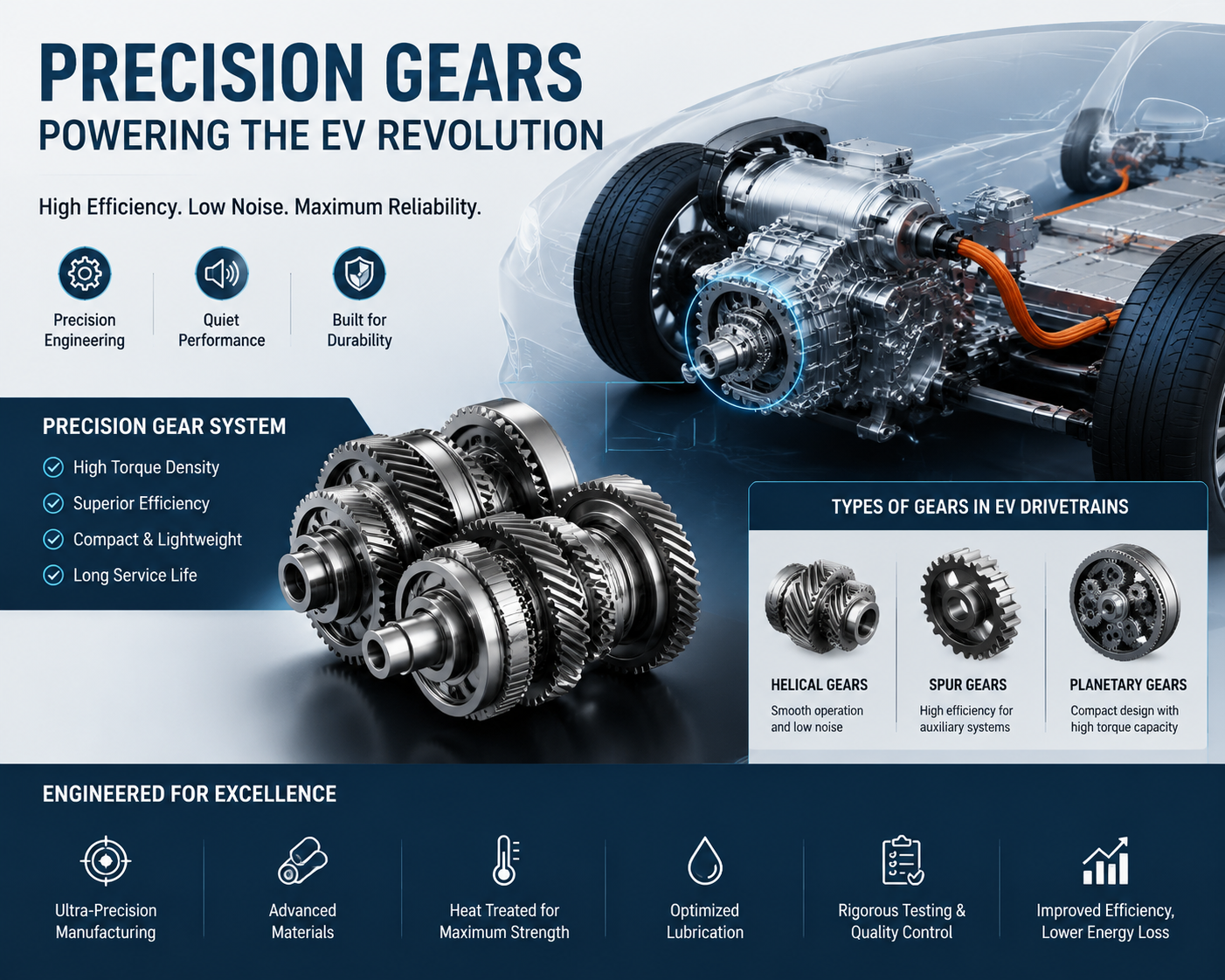
Automotive Gears Precision Engineering in EV Era
1. Introduction to Automotive Gears in EV Era
Evolution from ICE to EV drivetrain architecture
The transition from internal combustion engine platforms to electric vehicle architectures has rewritten the rulebook of drivetrain engineering in a way that feels almost like a tectonic shift. Traditional multi-speed transmissions, once the backbone of automotive motion control, are being replaced by far leaner and more deterministic reduction systems that prioritize efficiency over mechanical complexity. In this new landscape, gears are no longer just torque transmitters—they are precision energy regulators operating under far more unforgiving electrical dynamics.
Why precision gears are critical in electric mobility
Electric drivetrains deliver instantaneous torque, which sounds great on paper, but in practice it places brutal stress on gear meshing surfaces and contact patterns. Any deviation in tooth geometry or microfinish can snowball into NVH issues, efficiency loss, or premature fatigue failure. In short, precision is not a luxury anymore—it is the baseline survival requirement, no joke.
Key procurement priorities for global OEM buyers
For procurement professionals, the game has shifted toward ultra-tight tolerances, repeatability assurance, and long-term supplier stability under high-volume EV demand. Cost still matters, but consistency and traceability now sit at the same table, often taking priority when push comes to shove. Buyers are increasingly focused on suppliers who can prove process capability rather than just price competitiveness on paper.
2. Market Demand Shift Driven by Electric Vehicles
Decline of traditional transmission complexity
With EVs eliminating multi-gear transmissions in most passenger applications, the once sprawling gearbox ecosystem has been significantly simplified. This reduction in complexity has not reduced engineering demand—instead, it has concentrated it into fewer but far more critical components. Fewer parts, higher stakes, tighter tolerances—that’s the new reality.
Rise of reduction gear systems in EVs
Reduction gear assemblies have become the unsung heroes of EV drivetrains, quietly ensuring motor output is translated into usable wheel torque. These systems operate at extremely high rotational speeds, often pushing materials and lubrication regimes to their limits. In this space, there is zero room for sloppy machining or inconsistent heat treatment cycles.
Supply chain pressure on high-precision components
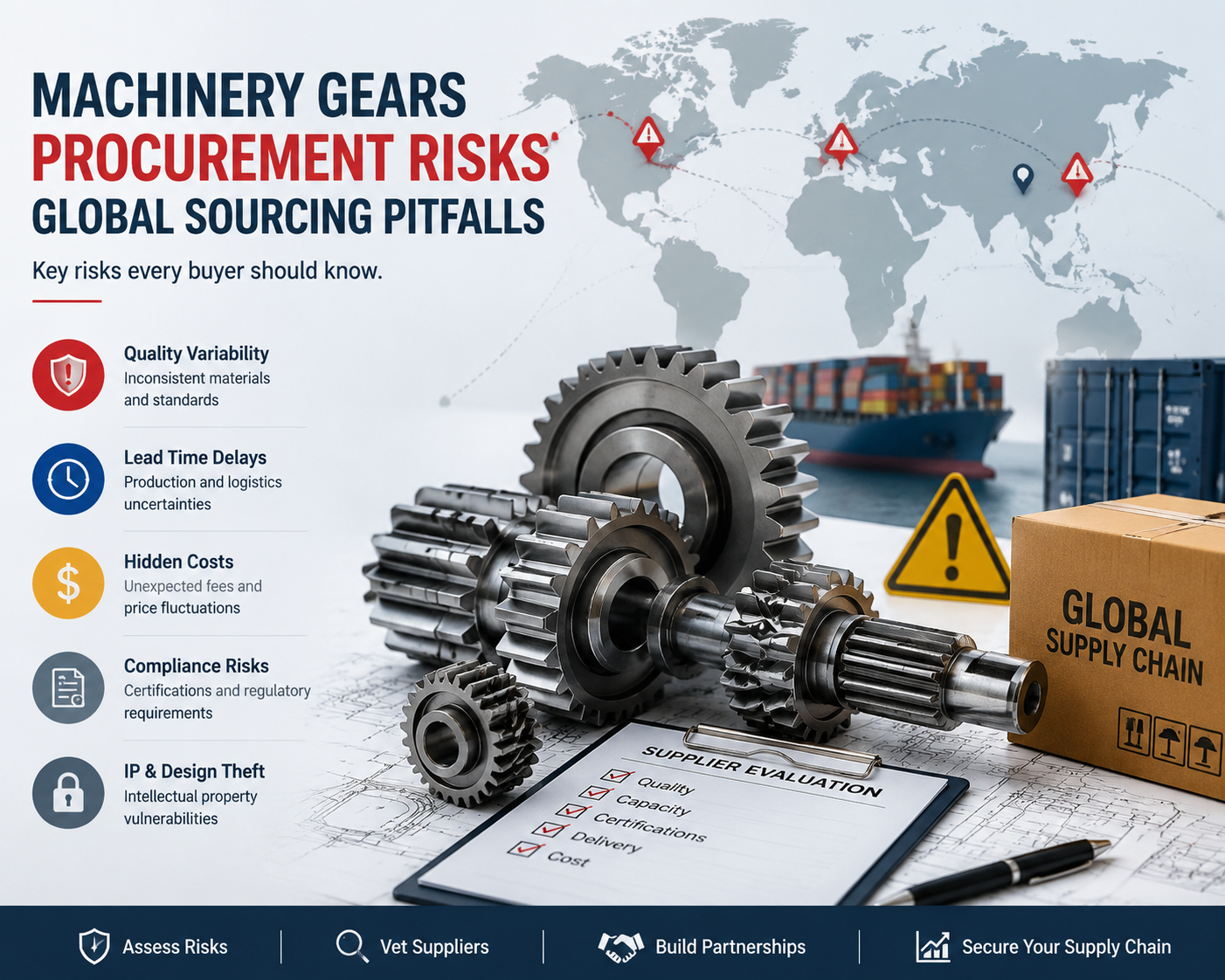
The EV boom has created a bottleneck effect where precision gear suppliers are suddenly treated like strategic assets rather than commodity vendors. Lead times are tightening, qualification requirements are increasing, and audit scrutiny is sharper than ever. It’s a high-pressure environment where only the most disciplined manufacturing ecosystems survive.
3. Fundamentals of Automotive Gear Precision Engineering
Gear geometry and dimensional accuracy basics
At the core of gear performance lies geometry—module consistency, pressure angle stability, and involute profile accuracy all working in concert. Even microscopic deviations can disrupt load distribution across the tooth face, creating hotspots that accelerate wear. Precision engineering here is less about machining and more about controlling microscopic reality.
Tolerance requirements in high-speed EV systems
EV gears often operate at rotational speeds that would make traditional ICE engineers raise an eyebrow. At these speeds, tolerance bands shrink dramatically, and what used to be acceptable in microns becomes unacceptable in real-world operation. It is a world where “close enough” simply does not exist anymore.
Surface finish and its impact on efficiency
Surface finish plays a surprisingly outsized role in reducing frictional losses and maintaining lubrication film stability. A poorly finished gear tooth surface can act like sandpaper under high-speed conditions, quietly draining efficiency. In contrast, ultra-fine finishing techniques help gears glide like they are running on invisible rails.
4. Types of Gears Used in EV Applications
Helical gears in EV reduction units
Helical gears dominate EV reduction systems thanks to their smooth engagement and superior load distribution characteristics. The angled tooth profile allows gradual meshing, reducing shock loads and improving NVH performance. They are essentially the “quiet operators” of the EV gear world. Reference: Helical Gear
Spur gears in auxiliary systems
Spur gears still hold relevance in auxiliary subsystems where simplicity and cost-effectiveness outweigh acoustic concerns. They are easier to manufacture and inspect, making them ideal for secondary mechanical functions. However, under high-speed conditions, their noise signature can become noticeable if not properly managed.
Planetary gears for compact torque density
Planetary gear systems are the heavy hitters when it comes to torque density in compact packaging environments. Their load-sharing architecture allows high torque transmission without excessive footprint expansion. In EVs where space is gold, planetary systems are basically the MVPs. Reference: Planetary Gear Train
5. EV Drivetrain Architecture and Gear Role
Single-speed reduction gearbox design
Most EVs rely on single-speed reduction gearboxes that eliminate the need for multi-gear shifting mechanisms. This simplifies mechanical architecture while still achieving optimal motor speed-to-wheel speed conversion. It’s elegant, efficient, and brutally effective.
Integration with electric motor output shafts
Direct coupling between motor shafts and gear input stages demands extreme alignment precision. Any misalignment introduces vibration signatures that can propagate through the entire drivetrain. Think of it as high-speed choreography where every micron matters.
Torque transfer efficiency considerations
Efficiency in torque transfer is directly tied to meshing quality, lubrication stability, and material resilience. Even minor inefficiencies get amplified at high RPMs, resulting in measurable energy losses. In EV terms, every fraction of a percent counts like gold dust.
6. Material Selection for High-Performance Gears
Alloy steels for fatigue resistance
High-performance alloy steels remain the backbone of EV gear manufacturing due to their exceptional fatigue endurance. Elements like chromium and molybdenum enhance hardness while maintaining structural integrity under cyclic loading. These materials are the workhorses that keep everything running without drama.
Case hardening vs through hardening options
Case hardening provides a hardened outer shell while preserving a ductile core, making it ideal for impact resistance scenarios. Through hardening, on the other hand, offers uniform hardness throughout the material but can sacrifice toughness. Choosing between them is a balancing act that depends heavily on application stress profiles.
Lightweight materials for efficiency optimization
Aluminum-based alloys and hybrid composites are gradually entering experimental gear applications to reduce rotational inertia. While they offer weight advantages, their wear resistance still requires careful engineering mitigation. It’s a classic trade-off between efficiency gains and durability assurance.
7. Heat Treatment and Hardening Processes
Carburizing and induction hardening methods
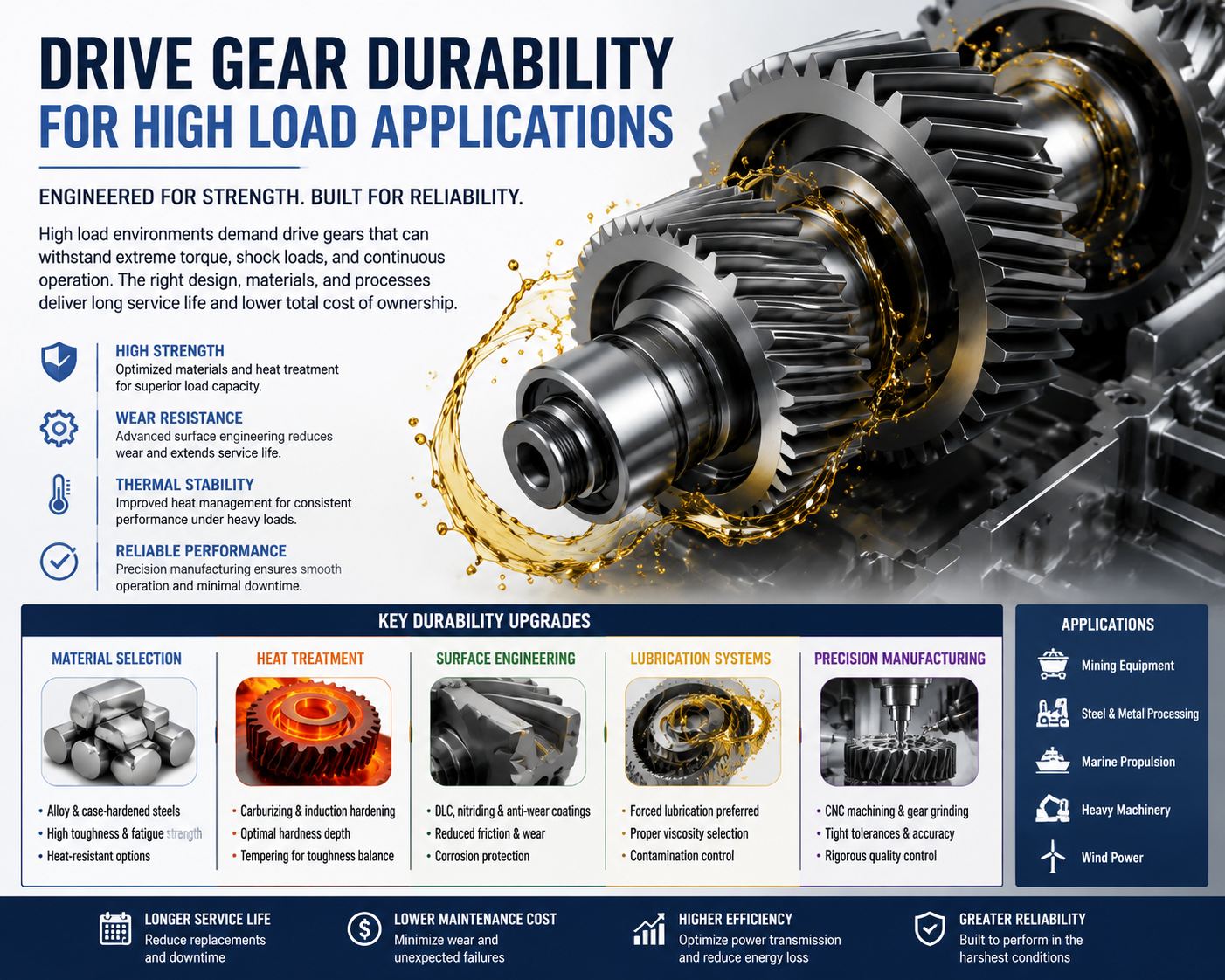
Carburizing infuses carbon into the surface layer, creating a hardened exterior capable of resisting wear. Induction hardening, meanwhile, uses electromagnetic heating for localized surface strengthening. Both processes are essential tools in the modern gear engineer’s arsenal.
Distortion control during heat treatment
Heat treatment inevitably introduces distortion risks due to thermal gradients and phase transformations. Precision fixturing and controlled cooling cycles are used to minimize dimensional drift. Without proper control, even perfectly machined gears can turn into rejects.
Impact on wear resistance and lifespan
Proper heat treatment dramatically extends operational lifespan by improving surface hardness and fatigue resistance. Poorly executed processes, however, can lead to premature pitting and catastrophic failure. In gear engineering, heat treatment is basically where destiny gets decided.
8. Precision Manufacturing Techniques
CNC gear shaping and hobbing processes
CNC hobbing and shaping remain foundational processes in gear production, offering repeatable accuracy at scale. These methods allow controlled tooth generation with high consistency across batches. When dialed in correctly, they are production workhorses that just don’t quit.
Grinding for ultra-fine accuracy requirements
Gear grinding is the final refinement stage where micron-level precision is achieved. It eliminates minor deviations left by earlier machining stages and enhances surface finish. This is where gears go from good to aerospace-level precise.
Advanced machining for micro-tolerances
Ultra-precision machining techniques are increasingly used for EV applications requiring extreme consistency. These methods often involve multi-axis CNC systems with real-time feedback control. It’s high-tech manufacturing at its finest, no cutting corners allowed.
9. Gear Noise, Vibration, and Harshness (NVH) Control
Tooth profile optimization for quiet operation
Optimized tooth profiles help distribute load smoothly and reduce impact noise during meshing. Slight modifications like tip relief and crowning can dramatically improve acoustic performance. In EVs, silence is not just comfort—it’s expectation.
Surface microgeometry adjustments
Microgeometry tuning allows engineers to fine-tune contact patterns at a microscopic level. These adjustments help stabilize lubrication films and reduce vibration spikes. It’s precision engineering that feels almost surgical in execution.
Balancing performance vs acoustic comfort
There is always a trade-off between maximum load capacity and acoustic refinement. Over-optimizing for strength alone can lead to noisy operation, which EV customers will not tolerate. The real art lies in striking a balance that satisfies both physics and passenger expectations.
10. Lubrication Requirements in EV Gear Systems
Low-viscosity lubricants for efficiency gains
Low-viscosity oils reduce drag losses and improve overall drivetrain efficiency. However, they require carefully engineered additive packages to maintain protective film strength. It’s a delicate balancing act between efficiency and protection.
Thermal management under high-speed rotation
High-speed gear systems generate significant thermal loads that must be dissipated effectively. Poor thermal control can degrade lubricant properties and accelerate wear. In EV systems, heat is the silent enemy that never sleeps.
Long-life lubrication strategies for sealed systems
Sealed drivetrain architectures demand lubricants capable of long service intervals without degradation. Synthetic formulations are commonly used to ensure stability over extended cycles. Once sealed, these systems are expected to run for years without complaint.
11. Quality Standards and Testing Methods
ISO and automotive industry compliance benchmarks
Compliance with ISO standards ensures baseline quality and global interoperability. Automotive OEMs often impose even stricter internal standards on top of these requirements. Certification is not optional—it’s entry-level qualification. Reference: ISO Standards | Gear Standards Overview
Gear contact pattern testing techniques
Contact pattern analysis reveals how load is distributed across gear tooth surfaces. Proper alignment produces uniform contact, while deviations indicate assembly or machining issues. It’s essentially the “truth test” of gear quality.
Fatigue and endurance testing protocols
Endurance testing simulates long-term operational stress to validate gear lifespan. Components are pushed to failure thresholds under controlled conditions. If it survives here, it survives almost anywhere.
12. Supplier Selection Criteria for OEM Procurement
Production capability and precision consistency
Suppliers must demonstrate stable production capability across large batch volumes without quality drift. Repeatability is more valuable than occasional perfection. Consistency is king in OEM procurement decisions.
Certification and quality management systems
Robust quality systems like IATF 16949 are often mandatory for automotive supply chains. These frameworks ensure traceability, process control, and continuous improvement. Without them, suppliers simply don’t make the cut.
Track record in automotive supply chains
A proven history with established automotive brands signals reliability and process maturity. Buyers often prioritize experience over theoretical capability. In this industry, reputation is earned in the trenches, not on paper.
13. Cost Optimization in Precision Gear Manufacturing
Balancing machining cost vs performance specs
Overengineering leads to unnecessary cost inflation, while underengineering risks failure. The sweet spot lies in optimizing specs to meet—not exceed—application needs. Smart procurement is about value engineering, not just price cutting.
Economies of scale in mass EV production
High-volume EV production enables significant cost reductions through scale efficiency. Tooling amortization and process optimization play major roles here. Scale is the silent cost killer in a good way.
Reducing scrap rate through process control
Advanced process monitoring reduces scrap rates and improves yield efficiency. Real-time feedback systems help detect deviations before they become defects. Less waste means more margin—simple math that still matters.
14. Common Manufacturing Defects and Risk Control
Gear tooth deformation and misalignment issues
Improper machining or heat treatment can lead to tooth distortion and misalignment. These defects directly impact load distribution and durability. Early detection is critical to avoid downstream failures.
Surface pitting and wear failure modes
Pitting occurs due to repeated stress cycles exceeding material fatigue limits. Once initiated, it tends to propagate rapidly under load. It is one of the most common long-term failure modes in gears.
Inspection systems for early defect detection
Advanced inspection technologies like CMM and laser scanning identify defects at early stages. Automated systems reduce human error and improve detection consistency. Catching issues early saves both time and cost.
15. EV Industry Challenges Impacting Gear Design
High-speed motor requirements and stress loads
Modern EV motors operate at extremely high rotational speeds, increasing stress on gear systems. This requires stronger materials and tighter engineering tolerances. Everything is basically running hotter, faster, and harder.
Compact packaging constraints in EV platforms
Space limitations force engineers to design smaller yet more capable gear systems. This increases design complexity and manufacturing precision requirements. It’s like fitting a powerhouse into a shoebox.
Rapid innovation cycles and design iteration pressure
EV platforms evolve quickly, forcing frequent design updates and fast validation cycles. Suppliers must adapt without sacrificing quality stability. The pace is relentless, and there’s no slow lane.
16. Future Trends in Automotive Gear Engineering
Integration of AI-driven design optimization
AI tools are increasingly used to simulate gear performance and optimize geometry. These systems reduce design cycles and improve predictive accuracy. Engineering is becoming more data-driven than ever before.
Advanced composites and hybrid materials
New material systems are emerging to reduce weight while maintaining strength. Hybrid composites offer promising performance improvements in specialized applications. The future material palette is getting more experimental.
Ultra-quiet, high-efficiency next-generation gear systems
Next-generation gear systems aim for near-silent operation with maximum efficiency. Innovations in microgeometry and lubrication science are driving this evolution. The end goal is simple: smoother, quieter, and smarter motion systems that just work.