Table of Contents
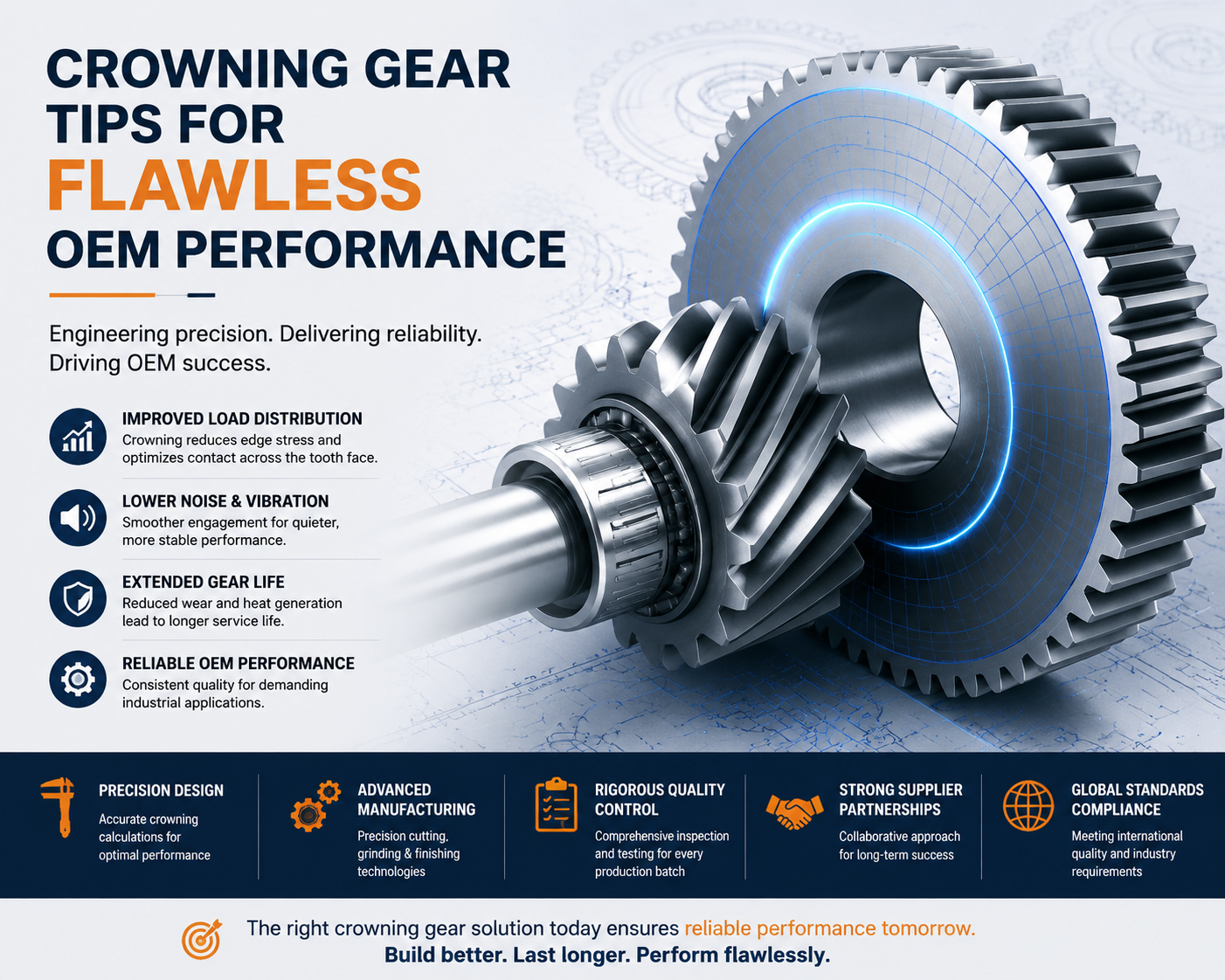
Crowning Gear Tips for Flawless OEM Performance
1. Introduction to Crowning Gear in OEM Manufacturing
1.1 What Crowning Gear Means in Industrial Applications
In modern OEM manufacturing, gear performance is rarely determined by material strength alone. The subtle geometric modifications applied to the tooth surface often become the hidden differentiator between a drivetrain that survives millions of cycles and one that quietly accumulates microfailures until it reaches an expensive point of collapse. Among those modifications, gear crowning occupies a particularly strategic position.
Crowning gear refers to the intentional creation of a slightly convex geometry across the gear tooth profile or face width. Unlike a perfectly flat contact plane, crowned teeth are designed to accommodate inevitable operational realities—shaft deflection, housing deformation, assembly tolerances, thermal expansion, and fluctuating load conditions.
At first glance, the modification appears almost paradoxical. Why deliberately alter a theoretically perfect tooth? The answer becomes obvious once real-world machinery enters the picture.
Mechanical systems do not operate inside pristine laboratory conditions. Bearings age. Frames flex. Operators push capacity limits. Installation conditions vary from region to region. Under these circumstances, ideal tooth contact becomes unattainable.
Crowning creates a controlled deviation that allows gears to remain tolerant under imperfect alignment.
From an engineering standpoint, crowning serves as a stress redistribution mechanism. Rather than concentrating force at the edge of a tooth—which often becomes the birthplace of pitting, scuffing, and premature fatigue—the contact pattern migrates toward the center where loads are managed more uniformly.
For procurement professionals, this translates into measurable business outcomes: lower warranty claims, reduced field service interventions, longer maintenance intervals, improved customer satisfaction, and greater supply chain reliability.
Experienced buyers often say: "Cheap gears cost twice." The saying survives because it repeatedly proves true. Selecting gears solely based on nominal dimensions without evaluating crowning quality frequently introduces hidden lifecycle expenses that dwarf initial purchasing savings.
1.2 Why Gear Crowning Matters for OEM Quality Targets
OEM organizations live under relentless performance expectations. Customers expect machinery to operate quietly, efficiently, and continuously while meeting increasingly aggressive durability targets. Every component therefore becomes part of a larger quality architecture.
Gear crowning directly contributes to achieving these objectives. One of the largest causes of transmission failure originates from uneven tooth engagement. Even micron-level misalignment can escalate local pressure dramatically, initiating wear mechanisms that spread across the drivetrain.
Proper crowning mitigates this risk. By concentrating initial contact near the center of the tooth and allowing progressive load sharing during operation, crowned gears reduce sensitivity to manufacturing variation.
For OEM quality managers, several metrics improve: lower failure rates, improved MTBF, reduced warranty exposure, greater assembly consistency, lower rejection rates, and improved equipment uptime. There is also an important commercial dimension: global customers increasingly evaluate suppliers not simply by component price but by lifecycle economics.
A procurement engineer evaluating crowned gears today may ask: How stable is the tooth modification process? Is measurement automated? Is contact pattern validation documented? Are production batches statistically monitored? These questions reflect a shift from transactional sourcing toward strategic sourcing. The objective is straightforward: Buy performance, not merely hardware.
1.3 Common Procurement and Engineering Challenges
Despite its advantages, crowning implementation is rarely straightforward. Mechanical engineers and purchasing teams often encounter competing objectives that create practical tension throughout sourcing and development.
Challenge 1: Balancing Cost and Precision
High-precision crowning requires advanced grinding systems, inspection equipment, and experienced process control. The temptation to reduce specifications in pursuit of lower costs can create downstream failures. Procurement teams constantly walk the tightrope between budget discipline and technical integrity.
Challenge 2: Translating Functional Requirements Into Specifications
Engineering teams frequently describe needs using operational language: reduce vibration, increase service life, improve transmission smoothness. Suppliers, however, manufacture from drawings and tolerances. Bridging this translation gap requires detailed technical communication.
Challenge 3: Supplier Capability Transparency
Not every supplier that claims crowning capability delivers equivalent results. Questions worth investigating include: Is crowning generated during cutting or grinding? Is measurement automated? Is contact pattern validation documented? Are production batches statistically monitored? Without verification, suppliers may produce nominally compliant gears with inconsistent real-world performance.
Challenge 4: Global Supply Chain Variability
OEM buyers sourcing internationally encounter further complexity: regional manufacturing standards, variable heat-treatment consistency, different quality cultures, logistics uncertainty. This makes robust qualification procedures indispensable. At the end of the day, gears are not bought by kilogram. They are purchased by transmitted reliability. And reliability begins long before production starts—it begins during design selection and supplier evaluation.
2. Understanding the Mechanical Principles Behind Gear Crowning
2.1 Definition and Functional Purpose of Gear Crowning
Mechanically speaking, gear crowning is a deliberate geometric correction intended to improve contact conditions under load. The modification introduces a slight convexity across the active tooth surface, allowing contact to remain centralized despite deformation and positional variation.
The functional objectives include compensating for shaft deflection, reducing edge loading, improving fatigue resistance, enhancing lubrication behavior, and increasing operational tolerance. The amount of crowning is never arbitrary. Too little produces negligible benefit. Too much reduces contact area and accelerates pressure buildup. Successful crowning therefore operates inside a carefully engineered equilibrium.
2.2 How Load Distribution Improves with Crowning
Gear loading behaves similarly to structural stress concentration. When surfaces contact unevenly, forces accumulate locally. Without crowning: Load → Edge Concentration → Elevated Stress → Surface Damage. With optimized crowning: Load → Distributed Contact → Lower Stress → Extended Life.
The improvement becomes particularly evident in heavy-duty OEM equipment where minor shaft displacement becomes unavoidable. Finite element simulations consistently demonstrate smoother pressure gradients across crowned tooth surfaces. That translates into tangible advantages: lower localized fatigue, reduced thermal generation, improved lubrication retention, and better shock absorption.
In practical engineering language: The gear stops fighting itself.
2.3 Relationship Between Tooth Geometry and Performance
Gear geometry governs behavior far beyond simple motion transfer. Even minute alterations influence noise signatures, efficiency curves, load capacity, wear progression, and dynamic stability. Crowning changes how engagement evolves through the mesh cycle. Rather than abrupt loading transitions, crowned gears encourage gradual force transfer, creating smoother operation and reducing excitation frequencies that generate vibration.
For OEM engineers pursuing premium equipment positioning, these seemingly microscopic modifications frequently create macroscopic competitive advantages. Learn more about gear geometry on Wikipedia.
3. Why Global OEM Buyers Prioritize Crowning Quality
3.1 Reducing Warranty and Service Costs
Warranty expenditure is one of the least forgiving metrics in OEM operations because it compresses margins long after revenue has already been booked. A transmission component that appears economical during sourcing can become disproportionately expensive after deployment if reliability assumptions fail under actual operating conditions.
Crowned gears are increasingly specified because they act as a preventative engineering measure rather than a corrective maintenance expense. When tooth contact remains centralized and stress concentrations are minimized, common failure modes become less frequent: tooth pitting, surface scuffing, microcracking, edge wear, noise escalation, and premature bearing degradation.
Each avoided failure represents more than a replaced component: fewer service visits, reduced logistics expense, lower labor consumption, improved customer retention, greater field confidence.
3.2 Extending Product Lifecycle Expectations
Modern industrial customers expect machinery to remain productive for years under increasingly severe operating conditions. Customers no longer ask how long a machine will last—they ask how long it will maintain performance. Crowning contributes directly to sustaining performance consistency by reducing cumulative surface damage and slowing the degradation mechanisms that gradually erode transmission efficiency.
3.3 Supporting Consistent Global Market Standards
OEM brands serving international markets must accommodate diverse operating environments such as tropical climates, high-altitude regions, dust-intensive facilities, variable maintenance practices, and differing operator skill levels. Crowned gears provide additional operational latitude and consistency, particularly in regions where service access is limited.
Explore global gear standards on ITU-T.
4. Types of Crowning Gear Profiles and Their Applications
4.1 Longitudinal Crowning
Longitudinal crowning modifies the tooth surface along the face width, creating a convex curvature from root to tip. This method is particularly effective in compensating for misalignment due to shaft deflection or bearing flexibility. Longitudinally crowned gears distribute load more evenly along the tooth face, reducing edge stress and improving noise and vibration characteristics in high-torque applications.
4.2 Profile Crowning
Profile crowning adjusts the curvature along the involute profile of the tooth, affecting how the teeth engage during rotation. It helps to prevent localized contact stresses and mitigates the risk of tooth flank pitting and surface fatigue. This type of crowning is commonly applied in automotive transmissions and high-precision machinery, ensuring consistent engagement under dynamic loads.
4.3 Combined Crowning Approaches
Some applications benefit from combining longitudinal and profile crowning to address both face-width and profile irregularities. This hybrid approach provides superior load distribution and vibration reduction, especially in heavy-duty industrial machinery and high-speed gear systems. The combined method requires advanced manufacturing techniques and precise quality control to ensure repeatable performance.
5. Key Performance Benefits of Proper Gear Crowning
5.1 Lower Contact Stress Across Tooth Surfaces
Proper crowning reduces contact stress peaks along the tooth surface, preventing early fatigue and surface failure. By distributing the load more evenly, crowned gears extend service life and minimize the likelihood of unexpected downtime. This contributes directly to the reliability of OEM equipment and improves overall operational efficiency.
5.2 Reduced Noise and Vibration Levels
Crowning gear teeth improves mesh quality and engagement smoothness, resulting in lower noise and vibration. Reduced NVH (noise, vibration, harshness) enhances operator comfort, lowers acoustic stress on surrounding structures, and meets stricter industry noise standards. This is particularly critical in automotive and robotics applications.
5.3 Improved Transmission Stability
Gears with proper crowning maintain stable tooth contact across varying loads and alignment conditions. Improved stability ensures consistent torque transfer, reduces backlash, and maintains accurate motion control. In automation and industrial machinery, this leads to precise operation, minimal wear, and enhanced system reliability.
6. Selecting the Right Gear Material for Crowned Gears
6.1 Material Strength Requirements
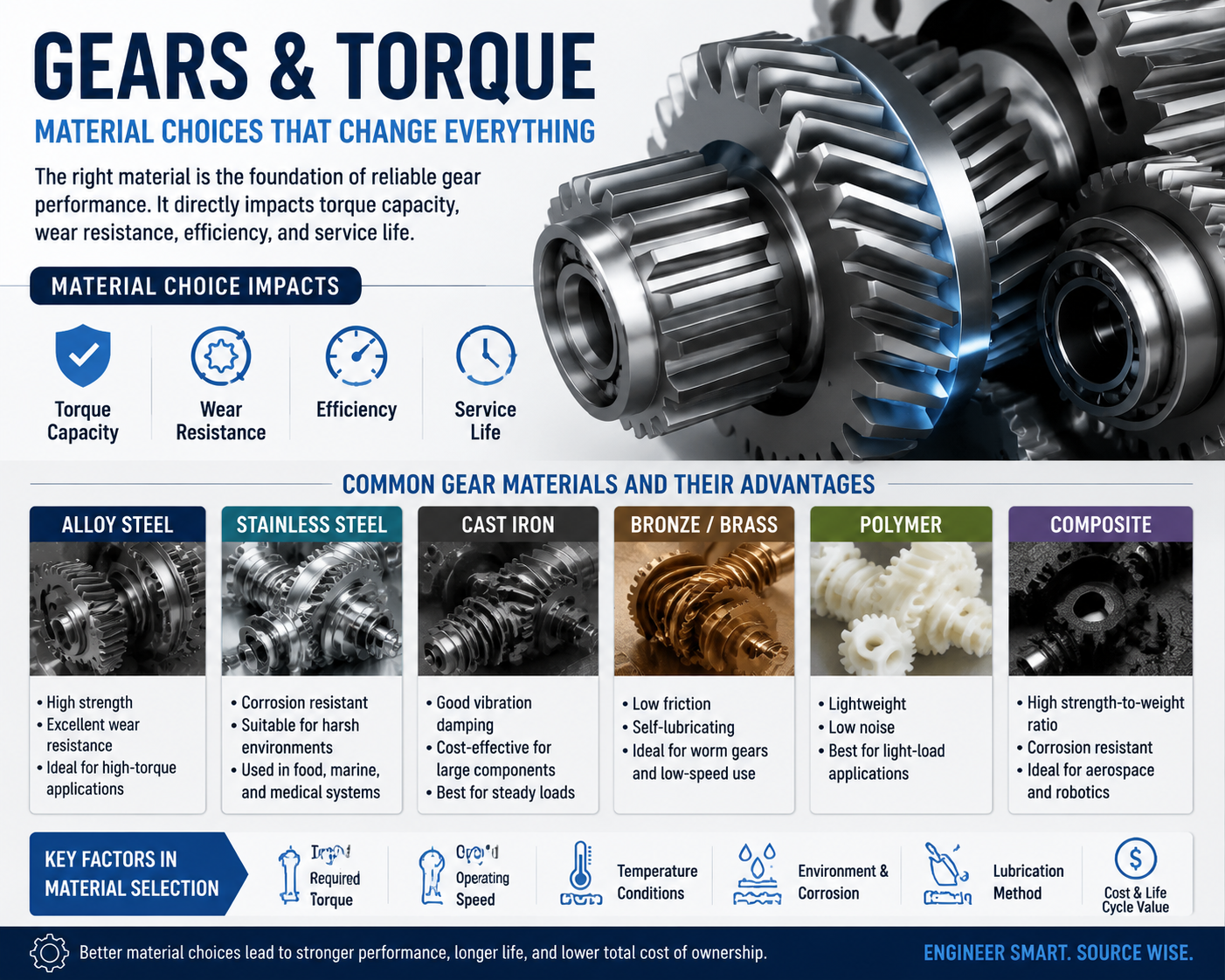
The selection of appropriate gear material is critical to leverage the benefits of crowning. Materials must withstand expected loads without excessive deformation or fatigue. Common choices include alloy steels, carburized steels, and specialty hardened materials that offer high tensile strength, wear resistance, and toughness suitable for OEM applications.
6.2 Heat Treatment Considerations
Heat treatment processes, such as carburizing, quenching, and tempering, enhance surface hardness and core toughness. Correct treatment ensures the material retains its designed crown geometry and can handle operational stresses. Improper heat treatment may lead to warping, residual stresses, or microcracks that compromise performance.
6.3 Cost Versus Performance Evaluation
Procurement engineers must balance material cost with performance expectations. While high-strength alloys and advanced treatments increase production cost, they reduce total lifecycle costs by minimizing maintenance and replacements. The optimal choice requires evaluating application requirements, load conditions, and OEM reliability targets.
7. Manufacturing Processes That Influence Crowning Accuracy
7.1 Precision Gear Cutting Methods
The foundation of effective crowning begins at the cutting stage. High-precision gear cutting ensures that the initial tooth form aligns closely with design specifications before any finishing operations. Techniques include hobbing, shaping, and milling, each requiring precise control to prevent geometric drift and ensure consistent tooth modification.
7.2 Grinding and Finishing Technologies
Grinding and finishing processes define the final tooth geometry and surface quality. Form grinding, flank grinding, and lapping reduce deviations, minimize roughness, and create the required convex profile for the crown. Consistent finishing ensures predictable load distribution and reduces noise and vibration in the final assembly.
7.3 Process Stability in Mass Production
Stable manufacturing processes are essential for reproducible crowning. Machine calibration, statistical process control (SPC), and operator training maintain consistent tooth geometry across production batches. High-volume OEM production requires repeatable processes to achieve reliable gear performance and reduce the risk of field failures.
8. Critical Design Parameters Procurement Teams Should Review
8.1 Gear Module and Tooth Dimensions
Procurement teams must ensure that gear module, pressure angle, and tooth width meet design requirements. These parameters influence load distribution, engagement quality, and compatibility with the mating components. Correct dimensions maximize the benefits of crowning and improve overall transmission efficiency.
8.2 Alignment Tolerance Requirements
Even perfectly crowned gears can underperform if shafts or housings are misaligned. Specifying alignment tolerances, such as concentricity and angular deviation, ensures that gears function as intended. Proper tolerance planning prevents edge loading and premature wear, maintaining reliable operation across variable installations.
8.3 Surface Finish Specifications
Surface finish directly affects lubrication, friction, and stress distribution. Proper specifications for roughness, hardness, and surface integrity prevent micro-pitting and ensure that the crowned geometry performs as designed. Smooth surfaces also contribute to quieter operation and extended gear life.
9. Common Crowning Gear Defects and How to Prevent Them
9.1 Uneven Contact Patterns
Uneven contact arises from misaligned grinding, inconsistent feeds, or poor machine calibration. Detection requires contact pattern testing, while prevention relies on precise process control, routine inspection, and calibration to maintain consistent engagement across the tooth surface.
9.2 Excessive Material Removal
Over-grinding can reduce contact area and increase localized stress. Preventing excessive material removal requires accurate design specifications, monitored grinding operations, and validation through prototype testing. Balancing material removal ensures optimal crowning performance.
9.3 Assembly Misalignment Risks
Misaligned installation undermines the benefits of crowning. Using precise assembly jigs, alignment verification tools, and documented installation procedures minimizes risk. Procurement teams should evaluate both the gear quality and assembly process to ensure proper engagement and operational reliability.
10. How Crowning Gear Improves OEM Equipment Reliability
10.1 Minimizing Unexpected Downtime
Crowned gears reduce the risk of sudden failures caused by edge loading and surface fatigue. By maintaining proper load distribution, they help prevent unexpected downtime in critical industrial systems such as conveyors, mixers, and material handling equipment.
10.2 Improving Load Adaptability
Crowning allows gears to tolerate minor misalignments, thermal expansion, and shaft deflection. This adaptability ensures consistent torque transfer and reliable operation under variable load conditions, enhancing the overall performance of OEM equipment.
10.3 Supporting Continuous Operation Conditions
For 24/7 operations, crowned gears maintain contact consistency, reduce fatigue accumulation, and improve lubrication efficiency. These features ensure extended continuous operation, minimizing maintenance interventions and prolonging machine life.
For more technical references on gear mechanics, see Gear Solutions Magazine.
11. Supplier Evaluation Criteria for Crowning Gear Projects
11.1 Technical Capability Assessment
Selecting a crowning gear supplier is not simply a sourcing exercise—it is a risk management decision disguised as procurement.
Many suppliers can manufacture gears. Far fewer can repeatedly manufacture crowned gears with predictable microgeometry, validated contact behavior, and long-term dimensional consistency.
Technical capability assessment should therefore extend well beyond catalog specifications.
Evaluation areas should include:
- Gear design expertise
- Crowning calculation capability
- Tooth modification simulation methods
- Application engineering support
- Gear cutting equipment level
- Grinding technology sophistication
- Measurement systems
- Heat treatment integration
- Contact analysis
- Durability testing
- Noise evaluation
- Load verification procedures
One practical rule used by experienced sourcing teams is straightforward:
Ask suppliers how they measure crowning—not how they create it.
Production equipment can be purchased. Process understanding must be developed.
11.2 Quality Management Systems Review
Quality systems determine whether excellent samples become repeatable production.
Procurement teams should investigate how suppliers control variation throughout manufacturing.
- Incoming material certification
- Chemical composition verification
- Traceability procedures
- Statistical control plans
- Tool wear monitoring
- Process approval checkpoints
- Dimensional validation
- Contact inspection
- Surface integrity review
Strong suppliers do not rely on end-of-line sorting. They design quality into the process itself.
Useful questions include:
- What process capability targets are maintained?
- How frequently are calibration routines performed?
- What corrective action process exists?
- How is batch consistency demonstrated?
11.3 Production Capacity and Delivery Stability
Even technically capable suppliers may struggle when production scales.
OEM operations require predictability.
Areas for evaluation include:
- Available machine hours
- Expansion capability
- Multi-line flexibility
- Material sourcing stability
- Heat-treatment capacity
- Secondary processing redundancy
- Historical on-time metrics
- Inventory strategy
- Lead time responsiveness
Production instability creates hidden costs including line interruptions, excess inventory, expedited logistics, and customer dissatisfaction.
12. Quality Inspection Standards for Crowned Gears
12.1 Dimensional Verification Methods
Inspection validates whether the manufactured gear reflects design intent.
For crowned gears, dimensional verification becomes more complex because controlled deviation is intentionally introduced.
Common methods include:
- Coordinate measurement systems
- Dedicated gear measurement centers
- Optical inspection systems
Critical dimensions commonly reviewed:
- Crown height
- Tooth thickness
- Runout
- Profile deviation
- Face alignment
Learn more about coordinate metrology: National Institute of Standards and Technology (NIST).
12.2 Gear Contact Pattern Testing
Contact pattern testing remains one of the most revealing validation tools.
The objective is simple: determine where load actually transfers.
Typical procedures involve:
- Controlled rotation under load
- Marking compounds
- Digital contact analysis
- Pattern comparison
Ideal patterns generally exhibit centralized engagement, balanced load spread, and smooth transition zones.
12.3 Performance Validation Procedures
Validation extends beyond measurement.
High-performing OEM suppliers verify behavior under operating conditions.
- Durability testing
- Thermal validation
- Noise and vibration testing
- Load simulation
Performance validation answers an important question:
Can the gear survive outside the inspection room?
13. Cost Optimization Strategies Without Sacrificing Quality
13.1 Balancing Precision and Manufacturing Cost
Every procurement project eventually arrives at a familiar challenge:
How much precision is enough?
Effective optimization requires evaluating:
- Functional requirements
- Operating conditions
- Failure consequences
- Production volume
Not every application requires aerospace-level tolerances, but every application requires sufficient engineering margin.
13.2 Design for Manufacturability Principles
Design decisions strongly influence cost.
Gear designs optimized for manufacturability generally provide:
- Shorter lead times
- Higher repeatability
- Lower rejection rates
- Reduced production complexity
Additional reading: American Society of Mechanical Engineers (ASME).
13.3 Long-Term Total Cost of Ownership Analysis
Unit price rarely reflects actual equipment cost.
Procurement evaluations should include:
- Initial cost
- Installation
- Maintenance
- Downtime
- Replacement
- Service support
An inexpensive gear replaced repeatedly becomes expensive surprisingly fast.
14. Crowning Gear Applications Across Key Industries
14.1 Industrial Machinery Systems
Industrial machinery operates under continuous load and demanding productivity expectations.
Crowned gears improve reliability, shock tolerance, load distribution, and service intervals.
- Conveyors
- Mixers
- Packaging lines
- Compressors
- Material handling systems
14.2 Automotive Transmission Components
Automotive systems demand compact packaging, low noise, high efficiency, and long service life.
Crowned gears improve:
- NVH performance
- Shifting smoothness
- Fatigue resistance
- Efficiency
14.3 Robotics and Automation Equipment
Automation systems require positional accuracy, smooth motion, and repeatable dynamics.
Crowned gears contribute through:
- Reduced backlash sensitivity
- Stable engagement behavior
- Lower vibration transmission
- Improved motion consistency
15. OEM and ODM Collaboration Best Practices
15.1 Aligning Technical Specifications Early
Successful crowning gear programs begin in conversations before production starts.
- Torque capacity
- Operating speed
- Load spectrum
- Lifecycle expectations
- Crowning values
- Surface requirements
Specifications should communicate performance intent—not merely dimensions.
15.2 Managing Prototype and Validation Cycles
Validation stages should progress systematically:
Concept Validation → Prototype Verification → Pilot Production → Mass Production
Each stage should evaluate mechanical performance, manufacturing feasibility, and commercial viability.
15.3 Building Long-Term Supply Partnerships
Strategic partnerships enable:
- Continuous improvement
- Forecast planning
- Technical collaboration
- Performance reviews
16. Common Mistakes Buyers Make When Sourcing Crowned Gears
16.1 Choosing Based on Unit Price Alone
Lower purchase prices frequently mask hidden operational costs including higher defects and shorter service life.
16.2 Ignoring Manufacturing Repeatability
Repeatability transforms engineering theory into industrial reality.
16.3 Overlooking Inspection Documentation
Inspection documents should include:
- Material certificates
- Heat treatment reports
- Inspection records
- Traceability reports
17. Future Trends in Crowning Gear Manufacturing
17.1 Digital Quality Control Systems
Modern gear manufacturing increasingly integrates:
- Inline measurement
- Automated data collection
- Real-time deviation alerts
- Closed-loop correction
17.2 Smart Manufacturing and Automation
Smart factories combine machines, sensors, analytics, and process intelligence to improve repeatability and throughput.
17.3 Advanced Surface Engineering Technologies
Emerging technologies include:
- Advanced nitriding
- Residual stress engineering
- Precision superfinishing
- Hybrid surface treatments
Reference: Surface Engineering Research.
18. Procurement Checklist for Achieving Flawless OEM Performance
18.1 Essential Technical Questions for Suppliers
- How is crowning determined?
- What assumptions support the design?
- How is repeatability maintained?
- What testing validates performance?
18.2 Verification Documents Before Approval
- Drawings
- Validation reports
- Inspection evidence
- Capacity confirmation
18.3 Final Decision Framework for Global Buyers
| Category | Weight |
|---|---|
| Technical Capability | 30% |
| Quality Performance | 25% |
| Manufacturing Stability | 20% |
| Commercial Competitiveness | 15% |
| Service Support | 10% |
19. Conclusion
19.1 Key Takeaways for Procurement Professionals
Crowning gear is a strategic engineering adjustment that directly influences reliability, durability, lifecycle cost, and customer satisfaction.
19.2 Building Competitive Advantage Through Gear Quality
Organizations that invest in supplier qualification and process validation often achieve lower failure rates and greater operational efficiency.
19.3 Next Steps for Successful OEM Sourcing
- Define operational requirements
- Align engineering and procurement
- Validate manufacturing capability
- Verify inspection discipline
- Evaluate total ownership cost
Crowning gear may represent only a small modification in geometry, but small geometric decisions often create very large business outcomes.