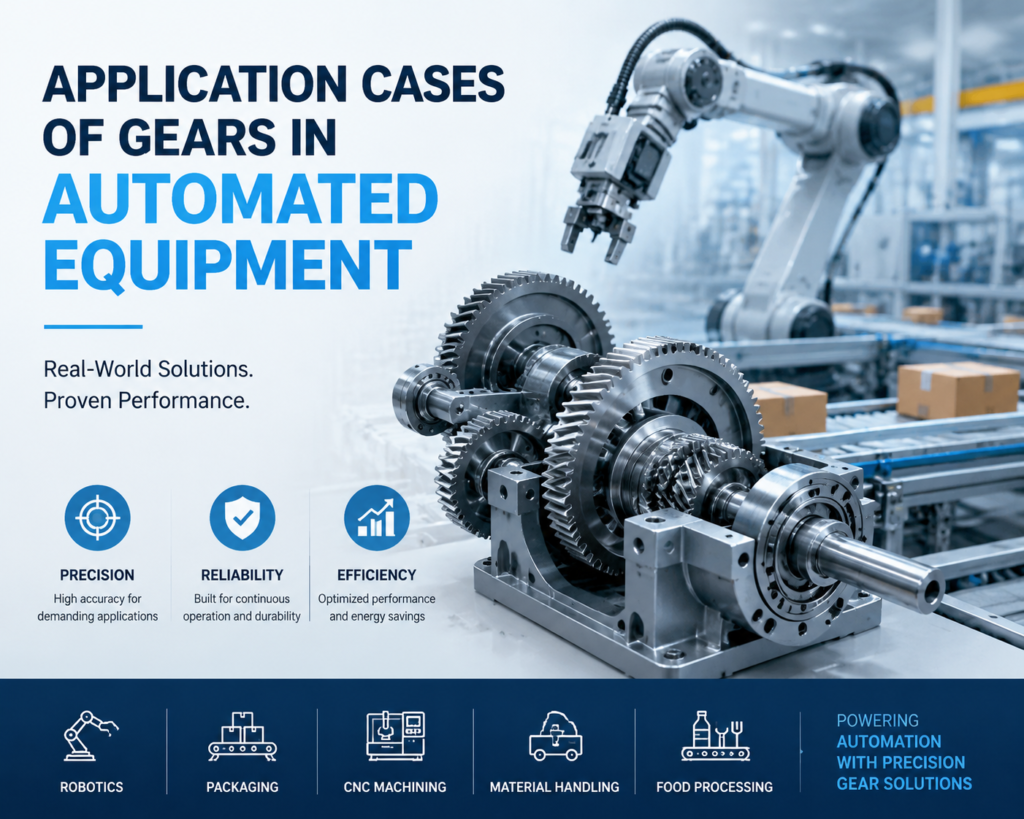
Application Cases of Gears in Automated Equipment
1. Introduction to Gears in Automated Equipment
1.1 Importance of gears in industrial automation
Gears form the skeletal framework of automated equipment, converting motor rotations into precise, controlled mechanical outputs. In industrial settings, their role extends far beyond simple torque transfer—they dictate speed modulation, positional accuracy, and load distribution. Skipping a proper gear selection can cascade into misalignments, premature wear, and catastrophic downtime, making them as crucial to machinery as a heart is to a human body.
1.2 Overview of automated equipment applications
From robotic assembly arms in automotive plants to high-speed packaging lines, automated equipment relies on the seamless orchestration of multiple components. Gears are the unsung heroes behind conveyors, CNC machines, material handling robots, and even food processing units. Their ability to transform rotational motion, shift torque, and maintain synchronized movement enables a level of precision that manual processes simply can’t replicate.
1.3 Purpose of sharing real-world case studies
While theoretical models and specifications are invaluable, real-world applications offer the most compelling insights. Case studies illuminate practical challenges like load surges, misalignment under repeated cycles, and the subtle interplay between gear materials, lubrication, and operational environment. Sharing these experiences provides engineers and procurement specialists with actionable intelligence that textbooks often overlook.
2. Types of Gears Commonly Used in Automation
2.1 Spur gears and their industrial applications
Spur gears, with their straight-cut teeth, are the workhorses of low-speed, high-load automation. They excel in linear motion transfer and are ubiquitous in conveyors, actuators, and simple gearboxes. Their straightforward geometry facilitates manufacturing and inspection, but their high tooth impact at engagement can lead to noise, requiring engineers to balance cost, durability, and acoustic performance.
2.2 Helical gears for high-speed automation
Helical gears are the go-to when smooth, high-speed operation is non-negotiable. The angled teeth engage gradually, reducing vibration and distributing load across multiple teeth. They’re commonly found in precision machinery, spindle drives, and industrial robots where every micron of deviation can affect throughput. The downside—axial thrust—requires careful housing and bearing selection.
2.3 Bevel and worm gears for directional motion
Bevel and worm gears enable angular and perpendicular motion transmission, essential in robotic wrists, conveyor deflections, and compact drive systems. Worm gears provide a unique self-locking capability, making them ideal for vertical lifting mechanisms where unintentional reverse motion could be catastrophic. Engineers must weigh efficiency losses in worm drives against their spatial advantages and load-holding capacity.
3. Key Benefits of Using Gears in Automated Equipment
3.1 Precision and efficiency improvements
Gears translate motor rotations into repeatable, quantifiable movement with minimal backlash when correctly designed. In automated equipment, this precision translates directly into fewer defects, consistent cycle times, and reduced scrap. Efficiency gains are compounded in multi-stage gear systems, where each reduction or amplification is fine-tuned to optimize power transfer.
3.2 Durability and maintenance advantages
High-quality gears fabricated from alloy steels or treated with surface-hardening processes offer exceptional wear resistance. Properly designed gear trains withstand cyclical loading for millions of rotations without requiring frequent intervention. This longevity reduces downtime, lowers maintenance costs, and improves overall equipment effectiveness (OEE)—a metric every plant manager obsesses over.
3.3 Energy savings and performance optimization
By optimizing gear ratios and material selection, engineers can minimize frictional losses and parasitic energy consumption. In high-speed conveyors or robotic actuators, even a small efficiency improvement translates to substantial energy savings over operational lifespans. Modern lubrication and coating technologies further amplify performance, enabling machines to run faster, smoother, and cooler.
4. Gear Material Selection for Automation
4.1 Steel vs. alloy options
Carbon steel remains the baseline for many industrial gears, prized for its tensile strength and machinability. Alloy steels, often containing chromium, molybdenum, or nickel, offer superior fatigue resistance and hardness, critical in high-load automated environments. Selecting the right steel grade requires balancing cost, anticipated torque, and environmental conditions such as temperature and corrosion risk.
4.2 Plastic and composite gears for lightweight applications
Engineering plastics, like acetal or PEEK, are increasingly favored in applications demanding low weight, minimal noise, and corrosion resistance. Composite materials can reduce inertia, improve cycle response, and extend service life when lubricants might be impractical. However, they’re generally limited to moderate torque applications due to lower mechanical strength.
4.3 Surface treatments and coatings
Hardening techniques such as carburizing, nitriding, and induction hardening can dramatically extend gear longevity. Coatings like PTFE or DLC reduce friction, improve efficiency, and allow operation in harsh environments without compromising performance. In automation, these treatments often make the difference between weekly maintenance and uninterrupted operation for years.
5. Gear Design Considerations in Automated Systems
5.1 Load capacity and torque requirements
Every gear must be engineered to handle expected torque peaks without plastic deformation. Overloading can trigger tooth bending, pitting, or catastrophic failure. Engineers leverage finite element analysis (FEA) to predict stress distribution and design teeth profiles capable of sustaining both continuous and shock loads.
5.2 Space constraints and compact design
Automated systems often operate in tight envelopes, necessitating compact gear trains. Inline and planetary configurations optimize spatial utilization while maintaining mechanical advantage. Achieving compactness without sacrificing performance is a balancing act involving gear ratio selection, tooth profile optimization, and housing design.
5.3 Noise reduction and vibration control
Gear engagement generates inevitable noise and vibration. Engineers mitigate this through helix angle optimization, profile shifting, and damping materials. In sensitive environments like semiconductor fabrication or laboratory automation, these considerations can influence gear selection as much as load capacity or speed.
6. Case Study: Automotive Assembly Robots
6.1 Gear mechanisms used in robotic arms
Industrial robots employ harmonic drives, planetary gears, and spur reductions in different axes. These gear systems enable multi-axis articulation with sub-millimeter accuracy, crucial for welding, painting, or component assembly.
6.2 Enhancing precision in assembly tasks
Minimized backlash and optimized tooth engagement translate to precise pick-and-place operations. This precision reduces rework, enhances product consistency, and allows higher throughput without sacrificing quality.
6.3 Maintenance and lifespan improvements
Through predictive lubrication schedules and load monitoring, gear wear can be minimized. Integrating high-hardness steel and surface treatments prolongs the operational lifespan of robotic joints, avoiding costly unplanned downtime.
7. Case Study: Packaging and Conveyor Systems
7.1 Gear-driven conveyor designs
Conveyor systems use helical and spur gears to drive belts and rollers. Proper gear alignment ensures smooth material flow, reducing jams and uneven wear.
7.2 Synchronization and speed control
Multiple conveyors in series require precise gear ratio coordination. Misalignment or improper ratios can disrupt throughput and lead to operational bottlenecks.
7.3 Reducing downtime through gear reliability
Robust gears combined with condition monitoring sensors minimize unplanned shutdowns. Lubrication management and wear-resistant materials are key to sustaining 24/7 operation.
8. Case Study: CNC and Machining Automation
8.1 Gears in spindle drives and axis control
Precision spur and helical gears transfer torque to spindles and linear axes, enabling micron-level cuts in metalworking applications.
8.2 Enhancing accuracy in metal cutting
Backlash reduction techniques and preloaded gear systems enhance repeatability, critical when machining high-precision components.
8.3 Case examples from high-volume production lines
CNC gearboxes in automotive parts production illustrate how well-designed gear systems sustain thousands of cycles daily without significant wear, maintaining tight tolerances.
9. Case Study: Automated Material Handling
9.1 Gear systems in automated guided vehicles (AGVs)
AGVs rely on compact, high-torque gearboxes to power wheels and lift mechanisms, ensuring smooth navigation and load carriage.
9.2 Load handling and torque optimization
Gears must handle variable payloads without excessive wear or energy loss. Planetary and bevel reductions are commonly used to balance speed, torque, and space constraints.
9.3 Reducing operational errors and maintenance costs
Integrated sensors and predictive maintenance schedules allow early detection of misalignment or tooth wear, reducing unexpected breakdowns.
10. Case Study: Food Processing Automation
10.1 Hygienic gear solutions for food machinery
Stainless steel and plastic gears resist corrosion and facilitate cleaning in food environments, meeting stringent hygiene standards.
10.2 Durability under high-speed operation
High-speed mixers and conveyors require gears that sustain cyclic loading and temperature variations without micro-cracking.
10.3 Case examples of multi-stage gear setups
Multi-stage reduction gearboxes optimize torque for heavy-duty cutters while maintaining low RPM at output shafts to preserve ingredient quality.
11. Gear Lubrication and Maintenance in Automation
11.1 Selecting the right lubricant for industrial gears
Synthetic oils, greases, and dry-film lubricants are selected based on load, speed, and temperature profiles. Proper lubrication mitigates pitting, scuffing, and thermal degradation.
11.2 Scheduled maintenance practices
Routine inspections, oil analysis, and gear alignment checks prevent failure and extend operational life.
11.3 Monitoring gear health in automated systems
Condition monitoring systems provide real-time vibration, temperature, and torque data, enabling predictive interventions.
12. Gear Failure
Analysis and Prevention
12.1 Common failure modes in automation gears
Tooth wear, pitting, scuffing, and bending fatigue are typical failure mechanisms in high-cycle industrial applications.
12.2 Root cause analysis techniques
Engineers employ metallurgical analysis, stress testing, and FEA to identify failure origins and implement corrective measures.
12.3 Design improvements to prevent failures
Optimized tooth geometry, improved material selection, and enhanced surface treatments minimize recurrence of failures.
13. Integration of Gears with Sensors and IoT
13.1 Smart gear monitoring systems
Encoders, strain gauges, and vibration sensors enable real-time performance tracking, crucial for high-value automated equipment.
13.2 Predictive maintenance using sensor data
IoT-enabled analytics anticipate gear degradation, allowing intervention before catastrophic failure occurs.
13.3 Real-world examples in automated production
Automotive assembly lines and pharmaceutical bottling plants showcase how sensor-integrated gear systems reduce downtime and enhance throughput.
14. Cost-Benefit Analysis of Gear Solutions
14.1 Initial investment vs. long-term ROI
High-quality gears may demand upfront capital but provide substantial savings via reduced maintenance, lower downtime, and extended operational life.
14.2 Comparing gear types and materials
Choosing between steel, alloy, plastic, or composite gears requires analyzing torque capacity, lifecycle costs, and operational environment.
14.3 Case examples of cost optimization
Multi-stage helical gearboxes in packaging lines often outperform single-stage steel alternatives when considering long-term energy and maintenance savings.
15. Emerging Trends in Gear Applications
15.1 High-efficiency and lightweight gear systems
Advanced materials and optimized tooth geometries reduce energy losses and weight, enhancing machine responsiveness and efficiency.
15.2 Integration with electric and hybrid drives
Gears are increasingly adapted for electric and hybrid actuation, balancing torque requirements with compact motor configurations.
15.3 Advanced manufacturing techniques for precision gears
Additive manufacturing, precision hobbing, and laser hardening improve tooth quality, reduce material waste, and enable complex geometries.
16. Conclusion and Key Takeaways
16.1 Summary of case studies and lessons learned
Industrial gear applications in automation demonstrate that precision, reliability, and material selection are pivotal for operational success.
16.2 Best practices for industrial gear selection
Analyze load profiles, environment, and expected duty cycles to choose the optimal gear type, material, and lubrication strategy.
16.3 Future outlook for gears in automated equipment
As automation becomes smarter and more interconnected, gear systems will evolve with enhanced materials, integrated sensors, and AI-driven maintenance, ensuring machines run longer, smoother, and more efficiently than ever.
If you want, I can also create a highly SEO-optimized meta title, meta description, and internal linking suggestions for this blog to make it B2B-ready. Do you want me to do that next?