
Detailed Explanation of the Working Principle of Spur Gears: Boost Your Machine Efficiency Today
1.Introduction to Spur Gears
1.1 Definition and Basic Concept of Spur Gears
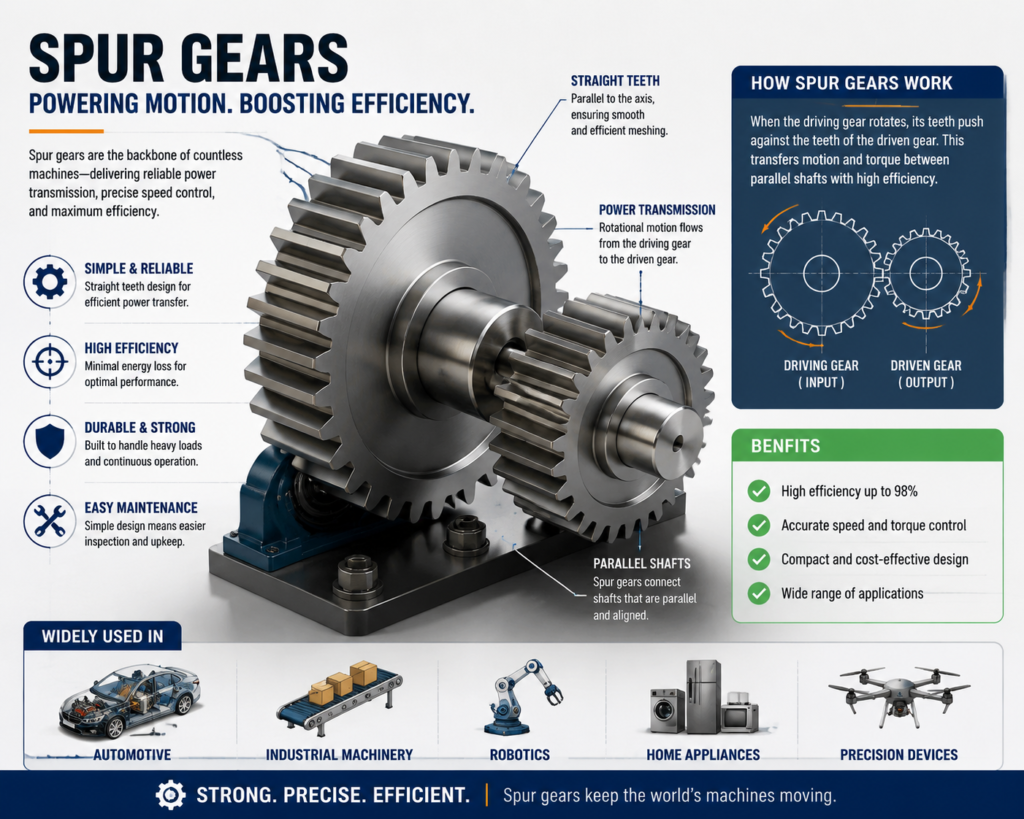
Spur gears, often dubbed the unsung heroes of mechanical transmissions, are cylindrical wheels with teeth meticulously machined parallel to the axis of rotation. They serve as the fundamental building blocks in countless machines, from conveyor belts in warehouses to the intricate gearboxes in high-performance robotics. These gears operate by transferring motion and torque between parallel shafts, creating a rhythmic dance of teeth engagement that transforms rotational energy into precise mechanical work. In essence, they are the mechanical equivalent of a well-timed rally, where every tooth meshes with perfect timing to drive the system forward.
1.2 Importance of Spur Gears in Machinery
The role of spur gears cannot be overstated—they are critical for ensuring smooth power transmission with minimal loss of energy. Their straightforward design offers high efficiency, reliability, and the ability to handle significant loads without the complexity of helical or bevel gears. In industrial settings, where uptime is gold, spur gears guarantee predictable performance, reduce vibration, and simplify maintenance. Think of them as the dependable teammates in a pickleball doubles match: consistent, precise, and never missing a swing.
1.3 Overview of the Blog Post Objectives
This article dives deep into the anatomy, working principles, and practical applications of spur gears, aiming to provide engineers, mechanics, and machine enthusiasts with a thorough understanding of how these gears amplify efficiency, durability, and performance in modern machinery. By the end, readers will not only grasp the technical nuances but also gain actionable insights to optimize gear-driven systems.
2.Historical Development of Spur Gears
2.1 Early Mechanical Applications
The concept of spur gears stretches back to antiquity, with rudimentary wooden gears appearing in early water clocks and textile machines. Artisans relied on the simple principle of interlocking teeth to transmit motion, marveling at how a set of notched wheels could transform manual labor into automated tasks. These early implementations, though primitive, laid the groundwork for centuries of mechanical ingenuity.
2.2 Evolution in Industrial Machinery
With the Industrial Revolution, spur gears underwent a metamorphosis from handcrafted wooden components to precision-forged metal gears. Factories harnessed their efficiency to drive steam engines, textile looms, and milling machines. The standardization of tooth profiles and gear modules emerged during this era, allowing for consistent manufacturing and interchangeability—turning spur gears into the backbone of industrial machinery.
2.3 Modern Advancements in Spur Gear Design
Today, advanced computational methods, CNC machining, and metallurgical breakthroughs have redefined spur gear design. Engineers now optimize tooth profiles for reduced backlash, enhanced load distribution, and extended lifespan. Specialized coatings, surface hardening, and precision grinding enable gears to operate under extreme loads with minimal wear, setting the stage for high-efficiency mechanical systems in robotics, automotive, and aerospace applications.
Key Components of a Spur Gear
3.1 Gear Teeth and Their Configuration
The teeth are the true workhorses, meticulously shaped to ensure smooth meshing and consistent torque transfer. Factors such as pressure angle, tooth depth, and helix angle determine load capacity and operational noise. The art of designing these teeth is a delicate balance between mechanical strength and energy efficiency.
3.2 Gear Body and Hub
The gear body provides structural integrity, while the hub interfaces with the shaft. Together, they ensure that the gear remains aligned under load, resisting bending, torsion, and misalignment. This combination is akin to a pickleball paddle: the grip and core must work harmoniously to transmit force accurately.
3.3 Shafts and Mounting Mechanisms
Shafts and mounting components anchor the gear in the mechanical system. Precision bearings, keys, and splines prevent slippage and maintain alignment, critical for avoiding premature wear and ensuring consistent torque transmission.
Materials Used in Spur Gear Manufacturing
4.1 Common Metals and Alloys
Steel alloys, often case-hardened or carburized, dominate spur gear manufacturing due to their excellent strength and wear resistance. Cast iron and bronze are also employed in lower-speed or quieter applications, offering good machinability and corrosion resistance.
4.2 High-Performance Polymers
Advanced polymers like PEEK and acetal are increasingly used in lightweight, low-load applications, providing corrosion resistance and self-lubrication properties. These materials are particularly useful in food processing, medical devices, and electronics.
4.3 Material Selection Based on Application
Selecting the right material depends on load, speed, environment, and budget. High-torque industrial gears demand hardened steel, whereas low-load, precision instruments may benefit from polymeric compositions. Material choice directly affects durability, efficiency, and operational noise.
Spur Gear Design Principles
5.1 Tooth Profile and Module Calculation
The involute profile is the cornerstone of spur gear design, ensuring smooth engagement and uniform motion transfer. The module, defined as the ratio of pitch diameter to the number of teeth, is a critical parameter for standardization and interchangeability.
5.2 Pitch Circle and Gear Ratio
The pitch circle is the imaginary line where two gears ideally mesh. Understanding pitch diameters allows engineers to calculate gear ratios, which directly influence torque multiplication, speed reduction, and mechanical advantage.
5.3 Load Distribution and Strength Considerations
Evenly distributed loads prevent premature tooth failure. Engineers consider factors like bending stress, contact stress, and safety margins to ensure gears perform reliably under varying conditions.
Working Mechanism of Spur Gears
6.1 Transmission of Rotational Motion
Spur gears transfer rotational motion from one shaft to another, converting input energy into a predictable output. The precise engagement of teeth minimizes slippage and energy loss, providing efficient mechanical power transmission.
6.2 Torque Transfer and Speed Control
Through careful ratio selection, spur gears can amplify torque while reducing speed, or vice versa. This balance allows machines to operate within optimal parameters, enhancing performance and extending component life.
6.3 Interaction Between Meshing Teeth
As teeth mesh, forces are transmitted along the line of action, generating both tangential and radial components. Proper tooth geometry ensures minimal vibration, reduced noise, and sustained operational integrity.
Types of Spur Gears
7.1 Standard Spur Gears
These are the conventional straight-toothed gears, ideal for general-purpose applications requiring efficiency, simplicity, and durability.
7.2 Helical Spur Gears
Although technically helical, some designs blur the line with spur gears, offering smoother engagement and higher load capacity at the cost of axial thrust.
7.3 Double-Helical and Special Spur Gears
Double-helical gears, or herringbone gears, cancel out axial forces and allow for heavy-load applications, while specialized spur gears can incorporate asymmetric teeth or custom profiles for unique requirements.
Gear Ratios and Their Calculation
8.1 Understanding Gear Ratio Concepts
Gear ratio defines the relationship between input and output rotational speeds. It is a critical factor in determining torque amplification and mechanical advantage.
8.2 Calculating Speed and Torque Ratios
The ratio of teeth between driving and driven gears determines the speed and torque transformation, enabling precise control of machine output characteristics.
8.3 Examples of Practical Gear Ratio Applications
From automotive transmissions to conveyor systems, selecting the right gear ratio optimizes efficiency, reduces energy consumption, and ensures smooth operation under variable loads.
Efficiency of Spur Gears
9.1 Factors Affecting Efficiency
Efficiency is influenced by tooth geometry, lubrication, alignment, and material friction. Even small misalignments can result in measurable energy losses.
9.2 Minimizing Energy Loss
Optimizing tooth design, ensuring proper lubrication, and maintaining precise alignment can elevate efficiency to over 98% in some high-performance systems.
9.3 Comparing Spur Gears to Other Gear Types
While helical and bevel gears offer quieter operation, spur gears excel in simplicity, reliability, and minimal manufacturing costs.
Lubrication and Maintenance
10.1 Importance of Proper Lubrication
Lubrication reduces friction, prevents wear, and dissipates heat, ensuring gears operate efficiently over prolonged periods.
10.2 Types of Lubricants for Spur Gears
Oil-based lubricants, greases, and synthetic compounds are selected based on speed, load, temperature, and environmental factors.
10.3 Maintenance Schedules and Best Practices
Routine inspections, timely lubrication, and cleaning prevent tooth wear, reduce downtime, and extend service life.
Common Issues and Troubleshooting
11.1 Gear Tooth Wear and Damage
Caused by misalignment, overload, or poor lubrication, tooth wear reduces efficiency and can lead to catastrophic failure if ignored.
11.2 Misalignment Problems
Even slight shaft misalignment increases stress on gear teeth, creating noise, vibration, and accelerated wear.
11.3 Noise and Vibration Concerns
Unwanted noise often signals misalignment, inadequate lubrication, or manufacturing defects, requiring immediate attention to avoid long-term damage.
Spur Gear Applications Across Industries
12.1 Automotive and Transportation
Used in transmissions, differential systems, and engine timing mechanisms, spur gears ensure reliable performance under varying loads.
12.2 Industrial Machinery and Robotics
From assembly lines to CNC machines, these gears transmit precise torque, maintain alignment, and withstand continuous operation.
12.3 Consumer Electronics and Appliances
Spur gears power everything from printers to washing machines, offering quiet, reliable, and compact mechanical solutions.
Innovations in Spur Gear Technology
13.1 Advanced Materials and Co
atings
Surface coatings like DLC (diamond-like carbon) reduce friction, improve wear resistance, and extend gear life, while advanced alloys enable higher torque applications.
13.2 Computer-Aided Gear Design
CAD and FEA simulations allow engineers to optimize tooth geometry, stress distribution, and efficiency before production.
13.3 Additive Manufacturing for Precision Gears
3D printing facilitates rapid prototyping and custom gear solutions with complex geometries that were previously impossible using traditional methods.
Spur Gear Testing and Quality Control
14.1 Inspection Techniques
Coordinate measuring machines, gear tooth verniers, and laser scanners ensure dimensional accuracy and proper alignment.
14.2 Measuring Gear Accuracy
Standards like AGMA and ISO define permissible deviations in tooth profiles, pitch, and runout, ensuring consistent performance.
14.3 Ensuring Long-Term Reliability
Regular testing, load trials, and stress analysis guarantee that gears meet operational demands and maintain efficiency over their lifespan.
Spur Gears vs. Other Gear Types
15.1 Comparing Spur and Helical Gears
Helical gears provide smoother, quieter operation, while spur gears excel in simplicity, efficiency, and cost-effectiveness.
15.2 Spur vs. Bevel and Worm Gears
Bevel gears transmit power between intersecting shafts, and worm gears offer high reduction ratios, but neither matches the straightforward reliability of spur gears.
15.3 Choosing the Right Gear Type for Your Machine
Consider load, speed, noise tolerance, and maintenance requirements when selecting gears to maximize machine performance and efficiency.
Tips for Boosting Machine Efficiency with Spur Gears
16.1 Optimizing Gear Ratios
Fine-tuning ratios to match operational requirements minimizes energy loss and improves torque utilization.
16.2 Regular Maintenance and Lubrication
Consistent inspection, cleaning, and lubrication prevent wear and ensure uninterrupted performance.
16.3 Implementing Modern Design Upgrades
Incorporating advanced materials, coatings, or precision-machined replacements can drastically improve efficiency and lifespan.
Case Studies of Efficient Spur Gear Systems
17.1 Automotive Transmission Examples
High-performance vehicles demonstrate how optimized spur gear arrangements reduce energy loss while maintaining durability under extreme torque.
17.2 Industrial Conveyor Systems
Precision-engineered spur gears maintain continuous operation with minimal downtime, even under heavy loads.
17.3 Robotics and Precision Machinery
Robotic arms rely on spur gears for accurate positioning, torque transfer, and smooth motion, demonstrating their versatility in complex systems.
Future Trends in Spur Gear Technology
18.1 Smart Gears and IoT Integration
Embedded sensors monitor wear, load, and temperature in real time, enabling predictive maintenance and enhanced machine intelligence.
18.2 Sustainable Materials and Eco-Friendly Designs
Bio-based polymers and recycled alloys reduce environmental impact without compromising mechanical performance.
18.3 Emerging Manufacturing Techniques
Additive manufacturing, hybrid machining, and precision casting open new possibilities for custom, lightweight, and high-efficiency gear designs.
Conclusion
19.1 Recap of Spur Gear Principles
Spur gears remain foundational to mechanical engineering, combining simplicity, reliability, and efficiency in countless applications.
19.2 Key Takeaways for Machine Efficiency
Optimized tooth design, proper material selection, accurate ratios, and diligent maintenance collectively enhance performance and durability.
19.3 Final Thoughts and Next Steps
By embracing modern design advancements and proactive maintenance, engineers can unlock the full potential of spur gears, boosting machine efficiency and operational excellence across industries.