Gear Standards and ISO Certification Guide
Interpretation of the Latest Standards and Certifications in the Gear Industry
1. Introduction to Gear Industry Standards
1.1 Definition and Importance of Gear Standards
In the contemporary power transmission sector, gear standards function as the invisible architecture underpinning manufacturing consistency, operational reliability, and international trade interoperability. Whether dealing with spur gears for compact reducers or colossal helical gears used in mining mills, standards establish the acceptable parameters for geometry, material integrity, surface hardness, dimensional tolerances, and fatigue performance.
From a mechanical engineering standpoint, gear standards are not merely bureaucratic paperwork sitting in a dusty filing cabinet. They are practical engineering compendiums that determine whether a gearbox operates smoothly for 60,000 hours or catastrophically fails during peak production. Purchasing engineers frequently say, “The cheapest gear becomes the most expensive one when downtime starts eating into production schedules,” and frankly, that statement hits the nail on the head.
For B2B buyers, adherence to Gear Standards directly influences supplier qualification, procurement confidence, and lifecycle cost calculations. Companies sourcing industrial gears for steel mills, wind turbines, marine propulsion systems, or robotics platforms often require strict compliance with ISO Certification frameworks before contracts are even discussed.
1.2 Evolution of Gear Standards Over Time
The evolution of Industry Regulations in gear manufacturing mirrors the broader industrial transformation from rudimentary machining practices to hyper-precise digital manufacturing ecosystems. Early gear production relied heavily on empirical craftsmanship, where machinists depended more on tactile intuition than standardized metrology.
As industrialization accelerated during the twentieth century, organizations such as AGMA, ISO, and DIN introduced codified standards to reduce variability and improve interchangeability between mechanical components. The proliferation of CNC machining, coordinate measuring systems, and finite element analysis later propelled standards into an era of astonishing precision.
Today’s standards encompass not only geometry and load ratings but also environmental sustainability, traceability, energy efficiency, and process documentation. In many respects, modern certification systems have transformed gear production from an artisanal discipline into a rigorously controlled engineering science.
1.3 Impact of Standards on Global Manufacturing
Global manufacturing would descend into logistical chaos without standardized specifications. Gear manufacturers in China, Germany, Japan, and the United States can collaborate seamlessly because internationally recognized standards create a common technical language.
For multinational OEMs, this standardization enables supplier diversification without sacrificing compatibility or performance reliability. A planetary gearbox assembled in Europe may contain pinions produced in Asia and shafts machined in North America, yet all components must conform to identical Industry Regulations.
Moreover, standards minimize warranty disputes, reduce production risks, and facilitate predictive maintenance strategies. In sectors like aerospace, renewable energy, and automotive manufacturing, compliance is no longer optional—it is the price of admission.
2. Overview of ISO Certifications Relevant to Gears
2.1 ISO 9001 Quality Management Systems
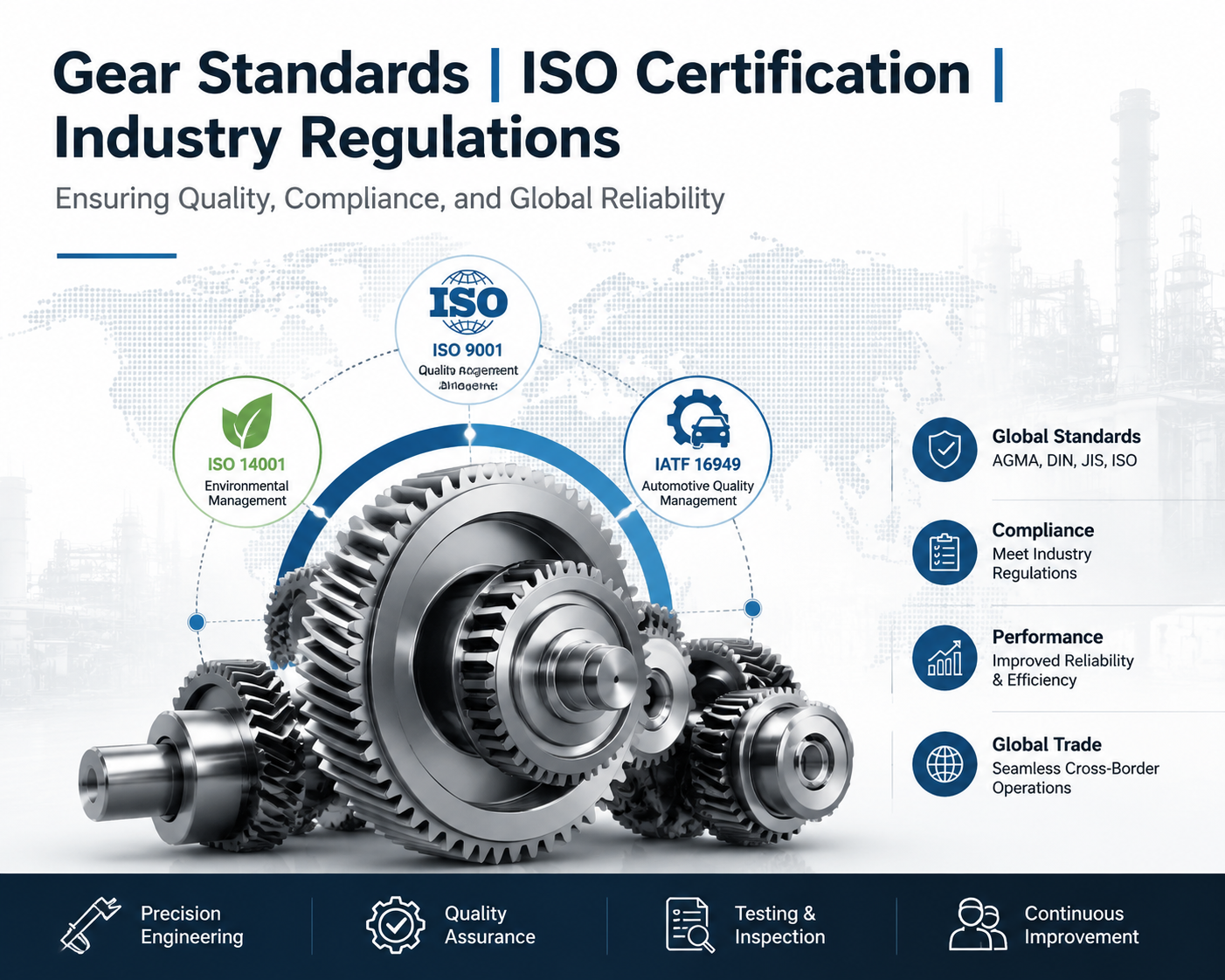
ISO 9001 remains the cornerstone of quality management within the gear manufacturing ecosystem. This certification focuses on process consistency, customer satisfaction, risk management, and continual improvement.
From a procurement perspective, ISO 9001 certification acts like a preliminary filtration mechanism. Buyers often think, “If a supplier cannot maintain basic quality management discipline, what happens when the pressure is really on?” That concern is entirely justified.
Certified manufacturers typically demonstrate stronger documentation control, better traceability systems, and reduced defect rates. This becomes particularly important for high-load industrial gears where even microscopic deviations can precipitate vibration anomalies or premature pitting failures.
2.2 ISO 14001 Environmental Management Standards
Environmental stewardship has become increasingly intertwined with industrial procurement decisions. ISO 14001 focuses on environmental management practices, including waste reduction, resource optimization, and pollution mitigation.
Modern gear manufacturing involves energy-intensive processes such as carburizing, nitriding, induction hardening, and grinding. Without proper environmental controls, these operations can generate significant emissions and industrial waste streams.
B2B corporate clients increasingly favor suppliers with environmentally responsible operations because sustainability metrics now influence investor evaluations, ESG reporting frameworks, and corporate reputation management.
2.3 ISO/TS 16949 Automotive Sector Implications
The automotive sector imposes extraordinarily stringent quality expectations due to massive production volumes and uncompromising safety requirements. ISO/TS 16949, now integrated into IATF 16949, establishes rigorous standards for automotive supply chains.
Transmission gears used in EV drivetrains, hybrid systems, and conventional gearboxes must meet exceptionally tight tolerances while maintaining high fatigue resistance under dynamic loading conditions.
Automotive buyers are famously demanding. One rejected batch can trigger expensive production stoppages across multiple assembly plants. Consequently, certification compliance within automotive gear manufacturing is treated with almost military precision.
3. Key International Gear Standards
3.1 AGMA (American Gear Manufacturers Association) Standards
AGMA standards are extensively utilized throughout North America and remain highly influential globally. These standards address gear classification, load capacity calculations, lubrication requirements, and inspection procedures.
AGMA methodologies are especially valuable for heavy industrial applications such as cement plants, mining conveyors, and petrochemical processing systems where operational reliability is paramount.
Engineers frequently appreciate AGMA standards because they provide practical guidance rooted in real-world industrial operating conditions rather than purely theoretical assumptions.
3.2 DIN (Deutsches Institut für Normung) Standards
German DIN standards have earned a reputation for exceptional precision and engineering rigor. DIN specifications are commonly associated with high-performance machinery, precision reducers, and advanced automation systems.
DIN gear classifications frequently emphasize microgeometry optimization, profile modifications, and transmission efficiency. In high-speed applications, these nuances significantly reduce noise, vibration, and thermal accumulation.
When procurement teams encounter DIN-compliant products, they often associate them with meticulous manufacturing discipline and elevated engineering sophistication.
3.3 JIS (Japanese Industrial Standards) for Gears
Japanese Industrial Standards prioritize reliability, compactness, and manufacturing consistency. JIS specifications are particularly prevalent in robotics, machine tools, and automotive applications.
Japanese engineering philosophy frequently emphasizes kaizen-oriented continuous improvement and production uniformity. This mindset has profoundly influenced gear manufacturing methodologies worldwide.
For high-volume precision production environments, JIS standards provide a balanced framework combining practicality with stringent quality expectations.
4. Recent Updates in ISO Gear Standards
4.1 ISO 1328-1 and Precision Classifications
ISO 1328-1 governs gear accuracy classifications and has undergone revisions to accommodate increasingly sophisticated manufacturing capabilities.
Modern applications such as robotics, aerospace actuators, and EV transmissions require extraordinarily low transmission error characteristics. Consequently, precision classifications have become more granular and technologically demanding.
Manufacturers utilizing advanced grinding machines, analytical inspection systems, and digital compensation algorithms now achieve tolerances that would have seemed almost fantastical decades ago.
4.2 ISO 6336: Gear Strength Calculations
ISO 6336 provides internationally recognized methodologies for calculating gear tooth strength, bending fatigue, and surface durability.
This standard plays a pivotal role in engineering validation because incorrect load calculations can result in catastrophic operational failures. Nobody wants a multi-million-dollar turbine gearbox to “throw in the towel” halfway through its service life.
Modern revisions increasingly account for variable loading conditions, advanced materials, and complex lubrication behaviors.
4.3 New Revisions in Measurement and Testing Methods
Advancements in metrology technology have transformed gear inspection methodologies. Contemporary standards increasingly incorporate digital scanning systems, analytical software, and automated inspection platforms.
Coordinate measuring machines (CMMs), laser scanners, and real-time process monitoring systems now enable manufacturers to detect deviations at micron-level precision.
These improvements enhance repeatability, reduce scrap rates, and strengthen overall manufacturing consistency.
5. Industry Regulations and Compliance Requirements
5.1 Regulatory Bodies Governing Gear Production
Multiple organizations influence Industry Regulations within the gear sector, including ISO, AGMA, DIN committees, national industrial agencies, and sector-specific authorities.
Industries such as aerospace, defense, marine, and automotive frequently impose additional proprietary compliance requirements beyond standard ISO frameworks.
Navigating this regulatory labyrinth requires substantial technical expertise and organizational discipline.
5.2 Compliance Challenges for Manufacturers
Compliance can be particularly challenging for small and medium-sized manufacturers due to rising documentation demands, testing costs, and audit requirements.
Maintaining compliance across multiple export markets further complicates matters because regional regulations often differ significantly.
Some manufacturers discover the hard way that achieving certification is one thing; consistently maintaining compliance during high-volume production is another kettle of fish entirely.
5.3 Penalties and Legal Implications of Non-Compliance
Non-compliance can trigger severe consequences including shipment rejection, financial penalties, litigation exposure, and reputational damage.
For industries involving safety-critical applications, defective gears may result in catastrophic operational incidents, legal liability, and contract termination.
In today’s hyper-connected industrial landscape, reputational damage spreads quickly, and recovering customer trust can take years.
6. Certification Processes for Gear Manufacturers
6.1 Steps to Obtain ISO Certification
The certification process typically begins with a comprehensive gap analysis followed by procedural implementation, employee training, documentation development, and internal audits.
Manufacturers must establish process controls covering procurement, machining, heat treatment, inspection, packaging, and customer service.
Certification is not a one-off trophy hanging on the wall—it demands continuous operational discipline.
6.2 Internal Audits and Documentation Requirements
Internal audits verify process adherence and identify operational weaknesses before external assessments occur.
Documentation requirements include calibration records, inspection reports, process parameters, material certifications, and corrective action procedures.
Well-maintained documentation systems significantly reduce operational ambiguity and audit-related stress.
6.3 Role of Third-Party Auditors
Third-party auditors provide independent verification of compliance integrity.
Their assessments evaluate not only paperwork but also real-world process implementation, workforce competence, and management commitment.
Experienced auditors often identify inefficiencies that manufacturers themselves may overlook due to operational familiarity.
7. Implications of Standards on Gear Design
7.1 Influence on Material Selection
Material selection profoundly impacts gear durability, fatigue resistance, and operational efficiency.
Standards frequently specify acceptable material compositions, heat treatment protocols, and hardness requirements to ensure predictable performance.
High-performance gears commonly utilize alloy steels with optimized carburizing characteristics to balance toughness and surface hardness.
7.2 Precision and Tolerance Considerations
Precision tolerances directly affect vibration behavior, thermal generation, and transmission efficiency.
Tighter tolerances improve operational smoothness but simultaneously increase manufacturing complexity and production costs.
Engineering teams must strike a delicate equilibrium between performance optimization and economic feasibility.
7.3 Lifecycle and Durability Predictions
Modern standards support sophisticated lifecycle prediction methodologies based on fatigue calculations and operating conditions.
These predictive capabilities enable manufacturers and buyers to estimate maintenance intervals and replacement schedules more accurately.
Predictive engineering has become indispensable in industries where downtime carries enormous financial repercussions.
8. Impact of Standards on Manufacturing Processes
8.1 CNC Machining and Gear Cutting Requirements
Modern standards heavily influence CNC machining parameters, cutter geometries, and inspection routines.
Advanced hobbing, shaping, and grinding systems must maintain extraordinary consistency to meet stringent accuracy classifications.
Automation and adaptive machining technologies increasingly enhance repeatability and productivity.
8.2 Heat Treatment and Surface Finishing Standards
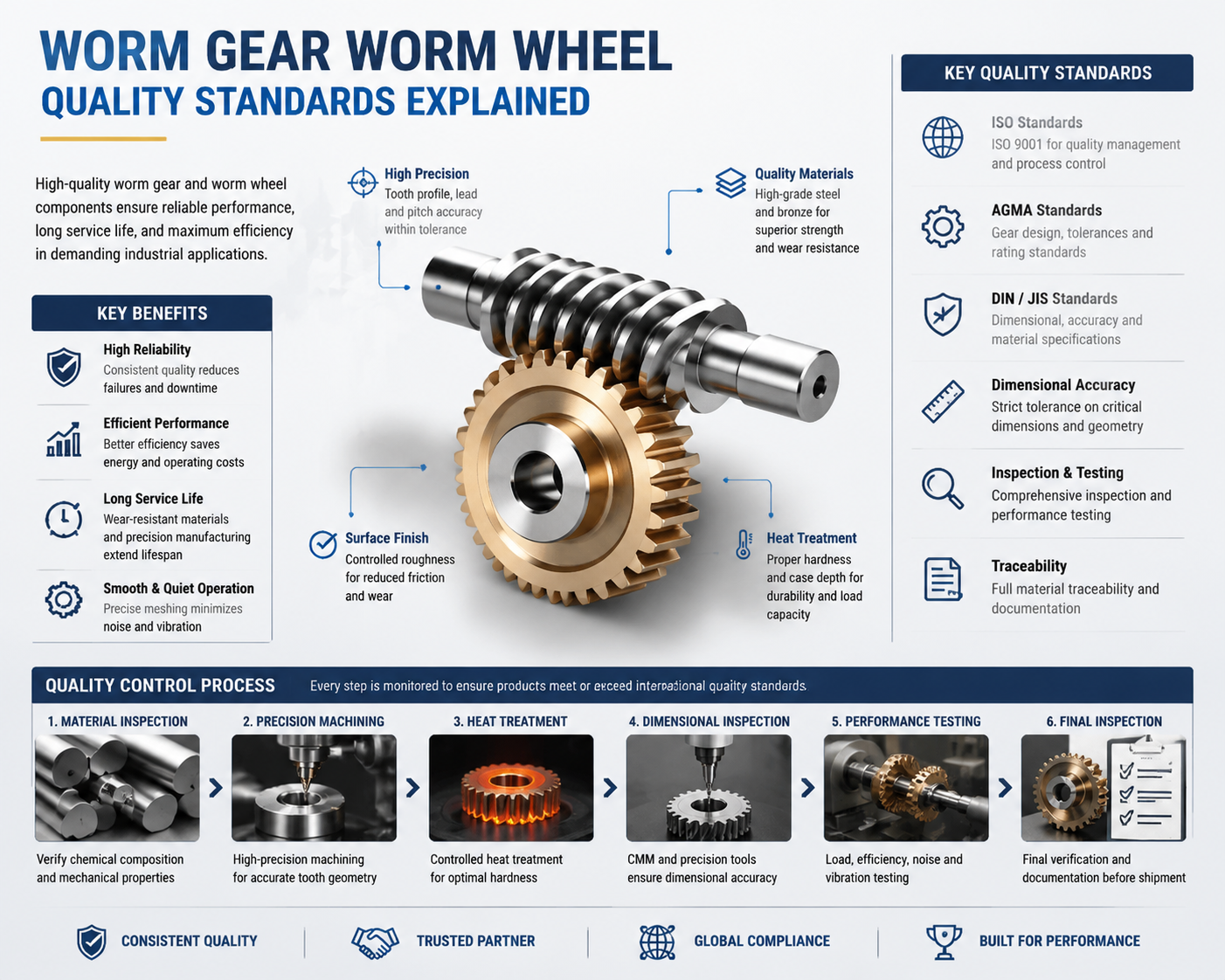
Heat treatment processes significantly influence gear strength and wear resistance.
Standards define acceptable hardness ranges, case depths, tempering requirements, and distortion limitations.
Surface finishing procedures such as superfinishing and isotropic polishing further enhance operational efficiency and fatigue resistance.
8.3 Quality Control Measures
Robust quality control systems include dimensional inspection, hardness verification, metallurgical analysis, and non-destructive testing.
Statistical process control methodologies help manufacturers identify process drift before defects escalate into large-scale production issues.
Quality control is essentially the industrial equivalent of preventive medicine—catching problems early saves everyone a mountain of trouble later on.
9. Standardization and Global Trade
9.1 Facilitating Cross-Border Gear Exports
Standardization dramatically simplifies international trade by reducing technical ambiguities between buyers and suppliers.
Export-oriented manufacturers benefit from broader market accessibility and streamlined qualification procedures.
Global procurement networks rely heavily on standardized specifications to minimize sourcing risks.
9.2 Harmonization of Standards Between Countries
Efforts to harmonize standards reduce duplication and improve international compatibility.
Although regional differences still exist, increasing convergence among ISO, AGMA, DIN, and JIS frameworks has improved global interoperability.
This harmonization supports multinational manufacturing strategies and integrated supply chains.
9.3 Case Studies of International Compliance
Numerous multinational OEMs have successfully established global sourcing networks by implementing unified compliance systems.
These case studies demonstrate how standardized quality protocols reduce defects, accelerate qualification, and strengthen supplier accountability.
Companies embracing comprehensive compliance strategies often outperform competitors in long-term operational stability.
10. Trends in Gear Certification
10.1 Digitalization of Certification Processes
Digital documentation systems, cloud-based audits, and AI-assisted analytics are transforming certification management.
Manufacturers increasingly utilize real-time monitoring platforms to maintain continuous compliance visibility.
Paper-heavy compliance systems are gradually becoming relics of the past.
10.2 Shift Toward Sustainability and Green Standards
Environmental sustainability now influences purchasing decisions across numerous industrial sectors.
Energy-efficient manufacturing, recyclable materials, and carbon reduction initiatives increasingly appear within procurement evaluations.
Suppliers unable to demonstrate sustainability credentials may find themselves losing competitive ground.
10.3 Emerging Standards in High-Performance Applications
Emerging industries such as electric mobility, robotics, and aerospace require increasingly sophisticated gear standards.
High-speed operation, lightweight materials, and extreme precision requirements continue driving regulatory evolution.
The technological bar keeps rising, and manufacturers must adapt quickly to remain competitive.
11. Common Misconceptions About Gear Standards
11.1 Confusing Certification with Compliance
Certification confirms that systems exist, while compliance verifies that those systems are consistently followed.
Some companies mistakenly assume certification alone guarantees product excellence, which is far from reality.
Operational discipline remains the true determinant of long-term manufacturing quality.
11.2 Overestimating or Underestimating Standard Requirements
Misinterpreting standards can lead either to excessive costs or insufficient quality control.
Overengineering unnecessarily inflates production expenses, while underestimating requirements creates operational vulnerabilities.
Balanced engineering judgment remains indispensable.
11.3 Misalignment Between Customer Expectations and Standards
Customers sometimes expect performance levels exceeding the scope of specified standards.
Clear communication between manufacturers and buyers is essential to prevent unrealistic assumptions.
Technical alignment at the quotation stage can save tremendous headaches later.
12. Case Studies of Standard Implementation
12.1 Automotive Gear Manufacturing Example
An automotive supplier implementing IATF-aligned systems reduced defect rates through automated inspection integration and statistical process optimization.
Improved process consistency enhanced customer confidence and minimized warranty claims.
12.2 Industrial Robotics and Precision Gear Standards
Robotics applications demand exceptionally low backlash and high positional accuracy.
Manufacturers utilizing advanced grinding and inspection technologies achieved remarkable precision improvements while maintaining scalable production efficiency.
12.3 Renewable Energy Gear Applications
Wind turbine gearboxes operate under fluctuating loads and harsh environmental conditions.
Compliance with stringent international standards significantly improved durability and reduced maintenance frequency.
13. Benefits of Adhering to Gear Standards
13.1 Improved Product Quality and Reliability
Standardized manufacturing practices enhance consistency, reduce defects, and improve operational reliability.
Reliable gears contribute directly to equipment uptime and customer satisfaction.
13.2 Enhanced Customer Trust and Marketability
Certification strengthens market credibility and simplifies supplier qualification procedures.
Buyers naturally gravitate toward suppliers demonstrating robust quality systems and transparent operational practices.
13.3 Risk Mitigation and Reduced Liability
Compliance reduces legal exposure and operational uncertainty.
Well-documented manufacturing systems also improve traceability during incident investigations or warranty assessments.
14. Challenges in Adopting New Standards
14.1 Costs Associated with Upgrading Equipment
Advanced compliance requirements often necessitate substantial investments in machinery, inspection systems, and software platforms.
Smaller manufacturers may struggle with capital allocation pressures.
14.2 Workforce Training and Skill Development
Sophisticated manufacturing systems require highly trained personnel capable of managing advanced equipment and analytical processes.
Continuous training has become indispensable within modern manufacturing environments.
14.3 Integration with Legacy Production Systems
Older production facilities frequently encounter compatibility challenges when integrating modern compliance frameworks.
Retrofitting legacy systems can become technically complex and financially demanding.
15. Future Outlook of Gear Industry Regulations
15.1 Anticipated ISO Updates and Revisions
Future ISO revisions will likely emphasize digital traceability, sustainability metrics, and predictive quality analytics.
As manufacturing technologies evolve, standards must continuously adapt to emerging operational realities.
15.2 Trends Toward Automation and Smart Manufacturing
Industry 4.0 technologies increasingly influence gear production methodologies.
Smart factories equipped with IoT sensors, machine learning algorithms, and autonomous inspection systems are reshaping manufacturing paradigms.
15.3 Influence of International Trade Policies
Geopolitical developments and evolving trade agreements continue influencing certification requirements and supply chain strategies.
Manufacturers operating globally must remain agile and well-informed regarding regulatory changes.
16. Conclusion and Strategic Recommendations
16.1 Key Takeaways for Gear Manufacturers
Modern Gear Standards and ISO Certification frameworks are fundamental pillars supporting quality assurance, operational reliability, and international competitiveness.
Manufacturers embracing compliance as a strategic advantage rather than a bureaucratic burden frequently achieve stronger market positioning.
16.2 Strategic Steps for Compliance and Certification
Companies should invest in robust quality systems, advanced metrology technologies, workforce training, and continuous process improvement initiatives.
Proactive compliance strategies generally prove more cost-effective than reactive corrective measures.
16.3 Preparing for Future Industry Changes
The future of the gear industry will be shaped by automation, sustainability, digitalization, and increasingly sophisticated Industry Regulations.
Manufacturers prepared to adapt quickly, innovate intelligently, and maintain uncompromising quality discipline will remain ahead of the curve while others struggle to keep pace.
Additional references: