Gear Heat Treatment for High Wear Resistance
Gear Heat Treatment Processes and Performance Enhancement
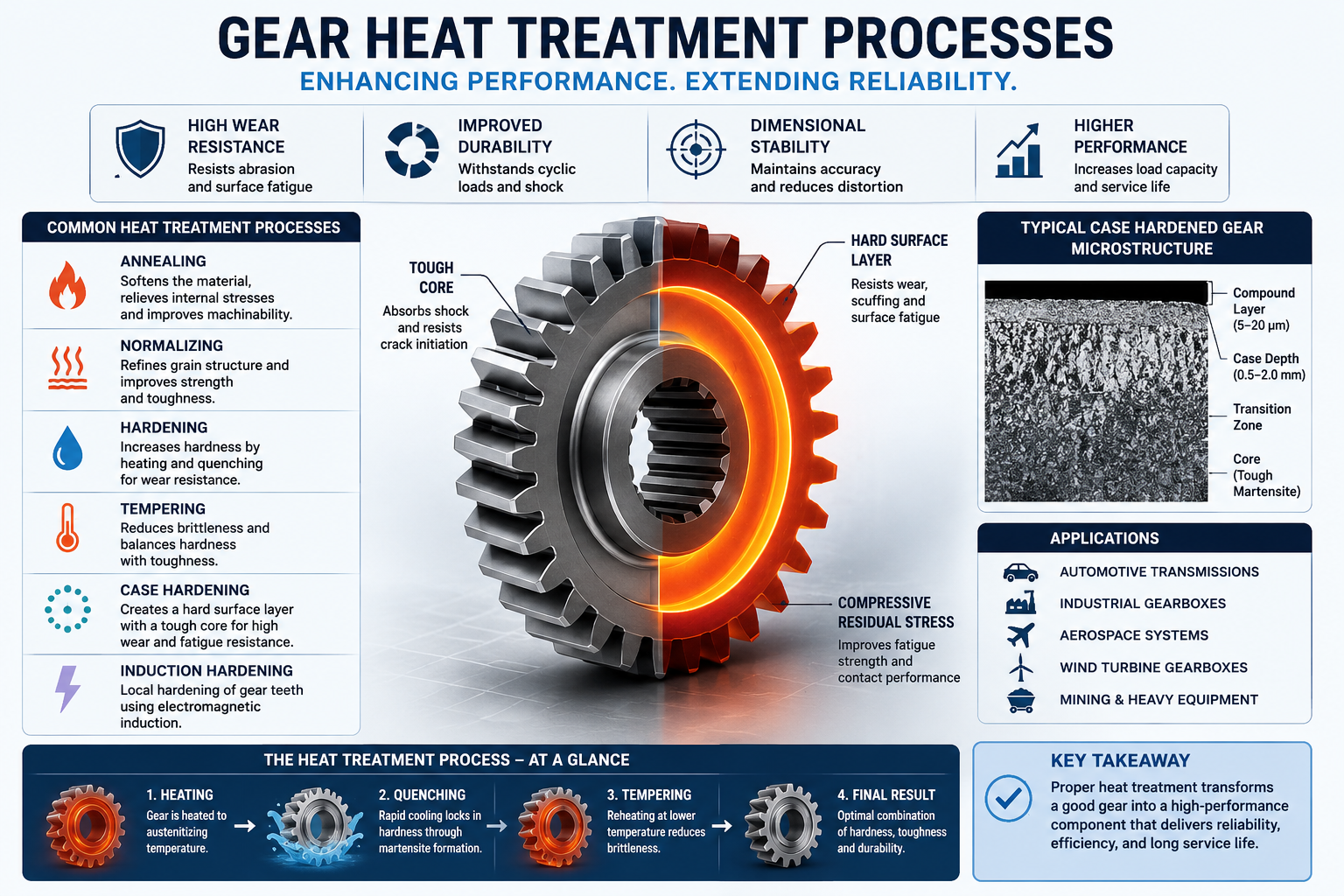
Gear heat treatment plays a critical role in modern power transmission systems, directly influencing durability, wear resistance, fatigue strength, and overall gearbox reliability. Whether utilized in automotive transmissions, aerospace assemblies, mining equipment, industrial reducers, or wind turbine gearboxes, properly heat-treated gears provide the mechanical resilience required to withstand severe operating conditions. This comprehensive guide explores the metallurgical foundations, engineering materials, heat treatment techniques, and performance enhancement strategies that define successful gear manufacturing.
1. Introduction to Gear Heat Treatment Processes
1.1 Definition and Purpose of Gear Heat Treatment
Gear heat treatment refers to a meticulously controlled thermal procedure applied to metallic gears in order to modify their internal microstructure, mechanical behavior, and surface integrity. In practical engineering environments, the process is not merely about heating and cooling steel; it is a calibrated metallurgical operation intended to augment hardness, elevate fatigue endurance, and suppress premature failure under cyclical loading conditions.
Within modern manufacturing ecosystems, untreated gears are rarely capable of surviving severe torsional loads, fluctuating contact stresses, and abrasive operational environments for extended durations. Heat treatment effectively transforms relatively machinable raw materials into highly resilient drivetrain components capable of enduring punishing service conditions.
From a purchase engineering standpoint, the heat treatment stage often becomes the decisive factor separating economical long-life gearing from “cheap today, expensive tomorrow” procurement disasters. Many procurement teams learn the hard way that low-cost gears without certified heat treatment documentation can become maintenance nightmares down the road.
1.2 Importance in Mechanical Power Transmission
Mechanical power transmission systems depend profoundly on gear reliability because gears operate as the primary intermediaries transferring torque, rotational speed, and kinetic energy between shafts. Whether inside industrial reducers, automotive transmissions, mining conveyors, marine propulsion systems, or wind turbines, gears continuously encounter rolling and sliding contact stresses of extraordinary magnitude.
Without appropriate heat treatment, gear teeth become susceptible to adhesive wear, pitting fatigue, scuffing, plastic deformation, and catastrophic tooth fracture. In high-load applications, even microscopic subsurface discontinuities may propagate rapidly into destructive failures. That is where thermal processing earns its stripes.
Engineers in heavy industry often say, “A gearbox is only as good as its weakest tooth,” and that statement carries more truth than marketing brochures ever will. Properly heat-treated gears ensure smoother torque transfer, reduced vibration, minimized backlash deterioration, and prolonged operational continuity.
1.3 Relationship Between Heat Treatment and Gear Performance
The relationship between heat treatment and gear performance is profoundly interdependent. Mechanical characteristics such as surface hardness, core toughness, fatigue resistance, wear behavior, and dimensional stability are directly influenced by thermal processing parameters.
For instance, carburized gears exhibit exceptionally hard outer case layers capable of resisting abrasive contact, while maintaining ductile cores that absorb shock loading without brittle fracture. Similarly, nitrided gears offer superior surface compressive stresses and excellent resistance against micropitting phenomena.
An improperly executed heat treatment cycle, however, may induce residual stresses, distortion, quench cracking, or undesirable retained austenite formation. In real-world shop-floor scenarios, one botched furnace cycle can wipe out an entire production batch faster than a forklift driver missing a corner turn.
2. Fundamentals of Engineering Materials for Gears
2.1 Common Steel Grades Used in Gear Manufacturing
Gear manufacturing predominantly utilizes alloy steels due to their favorable hardenability, toughness, and machinability characteristics. Widely employed grades include AISI 4140, AISI 4340, AISI 8620, AISI 9310, and EN36 steels. These materials contain carefully balanced alloying additions that enable deeper hardness penetration and improved fatigue behavior after heat treatment.
Low-carbon alloy steels such as 8620 are especially popular for carburized gears because they permit hard surface case development while preserving ductile cores. Conversely, medium-carbon steels like 4140 are frequently selected for through-hardened gears operating under moderate loading environments.
Aerospace applications often utilize ultra-clean vacuum-degassed steels possessing exceptional metallurgical purity because even minute inclusions can trigger fatigue crack nucleation under extreme rotational stresses.
2.2 Material Properties Affecting Heat Treatment Outcomes
Several intrinsic material properties govern the success or failure of heat treatment operations. Carbon content, grain size, thermal conductivity, hardenability, and alloy composition significantly influence the final mechanical properties.
Carbon concentration remains particularly critical because hardness capability is largely dependent on martensitic transformation potential. Materials with insufficient carbon content cannot attain the elevated hardness levels demanded by high-performance gearing systems.
Likewise, steel cleanliness plays a pivotal role. Nonmetallic inclusions, segregations, and porosity can create localized stress concentrations that become initiation sites for fatigue failure. In procurement circles, reputable steel sourcing is not just paperwork—it is insurance against future downtime.
2.3 Alloying Elements and Their Influence on Hardenability
Alloying elements dramatically affect steel behavior during thermal processing. Chromium improves wear resistance and corrosion tolerance, nickel enhances toughness, molybdenum increases high-temperature strength, and manganese improves hardenability depth.
Boron additions, even in minute quantities, significantly enhance hardenability by delaying ferrite transformation during quenching. Silicon strengthens ferrite matrices while vanadium refines grain structures through carbide formation.
These alloying constituents collectively determine cooling sensitivity, transformation kinetics, and achievable hardness profiles. Selecting improper alloy chemistry for a given duty cycle is akin to putting economy tires on a racing car—technically functional, but operationally foolish.
For further reading on alloy steels and metallurgy, engineers may refer to: Wikipedia – Alloy Steel and ASM International.
3. Metallurgical Principles Behind Heat Treatment
3.1 Phase Transformations in Steel
Steel undergoes multiple phase transformations during heating and cooling cycles. When heated above critical temperatures, ferrite and pearlite transform into austenite, a face-centered cubic structure capable of dissolving substantial carbon quantities.
Upon rapid quenching, austenite transforms into martensite, an extremely hard but brittle microstructure characterized by supersaturated carbon trapped within distorted crystal lattices. Slower cooling rates may instead produce bainite or pearlite structures with differing mechanical properties.
The entire science of heat treatment revolves around manipulating these phase transformations with surgical precision.
3.2 Microstructure Development During Heating and Cooling
Microstructural evolution determines gear performance to an extraordinary extent. Controlled heating promotes homogenization, carbide dissolution, and grain refinement, while controlled cooling dictates final hardness and toughness levels.
Excessive heating can cause grain coarsening, reducing impact strength and fatigue resistance. Conversely, inadequate heating may leave undissolved carbides and inconsistent hardness distribution.
Cooling rates must also remain carefully regulated. Overly aggressive quenching can induce distortion and cracking, while sluggish cooling may prevent full martensitic transformation. In many heat treatment facilities, furnace operators joke that “steel remembers every mistake,” and metallurgy proves that statement remarkably accurate.
3.3 Hardness, Toughness, and Residual Stress Relationships
Hardness and toughness often exist in direct opposition. Increasing hardness generally elevates brittleness, while improving toughness may reduce wear resistance. The challenge lies in balancing these properties according to operational requirements.
Residual stresses generated during quenching also profoundly affect component behavior. Compressive residual stresses may improve fatigue resistance, whereas tensile stresses can accelerate crack initiation.
Optimized heat treatment procedures seek equilibrium between hardness, toughness, dimensional accuracy, and internal stress distribution.
Additional educational resources can be found at: National Institute of Standards and Technology (NIST).
4. Objectives of Gear Heat Treatment
4.1 Achieving High Wear Resistance
High wear resistance represents one of the foremost objectives in gear heat treatment because gear teeth continuously experience rolling-sliding contact under substantial pressure. Surface degradation mechanisms such as adhesive wear, abrasive wear, and micropitting can rapidly compromise transmission efficiency.
Processes like carburizing and nitriding produce hardened surface layers capable of resisting mechanical abrasion and surface fatigue. Elevated hardness prevents tooth profile deterioration and preserves gear geometry throughout prolonged service intervals.
4.2 Improving Fatigue Strength and Durability
Gear teeth endure repeated cyclic loading during every rotation. Over millions of operational cycles, even small stress concentrations may evolve into fatigue cracks.
Heat treatment enhances fatigue strength by refining microstructures, introducing compressive stresses, and increasing surface hardness. Shot peening combined with case hardening often yields exceptional fatigue performance.
Durability improvements translate directly into reduced downtime, lower maintenance expenditure, and enhanced lifecycle economics.
4.3 Enhancing Dimensional Stability and Load Capacity
Dimensional stability is essential for maintaining accurate tooth geometry, backlash tolerances, and load distribution patterns. Distorted gears create vibration, noise, and uneven stress concentrations.
Advanced heat treatment procedures minimize warpage while enabling gears to sustain higher torque densities. Modern industrial gearboxes increasingly demand compact high-load configurations, making dimensional precision more critical than ever.
5. Pre-Heat Treatment Preparations
5.1 Gear Material Selection Criteria
Material selection depends on operational torque, rotational speed, shock loading, environmental exposure, and anticipated service life. Engineers must evaluate hardness requirements, machinability, heat treatment compatibility, and economic feasibility simultaneously.
In procurement-driven projects, balancing performance and budget often becomes a delicate tug-of-war between design aspirations and financial realities.
5.2 Surface Cleaning and Preparation Methods
Contaminants such as oils, oxides, and machining residues interfere with heat transfer and surface chemistry during treatment. Thorough cleaning ensures uniform thermal exposure and consistent case development.
Common preparation methods include alkaline washing, vapor degreasing, abrasive blasting, and ultrasonic cleaning.
5.3 Machining Allowances Before Heat Treatment
Heat treatment frequently causes dimensional variation due to thermal expansion and phase transformation stresses. Therefore, gears are intentionally machined with grinding allowances prior to thermal processing.
These allowances compensate for distortion and permit final finishing operations after hardening. Skipping this planning step is a classic rookie mistake that can scrap expensive components in a heartbeat.
6. Annealing Processes for Gears
6.1 Full Annealing Techniques
Full annealing involves heating steel above its critical transformation temperature followed by slow furnace cooling. This process softens the material, improves machinability, and relieves internal stresses.
The resulting coarse pearlitic structure facilitates easier cutting operations during subsequent gear manufacturing stages.
6.2 Stress Relief Annealing Applications
Stress relief annealing operates below transformation temperatures and primarily targets residual stress reduction. Welded gear assemblies and heavily machined components particularly benefit from this treatment.
Reducing internal stress prior to hardening minimizes distortion risks later in the manufacturing chain.
6.3 Effects of Annealing on Machinability and Structure
Annealed steels exhibit lower hardness and improved ductility, enabling efficient machining and tool longevity. Grain structures become more uniform, enhancing process consistency during subsequent operations.
From a production viewpoint, proper annealing saves tooling costs and reduces machining headaches considerably.
7. Normalizing Treatment in Gear Manufacturing
7.1 Process Parameters and Temperature Control
Normalizing involves heating steel above critical temperature followed by air cooling. Compared with annealing, cooling rates are faster, producing finer pearlitic structures.
Precise temperature regulation remains essential because overheating can coarsen grains and degrade toughness.
7.2 Grain Refinement Benefits
Fine grain structures improve mechanical strength, toughness, and fatigue resistance. Normalizing also enhances structural uniformity throughout the component cross-section.
This process is frequently employed prior to hardening treatments to establish consistent metallurgical foundations.
7.3 Comparison Between Annealing and Normalizing
Annealing produces softer structures and superior machinability, whereas normalizing yields higher strength and finer grain morphology.
Selection depends on manufacturing objectives, mechanical requirements, and downstream processing considerations.
Additional gear manufacturing resources are available from: American Gear Manufacturers Association (AGMA) and Wikipedia – Heat Treating.
8. Hardening Processes for Gears
8.1 Through Hardening Techniques
Through hardening transforms the entire gear cross-section into hardened martensitic structures. This technique suits smaller gears requiring uniform hardness distribution.
Unlike case hardening methods that primarily strengthen surface regions, through hardening provides consistent mechanical properties throughout the component thickness. This characteristic makes it particularly suitable for gears subjected to moderate wear conditions and significant impact loading.
Common methods involve austenitizing followed by oil or polymer quenching. The resulting microstructure typically consists predominantly of tempered martensite, delivering an advantageous combination of hardness and toughness.
8.2 Quenching Media and Cooling Rates
Quenching media strongly influence cooling severity and distortion behavior. Water provides rapid cooling but increases cracking risk, while oil offers gentler cooling characteristics and reduced distortion potential.
Polymer quenchants provide adjustable cooling performance and improved process consistency. Their concentration can be modified to achieve cooling characteristics tailored to specific gear geometries and alloy compositions.
Selecting an inappropriate quenching medium can lead to inadequate hardness development or excessive thermal stresses. Consequently, quench media selection must align closely with material chemistry, component dimensions, and desired mechanical properties.
8.3 Common Defects During Hardening
Quench cracking, distortion, decarburization, and uneven hardness profiles remain common hardening defects. These issues frequently arise from inadequate process control, improper furnace operation, or unsuitable quenching parameters.
Improper furnace atmosphere control may also produce oxidation and surface degradation. Such defects compromise wear resistance and may accelerate fatigue crack initiation during service.
In production environments, one uncontrolled quench can turn precision gears into expensive paperweights. Consequently, strict process monitoring remains indispensable throughout the hardening cycle.
9. Tempering and Its Role in Performance Enhancement
9.1 Tempering Temperature Selection
Tempering reheats hardened steel below critical transformation temperatures to reduce brittleness while retaining adequate hardness. This secondary thermal treatment modifies martensitic structures, relieving internal stresses generated during quenching.
Temperature selection directly determines final mechanical properties and must align with service requirements. Lower tempering temperatures generally preserve hardness, while higher temperatures increase toughness and ductility.
Engineers must carefully balance operational demands when selecting tempering parameters because excessive tempering can diminish wear resistance, whereas insufficient tempering may leave the component vulnerable to brittle fracture.
9.2 Balancing Hardness and Toughness
Excessive hardness may produce brittle failures, whereas insufficient hardness accelerates wear. Tempering establishes equilibrium between these competing characteristics.
Well-tempered gears survive shock loading far more effectively than excessively brittle components. This balance becomes especially important in mining equipment, heavy industrial drives, and off-highway machinery exposed to unpredictable loading conditions.
The most successful heat treatment strategies rarely seek maximum hardness alone. Instead, they pursue optimized performance through a carefully engineered combination of hardness, toughness, fatigue resistance, and dimensional stability.
9.3 Secondary Hardening Phenomena
Certain alloy steels exhibit secondary hardening due to alloy carbide precipitation during tempering. This phenomenon enhances hot hardness and wear resistance.
Elements such as molybdenum, vanadium, chromium, and tungsten contribute significantly to secondary hardening mechanisms. During tempering, finely dispersed alloy carbides form throughout the microstructure, increasing strength and stability.
Tool steels and aerospace gears often leverage this mechanism for demanding operating environments where elevated temperatures and sustained loading conditions are commonplace.
10. Case Hardening Methods for High Wear Resistance
10.1 Carburizing Process and Applications
Carburizing enriches surface carbon concentration before quenching, producing hard martensitic cases over tough cores. This process remains one of the most widely used gear heat treatment methods in modern manufacturing.
Automotive transmission gears heavily rely on carburizing because it delivers exceptional wear resistance and contact fatigue strength. The resulting hard case withstands intense tooth contact pressures while the ductile core absorbs shock loads.
Gas carburizing, vacuum carburizing, and low-pressure carburizing have become increasingly prevalent due to their ability to provide precise case depth control and superior process consistency.
10.2 Carbonitriding for Surface Strengthening
Carbonitriding introduces both carbon and nitrogen into the surface layer, improving hardness and hardenability. The simultaneous diffusion of these elements creates a robust hardened layer suitable for moderate-to-high performance gearing applications.
The process is particularly effective for smaller gears and moderate-duty applications where cost efficiency and production speed remain important considerations.
Carbonitrided gears often exhibit improved resistance to wear and fatigue while maintaining favorable dimensional stability characteristics.
10.3 Cyaniding Advantages and Limitations
Cyaniding provides rapid case hardening but involves toxic cyanide salts, creating substantial environmental and safety concerns.
Historically, the process offered short cycle times and effective surface hardening. However, increasing environmental regulations and workplace safety requirements have reduced its popularity.
Consequently, its industrial usage has declined significantly in modern facilities, with carburizing and carbonitriding frequently serving as safer alternatives.
For additional information regarding carburizing technologies, readers may consult Wikipedia – Carburizing.
11. Induction Hardening of Gears
11.1 Principles of Electromagnetic Heating
Induction hardening utilizes alternating electromagnetic fields to generate localized heating within gear surfaces. The process relies on induced electrical currents that rapidly heat selected regions without affecting the entire component.
Rapid heating followed by quenching creates hardened outer layers while preserving tough cores. This localized treatment minimizes distortion and supports efficient production workflows.
The ability to target specific tooth profiles or critical load-bearing regions makes induction hardening exceptionally versatile.
11.2 Surface Hardness Depth Control
Controlling frequency and power input enables precise adjustment of case depth. Higher frequencies generate shallower heating profiles, whereas lower frequencies produce deeper heat penetration.
This flexibility allows engineers to tailor hardness distribution according to anticipated service conditions and gear geometry.
Accurate case depth control remains particularly important because inadequate penetration may limit durability, while excessive depth can increase processing costs unnecessarily.
11.3 Advantages in High-Speed Production Environments
Induction systems deliver rapid cycle times, automation compatibility, and reduced energy consumption.
In mass production lines, induction hardening keeps throughput humming along without bottlenecking downstream operations. Modern automated induction cells frequently integrate robotic handling systems, real-time monitoring, and digital process controls.
The result is consistent quality, reduced labor requirements, and improved manufacturing efficiency.
12. Nitriding Processes for Precision Gears
12.1 Gas Nitriding Fundamentals
Gas nitriding diffuses nitrogen into steel surfaces at relatively low temperatures, forming hard nitrides without requiring quenching.
Because the process occurs below transformation temperatures, distortion remains minimal compared with carburizing methods.
Nitrided surfaces exhibit outstanding hardness, wear resistance, and fatigue performance, making them highly attractive for precision gearing applications.
12.2 Plasma Nitriding Technology
Plasma nitriding employs ionized gases within vacuum chambers to improve nitrogen diffusion efficiency and surface uniformity.
The process enables highly controlled treatment of precision aerospace and medical gears where strict dimensional tolerances must be maintained.
Compared with conventional gas nitriding, plasma nitriding frequently offers shorter cycle times, improved process control, and superior environmental performance.
12.3 Wear Resistance and Distortion Control Benefits
Nitrided surfaces exhibit remarkable wear resistance, scuffing resistance, and fatigue performance.
Minimal distortion makes nitriding ideal for precision gearing requiring tight tolerances. Manufacturers often select nitriding for components that cannot tolerate the dimensional changes associated with quench-based treatments.
These characteristics contribute significantly to long-term operational reliability and reduced maintenance requirements.
13. Advanced Heat Treatment Technologies
13.1 Vacuum Heat Treatment Systems
Vacuum furnaces eliminate oxidation and decarburization while ensuring exceptionally clean surfaces. By removing atmospheric contaminants, these systems provide highly controlled processing environments.
Vacuum heat treatment reduces surface degradation and promotes superior metallurgical consistency across production batches.
These systems are widely utilized for aerospace-grade gears demanding pristine metallurgical integrity and exceptional performance reliability.
13.2 Cryogenic Treatment for Gear Enhancement
Cryogenic treatment exposes steel to ultra-low temperatures, transforming retained austenite into martensite.
This transformation improves dimensional stability, hardness consistency, and wear resistance. Many manufacturers incorporate cryogenic processing as a supplementary operation following conventional heat treatment cycles.
The resulting microstructural refinement frequently contributes to longer service life and improved component reliability.
13.3 Laser and Electron Beam Surface Hardening
Laser hardening provides localized thermal treatment with minimal distortion. High-energy laser beams selectively heat surface regions before self-quenching occurs through conductive heat transfer into the surrounding material.
Electron beam systems offer similarly precise energy delivery while enabling treatment of complex geometries.
These advanced technologies support increasingly sophisticated gear geometries and high-performance applications requiring exceptional dimensional accuracy.
Additional technical information regarding advanced manufacturing technologies may be found at MIT and NASA.
14. Heat Treatment Distortion and Dimensional Control
14.1 Causes of Gear Distortion During Processing
Uneven heating, rapid quenching, residual stress imbalance, and asymmetric geometries commonly produce distortion.
During thermal processing, differential expansion and contraction occur throughout the gear structure. These dimensional changes may result in warping, tooth profile deviations, or out-of-round conditions.
Even slight dimensional deviations can compromise meshing accuracy, increase vibration levels, elevate operating temperatures, and accelerate wear.
14.2 Methods to Minimize Warping and Cracking
Controlled heating rates, fixture support systems, optimized quenching strategies, and stress-relief operations reduce distortion risks significantly.
Advanced process simulation software is increasingly used to predict thermal behavior and identify potential distortion issues before production begins.
Process discipline matters enormously because shortcuts almost always come back to bite later. Successful manufacturers understand that consistency is often more valuable than speed.
14.3 Post-Treatment Grinding and Finishing
Grinding restores dimensional accuracy and surface finish quality after hardening.
Modern gear grinding technologies achieve exceptionally tight tolerances while removing distortions introduced during heat treatment. Superfinishing operations may further reduce friction and improve gear efficiency.
The combination of proper heat treatment and precision finishing produces gears capable of delivering quiet operation, superior load distribution, and extended service life.
15. Surface Engineering and Coating Technologies
15.1 Physical Vapor Deposition Coatings
Physical Vapor Deposition (PVD) coatings represent one of the most advanced approaches to surface enhancement in modern gear manufacturing. Through a vacuum-based deposition process, thin but exceptionally hard coatings are applied to gear surfaces to improve wear resistance, reduce friction, and enhance operational longevity.
Common PVD coatings include titanium nitride (TiN), titanium carbonitride (TiCN), chromium nitride (CrN), and diamond-like carbon (DLC). These coatings exhibit excellent hardness characteristics while maintaining low coefficients of friction.
PVD coatings are increasingly applied to high-speed industrial, aerospace, and precision transmission gears where minimizing surface degradation is critical for long-term reliability.
15.2 Shot Peening for Fatigue Resistance
Shot peening introduces beneficial compressive residual stresses into gear surfaces through controlled impact of metallic, ceramic, or glass media. This process significantly improves fatigue resistance by reducing the likelihood of crack initiation and propagation.
The induced compressive stress layer counteracts tensile stresses generated during service, thereby increasing resistance to bending fatigue and contact fatigue failures.
Many high-performance gears undergo shot peening after heat treatment because the process delivers measurable improvements in service life without substantially altering dimensional accuracy.
15.3 Combined Heat Treatment and Coating Strategies
Combining heat treatment with advanced coatings delivers synergistic performance benefits that neither process can achieve independently.
A gear may first undergo carburizing or nitriding to develop a hard wear-resistant surface and then receive a PVD coating to further reduce friction and improve resistance to scuffing.
Many high-end gear manufacturers integrate carburizing, shot peening, and PVD coatings into unified process chains to maximize durability, efficiency, and operational reliability.
16. Quality Control in Gear Heat Treatment
16.1 Hardness Testing Standards
Hardness verification serves as one of the most fundamental quality assurance activities in gear heat treatment. Accurate hardness measurements confirm that heat treatment objectives have been achieved and that gears meet specified performance requirements.
Common testing methods include Rockwell, Vickers, and Brinell hardness testing. Each method offers unique advantages depending on material characteristics, case depth, and measurement precision requirements.
Consistent adherence to recognized testing standards ensures repeatability, traceability, and confidence in final product quality.
16.2 Microstructural Inspection Techniques
Metallographic analysis evaluates grain size, case depth, carbide distribution, decarburization levels, and phase structures. These inspections provide critical insights into the effectiveness of heat treatment processes.
Prepared specimens are examined under optical or electron microscopes to verify compliance with engineering specifications.
Microscopic examination often reveals hidden defects invisible to the naked eye, enabling corrective action before components enter service.
16.3 Non-Destructive Testing Methods
Non-destructive testing (NDT) methods provide valuable defect detection capabilities without damaging finished components.
Magnetic particle inspection, ultrasonic testing, eddy current testing, and dye penetrant examination are widely utilized throughout the gear manufacturing industry.
Reliable inspection protocols prevent defective gears from entering service, thereby reducing warranty claims, maintenance costs, and unexpected equipment failures.
Industry standards and inspection guidelines are available through The American Society for Nondestructive Testing (ASNT).
17. Performance Evaluation of Heat-Treated Gears
17.1 Wear Resistance Testing Procedures
Wear testing simulates operational contact conditions under controlled laboratory environments. These evaluations measure material loss, friction behavior, and resistance to surface degradation under representative loading conditions.
Results help engineers compare treatment processes, evaluate material performance, and optimize manufacturing parameters.
Effective wear testing contributes significantly to informed design decisions and improved gearbox reliability.
17.2 Contact Fatigue and Bending Fatigue Analysis
Fatigue analysis evaluates resistance against pitting, spalling, and tooth root fracture. Because gears experience millions of load cycles during their service life, fatigue resistance remains a critical design consideration.
Finite element analysis and experimental testing frequently work hand in hand during design validation. Engineers use these tools to identify stress concentrations and evaluate long-term durability.
Proper heat treatment dramatically improves fatigue performance by refining microstructures and introducing favorable residual stress conditions.
17.3 Noise, Vibration, and Efficiency Assessment
Improperly treated gears often generate excessive noise and vibration due to dimensional inaccuracies, poor surface finishes, or uneven hardness distributions.
Surface finish quality, tooth accuracy, and residual stress profiles significantly influence gearbox efficiency and operating smoothness.
Comprehensive performance evaluations ensure that heat-treated gears satisfy both mechanical performance requirements and customer expectations.
18. Failure Analysis of Heat-Treated Gears
18.1 Common Heat Treatment Failures
Common failures include quench cracks, spalling, pitting, tooth breakage, excessive wear, and dimensional instability.
Many failures can be traced directly to inadequate process control, improper material selection, incorrect heat treatment parameters, or insufficient quality verification.
Understanding these failure mechanisms enables manufacturers to improve process robustness and product reliability.
18.2 Fractography and Root Cause Investigation
Fractographic analysis examines crack morphology and fracture surfaces to determine failure origins. Investigators evaluate fracture patterns, fatigue striations, overload zones, and inclusion-related defects.
Advanced analytical techniques including scanning electron microscopy often reveal critical details regarding crack initiation and propagation.
Root cause investigations provide valuable feedback for continuous process improvement and preventive action implementation.
18.3 Preventive Measures for Extended Gear Life
Strict process control, proper lubrication, accurate alignment, and scheduled inspections significantly extend service life.
Preventive maintenance programs identify emerging issues before they evolve into costly failures. Routine monitoring of vibration, temperature, and lubricant condition provides valuable predictive maintenance information.
Preventive maintenance always costs less than emergency shutdowns—every seasoned maintenance engineer knows that story all too well.
19. Industrial Applications of Gear Heat Treatment
19.1 Automotive Transmission Systems
Automotive gears demand high fatigue resistance, quiet operation, and long service intervals. Modern transmissions operate under increasingly demanding conditions while maintaining strict efficiency requirements.
Carburized alloy steels dominate transmission manufacturing due to their durability, wear resistance, and cost-effectiveness.
Heat treatment remains a cornerstone technology supporting modern automotive reliability and performance expectations.
19.2 Aerospace and Heavy Machinery Applications
Aerospace gears require lightweight construction, extreme reliability, and exceptional fatigue resistance. Even minor component failures can have significant operational consequences.
Heavy machinery gears prioritize shock resistance, load-bearing capacity, and durability under harsh operating environments.
Advanced heat treatment technologies enable both industries to achieve stringent performance objectives while maintaining safety and reliability.
19.3 Renewable Energy and Wind Turbine Gears
Wind turbine gearboxes operate under fluctuating loads, varying environmental conditions, and extended service intervals.
Advanced heat treatment processes enhance reliability, reduce maintenance frequency, and improve resistance to fatigue-related failures in remote installations.
As renewable energy deployment expands globally, demand for high-performance heat-treated gears continues to increase.
20. Environmental and Energy Considerations
20.1 Energy Efficiency in Heat Treatment Furnaces
Modern furnaces incorporate improved insulation, recuperative burners, advanced controls, and optimized thermal management systems to reduce energy consumption.
Energy-efficient operations lower operating costs while simultaneously reducing greenhouse gas emissions.
Many manufacturers now evaluate furnace performance using sustainability metrics alongside traditional production indicators.
20.2 Sustainable Quenching and Cooling Solutions
Environmentally friendly quenchants and closed-loop cooling systems reduce waste generation and water consumption.
These technologies support sustainable manufacturing initiatives while maintaining required metallurgical performance characteristics.
Sustainability is no longer just corporate jargon—it has become a procurement requirement in many industries.
20.3 Emission Reduction and Regulatory Compliance
Heat treatment facilities must comply with increasingly stringent environmental regulations concerning emissions, hazardous materials handling, and energy consumption.
Vacuum technologies, low-pressure processes, and cleaner furnace systems support improved environmental performance and regulatory compliance.
Organizations that proactively embrace sustainable technologies often gain both economic and reputational advantages.
Environmental compliance resources are available from United States Environmental Protection Agency (EPA).
21. Future Trends in Gear Heat Treatment
21.1 Smart Heat Treatment and Industry 4.0 Integration
Digital furnace monitoring, Industrial Internet of Things (IIoT) sensors, and real-time process analytics are revolutionizing thermal processing operations.
Smart systems continuously collect operational data, enabling predictive maintenance, process optimization, and improved quality control.
These technologies help manufacturers achieve greater consistency, efficiency, and traceability throughout production.
21.2 AI-Driven Process Optimization
Artificial intelligence algorithms can optimize furnace cycles, predict distortion, identify quality deviations, and improve energy efficiency.
Machine learning models analyze large datasets to uncover process relationships that may not be immediately apparent through traditional engineering methods.
Data-driven metallurgy is rapidly transforming conventional heat treatment operations into highly intelligent manufacturing environments.
21.3 Emerging Engineering Materials for Next-Generation Gears
Advanced powder metallurgy alloys, nanostructured steels, hybrid composites, and novel surface-engineered materials are emerging as promising solutions for future gear systems.
These materials offer opportunities for higher power density, reduced weight, improved efficiency, and enhanced durability.
Continued material innovation will remain a major driver of future gearbox performance improvements.
22. Best Practices for Optimizing Gear Performance
22.1 Selecting the Right Heat Treatment Process
Process selection must align with operational loads, material properties, dimensional tolerances, environmental conditions, and economic objectives.
Factors such as gear size, geometry, production volume, and performance requirements all influence the optimal treatment strategy.
There is no universal solution because every gearbox application has its own personality and punishment level.
22.2 Balancing Cost, Performance, and Reliability
Overengineering unnecessarily inflates costs, while underengineering invites premature failures and increased maintenance expenses.
Successful procurement strategies focus on lifecycle value rather than initial purchase price alone. Engineers and purchasing professionals must collaborate closely to achieve optimal outcomes.
The most effective solutions deliver reliable performance while maintaining reasonable manufacturing and operating costs.
22.3 Maintenance Strategies for Long-Term Durability
Routine lubrication analysis, vibration monitoring, thermal inspections, alignment verification, and scheduled maintenance activities help maximize gear lifespan.
Condition-based maintenance programs provide valuable insight into equipment health and allow corrective actions before failures occur.
A well-maintained heat-treated gear can operate reliably for decades, whereas neglected systems tend to fail at the worst possible moment—usually during peak production demand.