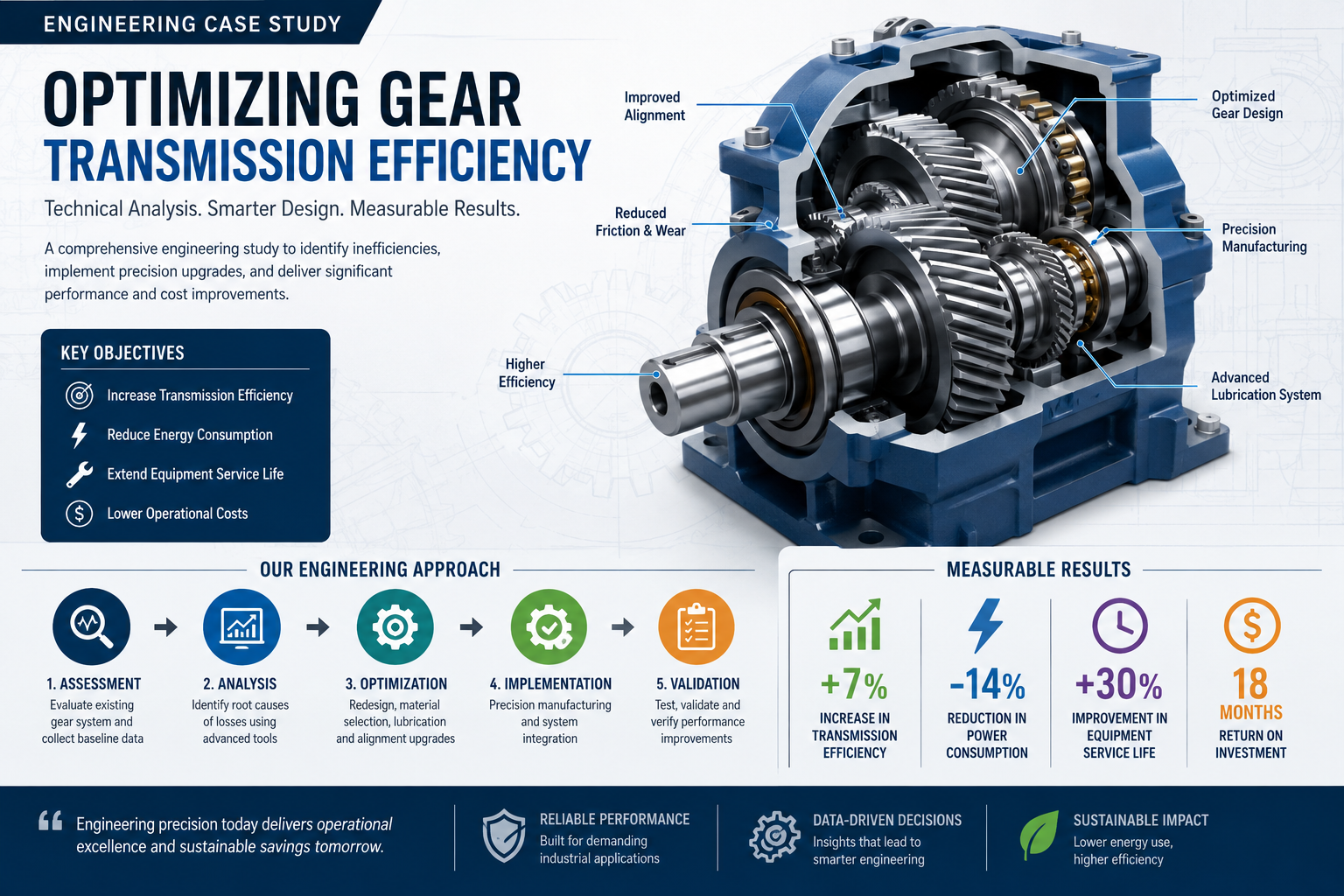
Case Study on Optimizing Gear Transmission Efficiency
Case Study on Optimizing Gear Transmission Efficiency
Transmission Efficiency has become one of the defining performance metrics in modern industrial engineering, especially in sectors where heavy-duty mechanical systems operate continuously under arduous loading conditions. From steel rolling mills to automated conveyor systems and precision robotic assemblies, enterprises are under increasing pressure to reduce energy dissipation while simultaneously maximizing operational dependability. This Engineering Case Study presents a comprehensive Technical Analysis of how an industrial client improved gearbox performance through strategic redesign, lubrication optimization, precision machining, and predictive maintenance methodologies.
1. Introduction to Gear Transmission Efficiency
1.1 Definition of Transmission Efficiency in Industrial Gear Systems
Transmission Efficiency refers to the percentage of input mechanical power successfully transferred into usable output power after accounting for frictional losses, thermal dissipation, vibration, and parasitic resistance within the drivetrain. In practical engineering terms, even a seemingly modest efficiency deviation of two or three percentage points can snowball into substantial annual energy expenditures. In heavy industry, that is where the rubber meets the road.
1.2 Why Efficiency Matters in Modern Manufacturing
Modern manufacturing facilities operate within increasingly austere economic frameworks where energy tariffs, environmental compliance obligations, and equipment reliability standards continue to tighten. High-efficiency transmission systems reduce electrical consumption, mitigate heat generation, and prolong asset longevity. Procurement departments are no longer purchasing components based solely on acquisition cost; lifecycle economics now dominate purchasing strategy.
1.3 Overview of the Engineering Case Study
The client in this Engineering Case Study operated a large-scale automated processing facility experiencing elevated energy consumption and recurrent gearbox failures. A multidisciplinary engineering initiative was launched to identify inefficiencies, implement corrective actions, and quantify operational gains through rigorous Technical Analysis.
2. Industry Background and Market Challenges
2.1 Rising Energy Costs in Industrial Operations
Escalating global electricity prices have dramatically altered operational budgeting strategies for industrial manufacturers. Facilities running continuous production schedules often discover that inefficient transmission assemblies quietly consume staggering amounts of power over time. Penny-wise and pound-foolish procurement decisions eventually catch up with operations teams.
2.2 Demand for High-Performance Mechanical Systems
Automation, high-speed production lines, and precision-driven manufacturing environments require gear systems capable of handling elevated torque loads while maintaining dimensional accuracy and low thermal distortion. Downtime tolerance has become razor-thin across most industrial sectors.
2.3 Common Efficiency Problems in Legacy Gear Assemblies
Older gearbox systems frequently suffer from micro-pitting, lubrication starvation, shaft misalignment, and excessive backlash. These deficiencies collectively amplify frictional resistance and accelerate wear propagation throughout the drivetrain architecture.
3. Client Profile and Project Objectives
3.1 Overview of the B2B Enterprise Client
The client was a multinational manufacturing enterprise operating multiple high-capacity processing lines utilizing helical and bevel gear transmission systems. Production continuity represented a mission-critical requirement due to contractual delivery obligations.
3.2 Operational Challenges Faced by the Facility
Operators reported abnormal heat accumulation, excessive vibration signatures, declining throughput stability, and increasing lubricant contamination rates. Maintenance shutdowns were becoming alarmingly frequent.
3.3 Performance Targets and Expected Outcomes
Project objectives included increasing Transmission Efficiency above 96%, reducing power consumption by double-digit percentages, extending service intervals, and lowering maintenance expenditures.
4. Original Gear Transmission System Assessment
4.1 Existing Gearbox Configuration
The facility utilized multi-stage industrial gearboxes composed primarily of carburized alloy steel gears operating under substantial radial and axial loading conditions.
4.2 Baseline Transmission Efficiency Measurements
Baseline measurements revealed average efficiency values between 88% and 91%, substantially below modern performance benchmarks.
4.3 Initial Signs of Mechanical Losses
Thermographic inspections revealed localized overheating near bearing assemblies, while vibration analysis indicated harmonic irregularities associated with alignment deficiencies.
5. Technical Analysis Methodology
5.1 Engineering Inspection Procedures
The Technical Analysis incorporated laser alignment inspections, gear mesh pattern evaluations, oil debris analysis, and thermal imaging diagnostics.
5.2 Data Collection and Monitoring Techniques
Sensors continuously monitored rotational speed, torque distribution, lubricant viscosity, and acoustic emissions throughout operational cycles.
5.3 Analytical Tools Used in the Study
Finite element analysis, computational tribology models, and predictive wear simulations were employed to identify hidden inefficiency vectors.
6. Root Causes of Low Transmission Efficiency
6.1 Gear Tooth Friction and Surface Wear
Microscopic asperities along gear tooth surfaces increased friction coefficients, resulting in measurable power losses during load transfer.
6.2 Lubrication Deficiencies and Heat Generation
Inadequate lubricant film formation allowed intermittent metal-to-metal contact, creating excessive thermal buildup and accelerated wear.
6.3 Alignment Errors and Load Imbalance
Minor shaft eccentricities produced disproportionate stress concentrations that compromised rotational smoothness and bearing integrity.
7. Gear Design Optimization Strategy
7.1 Redesigning Gear Tooth Profiles
Modified involute geometries were introduced to improve load distribution and reduce localized contact stress.
7.2 Material Selection for Reduced Energy Loss
Advanced alloy steels with enhanced surface hardness and fatigue resistance replaced conventional materials.
7.3 Surface Finishing Improvements
Superfinishing techniques reduced surface roughness and minimized frictional interaction during meshing cycles.
8. Lubrication System Improvements
8.1 Selection of High-Performance Industrial Lubricants
Synthetic lubricants possessing superior thermal stability and oxidation resistance were selected for implementation.
8.2 Optimizing Lubrication Delivery Methods
Directed oil spray systems improved lubricant penetration into critical contact zones.
8.3 Reducing Thermal Degradation in Operation
Enhanced cooling and filtration systems significantly reduced lubricant contamination and viscosity breakdown.
9. Precision Manufacturing Enhancements
9.1 Advanced CNC Gear Machining Processes
Five-axis CNC machining improved tooth geometry consistency and dimensional precision.
9.2 Tightening Tolerance Control Standards
Manufacturing tolerances were reduced to improve concentricity and rotational stability.
9.3 Improving Gear Surface Accuracy
Advanced grinding operations achieved exceptional surface uniformity across mating components.
10. Load Distribution and Alignment Corrections
10.1 Shaft Alignment Optimization Techniques
Laser-assisted shaft alignment procedures minimized angular deviation and rotational imbalance.
10.2 Bearing Configuration Improvements
Optimized bearing arrangements improved load absorption and rotational smoothness.
10.3 Reducing Vibration and Mechanical Stress
Dynamic balancing procedures reduced oscillatory forces and improved mechanical stability.
11. Testing and Validation Procedures
11.1 Pre-Optimization Performance Testing
Comprehensive operational data established a measurable baseline for comparison.
11.2 Post-Optimization Efficiency Validation
Post-upgrade testing confirmed measurable gains in Transmission Efficiency and thermal stability.
11.3 Reliability and Durability Verification
Accelerated endurance testing demonstrated improved fatigue resistance and component longevity.
12. Quantitative Results of the Engineering Case Study
12.1 Measured Increase in Transmission Efficiency
Overall efficiency improved from approximately 90% to 97%, representing a substantial operational breakthrough.
12.2 Reduction in Power Consumption
Electrical consumption decreased by nearly 14%, generating significant annual cost reductions.
12.3 Improvement in Equipment Service Life
Component lifespan projections increased by more than 30%, reducing replacement frequency.
13. Financial Impact and ROI Analysis
13.1 Operational Cost Savings Achieved
Energy savings and reduced maintenance expenditures produced immediate financial benefits.
13.2 Return on Investment Timeline
The project achieved full ROI within approximately 18 months of implementation.
13.3 Long-Term Financial Benefits for the Client
Long-term operational resilience improved procurement planning and reduced lifecycle costs.
14. Operational Benefits Beyond Efficiency
14.1 Reduced Maintenance Downtime
Unexpected shutdown frequency declined dramatically following optimization.
14.2 Improved Production Stability
Consistent torque delivery improved production throughput and process stability.
14.3 Enhanced Equipment Reliability
Operators observed substantially fewer mechanical anomalies during continuous operation.
15. Challenges Encountered During Implementation
15.1 Production Interruption Risks
Scheduling retrofit activities without disrupting production required meticulous coordination.
15.2 Engineering Integration Difficulties
Integrating upgraded systems with legacy infrastructure presented compatibility challenges.
15.3 Managing Performance Expectations
Stakeholders required realistic timelines regarding measurable efficiency gains.
16. Lessons Learned from the Technical Analysis
16.1 Importance of Data-Driven Engineering Decisions
Objective measurement and Technical Analysis remain indispensable for identifying inefficiencies accurately.
16.2 Value of Preventive Maintenance Programs
Preventive maintenance strategies proved instrumental in preserving optimized performance.
16.3 Key Takeaways for Industrial Gear Optimization
Small mechanical refinements often produce disproportionately large operational improvements.
17. Best Practices for Improving Transmission Efficiency
17.1 Regular Gear Inspection Protocols
Routine inspections help identify wear progression before catastrophic failure occurs.
17.2 Predictive Maintenance and Monitoring Systems
Condition-monitoring technologies enable proactive maintenance planning and improved reliability.
17.3 Collaboration Between Engineering and Procurement Teams
Engineering and procurement departments must work hand in glove when evaluating lifecycle value.
18. Emerging Technologies in Gear Transmission Systems
18.1 Smart Sensors and Real-Time Monitoring
IoT-enabled monitoring systems now provide instantaneous visibility into gearbox health metrics.
18.2 AI-Driven Performance Optimization
Artificial intelligence platforms increasingly identify inefficiency patterns before operators notice symptoms.
18.3 Advanced Materials and Coating Technologies
Nano-coatings and advanced metallurgy continue to redefine modern gear durability standards.
19. Recommendations for B2B Enterprise Clients
19.1 Evaluating Existing Transmission Systems
Comprehensive audits should be conducted before major procurement decisions are finalized.
19.2 Choosing the Right Gear Manufacturing Partner
Suppliers should demonstrate proven expertise in precision manufacturing and performance validation.
19.3 Building a Long-Term Efficiency Improvement Strategy
Sustainable efficiency gains require long-term engineering collaboration and continuous monitoring.
20. Conclusion and Future Outlook
20.1 Summary of the Engineering Case Study
This Engineering Case Study demonstrated how systematic Technical Analysis, precision engineering, and operational discipline significantly improved Transmission Efficiency while reducing operational expenditure.
20.2 Future Trends in Transmission Efficiency Optimization
Future gearbox systems will increasingly incorporate AI diagnostics, adaptive lubrication technologies, and intelligent predictive analytics to maximize performance under dynamic operating conditions.
20.3 Final Insights for Industrial Decision-Makers
Industrial competitiveness increasingly depends upon mechanical efficiency, operational reliability, and lifecycle cost optimization. Companies that ignore gearbox efficiency improvements today may find themselves fighting an uphill battle tomorrow.