Future Gear Industry Trends and Industry 4.0
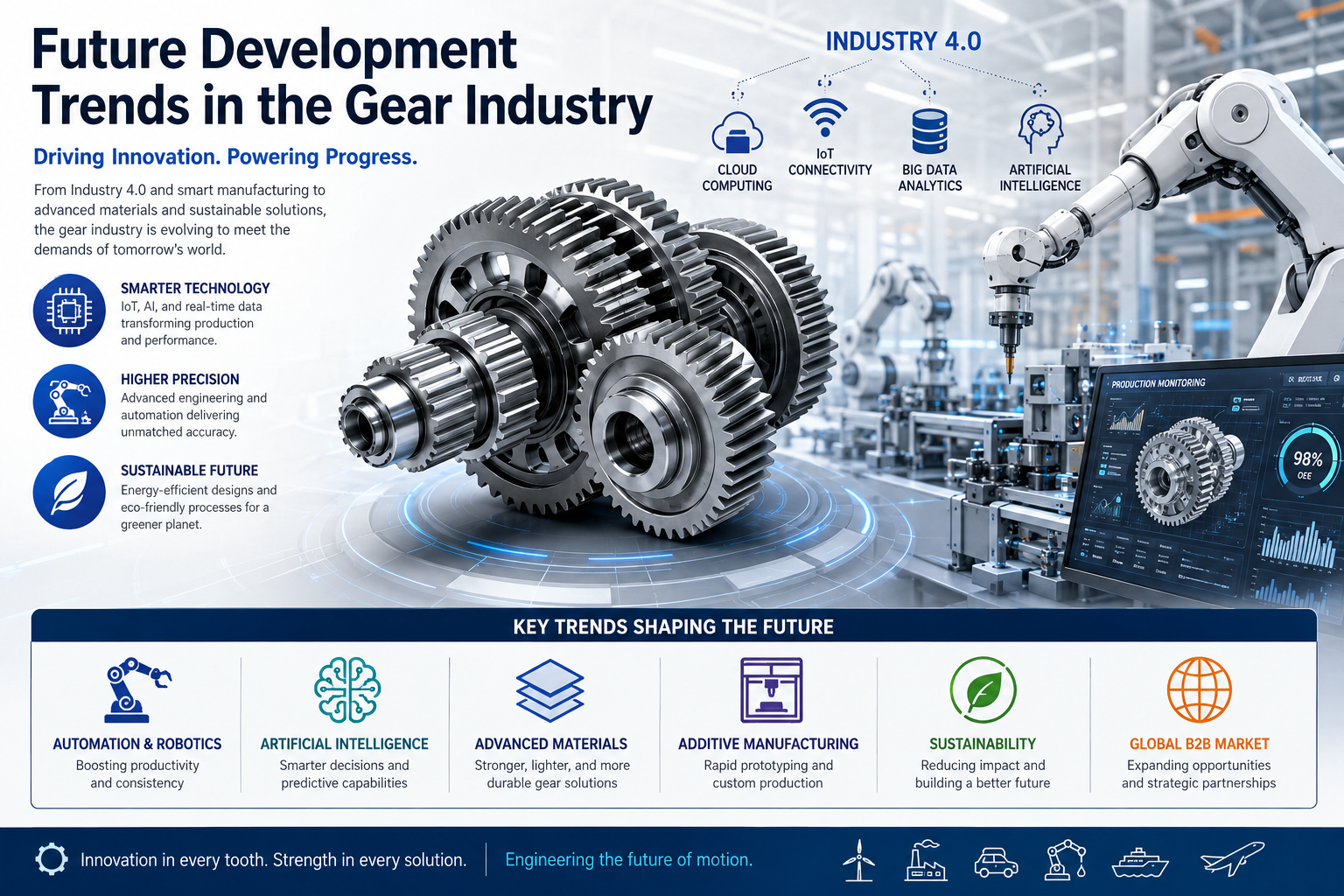
Future Development Trends in the Gear Industry
1. Introduction to the Future of the Gear Industry
1.1 Overview of Global Gear Manufacturing Evolution
The gear industry has traveled a remarkable path from conventional casting and machining practices to highly sophisticated manufacturing ecosystems driven by digitalization, automation, and precision engineering. Historically, gears were viewed as simple mechanical components responsible for transmitting torque and motion. Today, they have evolved into mission-critical elements that directly influence efficiency, reliability, and performance across countless industrial applications.
As manufacturing technologies continue to mature, gear producers are increasingly integrating advanced machining centers, simulation software, intelligent inspection systems, and automated production lines. The result is a sector characterized by tighter tolerances, improved material performance, and significantly enhanced production consistency.
1.2 Why Gear Technology Trends Matter in Modern Industry
In modern industrial environments, equipment uptime, energy efficiency, and operational reliability are no longer optional—they are business imperatives. Gear systems sit at the heart of power transmission in industries ranging from automotive and aerospace to mining and renewable energy.
Emerging gear technology trends are enabling manufacturers to deliver higher load capacities, reduced friction losses, and extended service life. For procurement professionals and engineering teams alike, understanding these developments is becoming increasingly important because today's purchasing decisions often determine tomorrow's operational competitiveness.
1.3 The Growing Role of B2B Market Demands in Innovation
B2B customers are no longer satisfied with standard catalog products. Instead, they seek customized gear solutions tailored to specific operating conditions, performance requirements, and lifecycle expectations.
This shift is compelling manufacturers to accelerate innovation, adopt flexible production methods, and collaborate more closely with clients. As the saying goes, "the customer is in the driver's seat," and nowhere is this more evident than in the rapidly evolving gear industry.
2. The Current State of the Global Gear Industry
2.1 Market Size and Industrial Growth Forecasts
The global gear industry continues to experience steady expansion, supported by industrial automation, infrastructure development, electric vehicle adoption, and increasing investments in advanced manufacturing. Market analysts anticipate sustained growth over the coming decade as industrial equipment becomes more sophisticated and energy-efficient.
2.2 Key Sectors Driving Gear Demand
- Automotive and electric vehicles
- Industrial machinery
- Renewable energy
- Aerospace and defense
- Construction equipment
- Robotics and automation
- Mining and material handling
Each of these industries requires specialized gear solutions capable of operating under unique performance conditions.
2.3 Competitive Landscape Among Global Manufacturers
Competition is intensifying as manufacturers pursue technological differentiation rather than competing solely on price. Companies investing heavily in research and development are gaining advantages through superior precision, reliability, and production efficiency.
3. Major Gear Technology Trends Reshaping the Industry
3.1 Smart Gear Systems and Intelligent Components
Smart gears equipped with embedded sensors represent one of the most transformative developments in modern power transmission systems. These components can continuously monitor vibration, temperature, load conditions, and wear patterns.
3.2 High-Precision Engineering Developments
Precision has become the cornerstone of modern gear manufacturing. Advanced grinding, honing, and finishing technologies now achieve microscopic accuracy levels that were previously unimaginable.
3.3 Energy-Efficient Gear Design Innovations
Energy losses within transmission systems represent a substantial operational expense. Consequently, engineers are focusing on optimized tooth profiles, reduced friction surfaces, and advanced lubrication systems.
4. Industry 4.0 and Digital Transformation in Gear Manufacturing
4.1 Integration of IoT in Gear Production
The Internet of Things (IoT) is fundamentally changing manufacturing environments. Connected machines continuously communicate operational data, enabling real-time visibility across production processes.
4.2 Real-Time Monitoring and Predictive Maintenance
Predictive maintenance has become a game-changer. Instead of relying on fixed maintenance intervals, companies use sensor-generated data to determine actual equipment conditions.
4.3 Data-Driven Manufacturing Decision Processes
Modern factories generate vast quantities of production data. Advanced analytics transform this information into actionable insights that improve quality control, scheduling efficiency, and resource allocation.
5. Automation and Robotics in Gear Production
5.1 Automated CNC Machining Systems
Modern CNC systems offer exceptional repeatability and precision while reducing dependence on manual intervention. Automated loading and unloading systems further increase productivity.
5.2 Robotics for Precision Assembly Operations
Industrial robots are increasingly utilized for assembly, inspection, and material handling tasks. Their ability to perform repetitive operations with consistent accuracy significantly improves production reliability.
5.3 Labor Efficiency and Cost Optimization Benefits
Automation helps address labor shortages while reducing operational costs. Although initial investments can be substantial, long-term productivity gains often justify the expenditure.
6. Artificial Intelligence Applications in the Gear Industry
6.1 AI-Powered Quality Inspection Systems
Computer vision systems powered by artificial intelligence can identify microscopic defects that may escape human inspection. This enhances product consistency and reduces quality-related risks.
6.2 Machine Learning for Production Optimization
Machine learning algorithms continuously analyze manufacturing data to identify opportunities for process improvement.
6.3 AI-Based Demand Forecasting in the B2B Market
Accurate demand forecasting allows manufacturers to optimize inventory levels, reduce excess stock, and improve supply chain responsiveness.
7. Advanced Materials Transforming Gear Manufacturing
7.1 Lightweight Composite Materials
Composite materials offer attractive strength-to-weight ratios and are becoming increasingly relevant in transportation and aerospace applications.
7.2 High-Strength Alloys and Surface Treatments
Advanced alloys combined with specialized heat treatment and coating technologies significantly enhance gear performance under demanding operating conditions.
7.3 Wear Resistance and Durability Improvements
Improved material science is extending service intervals and reducing maintenance requirements, creating substantial lifecycle cost benefits.
8. Additive Manufacturing and 3D Printing Technologies
8.1 Rapid Prototyping for Gear Design
3D printing enables engineers to quickly evaluate design concepts before committing to full-scale production.
8.2 Custom Gear Production for Industrial Applications
Low-volume, highly specialized gear designs can now be produced economically using additive manufacturing technologies.
8.3 Cost and Time Advantages of Additive Manufacturing
Faster iteration cycles, reduced tooling costs, and improved design flexibility make additive manufacturing increasingly attractive.
9. Sustainability Trends in the Gear Industry
9.1 Eco-Friendly Manufacturing Processes
Manufacturers are adopting cleaner production techniques, reducing waste generation and minimizing environmental impact.
9.2 Energy Conservation and Carbon Reduction Goals
Organizations across the supply chain are implementing initiatives aimed at lowering energy consumption and supporting carbon neutrality objectives.
9.3 Circular Economy and Material Recycling Strategies
Recycling metals, reclaiming materials, and extending product lifecycles are becoming important strategic priorities.
10. The Rise of Smart Factories in Gear Manufacturing
10.1 Fully Connected Production Environments
Smart factories connect machines, software, operators, and supply chains into a unified digital ecosystem.
10.2 Digital Twins and Simulation Technologies
Digital twins allow engineers to simulate equipment performance before physical deployment, reducing risk and accelerating optimization.
10.3 Cloud-Based Manufacturing Management Systems
Cloud technologies improve accessibility, collaboration, and decision-making across geographically distributed operations.
11. Supply Chain Evolution in the Global B2B Market
11.1 Supply Chain Digitization and Transparency
Digital platforms provide enhanced visibility into inventory levels, production schedules, and supplier performance.
11.2 Risk Management and Resilient Sourcing Strategies
Recent global disruptions have highlighted the importance of diversified sourcing and contingency planning.
11.3 Regional Manufacturing and Localization Trends
Many companies are adopting regional manufacturing strategies to improve supply chain resilience and reduce transportation risks.
12. Customization and Client-Centric Manufacturing
12.1 Increasing Demand for Tailored Gear Solutions
Customers increasingly require application-specific gear systems optimized for unique operational environments.
12.2 Flexible Manufacturing Systems for B2B Clients
Flexible production technologies allow manufacturers to accommodate smaller batch sizes without sacrificing efficiency.
12.3 Faster Product Development Cycles
Digital design tools and collaborative engineering approaches are significantly reducing product development timelines.
13. Cybersecurity Challenges in Industry 4.0 Manufacturing
13.1 Risks Associated with Connected Production Systems
Greater connectivity creates increased exposure to cyber threats and operational disruptions.
13.2 Protecting Industrial Data and Intellectual Property
Safeguarding proprietary designs, production data, and customer information has become a strategic necessity.
13.3 Best Practices for Cybersecurity Compliance
Robust cybersecurity frameworks, employee training, and continuous monitoring are essential components of modern manufacturing operations.
14. Emerging Applications Driving Gear Industry Growth
14.1 Electric Vehicles and E-Mobility Systems
Electric drivetrains require highly specialized gear systems designed for efficiency, durability, and low-noise operation.
14.2 Renewable Energy Equipment and Wind Turbines
Wind turbines rely heavily on advanced gearboxes capable of handling enormous loads while maintaining reliability.
14.3 Aerospace, Robotics, and Automation Industries
These sectors demand exceptional precision, lightweight construction, and superior performance characteristics.
15. Global Market Opportunities and Regional Trends
15.1 Growth Opportunities in Asia-Pacific Markets
Rapid industrialization and manufacturing expansion continue to drive substantial demand throughout the region.
15.2 North American and European Innovation Hubs
These regions remain leaders in advanced engineering, automation, and high-value manufacturing technologies.
15.3 Expansion Potential in Emerging Economies
Developing economies present attractive opportunities for long-term market growth and investment.
16. Challenges Facing the Future Gear Industry
16.1 Rising Raw Material Costs and Supply Constraints
Volatile material prices continue to challenge manufacturers and procurement professionals alike.
16.2 Skilled Workforce Shortages in Advanced Manufacturing
Finding qualified engineers, machinists, and technical specialists remains a persistent industry concern.
16.3 Adapting to Rapid Technological Changes
Companies must continuously invest in training, equipment, and innovation to remain competitive.
17. Investment Trends and Strategic Partnerships
17.1 Increasing Investments in Smart Manufacturing
Capital investments increasingly target automation, digitalization, and intelligent production technologies.
17.2 Mergers, Acquisitions, and Industry Consolidation
Consolidation enables companies to expand technological capabilities and strengthen market presence.
17.3 Collaborations Between Technology Providers and Manufacturers
Strategic partnerships accelerate innovation and facilitate the adoption of emerging technologies.
18. Future Outlook for Gear Technology Trends
18.1 Predictions for the Next Decade of Innovation
The next decade will likely witness significant advances in intelligent systems, advanced materials, and autonomous manufacturing technologies.
18.2 How Industry 4.0 Will Continue to Shape Manufacturing
Industry 4.0 initiatives will increasingly blur the boundaries between physical production systems and digital intelligence platforms.
18.3 Strategic Recommendations for B2B Enterprise Clients
Enterprise buyers should prioritize suppliers that demonstrate technological competence, quality consistency, digital capabilities, and long-term innovation strategies.
19. Conclusion
19.1 Key Takeaways from Emerging Gear Industry Trends
The gear industry is entering an era characterized by unprecedented technological advancement, driven by automation, digitalization, artificial intelligence, and sustainability initiatives.
19.2 Preparing Businesses for Future Market Changes
Organizations that proactively embrace innovation will be better positioned to navigate evolving customer expectations and competitive pressures.
19.3 Long-Term Competitive Advantages Through Innovation
From a mechanical engineering perspective and a procurement standpoint, the future belongs to companies capable of combining technical excellence, operational agility, and strategic foresight. Those that invest in smart manufacturing, advanced materials, and customer-focused solutions will not merely keep pace with industry evolution—they will help define it.
In an increasingly competitive global marketplace, standing still is not an option. The gears of progress are already turning, and the organizations prepared to move with them will secure the strongest position in the years ahead.