Table of Contents
System of Gears: Build a Stronger Supply Chain Faster
1. Introduction: Why System of Gears Procurement Shapes Supply Chain Performance
Growing Pressure on Procurement Teams to Improve Speed and Resilience
Modern industrial procurement no longer operates as a transactional back-office function. In sectors where rotating equipment, transmission assemblies, automated production lines, and precision mechanical systems define output capability, procurement has evolved into a strategic command center responsible for sustaining velocity, quality continuity, and operational resilience.
Mechanical engineers and purchase engineers are increasingly expected to deliver an uncomfortable trio simultaneously: lower costs, shorter lead times, and superior reliability. That balancing act becomes especially demanding when sourcing a system of gears because these components sit at the nexus of motion transmission, torque conversion, and equipment longevity.
Market volatility, transportation disruptions, fluctuating raw material pricing, and compressed product development cycles have changed the procurement landscape dramatically. What worked five years ago—a single approved vendor, quarterly ordering cadence, and reactive inventory policies—can now become a bottleneck overnight.
Procurement teams are under mounting scrutiny because every delayed shipment or dimensional inconsistency eventually surfaces on the production floor. When assembly lines stop, nobody asks where the purchase order stalled; they ask why continuity planning failed.
In practical terms, resilient procurement means building sourcing ecosystems capable of absorbing shocks without compromising engineering specifications. That requires disciplined supplier qualification, proactive demand planning, and tighter synchronization between engineering and purchasing functions.
The Strategic Role of Gear Systems in Manufacturing Continuity
A system of gears is rarely treated as a glamorous product category, yet its influence stretches across virtually every industrial process. Whether embedded in robotic actuators, heavy machinery, industrial conveyors, packaging equipment, agricultural systems, or precision automation cells, gear assemblies transform energy into controlled mechanical motion.
When gear procurement performs poorly, consequences compound rapidly. Microscopic deviations in tooth geometry can amplify vibration. Material inconsistency may accelerate wear. Surface treatment defects can reduce fatigue life. Lead-time variability can delay complete assemblies.
Procurement professionals increasingly evaluate gear suppliers not merely as component vendors but as strategic manufacturing partners. The conversation has shifted from “Can you produce?” toward “Can you maintain continuity under changing conditions?”
Strong gear sourcing strategies therefore include:
- Capacity transparency
- Process capability verification
- Engineering support accessibility
- Supply redundancy planning
- Continuous quality feedback loops
A robust system of gears procurement framework reduces operational fragility and creates a supply chain that moves faster without becoming brittle.
Common Sourcing Challenges Faced by Global Buyers
Global sourcing offers scale advantages but introduces multidimensional complexity. One recurring challenge involves specification ambiguity. Engineering drawings may appear complete while leaving critical manufacturing variables undefined—heat treatment routes, inspection methods, grinding allowances, or surface finish expectations.
Another challenge is supplier overdependence. Many procurement teams discover too late that multiple “independent” vendors actually share the same upstream forging, machining, or heat-treatment infrastructure.
Communication latency also creates hidden costs. Time-zone differences, fragmented approval chains, and inconsistent technical interpretation often transform minor revisions into schedule derailments. Quality variability remains another persistent obstacle. Initial samples may pass qualification while production lots drift due to insufficient process control.
Then there is the classic trap every seasoned buyer recognizes: chasing the lowest quoted price and discovering later that freight premiums, quality containment actions, downtime losses, and emergency air shipments quietly erased every apparent saving.
The lesson is straightforward—buying gears is easy; building a supply chain around gear systems that remains stable under pressure is where procurement expertise earns its keep.
2. Understanding the System of Gears and Its Industrial Importance
Definition and Operating Principles of a Gear System
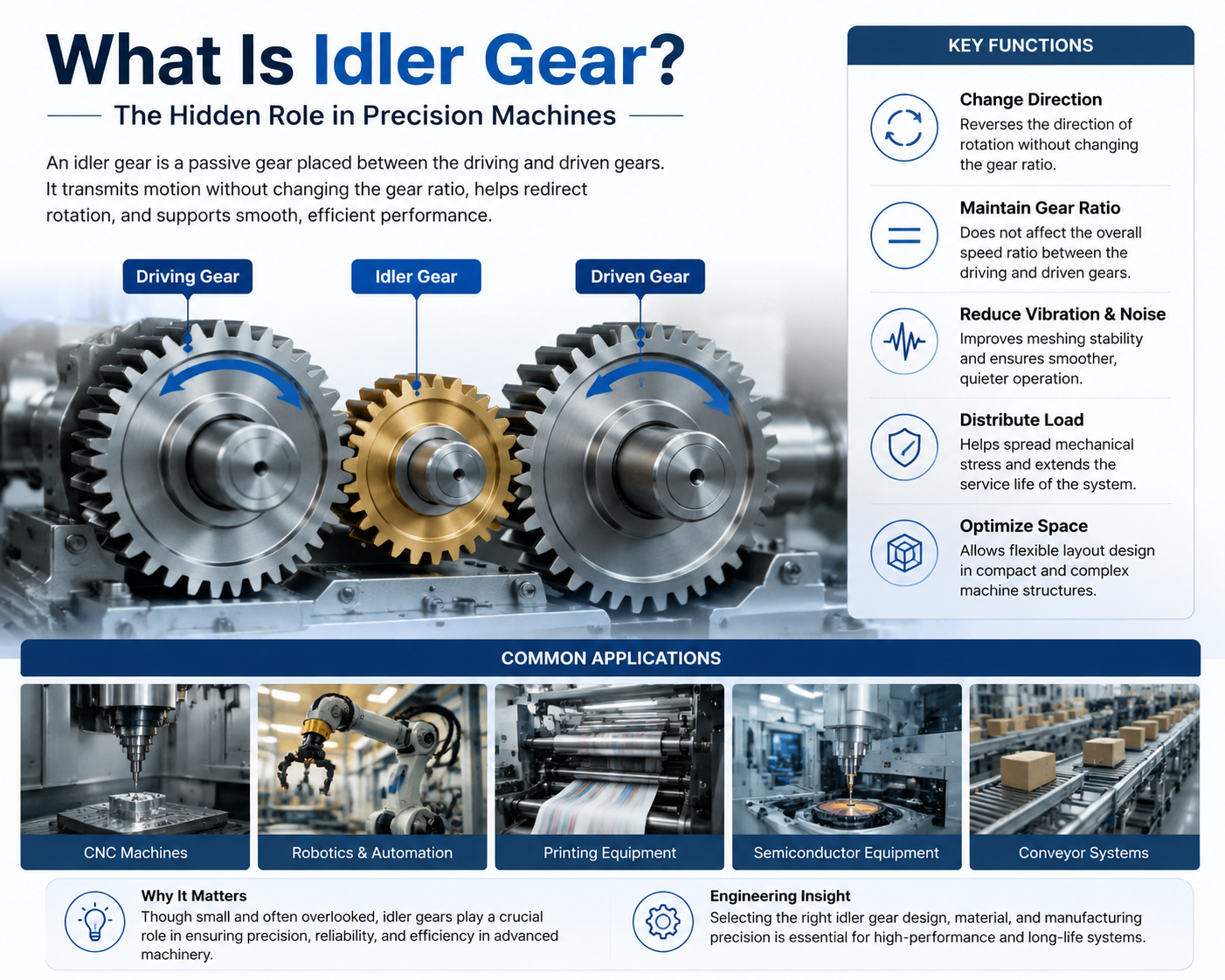
A system of gears refers to an integrated mechanical arrangement where multiple gears interact to transfer rotational energy, modify torque characteristics, control speed, or alter motion direction.
At its core, gear operation depends upon controlled tooth engagement. As one gear rotates, force transfers through meshing surfaces and produces synchronized movement.
However, industrial gear systems extend far beyond textbook gear ratios. Modern assemblies often incorporate:
- Multi-stage reduction systems
- Compound gearing
- Differential arrangements
- Precision backlash control
- Thermal compensation mechanisms
Performance depends on variables including tooth profile accuracy, module selection, contact ratio, lubrication strategy, surface hardness, and alignment precision. Procurement professionals who understand these variables gain a substantial advantage because supplier evaluation becomes evidence-based rather than quotation-driven.
Key Industries That Rely on Integrated Gear Systems
Gear systems quietly underpin industrial civilization. Automotive manufacturers rely on transmission systems and steering mechanisms. Industrial automation depends on servo-driven reduction gear assemblies. Construction equipment requires torque-intensive gearboxes capable of surviving extreme operating environments. Energy applications—from wind turbines to industrial generators—depend heavily upon long-life gearing solutions. Food processing equipment demands hygienic and reliable transmission systems. Mining operations require heavy-duty assemblies designed for sustained overload conditions.
Across all sectors, procurement decisions surrounding gear systems influence uptime, maintenance cost, and capital efficiency. More technical reference on gear applications can be found at ASME.org.
How Gear Performance Influences Production Efficiency
Production efficiency is often discussed in percentages, yet gear performance determines whether those percentages remain theoretical or become reality. High-efficiency gear systems reduce transmission losses and lower energy consumption. Stable tooth engagement minimizes vibration and preserves machine accuracy. Improved wear resistance reduces maintenance intervals. Dimensional consistency accelerates assembly throughput.
In contrast, unstable gear performance creates cascading inefficiencies: higher reject rates, increased maintenance labor, unexpected shutdowns, excess inventory buffers, and customer delivery delays. Experienced purchase engineers understand that productivity gains rarely originate from buying cheaper parts—they emerge from reducing operational friction.
3. Mapping Supply Chain Risks in Gear Procurement
Identifying Hidden Supplier Dependencies
Supplier concentration risk frequently remains invisible until disruption occurs. Procurement teams must investigate entire manufacturing ecosystems rather than direct vendors alone.
Questions worth asking include:
- Who performs heat treatment?
- Where are forgings sourced?
- Is grinding internal or subcontracted?
- Are critical inspection processes outsourced?
Dependency mapping reveals hidden chokepoints before they become operational emergencies.
Managing Regional and Geopolitical Supply Risks
Global procurement exposes organizations to policy shifts, logistics disruption, tariff fluctuations, and regional instability. A resilient sourcing strategy distributes manufacturing capability across multiple regions and maintains alternate qualification pathways. Forward-looking procurement teams treat geographic diversification as operational insurance rather than redundant cost.
Preventing Inventory Shortages and Production Delays
Inventory shortages rarely originate from inventory itself. Root causes typically include forecast inaccuracy, supplier variability, engineering revisions, and long approval cycles. Effective prevention combines demand visibility, collaborative planning, supplier integration, and disciplined reorder governance. Because in manufacturing, the fastest shipment is still slower than inventory already positioned where production needs it.
4. Defining Procurement Objectives Before Supplier Selection
Aligning Engineering Requirements with Purchasing Goals
One of the most persistent inefficiencies in industrial sourcing emerges when engineering and procurement pursue different definitions of success. Engineering teams prioritize performance, durability, precision, and technical compliance, while procurement departments focus on lead-time compression, cost control, supplier responsiveness, and inventory efficiency.
Specification packages should include functional performance expectations, operating environment conditions, reliability targets, service life requirements, inspection methodology, and acceptance standards. Cross-functional workshops often produce better sourcing outcomes than isolated RFQs, as engineers define critical-to-quality parameters while purchasing identifies commercially sustainable sourcing paths.
Setting Cost, Quality, and Lead-Time Benchmarks
Benchmarking is not about selecting the lowest number—it is about defining acceptable operating boundaries. Cost benchmarks should include material assumptions, processing requirements, logistics conditions, and packaging expectations. Quality benchmarks should define dimensional tolerances, defect limits, inspection frequencies, and reliability targets. Lead-time benchmarks should distinguish prototype timing, initial production timing, repeat order timing, and emergency replenishment timing.
Creating Measurable Sourcing KPIs
Procurement maturity begins when decisions become measurable. Useful gear procurement KPIs include on-time delivery performance, first-pass acceptance rate, supplier response cycle, inventory turns, engineering change implementation speed, and cost avoidance ratio. Measurement transforms sourcing from a reactive purchasing activity into an iterative improvement system.
Additional resources on industrial gear standards and procurement strategy are available at NIST.gov and Gears.org.
5. Types of Gear Systems and Their Supply Chain Implications
Spur, Helical, Bevel, and Planetary Gear Systems
Different gear architectures create entirely different sourcing realities.
Spur gears remain popular because of manufacturing simplicity and cost efficiency. Their straightforward geometry supports easier inspection and relatively predictable supply chains.
Helical gears introduce smoother engagement and greater load capacity but require tighter manufacturing control and more advanced machining capability.
Bevel gears enable directional power transfer and often demand elevated precision during machining and assembly.
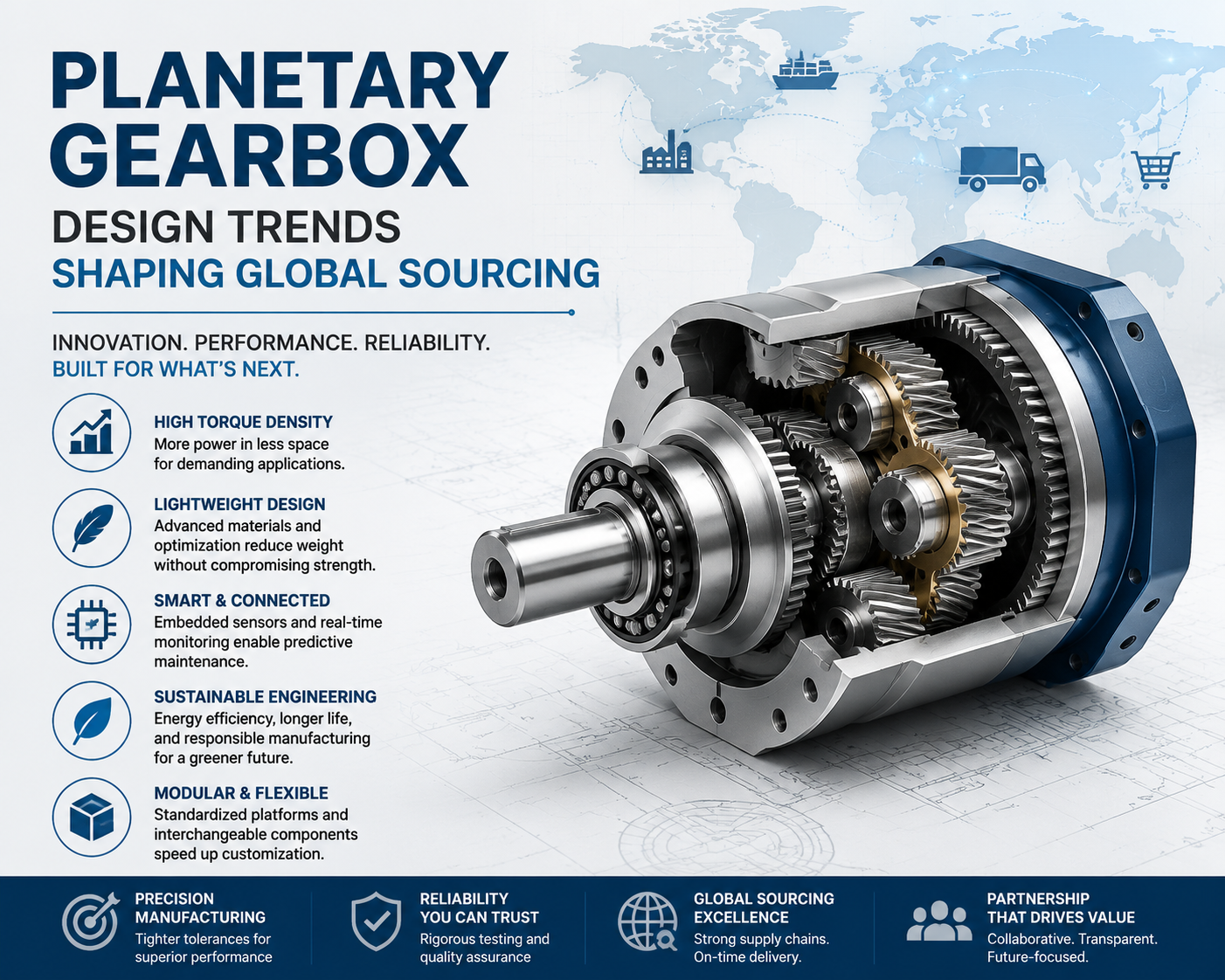
Planetary gear systems offer exceptional torque density and compact packaging, though their integrated structure increases production complexity.
Each configuration carries unique implications for:
- Tooling requirements
- Inspection complexity
- Production lead time
- Supplier specialization
- Inventory planning
Understanding those implications prevents procurement teams from applying identical sourcing methods to fundamentally different products.
Selecting Configurations for Different Applications
Selecting gear architecture should begin with application requirements rather than historical purchasing habits.
Questions that guide selection include:
- What torque levels must be transmitted?
- What operating temperatures exist?
- Is noise reduction critical?
- Are compact dimensions required?
- What maintenance interval is expected?
A conveyor application may prioritize durability and maintenance simplicity.
A robotics application may emphasize backlash control and positioning accuracy.
A heavy industrial environment may require impact resistance and contamination tolerance.
Procurement accelerates when selection criteria are standardized early.
Balancing Customization and Standardization
Customization offers differentiation.
Standardization offers speed.
Supply chain leaders understand the value of balancing both.
Over-customization increases:
- Qualification workload
- Inventory complexity
- Supplier dependency
- Change management burden
Over-standardization may reduce performance optimization.
A practical strategy separates components into categories:
- Strategic custom elements
- Standard industrial elements
- Configurable modular assemblies
This layered approach often reduces procurement friction without sacrificing engineering intent.
6. Critical Technical Specifications Buyers Must Evaluate
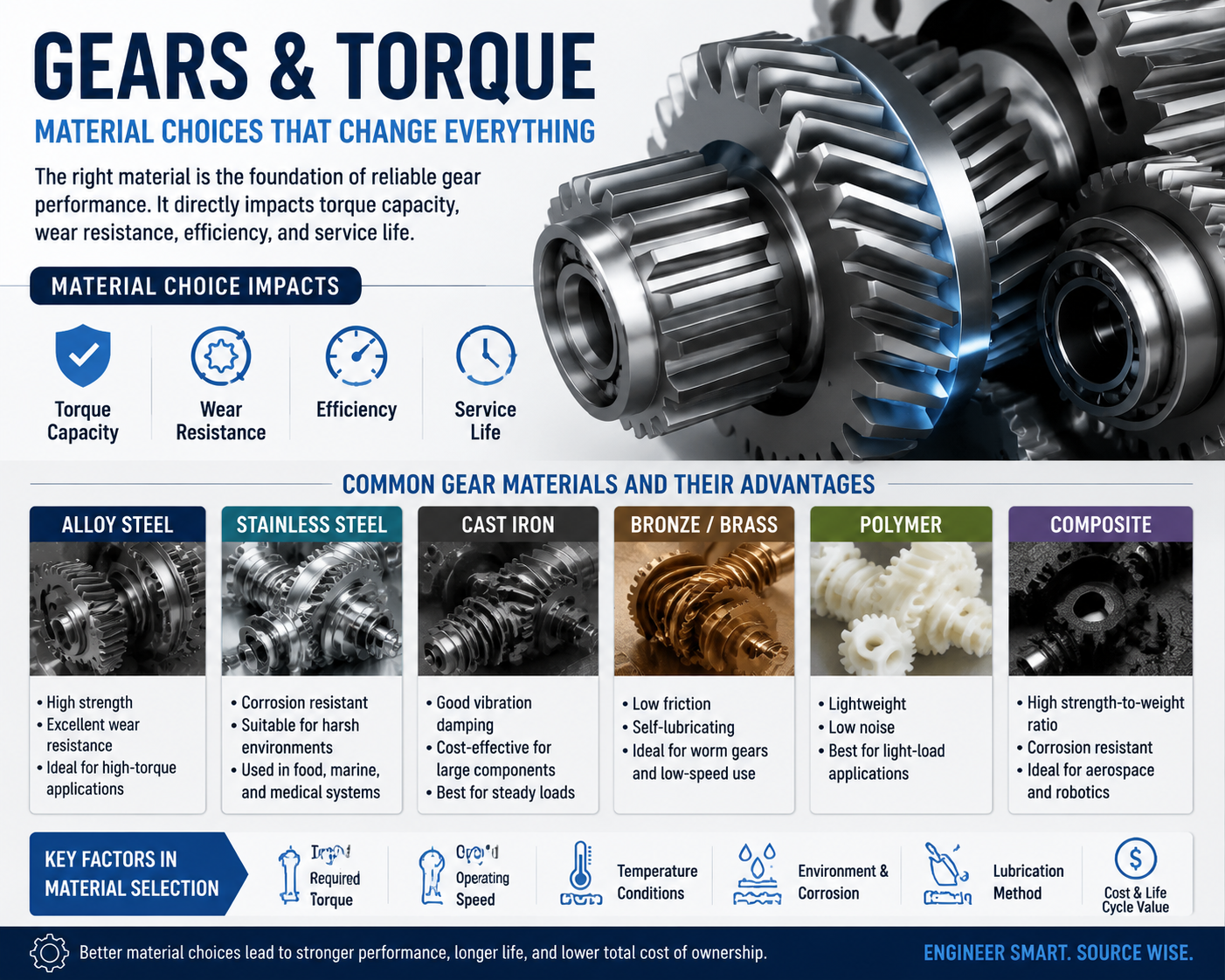
Material Selection and Durability Requirements
Material selection remains one of the most consequential decisions in gear procurement.
The selected alloy influences:
- Strength
- Fatigue resistance
- Machinability
- Heat-treatment response
- Lifecycle economics
Common material approaches include:
- Carbon steels
- Alloy steels
- Case-hardening grades
- Stainless variants
- Specialty engineered materials
Material decisions should consider actual operating conditions instead of relying on legacy specifications.
Overengineering increases unnecessary cost.
Underengineering invites premature failure.
Successful procurement finds the narrow corridor between both extremes.
Reference: ASME
Tolerance Control and Dimensional Consistency
Precision defines performance.
Even modest dimensional drift can generate measurable changes in:
- Contact patterns
- Noise levels
- Efficiency
- Service life
Critical control areas include:
- Pitch accuracy
- Runout
- Concentricity
- Tooth profile
- Surface roughness
Procurement teams should request documented process capability and inspection consistency.
Good parts are valuable.
Predictably good parts are what supply chains are built upon.
Load Capacity and Operational Lifespan
Load requirements extend beyond maximum torque figures.
Real-world applications introduce:
- Shock loading
- Variable duty cycles
- Thermal expansion
- Cyclic fatigue
Reliable suppliers validate capacity assumptions through engineering analysis and production controls.
Lifecycle evaluation should include:
- Mean operating hours
- Maintenance intervals
- Replacement cost
- Downtime impact
Procurement decisions become stronger when operating lifespan becomes a sourcing criterion rather than an afterthought.
7. How OEM and ODM Models Accelerate Supply Chain Strength
Comparing OEM Versus ODM Sourcing Approaches
OEM sourcing follows buyer-defined engineering.
ODM sourcing introduces supplier-driven development capability.
OEM offers:
- Greater design ownership
- Specification control
- Proprietary protection
ODM offers:
- Faster market entry
- Engineering support
- Reduced development burden
The right model depends upon organizational priorities.
Many leading procurement teams increasingly combine both approaches to maximize flexibility.
Reducing Engineering Workload Through Collaboration
Supplier collaboration compresses development cycles.
Qualified manufacturers frequently contribute:
- Manufacturability feedback
- Process optimization
- Cost reduction ideas
- Material alternatives
This collaboration allows internal engineering teams to concentrate on strategic innovation instead of repetitive redesign.
Strong partnerships create an environment where technical problems are solved upstream instead of corrected downstream.
Scaling Production With Flexible Manufacturing
Supply chains strengthen when suppliers scale without destabilizing quality.
Flexible manufacturing typically includes:
- Modular production cells
- Rapid tooling changes
- Integrated inspection
- Capacity buffering
Procurement should validate whether scaling capability is operational reality or merely sales terminology.
Because when demand doubles, promises alone do not ship parts.
8. Building a Reliable Global Supplier Qualification Framework
Evaluating Manufacturing Capability
Supplier capability is the foundation of consistent gear performance. Procurement teams should assess whether suppliers possess:
- Precision machining equipment
- Heat treatment facilities
- Surface finishing and grinding capabilities
- In-house inspection and metrology tools
Capability assessment also includes workforce expertise, process documentation, and production planning rigor. Suppliers with documented repeatability minimize variability and risk.
Auditing Quality Management Systems
ISO 9001, IATF 16949, and other industry certifications provide initial confidence, but audits should verify actual practice versus documentation. Look for:
- Internal audit frequency and outcomes
- Statistical process control usage
- Non-conformance resolution mechanisms
- Continuous improvement programs
Quality systems are only effective if rigorously applied to daily operations, especially in precision gear production.
Assessing Financial and Operational Stability
Supplier stability directly affects supply chain resilience. Key considerations include:
- Financial health and liquidity
- Order fulfillment history
- Production capacity and lead-time reliability
- Dependency on critical sub-suppliers
Procurement should combine operational audits with financial risk assessment to ensure continuity under market or geopolitical stress.
9. Supplier Capacity Planning and Lead-Time Optimization
Understanding Production Scheduling Practices
Lead-time performance is driven by supplier scheduling discipline. Procurement professionals should evaluate:
- Master production scheduling processes
- Flexibility to handle rush orders
- Capacity utilization and bottleneck management
- Communication of schedule deviations
Transparent scheduling practices reduce surprises and enable better internal planning.
Managing Peak-Demand Scenarios
High-demand periods expose suppliers’ true capacity. Effective planning may include:
- Seasonal inventory buffers
- Production overtime policies
- Alternate sourcing strategies
- Priority allocation agreements
Anticipating peaks avoids emergency air shipments and production delays.
Creating Responsive Replenishment Systems
Responsive replenishment relies on timely data, clear agreements, and monitoring tools. Key practices include:
- Pull-based ordering and kanban systems
- Collaborative forecast sharing
- Safety stock optimization
- Digital alerts for order changes
These mechanisms ensure parts arrive when needed without overstocking, balancing cash flow with operational reliability.
10. Quality Control Systems That Reduce Procurement Risk
Incoming Inspection and Process Validation
Receiving inspection is the first line of defense against defective components. Procurement teams should insist on:
- Dimensional verification
- Material certification checks
- Functional testing of critical assemblies
- Sample batch validation before full production
Proper validation ensures that upstream defects do not cascade into assembly downtime or customer complaints.
Statistical Quality Monitoring Methods
Statistical process control (SPC) provides continuous insight into production stability. Useful tools include:
- Control charts for critical dimensions
- Process capability (Cp/Cpk) analysis
- Trend analysis for wear and tear
- Random sampling audits
SPC allows procurement and engineering teams to detect deviations early and prevent widespread impact.
Corrective Action and Continuous Improvement Programs
Effective suppliers integrate corrective action and continuous improvement into their operations. Procurement should monitor:
- Root cause analysis rigor
- CAPA (Corrective and Preventive Action) implementation
- Follow-up audit results
- Supplier-led innovation to prevent recurrence
Continuous improvement aligns supplier performance with long-term operational goals, reducing unexpected risks in the supply chain.
11. Cost Engineering Strategies for Long-Term Savings
Moving Beyond Unit-Price Comparisons
Focusing solely on unit price often masks hidden costs. Procurement should evaluate:
- Process-related scrap and rework
- Maintenance and downtime impacts
- Inspection and quality assurance effort
- Freight and logistics charges
Total cost analysis provides a more accurate understanding of supplier value over time.
Calculating Total Cost of Ownership
Total cost of ownership (TCO) includes acquisition, installation, operation, and disposal costs. For gears, this may include:
- Energy losses due to efficiency variation
- Replacement cycle and spare parts inventory
- Labor for installation and maintenance
- Warranty claims and failure mitigation
Evaluating TCO shifts procurement decisions toward suppliers who deliver consistent, reliable performance.
Identifying Hidden Operational Expenses
Hidden costs include:
- Extended lead times causing line downtime
- Emergency airfreight for missed shipments
- Non-conformance containment and rework
- Engineering redesign for supplier limitations
Awareness of these expenses enables purchase engineers to make decisions that reduce total supply chain friction.
12. Digital Procurement Tools for Faster Decision-Making
Using Supplier Performance Dashboards
Procurement velocity improves when decisions are driven by visible signals instead of fragmented spreadsheets and institutional memory.
Supplier performance dashboards convert dispersed operational data into actionable intelligence.
High-value dashboard metrics commonly include:
- On-time delivery performance
- Quality acceptance rates
- Quote turnaround speed
- Engineering response time
- Capacity utilization trends
- Corrective action closure cycles
For system of gears procurement, dashboard visibility becomes especially valuable because small process fluctuations can create downstream operational consequences.
The strongest dashboards emphasize exceptions and allow procurement teams to intervene before issues become disruptions.
Integrating Procurement and ERP Platforms
Disconnected systems create invisible friction.
Engineering stores specifications in one location while procurement manages purchase orders elsewhere and inventory resides in another environment.
ERP integration creates a synchronized operational backbone.
Integrated environments allow organizations to:
- Connect demand forecasts to purchasing
- Track inventory in real time
- Manage engineering revisions
- Standardize supplier communication
- Improve order traceability
For gear procurement, integrated platforms reduce revision errors and accelerate execution.
Applying Predictive Analytics in Sourcing
Historical data increasingly predicts future behavior.
Predictive analytics helps organizations anticipate:
- Demand changes
- Supplier delays
- Material volatility
- Inventory shortages
- Capacity constraints
Effective predictive procurement combines historical purchasing data, supplier performance history, production schedules, market signals, and inventory movement.
This capability allows teams to move from firefighting toward orchestrating supply continuity.
13. Inventory Strategies for Gear System Stability
Safety Stock and Demand Forecasting
Inventory often creates competing priorities between finance and operations.
Safety stock exists to absorb uncertainty rather than compensate for poor planning.
Effective safety stock calculations consider:
- Lead-time variability
- Consumption fluctuations
- Supplier reliability
- Service-level expectations
Demand forecasting improves inventory decisions by combining historical demand, engineering forecasts, customer schedules, and market indicators.
The objective is controlled availability rather than maximum inventory.
Vendor-Managed Inventory Approaches
Vendor-managed inventory has evolved into a strategic procurement mechanism.
Under VMI models, suppliers participate directly in inventory planning and replenishment.
Advantages often include:
- Reduced administrative workload
- Faster replenishment cycles
- Improved inventory visibility
- Lower emergency ordering
Successful implementation depends upon clear governance, replenishment triggers, and measurable service expectations.
Balancing Inventory With Cash Flow Goals
Inventory and cash flow maintain a constant balancing act.
Strong procurement teams segment inventory strategically:
- Strategic inventory
- Buffer inventory
- Operational inventory
- Critical reserve inventory
This segmentation allows organizations to invest inventory where interruption costs exceed carrying costs.
14. Strengthening Collaboration Between Engineering and Procurement
Creating Cross-Functional Sourcing Workflows
Supply chain acceleration comes from eliminating handoff friction.
Cross-functional sourcing workflows create structured collaboration between:
- Engineering
- Procurement
- Quality
- Operations
- Supplier management
Instead of sequential approvals, mature organizations move toward concurrent decision-making.
Integrated workflows shorten cycle times and improve execution quality simultaneously.
Improving Specification Handoff Processes
Specification transfer remains one of the largest hidden sources of sourcing error.
Strong specification packages include:
- Controlled drawings
- Material requirements
- Inspection expectations
- Revision tracking
- Functional criteria
The fewer assumptions suppliers must make, the more stable results become.
Establishing Shared Performance Targets
Organizations improve faster when teams pursue shared outcomes.
Engineering and procurement should jointly track:
- Product launch timing
- Supplier qualification speed
- Cost reduction
- Quality performance
- Supply continuity
Shared accountability reduces departmental optimization and accelerates decision-making.
15. Supply Chain Resilience Through Multi-Sourcing
Benefits of Supplier Diversification
Single sourcing creates efficiency while multi-sourcing creates resilience.
Diversification reduces exposure to:
- Capacity shortages
- Regional disruptions
- Logistics interruptions
- Supplier instability
Supplier diversification can also improve competitiveness through benchmark visibility.
Managing Quality Across Multiple Vendors
Multi-sourcing only succeeds when quality remains consistent.
Procurement should establish:
- Unified specifications
- Common inspection criteria
- Shared qualification procedures
- Performance monitoring
Consistency mechanisms reduce variability and maintain interchangeability.
Reducing Dependence on Single-Source Procurement
Dependency reduction strategies include:
- Dual qualification
- Regional balancing
- Shared tooling arrangements
- Emergency sourcing plans
The higher the operational impact, the lower the acceptable dependency level.
16. Sustainability and Compliance in Gear Supply Chains
Environmental Standards and Supplier Accountability
Sustainability has shifted from branding language into procurement reality.
Global buyers increasingly expect suppliers to demonstrate responsible operational practices.
Areas receiving growing scrutiny include:
- Energy usage
- Emissions management
- Waste reduction
- Water consumption
- Environmental governance
Verification increasingly includes audits, reporting, and measurable improvement plans.
Responsible Sourcing Expectations From Global Brands
Expectations commonly include:
- Ethical labor practices
- Operational transparency
- Responsible material sourcing
- Supplier governance
Responsible sourcing has become part of competitive positioning.
Documentation and Traceability Requirements
Traceability transforms supply chains from opaque networks into manageable systems.
Documentation expectations often include:
- Material certificates
- Inspection records
- Process documentation
- Revision histories
- Shipment traceability
For gear systems, traceability enables faster containment and more efficient root-cause investigation.
17. Common Procurement Mistakes That Slow Supply Chains
Overemphasis on Price Reduction
Chasing the lowest unit price often leads to hidden costs such as increased rework, emergency shipments, or early component failure. Effective procurement balances cost with quality, lead-time reliability, and supplier capability.
Ignoring Supplier Process Capability
Failing to evaluate supplier process consistency can result in unexpected defects, dimensional deviations, and downtime. Auditing manufacturing processes and capabilities is essential before finalizing supplier selection.
Delaying Qualification and Approval Cycles
Slow qualification can create bottlenecks that delay production. Streamlined processes and early engagement with potential suppliers minimize approval delays and accelerate the supply chain.
18. Developing Long-Term Strategic Supplier Partnerships
Establishing Transparent Communication Channels
Open and timely communication builds trust, prevents misunderstandings, and allows proactive problem-solving. Tools like supplier portals and integrated dashboards support continuous collaboration.
Creating Joint Improvement Initiatives
Collaborative programs targeting cost reduction, quality enhancement, or lead-time optimization enable both buyers and suppliers to benefit from performance improvements.
Measuring Partnership Success Over Time
KPIs such as on-time delivery, quality performance, cost savings, and responsiveness should be jointly tracked to ensure partnerships remain effective and mutually beneficial.
19. Future Trends Transforming System of Gears Procurement
Smart Manufacturing and Connected Production
IoT-enabled gear production lines and real-time monitoring allow buyers to gain early insights into production issues and anticipate supply constraints, enhancing responsiveness and efficiency.
Increased Demand for Customized Solutions
Market pressure for optimized performance drives demand for custom gear designs. Suppliers offering flexible, configurable, and rapid prototyping capabilities gain competitive advantage.
AI-Driven Sourcing and Forecasting Technologies
Artificial intelligence can predict demand, optimize inventory, suggest alternate suppliers, and flag risks in advance, allowing procurement teams to make faster and more data-driven decisions.
20. Conclusion: Turning Gear Procurement Into a Competitive Advantage
Building Faster and More Resilient Sourcing Networks
Strategically structured procurement networks ensure that gear systems are delivered reliably and efficiently, minimizing downtime and increasing production throughput.
Creating Scalable Procurement Frameworks
Flexible processes, clear KPIs, and strong supplier partnerships allow procurement to scale with production demands while maintaining quality and cost targets.
Preparing for Future Supply Chain Challenges
By integrating digital tools, diversifying suppliers, emphasizing sustainability, and fostering cross-functional collaboration, mechanical engineers and purchase professionals can convert gear procurement into a source of competitive advantage, turning supply chain complexity into operational strength.
Additional references for industry standards and best practices: