Table of Contents
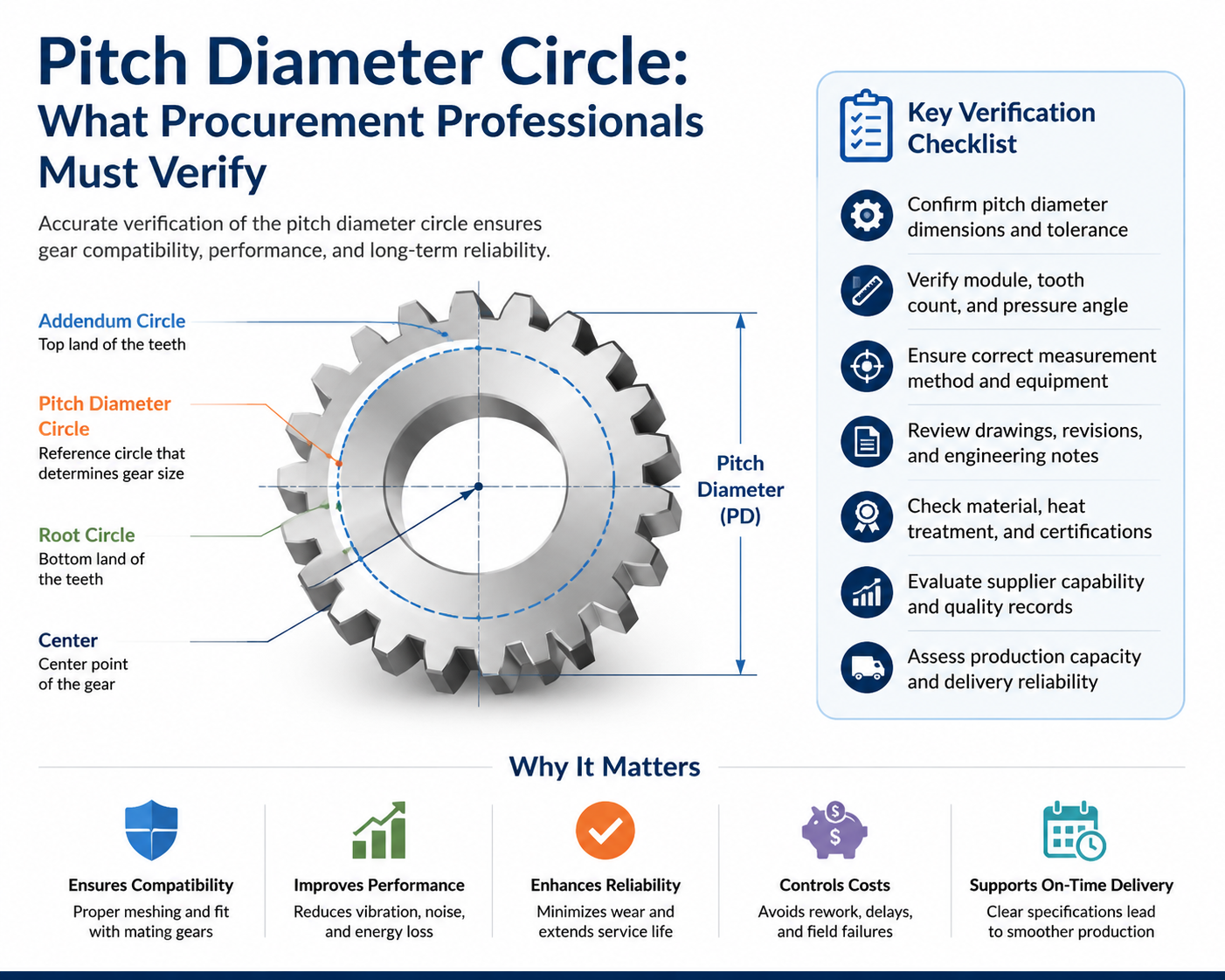
Pitch Diameter Circle: What Buyers Must Verify
1. Introduction to Pitch Diameter Circle in Procurement
What pitch diameter circle means in gear manufacturing
In gear engineering and industrial procurement, the pitch diameter circle is not simply another geometric notation buried inside a technical drawing. It is one of the governing dimensions that determines whether a transmission system will operate smoothly or become an expensive lesson in overlooked details.
The pitch diameter circle represents the theoretical circle where two meshing gears engage and transmit motion without slipping. Although invisible on the physical gear body, it acts as the operational reference line for rotational transfer, torque transmission, and velocity ratio control. Manufacturing teams frequently describe it as the working diameter because it defines the effective contact relationship rather than the outer boundaries of the component.
For procurement professionals sourcing gears internationally, particularly under OEM and ODM models, pitch diameter verification becomes more than an engineering exercise. It becomes a supply chain safeguard.
A gear may appear visually correct, pass incoming appearance inspection, and even match outside dimensions, yet still fail in actual assembly because the pitch diameter was incorrectly interpreted during design transfer or production setup. In practice, that tiny discrepancy often snowballs into excessive backlash, premature wear, abnormal noise, and elevated operating temperatures.
Modern gear manufacturing calculates pitch diameter using established relationships among module, tooth count, and pressure angle. Any deviation propagates through the entire drivetrain architecture. Once production reaches scale, correcting such deviations becomes exponentially more expensive.
For buyers responsible for global sourcing decisions, understanding pitch diameter is less about becoming a gear designer and more about developing enough technical fluency to ask the right questions before purchase orders become liabilities.
Why procurement teams should understand this parameter
Procurement has evolved well beyond obtaining the lowest quotation. Today’s purchasing engineers and strategic sourcing managers operate at the intersection of commercial objectives and engineering accountability. When evaluating gear suppliers, technical awareness directly influences supplier selection, risk reduction, and total ownership cost.
Pitch diameter sits at the center of that responsibility. If procurement personnel rely exclusively on supplier declarations without validating dimensional logic, they expose projects to avoidable uncertainty. Drawings may move across continents, specifications may undergo multiple revisions, and terminology may vary between regions, yet the final hardware still has to fit together.
Understanding pitch diameter enables procurement teams to:
- Validate drawing completeness before RFQ release
- Compare supplier quotations on equivalent specifications
- Detect dimensional inconsistencies early
- Reduce engineering change orders
- Improve first-pass production success
- Strengthen supplier accountability
Experienced buyers know that technical ambiguity becomes commercial friction. For example, two suppliers may quote the same gear application with identical material grades and lead times while producing different functional outcomes due to assumptions around pitch geometry. The lower unit price quickly becomes irrelevant if field failures begin appearing after deployment.
Technical procurement maturity means understanding which dimensions control performance and which dimensions merely describe appearance. Pitch diameter belongs firmly in the first category.
How incorrect verification impacts cost and performance
Verification failures rarely announce themselves during quotation review. Instead, they emerge later—during pilot assembly, customer acceptance testing, warranty claims, or production ramp-up.
When pitch diameter is not properly verified, consequences spread across several operational layers. At the assembly level, incorrect engagement geometry creates fitment problems. Components that appear dimensionally acceptable individually suddenly resist alignment when integrated. At the performance level, transmission accuracy deteriorates. Gear noise increases. Dynamic loads fluctuate. Contact patterns migrate away from intended zones.
At the business level, hidden costs begin accumulating, often including:
- Emergency tooling adjustments
- Additional incoming inspections
- Rework labor
- Production downtime
- Supplier corrective actions
- Freight acceleration
- Customer penalties
Procurement teams frequently underestimate indirect costs because they focus on purchase price variance instead of process disruption. Yet in many industrial sectors, one delayed production line can consume savings generated across dozens of successful sourcing projects.
The most effective buyers recognize an important principle: A verified specification costs little. A corrected specification costs considerably more. And a failed specification in the field can become the most expensive scenario of all.
2. Why Pitch Diameter Circle Directly Affects Purchase Success
Relationship between pitch diameter circle and gear compatibility
Gear compatibility is fundamentally a geometric relationship rather than a visual one. Two gears can possess identical outside diameters and still refuse to mesh correctly if pitch diameter relationships differ. This distinction becomes especially important during multinational sourcing programs where engineering files pass between different CAD systems and manufacturing conventions.
Pitch diameter determines the functional mating condition between components. When the values align properly, load transfers predictably, motion remains synchronized, and wear distributes evenly. When they do not, the system begins fighting itself from the first rotation. Procurement teams evaluating interchangeable sourcing options should therefore treat pitch diameter compatibility as a non-negotiable verification point rather than an assumed parameter.
Influence on transmission accuracy
Transmission accuracy determines how faithfully rotational motion moves from input to output. Pitch diameter directly affects angular velocity consistency, positioning repeatability, and energy transfer efficiency. Small dimensional deviations create cumulative error patterns that become increasingly visible under higher speeds and tighter tolerances. Applications such as robotics, indexing systems, and automated assembly equipment often reveal these issues immediately. A few hundredths of a millimeter can separate precision from instability.
Impact on installation and field reliability
Installation success is frequently viewed as a logistics milestone, but from an engineering standpoint it is the first real validation event. Incorrect pitch diameter relationships may cause:
- Unexpected assembly force
- Elevated vibration
- Thermal generation
- Accelerated tooth fatigue
- Lubrication degradation
Field reliability depends heavily on dimensional discipline established long before production begins. When buyers verify correctly, installation becomes routine. When they do not, the field becomes the inspection department.
3. Understanding the Technical Definition Buyers Must Know
Difference between pitch circle and outside diameter
Many buyers get tripped up by the seemingly simple difference between pitch circle diameter (PCD) and outside diameter (OD). The OD refers to the total physical span from the tip of one tooth to the tip of the opposite tooth, while the pitch diameter is the theoretical circle along which the gears actually transmit torque. This subtle distinction can be easily overlooked when reviewing supplier drawings, but it has massive implications on assembly, backlash, and wear patterns.
Confusing the two can result in gears that physically fit but perform poorly in operation, creating a classic case of “looks right, feels wrong.”
Relationship between pitch diameter and gear geometry
Pitch diameter is intrinsically tied to the gear's module, number of teeth, and pressure angle. It dictates the curvature and spacing of the teeth, ensuring that contact ratios are maintained and power is transmitted efficiently. When the pitch diameter is off—even slightly—the geometry shifts, causing uneven load distribution, tooth stress concentration, and accelerated wear. Buyers must recognize that pitch diameter is not an isolated number; it is a keystone in the geometric architecture of a gear.
Common terminology suppliers use
Suppliers often employ jargon such as “pitch line,” “base circle,” or “reference circle” interchangeably, depending on regional practices and standards. Procurement engineers should be fluent in these terms to avoid miscommunication that could lead to specification errors. Misinterpretation at this stage often translates into costly revisions, especially when international suppliers with varying metric and imperial standards are involved. A solid grasp of terminology allows buyers to verify drawings with confidence, ensuring that what is ordered matches exactly what will perform reliably in the field.
4. Industries Where Pitch Diameter Circle Verification Is Critical
Industrial machinery applications
Heavy industrial machinery—like presses, conveyors, and milling equipment—depends on precise gear engagement for consistent performance. Any mismatch in pitch diameter can translate into vibration, noise, and premature component failure. Procurement teams sourcing these components must ensure that specifications are verified rigorously, as downtime can cost thousands per hour and ripple across production schedules.
Automotive and mobility systems
In automotive applications, the stakes are even higher. Transmission gears, differential systems, and drive trains rely on tight pitch diameter tolerances to maintain efficiency, reduce noise, and ensure safety. Buyers sourcing globally must confirm that pitch diameters are measured accurately and that suppliers adhere to automotive quality standards, as even minor deviations can affect vehicle reliability and consumer satisfaction.
Automation and robotics equipment
Robotics and automated systems demand repeatable precision. Gear pitch diameter affects positioning accuracy, backlash, and cycle timing. A misaligned pitch diameter may cause a robot to drift, misplace components, or exert excessive force, resulting in damaged products or downtime. Verification protocols are essential to prevent costly failures and maintain operational continuity.
5. Core Gear Parameters That Must Be Reviewed Together
Module and pitch diameter relationship
The module defines the size of the gear teeth and directly affects pitch diameter. It serves as a bridge between theoretical geometry and practical manufacturing. Buyers must verify that the module used by the supplier is compatible with mating gears and maintains consistent pitch diameter relationships across the production lot.
Number of teeth and dimensional outcomes
Tooth count determines the overall gear circumference and, in combination with module, defines the pitch diameter. A change in tooth number affects gear ratio, rotational speed, and torque transmission. Procurement professionals must ensure that suppliers respect the specified tooth count to maintain mechanical integrity and system compatibility.
Pressure angle compatibility requirements
Pressure angle influences tooth engagement, load distribution, and pitch circle location. Incorrect pressure angles can alter pitch diameter contact points, causing slippage or uneven wear. Buyers must confirm that both mating gears share compatible pressure angles to ensure smooth operation and long-term reliability. Resources like Gear Technology Magazine provide insights on pressure angle selection and industry standards.
6. Procurement Risks of Incorrect Pitch Diameter Specifications
Assembly failures and rework costs
Incorrect pitch diameter specifications often result in assembly failures that require costly rework. Components may not fit together properly, causing repeated adjustments or the replacement of parts. Procurement teams must ensure that specifications are verified before release to minimize downstream disruptions and extra labor costs.
Production delays from dimensional mismatch
Dimensional mismatches disrupt production schedules. Even a minor deviation in pitch diameter can halt assembly lines, forcing engineering teams to pause, evaluate, and correct the issue. These delays often cascade, affecting delivery commitments, increasing operational costs, and impacting customer satisfaction. Understanding and verifying pitch diameter early reduces the risk of such delays.
Increased warranty and replacement expenses
Gears with incorrect pitch diameter specifications may fail prematurely in operation, generating warranty claims and replacement costs. Buyers should recognize that initial savings on sourcing can be quickly eroded by field failures and service interventions. Verification protocols mitigate these financial risks and safeguard the brand reputation.
7. How Buyers Should Read Gear Technical Drawings
Identifying pitch diameter information on drawings
Pitch diameter is typically annotated as PD, PCD, or reference diameter. Buyers should locate the values, verify calculations using module and tooth count, and ensure alignment with mating components. Resources like Wikipedia Gear Page provide standard definitions for reference.
Reviewing tolerances and annotations
Review tolerance ranges, bilateral/unilateral specifications, surface finish notes, and any heat treatment remarks. Annotations like “controlled after heat treatment” or “reference only” may alter manufacturing interpretation. Procurement teams must ensure tolerances align with functional requirements to avoid downstream issues.
Detecting missing or incomplete specifications
Check for missing pitch diameter values, undefined tolerance classes, and absent inspection methods. Incomplete drawings often lead suppliers to assume specifications, which can introduce errors in production. Buyers should request clarification or updated documentation before RFQ release to ensure accuracy.
8. Questions Procurement Teams Should Ask Suppliers
How pitch diameter is measured and verified
Ask suppliers about measurement methods, inspection frequency, and traceability. Confirm whether pitch diameter is directly measured or derived from calculations. Verification at multiple stages—first article, in-process, and final inspection—is recommended to ensure consistent quality.
Which inspection standards are applied
Confirm the gear standards, acceptance criteria, calibration intervals, and gauge traceability. Ensuring alignment with ISO Gear Standards helps avoid cross-regional interpretation errors. Standardization prevents subjective inspection results and ensures functional compliance.
What process controls ensure consistency
Investigate tool wear monitoring, statistical process control, preventive maintenance, and operator qualification. Ask how process drift is detected and corrected. Suppliers with strong closed-loop control processes typically maintain dimensional stability and minimize pitch diameter variations across production lots.
9. Manufacturing Factors That Influence Pitch Diameter Accuracy
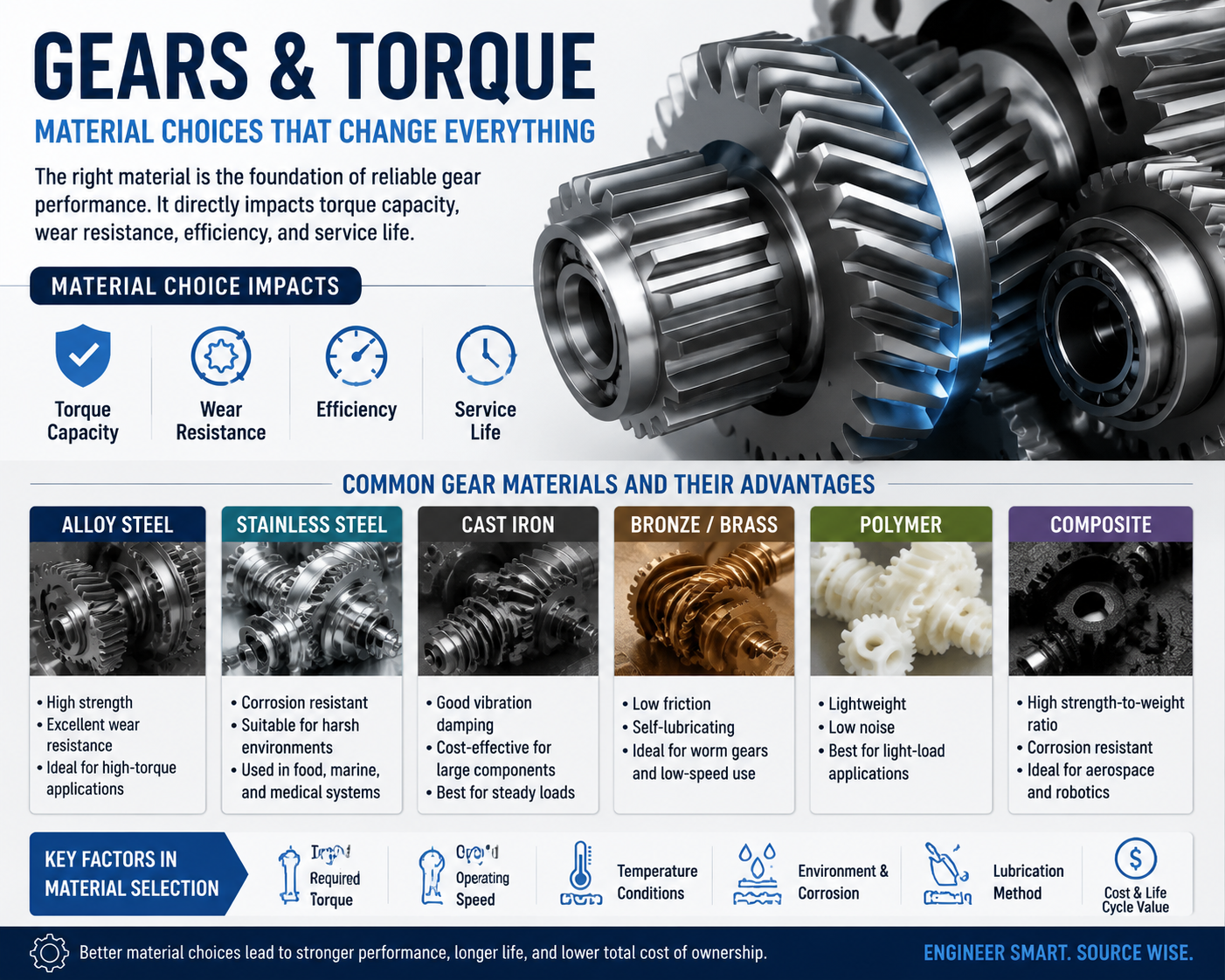
Material selection and dimensional stability
Material behavior affects dimensional stability. Factors like residual stress, thermal expansion, and microstructure consistency can change pitch diameter after heat treatment or machining. Procurement teams should verify material specifications and select alloys that maintain geometric accuracy.
Machining precision and process capability
Machine rigidity, cutter wear, fixture repeatability, and environmental control influence pitch diameter outcomes. Ask suppliers for process capability data (Cp, Cpk) to ensure they can achieve the required tolerances consistently. Process maturity often predicts reliability better than machine model alone.
Heat treatment distortion considerations
Heat treatment processes such as carburizing or nitriding can distort gears, affecting pitch diameter. Suppliers should document compensation strategies and verify dimensions post-treatment. Buyers must ensure inspection accounts for these changes to maintain functional performance.
10. Inspection Methods Used to Validate Pitch Diameter Circle
Coordinate measuring machine verification
CMMs provide high-precision measurement of pitch diameter and other critical dimensions. Buyers should request detailed CMM reports showing measured values, tolerances, environmental conditions, and traceable operator approval. Precision alone does not guarantee meaningful results; execution quality is crucial.
Gear measuring equipment and reports
Dedicated gear measurement systems evaluate pitch deviation, profile deviation, helix analysis, and runout. Detailed reports with actual values—not just pass/fail indicators—allow procurement teams to assess production consistency and supplier competence effectively.
Sampling versus full inspection approaches
Inspection strategy depends on production volume, criticality, and historical quality. Sampling reduces time but carries statistical risk; full inspection provides confidence at higher cost. Buyers should balance inspection strategy with functional requirements, aiming for intelligent verification rather than maximum measurement.
11. Tolerance Management for Global Sourcing Projects
Establishing acceptable dimensional ranges
Tolerance decisions should reflect functional requirements rather than arbitrary precision targets.
Overly tight tolerances increase cost.
Overly broad tolerances increase operational risk.
Effective procurement teams define ranges based on:
- Functional analysis
- Manufacturing capability
- Application criticality
- Lifecycle expectations
The right tolerance is the one that protects performance without purchasing unnecessary perfection.
For additional engineering tolerance references, see National Institute of Standards and Technology (NIST).
Managing international specification differences
Global sourcing introduces multiple technical dialects.
Differences appear in:
- Units
- Drawing conventions
- Inspection assumptions
- Quality definitions
Procurement teams should establish standard conversion and validation procedures to eliminate ambiguity.
Translation errors remain one of the most underestimated causes of dimensional disputes.
Additional guidance on international standardization can be referenced through ISO.
Balancing cost and precision requirements
Every micron has a price.
Increasing precision often requires:
- Additional machining
- Slower cycle times
- Specialized tooling
- Expanded inspection
Buyers should evaluate whether tighter requirements generate measurable business value.
Not every application needs aerospace-level control.
Smart sourcing aligns precision with actual operational need.
12. Comparing OEM, ODM, and Standard Gear Procurement Models
Control advantages of OEM production
OEM sourcing provides maximum authority over specifications.
Benefits include:
- Controlled geometry
- Proprietary design retention
- Supplier accountability
- Defined validation processes
For applications with strict performance targets, OEM structures often reduce long-term variability.
Design flexibility under ODM cooperation
ODM arrangements accelerate development by leveraging supplier engineering expertise.
Advantages include:
- Faster project launch
- Design optimization
- Reduced engineering workload
However, procurement teams should maintain control over critical dimensions to prevent specification drift.
Flexibility should never replace verification.
When standard products are sufficient
Not every application requires custom engineering.
Standard gears may deliver excellent value when:
- Operating conditions are stable
- Load profiles are predictable
- Availability matters more than customization
The key question is simple:
Does standardization support performance objectives without introducing compatibility risk?
If yes, standard sourcing can become a powerful cost and lead-time advantage.
13. Supplier Evaluation Criteria Beyond Unit Price
Technical capability assessment
Seasoned procurement professionals know that unit price is visible, but capability is consequential.
A supplier may offer attractive pricing, polished presentations, and aggressive delivery commitments, yet still lack the technical infrastructure required to repeatedly produce gears that maintain pitch diameter integrity under real manufacturing conditions.
Technical capability assessment should move beyond generic questions and examine how the supplier transforms engineering requirements into controlled production output.
Areas to evaluate include:
- Gear design support capability
- Process engineering competence
- Manufacturing technology maturity
- Metrology infrastructure
- Tool management practices
- Engineering change responsiveness
Buyers should request examples of comparable applications rather than broad capability statements.
Quality system and certification review
Certifications do not manufacture quality.
Processes do.
However, certifications provide useful evidence that systems exist to support consistency.
Procurement teams should examine:
- Document control systems
- Corrective action procedures
- Calibration management
- Internal audit frequency
- Traceability controls
- Supplier management methods
Audit discussions should move beyond certificates displayed on walls.
Review quality management guidance through ASQ Quality Management Resources.
Production scalability and delivery reliability
A supplier that performs well at prototype volume does not automatically scale successfully into mass production.
Procurement teams should verify:
- Capacity utilization
- Bottleneck operations
- Shift flexibility
- Equipment redundancy
- Supplier network resilience
Pitch diameter consistency frequently changes under increased throughput.
Good suppliers maintain stability.
Great suppliers maintain stability while expanding output.
14. Documentation Buyers Must Request Before Approval
Dimensional inspection reports
Inspection reports convert supplier claims into verifiable evidence.
Critical report elements include:
- Nominal values
- Measured values
- Tolerance windows
- Sample quantity
- Inspection equipment
- Inspection date
- Traceability identifiers
For pitch diameter verification specifically, reports should indicate:
- Measurement method
- Environmental conditions
- Operator approval
- Batch references
Review trends instead of isolated results.
First article inspection records
First Article Inspection (FAI) acts as the bridge between drawing intent and production reality.
Effective FAI packages generally include:
- Ballooned drawings
- Characteristic tracking
- Measurement evidence
- Material confirmation
- Process verification
- Approval history
A successful FAI is not proof that production is solved.
It is proof that production has started correctly.
Material and process certifications
Material selection influences dimensional stability as much as machining quality.
Certification packages should verify:
- Raw material conformity
- Heat treatment conditions
- Mechanical properties
- Surface treatment records
- Lot traceability
Documentation only creates value when it accurately describes reality.
15. Common Red Flags During RFQ and Quotation Review
Missing pitch diameter details
One of the earliest indicators of sourcing risk appears during quotation preparation.
Common warning signs include:
- Reference-only dimensions
- Missing gear calculation tables
- Undefined measurement methods
- Contradictory revision levels
- Partial geometry descriptions
Experienced buyers adopt a simple rule:
No critical dimension, no commercial evaluation.
Unrealistic tolerance commitments
Procurement teams occasionally receive quotations promising exceptionally tight tolerances at unusually low pricing.
Warning indicators include:
- No explanation of manufacturing method
- No process capability evidence
- Extremely short lead times
- Limited inspection details
Procurement is not about purchasing promises.
It is about purchasing controlled outcomes.
Inconsistent engineering documentation
Documentation inconsistency often predicts future execution inconsistency.
Review for:
- Different revisions across files
- Conflicting dimensions
- Unmatched CAD and drawing versions
- Missing specification references
- Unclear approval ownership
Consistency upstream prevents confusion downstream.
16. Cost Optimization Without Sacrificing Gear Accuracy
Standardization opportunities for sourcing
Standardization remains one of the most underutilized procurement levers.
Reducing unnecessary variation creates benefits across:
- Inventory
- Supplier qualification
- Tooling investment
- Lead time
- Inspection effort
When reviewing gear portfolios, buyers should identify opportunities to standardize:
- Modules
- Pressure angles
- Materials
- Inspection requirements
Standardization reduces complexity without automatically reducing performance.
The objective is controlled simplification.
Not compromise.
Reducing overengineering expenses
Many procurement programs quietly absorb costs caused by specifications that exceed operational requirements.
Typical examples include:
- Excessively tight tolerances
- Premium materials with limited benefit
- Unnecessary inspection frequency
- Overspecified surface requirements
Buyers should collaborate with engineering teams to distinguish:
Critical-to-function requirements
from
Nice-to-have preferences.
Overengineering creates hidden cost layers that accumulate over thousands of production units.
The strongest sourcing decisions optimize for fitness of purpose.
Additional reading: NASA Engineering Design Resources
Long-term total cost of ownership analysis
Lowest purchase price rarely equals lowest total cost.
Procurement evaluations should include:
- Quality performance
- Service life
- Replacement frequency
- Maintenance burden
- Downtime exposure
- Logistics cost
A slightly higher initial gear cost may generate substantial savings across operational life.
When evaluating pitch diameter control capability, buyers should calculate:
Initial price + quality cost + operational cost + failure risk
That equation frequently changes sourcing decisions.
17. Building a Procurement Verification Workflow
Creating technical review checkpoints
High-performing procurement organizations do not depend on individual experience or last-minute engineering heroics.
They build repeatable verification workflows that prevent dimensional problems from progressing unnoticed through sourcing stages.
A practical procurement verification structure typically includes:
- Requirement definition
- RFQ technical review
- Supplier feasibility assessment
- Prototype validation
- First article approval
- Production release
- Ongoing supplier monitoring
At each stage, buyers should confirm:
- Controlled drawings are released
- Gear geometry calculations align
- Inspection requirements are documented
- Risk ownership is assigned
Well-structured checkpoints do not slow procurement.
They accelerate confidence.
Aligning engineering and sourcing teams
Procurement and engineering sometimes operate as parallel functions pursuing different metrics.
Engineering prioritizes performance.
Procurement prioritizes delivery, cost, and continuity.
The strongest organizations eliminate this divide.
Recommended collaboration practices include:
- Joint supplier qualification meetings
- Shared RFQ approval processes
- Cross-functional drawing reviews
- Combined risk assessments
- Unified corrective action tracking
When alignment is strong, suppliers receive clear expectations.
Establishing supplier approval procedures
Supplier approval should be treated as a controlled engineering process—not an administrative event.
Approval procedures should include:
Commercial qualification
- Financial stability
- Delivery performance
- Commercial responsiveness
Technical qualification
- Manufacturing capability
- Inspection competence
- Process maturity
Operational qualification
- Capacity planning
- Change control
- Traceability systems
The real question is whether suppliers can repeat successful results thousands of times.
18. Case Examples of Successful Verification Practices
Preventing assembly issues before production
A global industrial equipment manufacturer sourced a gear set through multiple approved vendors to reduce supply concentration.
Initial dimensional checks passed.
Outside diameters matched.
Materials complied.
However, engineering review identified inconsistent pitch diameter assumptions.
After dimensional alignment:
- Assembly variation dropped
- Installation time improved
- Rework was eliminated
- Delivery schedules stabilized
The lesson was simple:
Visual conformity does not guarantee functional compatibility.
Improving supplier communication outcomes
Another sourcing team introduced a standardized technical questionnaire before issuing RFQs.
The questionnaire required suppliers to explain:
- Measurement methods
- Inspection intervals
- Gear geometry validation
- Change control practices
As a result:
- Technical clarification cycles decreased
- Quote comparison became easier
- Qualification time shortened
- Supplier transparency improved
Good communication is not about more meetings.
It is about better questions.
Lessons learned from global procurement projects
International sourcing introduces advantages—but also dimensional interpretation risks.
Lessons repeatedly observed include:
- Never assume standards alignment
- Translate engineering intent, not only language
- Validate calculations independently
- Confirm measurement methodology
- Lock revision control before production
19. Future Trends in Gear Procurement and Quality Control
Digital inspection technologies
Inspection is moving rapidly from retrospective detection toward real-time control.
Advanced measurement technologies increasingly support:
- Automated dimensional capture
- Digital comparison models
- Real-time process feedback
- Electronic traceability
Modern procurement teams should evaluate suppliers based on their ability to generate reliable data—not only manufacture hardware.
Further industry reading: ASME Engineering Resources
Data-driven supplier management
Supplier management is evolving from relationship-based evaluation into evidence-based decision making.
Forward-looking procurement organizations monitor:
- Defect trends
- Process capability
- Delivery variation
- Corrective action performance
- Cost stability
Better data reduces surprises.
And fewer surprises usually mean lower procurement risk.
Predictive quality monitoring
The next evolution in sourcing quality is prediction.
Organizations increasingly use production history and inspection data to anticipate dimensional drift before failures occur.
This enables teams to:
- Schedule preventive actions
- Detect emerging instability
- Optimize inspection frequency
- Reduce quality costs
20. Final Buyer Checklist for Pitch Diameter Circle Verification
Technical specifications to confirm
- Pitch diameter definition
- Module verification
- Tooth quantity
- Pressure angle
- Tolerance requirements
- Material specification
- Heat treatment conditions
- Inspection method
- Revision status
- Functional fit requirements
If any item remains unclear, release should stop until clarification is completed.
Supplier documents to collect
- Controlled drawings
- Dimensional reports
- First article inspection records
- Material certificates
- Process flow documentation
- Capability summaries
- Change management procedures
- Traceability records
Documentation enables verification.
Approval steps before purchase order release
- Freeze technical requirements
- Validate dimensional calculations
- Review supplier capability
- Confirm inspection plans
- Approve qualification results
- Release controlled purchase order
- Monitor initial production
The final objective is simple:
Ensure the gear that arrives is the same gear that was engineered, quoted, approved, manufactured, inspected, and expected.
Conclusion
Pitch diameter circle may appear to be a theoretical geometric reference, but for procurement professionals and mechanical engineers, it functions as a practical control point that influences compatibility, reliability, quality, and cost.
The most successful sourcing organizations understand that dimensional verification is not administrative overhead—it is operational insurance.
When buyers validate the right dimensions, ask better technical questions, demand stronger documentation, and align suppliers with engineering intent, procurement transforms from purchasing activity into performance assurance.
In gear sourcing, details do not create complexity.
They create results.