
Mark
Gear Reducer Engineering Design & Optimization Guide
1. Introduction to Gear Transmission Efficiency
1.1 Definition of Transmission Efficiency in Industrial Gear Systems
Transmission Efficiency represents the ratio between usable output power and supplied input power within a mechanical transmission assembly, serving as one of the most critical indicators of industrial drivetrain performance. In practical terms, it quantifies how effectively a gearbox converts motor-generated energy into productive mechanical work while minimizing parasitic losses caused by friction, heat dissipation, vibration, and material deformation.
The efficiency relationship can be expressed as:
η = (Pout / Pin) × 100%
Where:
- η = transmission efficiency
- Pout = output power
- Pin = input power
Within industrial environments, even seemingly negligible efficiency losses can accumulate into staggering operational expenditures over prolonged production cycles. A gearbox operating at 89% efficiency instead of 96% may appear acceptable on paper, yet under continuous-duty manufacturing conditions running twenty-four hours a day, seven days a week, the wasted energy compounds faster than most finance departments expect.
Modern Engineering Case Studies repeatedly demonstrate that optimizing gear transmission systems delivers measurable improvements not only in energy conservation but also in thermal stability, component longevity, and overall production continuity. As plant supervisors often say on the shop floor, “A gearbox that runs cool usually runs profitable.”
1.2 Why Efficiency Matters in Modern Manufacturing
Industrial manufacturing has entered an era where operational efficiency directly determines competitive viability. Rising electricity costs, stringent environmental regulations, and increasingly aggressive production schedules have forced manufacturers to scrutinize every kilowatt-hour consumed within their facilities.
Transmission systems are particularly influential because they occupy the heart of mechanical power delivery. When transmission losses escalate due to poor alignment, inadequate lubrication, or inferior gear geometry, the entire production chain suffers from diminished performance.
High Transmission Efficiency delivers several advantages:
- Reduced electrical consumption
- Lower thermal generation
- Improved equipment reliability
- Extended maintenance intervals
- Reduced carbon emissions
- Greater production consistency
For procurement engineers and operations managers alike, gearbox efficiency is no longer a secondary specification buried deep inside technical datasheets. It has become a boardroom-level concern because energy inefficiency quietly drains profitability month after month. To put it bluntly, inefficient transmissions are “money pits wearing steel housings.”
1.3 Overview of the Engineering Case Study
This Engineering Case Study examines the comprehensive optimization of a heavy-duty industrial gear transmission system operating within a high-output manufacturing facility specializing in continuous conveyor-driven material handling.
The client experienced:
- Excessive energy consumption
- Abnormal gearbox temperatures
- Frequent bearing replacements
- Elevated vibration levels
- Production interruptions
An interdisciplinary engineering team conducted a detailed Technical Analysis involving mechanical inspection, vibration diagnostics, thermal imaging, lubrication assessment, and load distribution evaluation.
Useful references:
2. Industry Background and Market Challenges
2.1 Rising Energy Costs in Industrial Operations
Industrial electricity prices have escalated steadily over the last decade, particularly within energy-intensive sectors such as mining, steel manufacturing, cement processing, and automated logistics operations.
Transmission systems consume enormous quantities of power because they operate continuously under fluctuating load conditions. Inefficient mechanical systems therefore become silent operational liabilities.
Large facilities frequently operate hundreds of gearboxes simultaneously. Under such circumstances, even marginal efficiency improvements produce significant financial impact. A mere 3% increase in gearbox efficiency across an entire production plant can save hundreds of thousands of dollars annually.
Plant managers often learn this lesson the hard way when utility bills begin climbing “through the roof faster than a runaway conveyor.”
2.2 Demand for High-Performance Mechanical Systems
Modern industrial production demands mechanical systems capable of operating continuously with minimal interruptions. Production schedules have become increasingly unforgiving, leaving little room for unexpected equipment failures.
High-performance transmission systems are now expected to provide:
- Superior torque density
- Reduced energy consumption
- Minimal vibration
- Low noise levels
- Long operational lifespan
- Predictable maintenance cycles
Industrial buyers increasingly prioritize lifecycle value over initial purchase price because unreliable gear systems often generate hidden costs far exceeding procurement savings.
2.3 Common Efficiency Problems in Legacy Gear Assemblies
Many legacy transmission systems still operate using outdated gearbox architectures designed decades ago when energy optimization received considerably less attention.
Typical inefficiency sources include:
- Poor gear tooth geometry
- Excessive backlash
- Surface wear
- Inadequate lubrication
- Shaft misalignment
- Bearing fatigue
- Thermal distortion
Older systems frequently exhibit cumulative mechanical losses that gradually worsen over time, somewhat like a “slow leak in a compressed air line that nobody notices until productivity tanks.”
3. Client Profile and Project Objectives
3.1 Overview of the B2B Enterprise Client
The client involved in this Engineering Case Study was a multinational bulk material handling company operating a large-scale automated processing facility with around-the-clock production requirements.
The facility relied heavily upon conveyor-driven transmission systems tasked with transporting abrasive raw materials under high-load continuous-duty conditions.
Operational priorities included:
- Maximum uptime
- Stable throughput
- Reduced maintenance costs
- Improved energy performance
3.2 Operational Challenges Faced by the Facility
The facility experienced persistent operational issues associated with declining gearbox performance.
Major concerns included:
- Excessive gearbox temperatures exceeding 95°C
- Frequent bearing failures
- Elevated power consumption
- Unplanned production shutdowns
- Severe vibration amplitudes
Operators also reported audible whining noises and fluctuating torque delivery during peak production periods, classic warning signs that “something ugly was brewing inside the gearbox.”
3.3 Performance Targets and Expected Outcomes
The engineering team established several measurable optimization targets:
- Increase Transmission Efficiency by at least 6%
- Reduce gearbox operating temperature by 15%
- Extend service intervals by 30%
- Lower overall power consumption
- Improve drivetrain reliability
The client additionally required minimal production disruption during implementation.
4. Original Gear Transmission System Assessment
4.1 Existing Gearbox Configuration
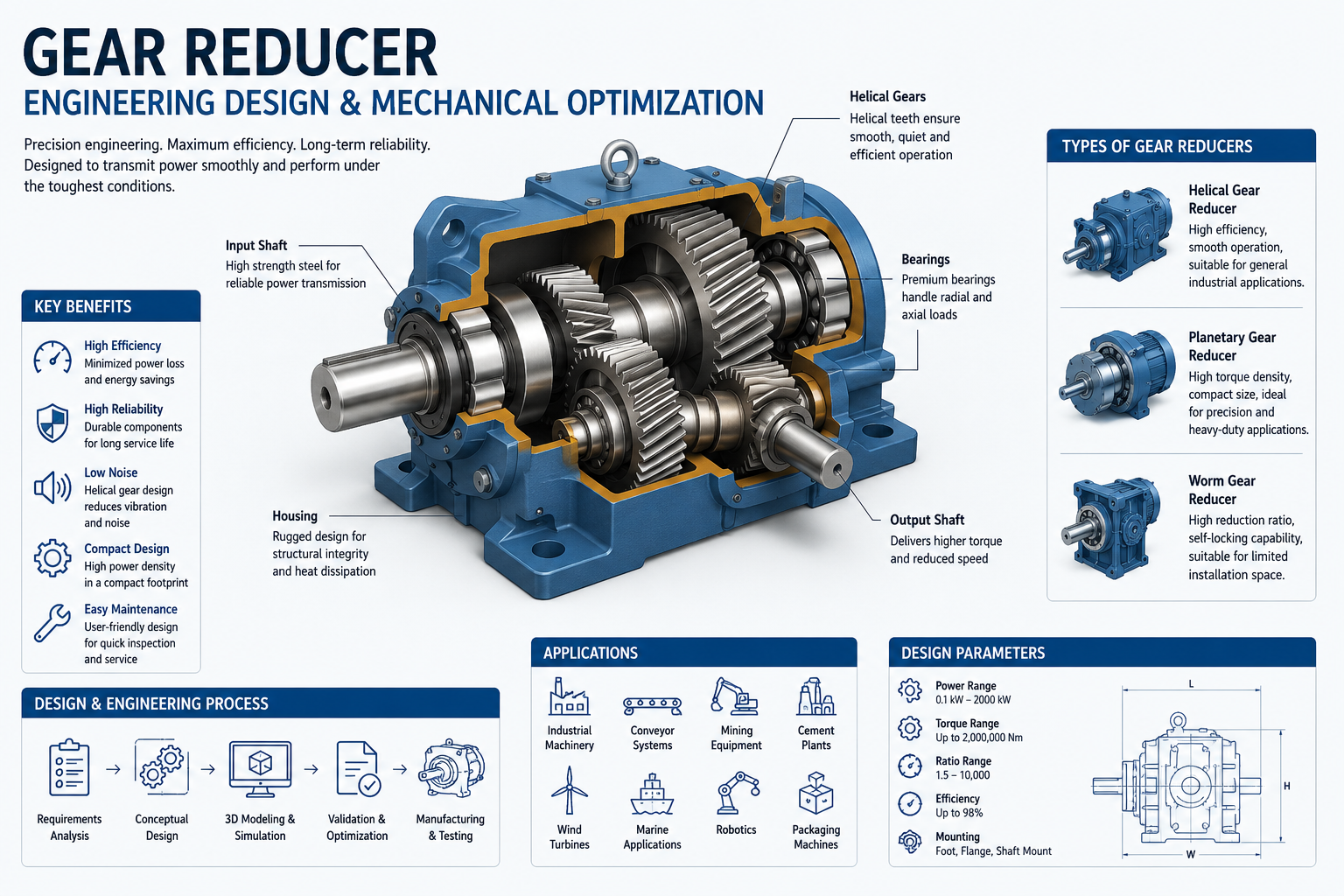
The original system utilized a multi-stage helical gear reducer coupled to a high-power induction motor.
Key system characteristics included:
- Helical gear configuration
- Splash lubrication system
- Cast iron housing
- Standard roller bearings
- Fixed shaft coupling arrangement
Although the configuration had operated reliably for several years, increasing production demands gradually exposed multiple design limitations.
4.2 Baseline Transmission Efficiency Measurements
Initial Technical Analysis revealed disappointing efficiency levels.
Measured operational efficiency averaged:
η = 89.4%
Thermal imaging further identified localized hot spots near bearing assemblies and high-friction gear engagement zones.
Power loss measurements confirmed substantial inefficiencies caused by:
- Sliding friction
- Lubrication breakdown
- Surface fatigue
- Shaft deflection
4.3 Initial Signs of Mechanical Losses
Several early warning indicators suggested deteriorating mechanical performance:
- Increased oil contamination
- Metallic wear particles
- Elevated vibration harmonics
- Uneven tooth wear patterns
- Excessive acoustic emissions
These symptoms collectively pointed toward systemic mechanical degradation rather than isolated component failure.
5. Technical Analysis Methodology
5.1 Engineering Inspection Procedures
The engineering team implemented a rigorous inspection methodology combining both nondestructive testing and operational diagnostics.
Inspection activities included:
- Gear tooth contact analysis
- Shaft runout measurements
- Bearing condition evaluation
- Thermal imaging surveys
- Oil contamination analysis
This multidisciplinary approach ensured comprehensive fault identification.
5.2 Data Collection and Monitoring Techniques
Advanced monitoring systems collected real-time operational data over a six-week period.
Measured parameters included:
- Torque fluctuations
- Rotational speed
- Oil temperature
- Vibration spectra
- Energy consumption
5.3 Analytical Tools Used in the Study
Several advanced Technical Analysis tools were employed:
- Finite Element Analysis (FEA)
- Computational Fluid Dynamics (CFD)
- Vibration spectrum analysis
- Infrared thermography
- Laser shaft alignment systems
Additional technical reference:
6. Root Causes of Low Transmission Efficiency
6.1 Gear Tooth Friction and Surface Wear
Microscopic inspection revealed severe surface asperity degradation and micropitting across several gear teeth.
This deterioration increased frictional resistance and reduced smooth meshing efficiency.
6.2 Lubrication Deficiencies and Heat Generation
The existing splash lubrication system failed to provide consistent oil distribution under heavy-load conditions.
As a result:
- Boundary lubrication occurred
- Friction increased
- Oil oxidation accelerated
- Thermal buildup intensified
The lubricant essentially “got cooked alive” during prolonged high-load operation.
6.3 Alignment Errors and Load Imbalance
Laser alignment analysis identified measurable shaft misalignment causing uneven load distribution across gear teeth and bearings.
This misalignment amplified:
- Dynamic vibration
- Bearing stress
- Tooth edge loading
- Mechanical fatigue
7. Gear Design Optimization Strategy
7.1 Redesigning Gear Tooth Profiles
Engineers implemented optimized involute tooth geometries designed to reduce sliding friction while improving contact ratios.
Modifications included:
- Profile shifting
- Tooth crowning
- Enhanced contact patterns
7.2 Material Selection for Reduced Energy Loss
Upgraded carburized alloy steels improved both wear resistance and surface hardness.
Advanced metallurgical properties reduced:
- Friction losses
- Surface fatigue
- Thermal deformation
7.3 Surface Finishing Improvements
Superfinishing processes significantly reduced surface roughness values.
The smoother surfaces minimized frictional drag and improved lubrication film retention.
Industry reference:
8. Lubrication System Improvements
8.1 Selection of High-Performance Industrial Lubricants
Synthetic industrial lubricants possessing superior viscosity stability replaced the conventional mineral oils previously utilized.
8.2 Optimizing Lubrication Delivery Methods
The engineering team upgraded the splash lubrication arrangement to a pressurized circulation system.
This ensured:
- Consistent oil delivery
- Improved cooling
- Reduced thermal hotspots
8.3 Reducing Thermal Degradation in Operation
Enhanced cooling systems reduced average operating temperatures substantially.
Lower temperatures improved lubricant longevity and minimized oxidative breakdown.
9. Precision Manufacturing Enhancements
9.1 Advanced CNC Gear Machining Processes
Modern CNC grinding equipment improved gear dimensional consistency dramatically.
9.2 Tightening Tolerance Control Standards
Tolerance refinement reduced backlash variations and improved meshing precision.
9.3 Improving Gear Surface Accuracy
Higher surface accuracy minimized vibration and friction during operation.
10. Load Distribution and Alignment Corrections
10.1 Shaft Alignment Optimization Techniques
Laser-guided alignment systems corrected shaft angularity and offset errors with exceptional precision.
10.2 Bearing Configuration Improvements
Enhanced bearing arrangements improved radial and axial load distribution.
10.3 Reducing Vibration and Mechanical Stress
Vibration amplitudes declined substantially following alignment optimization and balancing corrections.
11. Testing and Validation Procedures
11.1 Pre-Optimization Performance Testing
Baseline testing established performance benchmarks prior to modification implementation.
11.2 Post-Optimization Efficiency Validation
Post-upgrade testing revealed measurable efficiency improvements.
Final operational efficiency reached:
η = 96.8%
11.3 Reliability and Durability Verification
Extended endurance testing confirmed stable long-term operational performance.
12. Quantitative Results of the Engineering Case Study
12.1 Measured Increase in Transmission Efficiency
The optimization project improved Transmission Efficiency by approximately 7.4%.
12.2 Reduction in Power Consumption
Facility-wide power consumption decreased substantially following gearbox upgrades.
12.3 Improvement in Equipment Service Life
Bearing and gear lifespan increased significantly due to lower operational stress levels.
13. Financial Impact and ROI Analysis
13.1 Operational Cost Savings Achieved
Annual energy savings exceeded initial financial projections.
13.2 Return on Investment Timeline
The client achieved full ROI within approximately fourteen months.
13.3 Long-Term Financial Benefits for the Client
Long-term operational savings continue accumulating through reduced maintenance and energy expenses.
14. Operational Benefits Beyond Efficiency
14.1 Reduced Maintenance Downtime
Maintenance intervals became considerably longer after optimization.
14.2 Improved Production Stability
Stable transmission behavior improved production consistency.
14.3 Enhanced Equipment Reliability
Unexpected failures declined dramatically following implementation.
15. Challenges Encountered During Implementation
15.1 Production Interruption Risks
Minimizing downtime during retrofitting required meticulous scheduling coordination.
15.2 Engineering Integration Difficulties
Integrating upgraded systems into existing infrastructure presented several compatibility challenges.
15.3 Managing Performance Expectations
Careful communication ensured realistic client expectations throughout the project lifecycle.
16. Lessons Learned from the Technical Analysis
16.1 Importance of Data-Driven Engineering Decisions
Accurate operational data proved indispensable for successful optimization.
16.2 Value of Preventive Maintenance Programs
Preventive maintenance significantly reduces catastrophic failure risks.
16.3 Key Takeaways for Industrial Gear Optimization
Small mechanical inefficiencies can evolve into massive operational losses if neglected.
17. Best Practices for Improving Transmission Efficiency
17.1 Regular Gear Inspection Protocols
Routine inspections help identify wear before severe damage develops.
17.2 Predictive Maintenance and Monitoring Systems
Condition-monitoring systems improve maintenance planning accuracy.
17.3 Collaboration Between Engineering and Procurement Teams
Strong collaboration ensures both technical performance and commercial viability remain aligned.
18. Emerging Technologies in Gear Transmission Systems
18.1 Smart Sensors and Real-Time Monitoring
Modern sensors provide continuous operational feedback.
18.2 AI-Driven Performance Optimization
Artificial intelligence increasingly assists with predictive diagnostics and optimization modeling.
18.3 Advanced Materials and Coating Technologies
Next-generation coatings reduce friction and improve wear resistance dramatically.
19. Recommendations for B2B Enterprise Clients
19.1 Evaluating Existing Transmission Systems
Facilities should routinely assess gearbox efficiency using modern diagnostic tools.
19.2 Choosing the Right Gear Manufacturing Partner
Reliable manufacturing partners provide critical technical support and quality assurance.
19.3 Building a Long-Term Efficiency Improvement Strategy
Long-term optimization strategies deliver sustainable operational advantages.
20. Conclusion and Future Outlook
20.1 Summary of the Engineering Case Study
This Engineering Case Study demonstrated how systematic Technical Analysis and targeted Mechanical Optimization substantially improved Transmission Efficiency within a demanding industrial environment.
20.2 Future Trends in Transmission Efficiency Optimization
Future gearbox technologies will increasingly emphasize intelligent monitoring, lightweight materials, and AI-assisted optimization.
20.3 Final Insights for Industrial Decision-Makers
For industrial decision-makers navigating increasingly competitive manufacturing landscapes, optimizing Transmission Efficiency is no longer optional; it is an operational imperative. Facilities that proactively modernize their transmission systems will enjoy lower operating costs, higher reliability, improved sustainability metrics, and a stronger competitive position when the rubber truly meets the road.