
Mark
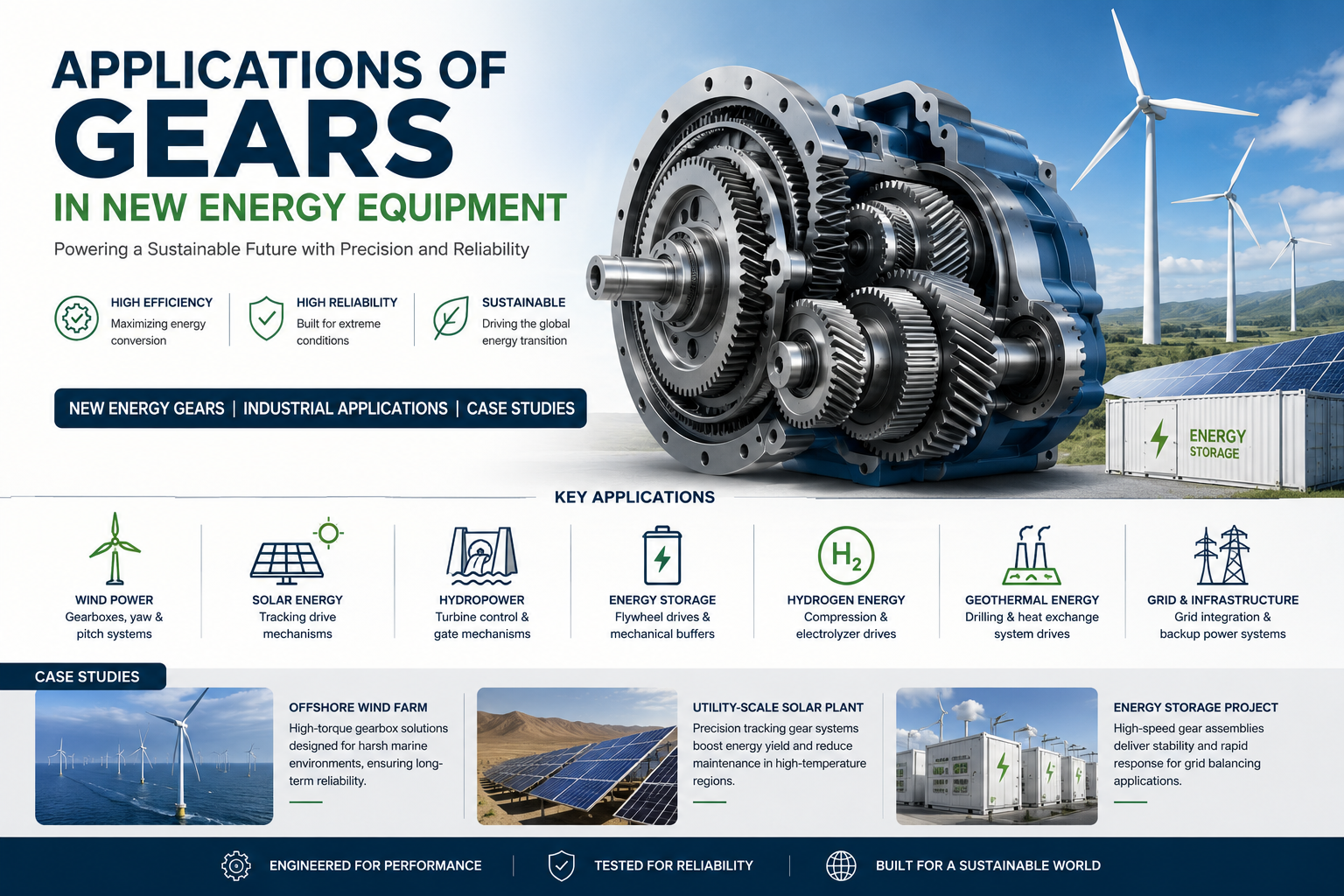
New Energy Gears: Industrial Applications & Case Studies
1. Overview of New Energy Gear Systems
Role of Gears in Renewable Energy Equipment
In the rapidly evolving renewable sector, New Energy Gears have become indispensable mechanical constituents responsible for transmitting torque, regulating rotational velocity, and ensuring synchronized operational continuity across highly sophisticated systems. Whether integrated into wind turbines, solar tracking structures, hydropower installations, or hydrogen compression units, gears serve as the kinetic nexus between energy generation and mechanical execution. Frankly speaking, without robust gearing architecture, the whole setup would wobble like a shopping cart with a broken wheel.
Modern renewable equipment operates under fluctuating environmental loads, intermittent energy conditions, and prolonged duty cycles. Consequently, gear systems must accommodate dynamic torque variations while maintaining exceptional meshing precision. In wind energy systems, for instance, planetary gear assemblies amplify rotor motion into generator-compatible rotational speeds, thereby maximizing energy conversion efficiency under erratic wind conditions.
Core Mechanical Requirements in New Energy Systems
Renewable energy equipment imposes severe operational demands on mechanical transmission systems. High torque density, superior fatigue endurance, low vibration characteristics, and corrosion resistance are among the primary engineering prerequisites. Unlike conventional industrial drives, renewable applications frequently experience variable load spectra and environmental extremities that can accelerate material degradation if engineering tolerances are not meticulously controlled.
Gear manufacturers serving the renewable sector must prioritize thermodynamic stability, microgeometry optimization, and tribological performance. Precision-ground tooth profiles, carburized alloy steels, and advanced lubrication strategies have become standard specifications for high-performance systems. In practical engineering circles, many procurement specialists simply say, “If the gearbox fails, the whole project is dead in the water.”
Importance for B2B Industrial Supply Chains
From a procurement and industrial operations perspective, gear systems occupy a strategic position within renewable energy supply chains. Delayed gearbox deliveries or inconsistent quality can trigger cascading project postponements, contractual penalties, and inflated maintenance expenditures. Therefore, B2B buyers increasingly evaluate suppliers based not only on pricing, but also on lifecycle reliability, technical support capabilities, and manufacturing traceability.
Large-scale renewable projects require synchronized coordination between OEMs, gearbox suppliers, metallurgy providers, logistics partners, and maintenance contractors. In this ecosystem, dependable gear manufacturing partners become long-term strategic collaborators rather than transactional vendors.
2. Market Landscape of New Energy Gears
Global Demand Trends Across Renewable Sectors
The worldwide expansion of renewable infrastructure has generated extraordinary demand for advanced gear systems. Wind farms, solar tracking facilities, hydropower stations, and hydrogen production plants continue to proliferate as governments intensify decarbonization initiatives and corporations pursue sustainability targets.
According to global energy development statistics published by the International Energy Agency (IEA), renewable electricity capacity additions continue to rise annually, thereby stimulating unprecedented requirements for industrial transmission equipment. This trend has elevated Industrial Applications of gearing systems into one of the fastest-growing mechanical sectors globally.
Key Industrial Drivers Influencing Adoption
Several industrial catalysts are accelerating the adoption of advanced renewable gear technologies. Rising fossil fuel volatility, stricter environmental legislation, and expanding electrification initiatives are compelling manufacturers to modernize energy infrastructure. Furthermore, corporate ESG commitments have amplified investments in renewable facilities requiring durable mechanical transmission systems.
Technological advancement also plays a substantial role. Higher-capacity wind turbines and precision solar trackers necessitate increasingly sophisticated gearbox configurations capable of withstanding immense cyclic loads while minimizing maintenance intervals.
Regional Growth Patterns and Investment Flows
Asia-Pacific remains a dominant manufacturing and deployment hub for renewable gear systems due to extensive industrialization and government-backed energy initiatives. China, in particular, has become a pivotal supplier of wind turbine gearbox assemblies and solar tracking components.
Meanwhile, Europe continues investing heavily in offshore wind infrastructure, while North America experiences accelerated growth in utility-scale solar installations. Cross-border investment flows into renewable infrastructure projects are stimulating substantial procurement opportunities for gear manufacturers worldwide.
3. Classification of New Energy Gears
Wind Turbine Gearbox Systems
Wind turbine gearboxes typically employ planetary-helical hybrid architectures engineered to convert low-speed rotor rotation into high-speed generator input. These systems must withstand extreme torque loads, stochastic wind conditions, and prolonged operational durations that often exceed twenty years.
Advanced wind gearboxes utilize case-hardened gears, optimized bearing arrangements, and integrated lubrication circuits to minimize micropitting and thermal distortion. In large offshore turbines, gearbox dimensions can become absolutely massive — no kidding, some units weigh more than several trucks combined.
Solar Tracking Drive Gear Mechanisms
Solar tracking systems utilize slew drives, worm gears, and spur gear assemblies to maintain optimal photovoltaic panel orientation throughout daylight cycles. These mechanisms significantly improve solar capture efficiency by continuously aligning panels with solar trajectories.
Precision backlash control is particularly important in tracking applications because even minor positional inaccuracies can reduce cumulative energy generation over extended operational periods.
Energy Storage and Transmission Gear Assemblies
Mechanical energy storage systems, including flywheel assemblies and rotational buffering units, depend heavily on precision-engineered gear transmissions. These systems require exceptional balancing characteristics and rotational stability to safely manage high-speed kinetic energy transfer.
Transmission assemblies supporting grid integration infrastructure also rely on heavy-duty gearing systems capable of accommodating fluctuating load conditions without compromising synchronization efficiency.
4. Functional Principles in Energy Transmission
Torque Conversion in High-Load Environments
Torque conversion represents one of the fundamental operational principles of renewable energy gearing systems. Gear ratios allow low-speed, high-torque rotational inputs to be transformed into high-speed outputs suitable for generators and transmission equipment.
In wind turbines, planetary gear systems distribute torque across multiple gear meshes simultaneously, thereby enhancing load-bearing capacity and reducing localized stress concentrations.
Speed Regulation for Stable Energy Output
Stable energy generation requires consistent rotational speed regulation despite fluctuating environmental conditions. Gear systems facilitate this process by harmonizing variable mechanical inputs with generator operating requirements.
Sophisticated gearbox designs integrate adaptive control mechanisms and sensor feedback systems that help maintain rotational consistency even under rapidly changing load conditions.
Load Distribution in Continuous Operation Systems
Continuous renewable operation subjects gears to relentless cyclic loading. Effective load distribution across gear teeth and bearing surfaces is therefore essential for minimizing fatigue accumulation and extending service life.
Finite element analysis and contact stress simulation technologies enable engineers to optimize gear geometry for improved load dispersion and reduced mechanical attrition.
5. Wind Power Gearbox Applications
Main Gearbox in Horizontal-Axis Turbines
Horizontal-axis wind turbines depend on high-capacity gearboxes to elevate rotor speeds from relatively slow blade rotation to generator-compatible velocities. These systems often incorporate multi-stage planetary-helical configurations to achieve high transmission efficiency.
Given the enormous operational stresses involved, gearbox reliability directly influences project profitability and maintenance economics.
Yaw and Pitch Control Gear Systems
Yaw and pitch mechanisms utilize auxiliary gear systems to optimize turbine orientation and blade angles relative to wind direction. These systems contribute significantly to energy capture optimization and structural load mitigation.
Precision positioning accuracy is crucial because even slight angular deviations can substantially impact aerodynamic performance.
Offshore Wind Durability Considerations
Offshore wind installations expose gear systems to corrosive saline environments, severe humidity, and persistent mechanical vibration. Consequently, offshore gearbox engineering emphasizes anti-corrosion coatings, advanced sealing technologies, and redundant lubrication systems.
As many field engineers like to say, offshore equipment either survives the ocean or becomes expensive scrap metal pretty quickly.
6. Solar Energy Tracking Systems
Single-Axis Tracking Gear Mechanisms
Single-axis tracking systems rotate photovoltaic arrays along one directional plane to maximize solar exposure throughout the day. Worm gear drives are commonly utilized because of their self-locking characteristics and compact design geometry.
Dual-Axis Precision Drive Systems
Dual-axis systems provide enhanced tracking precision by enabling simultaneous horizontal and vertical panel adjustments. These configurations substantially improve solar capture efficiency but require highly accurate gear synchronization.
Efficiency Optimization Through Motion Control
Motion control algorithms integrated with precision gear systems help minimize unnecessary actuator movement while maximizing energy generation efficiency. Smart control architecture reduces mechanical wear and operational energy consumption simultaneously.
7. Hydropower Equipment Gear Usage
Turbine Speed Regulation Systems
Hydropower turbines rely on gear-driven speed regulation mechanisms to maintain stable electrical output despite fluctuating water flow conditions. Robust gear assemblies ensure continuous synchronization between turbine shafts and generator systems.
Gate Control Mechanisms in Dams
Dam infrastructure frequently utilizes heavy-duty gearing systems for sluice gate positioning and flow regulation operations. These mechanisms must maintain operational reliability under substantial hydraulic pressure and environmental exposure.
Heavy-Duty Submerged Gear Protection
Submerged gear systems require specialized sealing technologies, corrosion-resistant metallurgy, and water-resistant lubrication compounds to ensure long-term operational integrity.
8. Energy Storage System Mechanical Integration
Flywheel Energy Storage Gear Assemblies
Flywheel energy storage systems utilize high-speed rotational assemblies to store kinetic energy efficiently. Precision-balanced gear trains facilitate stable energy transfer while minimizing vibrational disturbances.
Mechanical Buffering Systems for Grid Stability
Grid stabilization infrastructure increasingly incorporates mechanical buffering systems capable of absorbing transient load fluctuations and mitigating voltage instability.
High-Speed Rotational Gear Design
High-speed gear systems demand exceptional balancing precision, thermal stability, and tribological optimization to safely manage elevated rotational velocities.
9. Hydrogen Energy Equipment Applications
Compression System Gear Drives
Hydrogen compression facilities require high-performance gear drives capable of handling substantial pressure loads and continuous operational duty cycles.
Electrolyzer Auxiliary Transmission Systems
Electrolyzer facilities incorporate auxiliary gear systems for coolant circulation, gas handling, and supporting mechanical operations.
Safety and Sealing Requirements in Hydrogen Environments
Hydrogen environments necessitate exceptional sealing performance due to the small molecular size and potential leakage risks associated with hydrogen gas.
10. Geothermal Energy Equipment Gear Systems
Deep-Well Drilling Gear Applications
Geothermal drilling operations employ ruggedized gear systems capable of enduring high mechanical stress and abrasive subterranean conditions.
Heat Exchange System Mechanical Drives
Heat exchange infrastructure relies on gear-driven pumps and circulation systems to facilitate efficient thermal energy transfer.
High-Temperature Resistance Design Requirements
Geothermal equipment often operates under elevated thermal conditions requiring specialized alloys and heat-resistant lubrication technologies.
11. Material Selection for New Energy Gears
High-Strength Alloy Steel Applications
Alloy steels incorporating chromium, molybdenum, and nickel are widely utilized for renewable gear manufacturing due to their exceptional hardness and fatigue resistance.
Composite and Lightweight Material Usage
Composite materials and lightweight alloys are increasingly adopted to reduce overall equipment mass while preserving structural rigidity.
Wear Resistance and Fatigue Performance
Advanced surface hardening technologies and optimized metallurgy significantly enhance gear durability under repetitive cyclic loading conditions.
12. Precision Engineering in Gear Manufacturing
CNC Machining and Tolerance Control
Modern gear production relies heavily on CNC machining technologies capable of achieving micron-level dimensional precision and repeatability.
Gear Profile Optimization Techniques
Profile modification techniques such as crowning and tip relief improve meshing performance while reducing vibration and operational noise.
Surface Treatment and Finishing Processes
Shot peening, nitriding, and superfinishing processes enhance surface integrity and improve long-term operational reliability.
13. Reliability and Lifecycle Performance
Fatigue Testing Under Extreme Conditions
Extensive fatigue testing validates gear performance under simulated operational loads, temperature fluctuations, and environmental stress conditions.
Maintenance Cycles in Industrial Deployment
Predictive maintenance scheduling and condition monitoring technologies help minimize downtime and extend gearbox service life.
Predictive Failure Analysis Methods
Advanced vibration analysis, thermal imaging, and oil particle monitoring facilitate early-stage failure detection before catastrophic damage occurs.
14. Efficiency Optimization Strategies
Friction Reduction Technologies
Low-friction coatings, optimized tooth geometries, and advanced bearing systems help improve overall transmission efficiency.
Lubrication System Integration
Integrated lubrication systems ensure consistent oil circulation, thermal regulation, and contaminant removal throughout gearbox operation.
Energy Loss Minimization in Gear Trains
Reducing parasitic energy losses within gear trains contributes directly to improved renewable system performance and operational profitability.
15. Case Studies in Wind Energy Projects
Large-Scale Offshore Wind Farm Gearboxes
Several offshore wind projects have demonstrated the importance of corrosion-resistant gearbox engineering and redundant lubrication systems in extending operational lifespan.
Maintenance Optimization in Desert Wind Farms
Desert-based wind facilities frequently implement enhanced filtration systems and specialized sealing technologies to mitigate abrasive sand intrusion.
Failure Analysis and Redesign Improvements
Detailed forensic engineering investigations have enabled manufacturers to refine gear geometries, improve bearing arrangements, and reduce stress concentrations in high-load systems.
16. Case Studies in Solar Energy Projects
Utility-Scale Solar Tracking Systems
Large utility-scale solar installations increasingly depend on precision tracking mechanisms to maximize energy capture efficiency and operational profitability.
Gear Performance in High-Temperature Regions
Solar facilities located in arid climates require thermally stable gear materials and specialized lubrication compounds capable of resisting heat-induced degradation.
Cost Efficiency Improvements in Mass Deployment
Mass deployment strategies have encouraged modular gear system designs that simplify maintenance while reducing manufacturing and logistics expenditures.
17. Industrial Applications Across Energy Infrastructure
Grid Integration Mechanical Systems
Grid integration equipment relies on durable mechanical transmission systems to ensure synchronized energy distribution and operational stability.
Hybrid Renewable Energy Plants
Hybrid facilities combining wind, solar, and storage technologies require highly adaptable gear systems capable of supporting multifaceted operational requirements.
Backup Power and Emergency Systems
Emergency backup infrastructure incorporates gear-driven generators and mechanical power transfer systems to maintain operational continuity during outages.
18. Future Development Trends of New Energy Gears
Smart Monitoring and IoT-Enabled Gear Systems
IoT-enabled monitoring systems provide real-time operational data regarding temperature, vibration, lubrication condition, and mechanical performance.
Emerging predictive analytics platforms increasingly integrate with industrial automation systems to facilitate proactive maintenance scheduling and operational optimization. Additional technical references regarding renewable integration can be found at U.S. Department of Energy and National Renewable Energy Laboratory.
Lightweight and High-Efficiency Design Evolution
Future gearbox development emphasizes lightweight architectures, advanced composite materials, and ultra-efficient transmission geometries capable of reducing operational losses while maintaining structural robustness.
Research into advanced tribology and renewable engineering continues at institutions such as MIT and through technical resources available on Wikipedia’s gear engineering overview.
AI-Driven Predictive Maintenance in Industrial Applications
Artificial intelligence is rapidly transforming maintenance methodologies across renewable infrastructure. Machine learning algorithms can now analyze operational datasets to predict component degradation, optimize spare parts inventory, and reduce unplanned downtime.
As renewable infrastructure scales globally, the convergence of AI diagnostics, smart sensors, and advanced New Energy Gears will continue redefining reliability standards across renewable Industrial Applications. These evolving technologies and real-world Case Studies collectively demonstrate that precision gearing systems remain foundational to the future of sustainable industrial energy.