Table of Contents
Worm and Gear Sourcing Secrets Every Buyer Should Know
1. Introduction to Worm and Gear Sourcing
In modern industrial power transmission systems, worm and gear assemblies occupy a unique position due to their ability to deliver high torque multiplication, compact mechanical layouts, smooth motion transfer, and significant speed reduction within a relatively small footprint. From the perspective of both mechanical engineers and procurement professionals, sourcing worm gear systems involves far more than simply comparing quotations. Successful procurement requires a deep understanding of engineering specifications, manufacturing capabilities, material science, supplier reliability, and total lifecycle costs.
In today's increasingly competitive global marketplace, purchasing departments are under constant pressure to reduce costs while maintaining uncompromising quality standards. Meanwhile, engineering teams focus on performance, durability, and reliability. The intersection of these priorities makes worm and gear sourcing a strategic function rather than a routine purchasing activity.
Whether the application involves industrial automation, material handling equipment, agricultural machinery, medical devices, packaging systems, or heavy-duty lifting equipment, selecting the right worm gear supplier can significantly impact operational efficiency, maintenance costs, and product reputation. As many experienced buyers say, cutting corners during sourcing often leads to paying twice later.
1.1 Importance of Efficient Sourcing for Buyers
Efficient sourcing directly influences profitability, operational continuity, and customer satisfaction. Procurement professionals increasingly recognize that sourcing decisions affect far more than purchase price alone.
When sourcing worm and gear components, buyers must evaluate several interconnected factors including manufacturing precision, raw material quality, lead times, logistics capabilities, and supplier responsiveness. An apparently inexpensive supplier may introduce hidden costs through inconsistent quality, delayed deliveries, or excessive warranty claims.
From an engineering standpoint, poorly manufactured worm gears can lead to excessive backlash, abnormal wear patterns, noise generation, efficiency losses, and premature system failure. Such problems often remain undetected until products reach the field, where correction costs can become exponentially higher.
Efficient sourcing also enables:
- Reduced inventory carrying costs
- Improved production scheduling
- Lower maintenance expenditures
- Enhanced product reliability
- Better customer satisfaction
- Stronger supply chain resilience
Global procurement teams increasingly adopt Total Cost of Ownership (TCO) methodologies rather than focusing solely on unit pricing. This approach evaluates every cost associated with a component throughout its service life, including transportation, inspection, installation, maintenance, and replacement expenses.
In many industries, procurement managers have learned that the cheapest quote frequently becomes the most expensive mistake.
1.2 Overview of Worm and Gear Applications
Worm gear systems are utilized across a remarkably diverse range of industries due to their ability to provide substantial gear reduction ratios while maintaining compact dimensions.
Common applications include:
Industrial Automation
Conveyor systems, robotic arms, automated assembly equipment, and positioning mechanisms frequently rely on worm gear drives to achieve precise motion control and torque transmission.
Material Handling Equipment
Forklifts, hoists, cranes, winches, and lifting platforms often employ worm gear reducers because of their load-holding characteristics and smooth operation.
Agricultural Machinery
Feed mixers, irrigation systems, grain handling equipment, and harvesting machinery benefit from the durability and torque multiplication capabilities of worm gear systems.
Automotive Systems
Seat adjustment mechanisms, steering systems, windshield wiper drives, and specialized transmission components frequently incorporate worm gears.
Packaging Machinery
Packaging lines require precise speed control and repeatable motion, making worm gear drives a popular choice.
Renewable Energy Systems
Solar tracking systems utilize worm gears to accurately position panels while resisting environmental loads such as wind forces.
Medical Equipment
Hospital beds, patient lifts, diagnostic devices, and rehabilitation equipment often use compact worm gear assemblies to achieve smooth and quiet movement.
One of the most valued characteristics of worm gear systems is their ability to achieve high reduction ratios within a single stage, often eliminating the need for complex multi-stage gear arrangements.
1.3 Common Challenges in Worm and Gear Procurement
Although worm gears appear relatively simple, procurement challenges can become surprisingly complex.
One common issue is specification ambiguity. Buyers sometimes request quotations using incomplete drawings or insufficient technical information. This often leads suppliers to make assumptions, resulting in variations between expected and delivered products.
Additional procurement challenges include:
Quality Variability
Manufacturing tolerances, gear tooth geometry, surface finish quality, and material consistency can vary significantly among suppliers.
Inconsistent Material Certifications
Material substitution remains a concern in global sourcing. Without proper verification procedures, supplied materials may differ from specified grades.
Long Lead Times
Specialized worm gears frequently require custom tooling, heat treatment processes, and precision machining operations that extend production schedules.
Communication Gaps
Technical misunderstandings between engineering and procurement teams can create costly sourcing errors.
Cost Fluctuations
Prices for bronze, alloy steel, stainless steel, and specialty materials can fluctuate significantly due to market conditions.
Supply Chain Disruptions
Global logistics challenges, geopolitical events, and raw material shortages can affect production continuity.
Experienced procurement teams mitigate these risks through detailed specifications, supplier audits, first-article inspections, and long-term supplier partnerships.
2. Understanding Worm and Gear Basics
Before sourcing decisions can be optimized, buyers must understand the fundamental principles governing worm gear operation. A strong technical foundation helps procurement professionals evaluate suppliers more effectively and communicate accurately with engineering teams.
2.1 What is a Worm Gear and How It Works
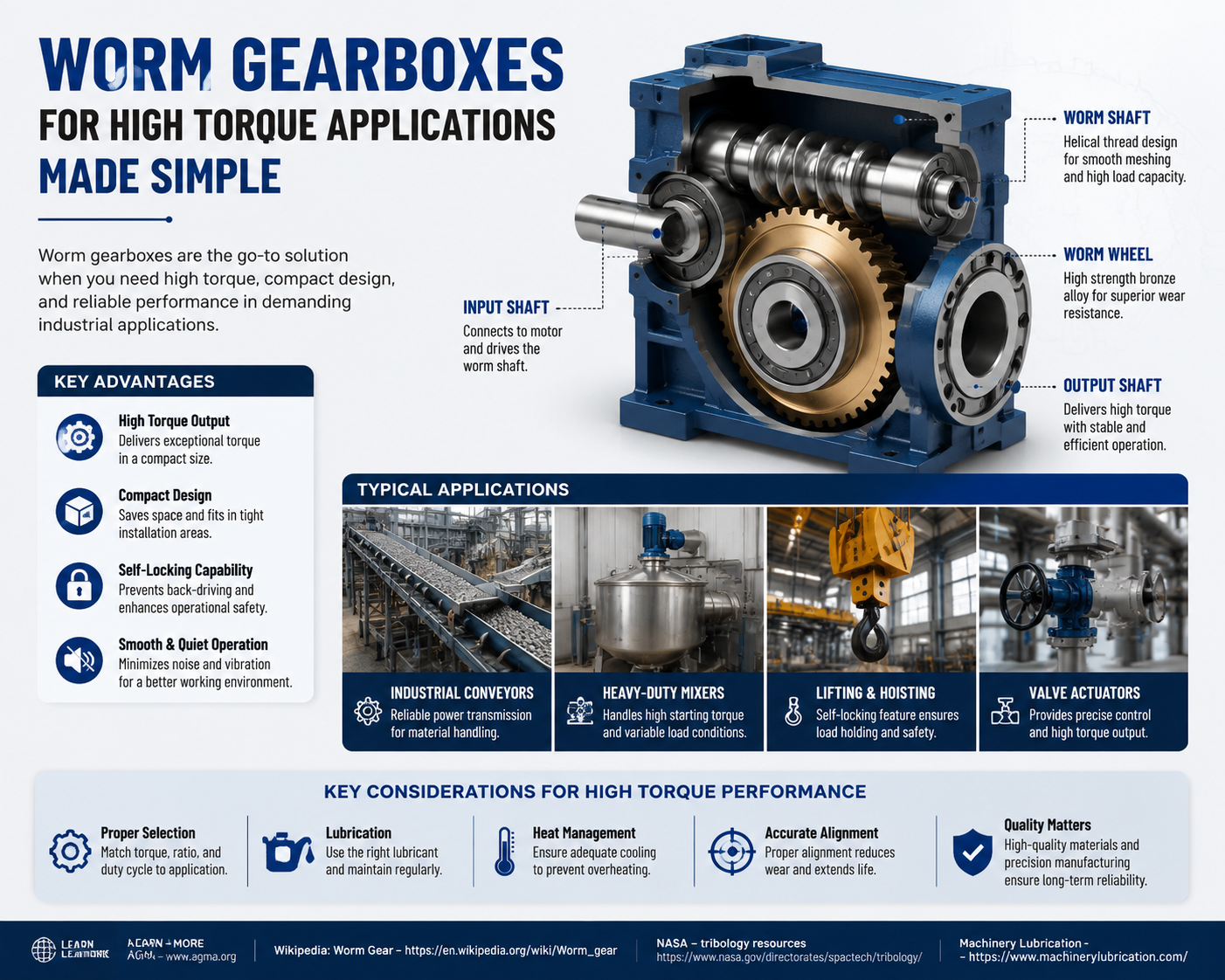
A worm gear system consists of two primary components:
- The worm
- The worm wheel
The worm resembles a threaded screw, while the worm wheel resembles a conventional gear. The two components mesh together at approximately ninety degrees.
As the worm rotates, its helical thread engages the teeth of the worm wheel, causing rotational motion transfer. This arrangement provides substantial speed reduction and torque multiplication.
For a deeper explanation of worm gear mechanics, see: Wikipedia – Worm Drive.
The reduction ratio depends on:
- Number of worm starts
- Number of worm wheel teeth
For example, a single-start worm driving a 40-tooth wheel produces a 40:1 reduction ratio.
One remarkable feature of worm gears is their potential for self-locking behavior. Under certain operating conditions, the worm wheel cannot drive the worm. This characteristic proves extremely valuable in lifting systems, positioning equipment, and load-holding applications.
Advantages include:
- High reduction ratios
- Compact design
- Smooth operation
- Low vibration
- Quiet performance
- Good shock absorption
However, worm gears also generate sliding friction, which can reduce efficiency compared to other gear systems.
2.2 Key Components of a Worm and Gear System
A complete worm gear assembly includes several critical elements.
Worm Shaft
The worm shaft serves as the driving component. It is usually manufactured from hardened alloy steel and ground to precise dimensions.
Worm Wheel
The worm wheel receives motion from the worm. It is often manufactured using bronze materials to reduce friction and wear.
Bearings
Bearings support radial and axial loads generated during operation. Their quality significantly influences system lifespan.
Housing
The gearbox housing maintains component alignment while protecting internal components from contamination.
Lubrication System
Lubricants reduce friction, dissipate heat, and minimize wear.
Sealing Components
Oil seals prevent lubricant leakage while protecting internal components from dust and moisture intrusion.
Mounting Interfaces
Precision-machined mounting surfaces ensure proper installation and alignment.
Each component contributes directly to overall gearbox performance, reliability, and service life.
2.3 Differences Between Worm Gears and Other Gear Types
Understanding the distinctions between gear technologies helps buyers select appropriate solutions.
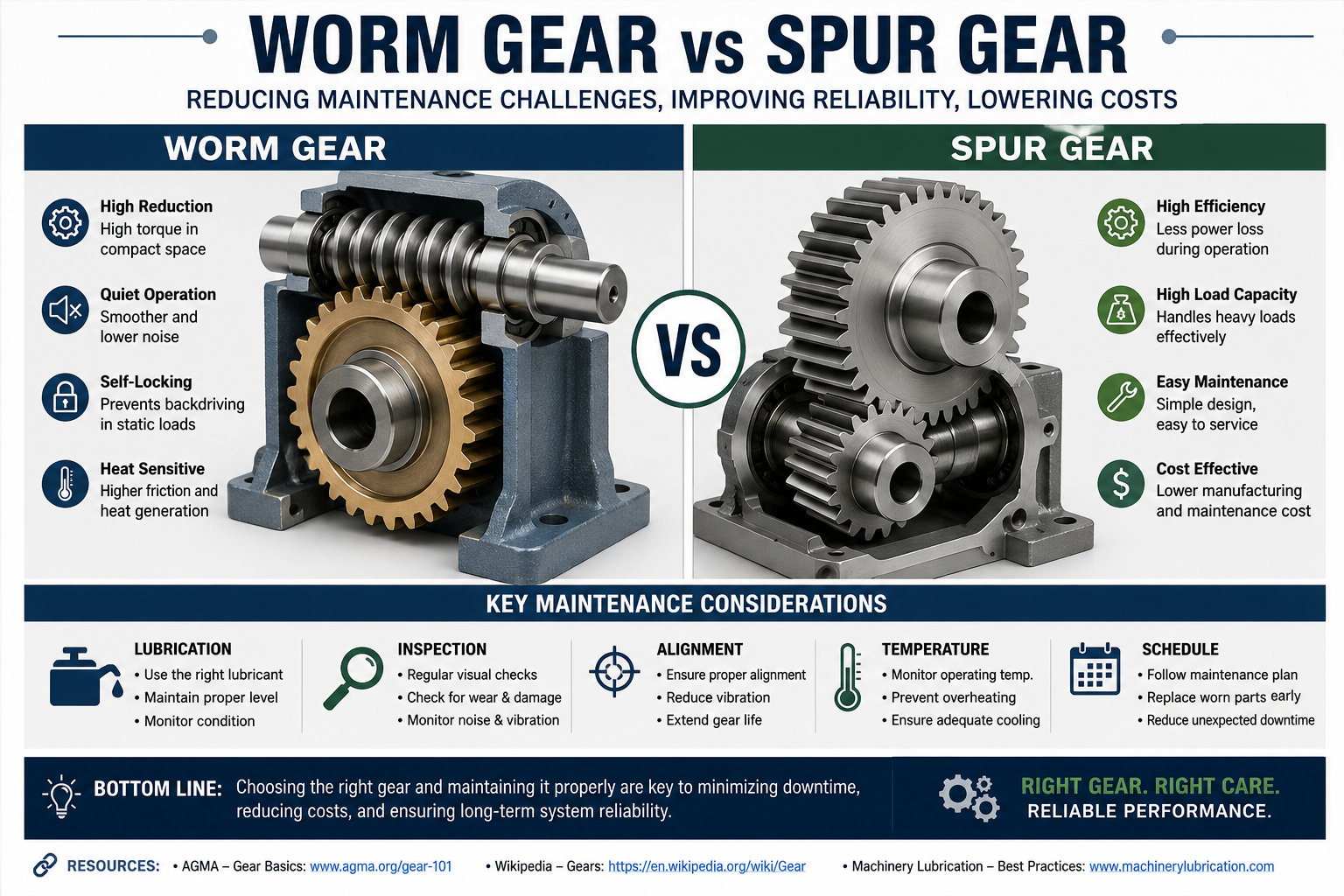
Worm Gears vs Spur Gears
Spur gears provide higher efficiency but lower reduction ratios per stage.
Worm gears offer:
- Higher reduction ratios
- Quieter operation
- Better shock absorption
Spur gears generally provide:
- Higher efficiency
- Lower heat generation
- Simpler manufacturing
Worm Gears vs Helical Gears
Helical gears offer smoother engagement than spur gears and higher load capacity.
Worm gears outperform helical gears when:
- High reduction ratios are required
- Compact layouts are necessary
- Self-locking characteristics are desired
Worm Gears vs Bevel Gears
Bevel gears transfer power between intersecting shafts.
Worm gears transfer power between non-intersecting shafts while delivering significantly higher reduction ratios.
Worm Gears vs Planetary Gears
Planetary gearboxes offer exceptional efficiency and power density.
However, worm gear systems frequently provide lower costs and simpler designs for many applications.
Selecting the correct gear type ultimately depends on operational requirements, efficiency targets, space constraints, and budget considerations.
3. Material Selection for Worm and Gear
Material selection represents one of the most critical factors affecting performance, reliability, and procurement costs. The interaction between worm and wheel materials directly influences wear resistance, efficiency, thermal characteristics, and service life.
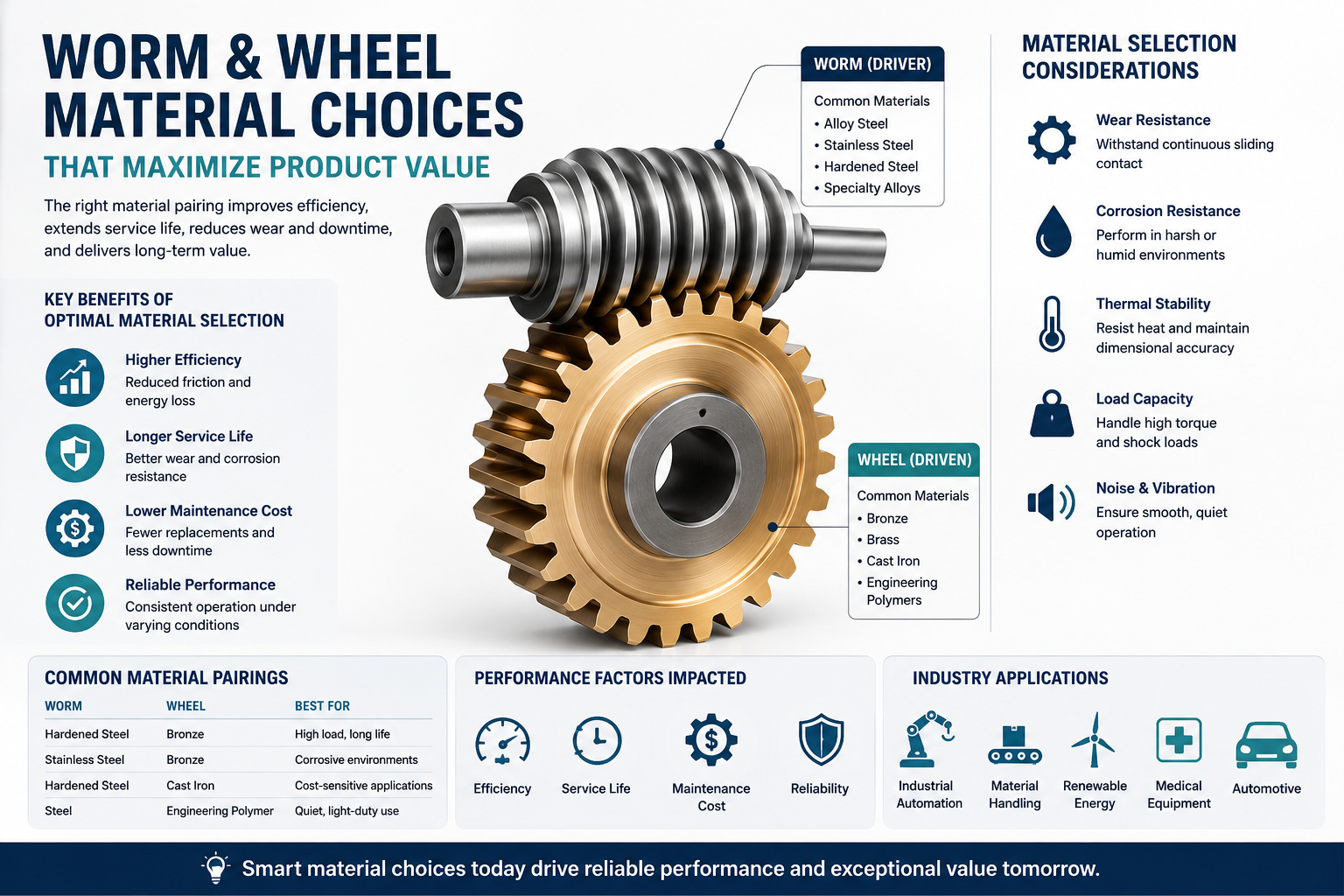
3.1 Common Materials Used in Worm Gears
Various materials are utilized depending on application requirements.
Alloy Steel
Alloy steel remains the most common material for worm shafts.
Benefits include:
- High strength
- Excellent fatigue resistance
- Superior hardenability
- Long service life
Popular grades include:
- 20CrMnTi
- 42CrMo
- 4140
- 8620
Bronze
Bronze is widely used for worm wheels due to its excellent anti-friction properties.
For additional information on bronze alloys: Wikipedia – Bronze.
Common grades include:
- Tin bronze
- Aluminum bronze
- Phosphor bronze
Advantages include:
- Reduced friction
- Good wear resistance
- Excellent compatibility with steel worms
Cast Iron
Cast iron remains popular for cost-sensitive applications.
Benefits include:
- Good machinability
- Vibration damping
- Competitive pricing
Stainless Steel
Used in food processing, marine, and medical applications requiring corrosion resistance.
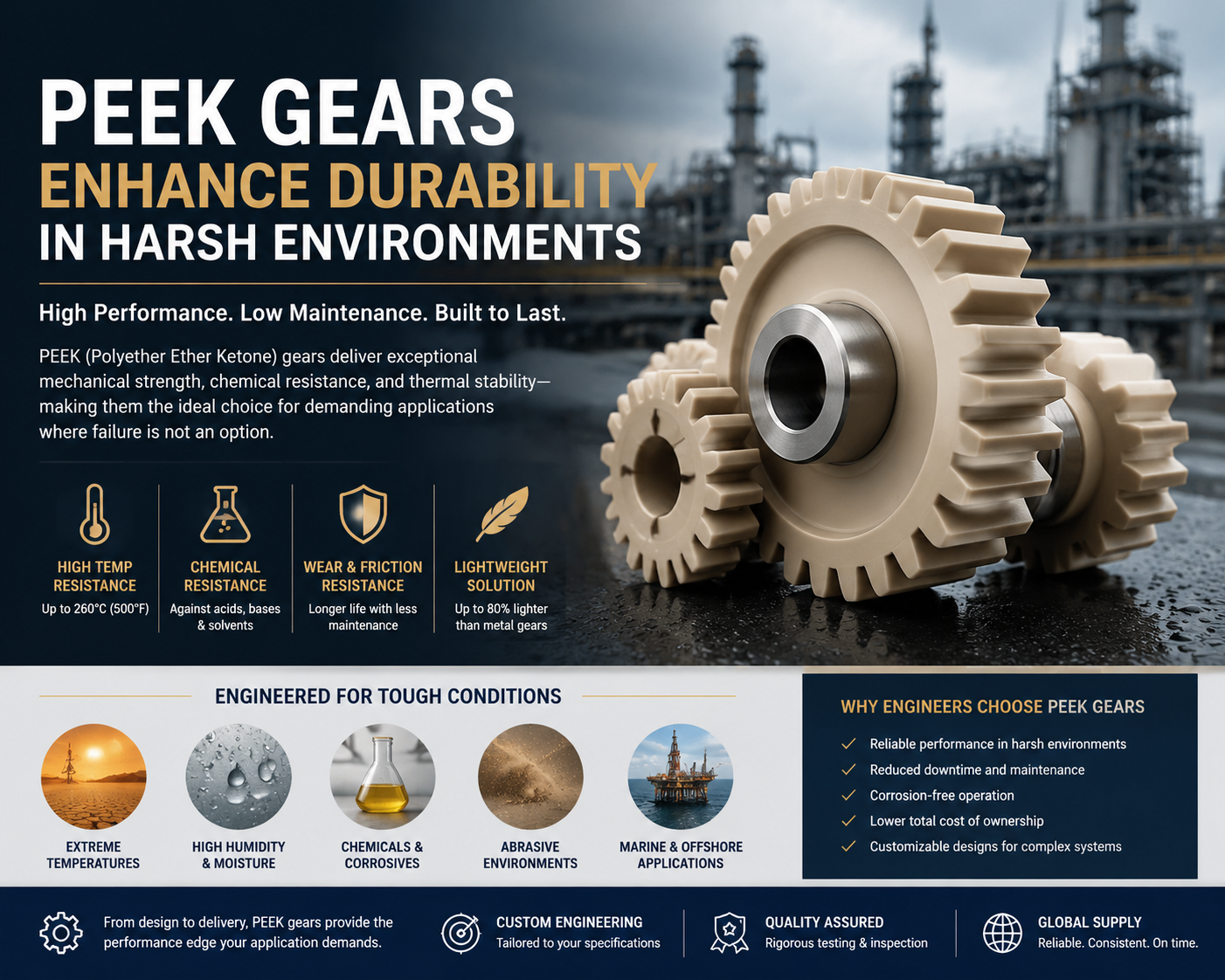
Engineering Plastics
Nylon and other polymers are occasionally used in light-duty applications requiring low noise and corrosion resistance.
3.2 Impact of Material on Performance and Durability
Material selection dramatically affects operational outcomes.
Wear Resistance
Proper material pairing reduces adhesive wear and abrasive wear.
A hardened steel worm paired with a bronze wheel remains one of the most successful combinations in power transmission.
Thermal Performance
Materials influence heat generation and dissipation.
Bronze materials typically offer favorable thermal conductivity characteristics that help manage operating temperatures.
Corrosion Resistance
Environmental conditions may necessitate corrosion-resistant materials.
Applications involving moisture, chemicals, or salt exposure often require stainless steel or protective coatings.
Load Capacity
Higher-strength materials support greater torque transmission capabilities.
Fatigue Life
Repeated loading cycles can initiate microscopic cracks that eventually lead to failure. High-quality materials improve fatigue resistance and extend service life.
The old engineering principle remains true: the right material in the right application saves far more money than any discount obtained during purchasing.
3.3 Material Cost Considerations for Procurement
Material costs often account for a significant portion of overall manufacturing expenses.
Procurement professionals must balance technical requirements against budget constraints.
Major cost factors include:
- Raw Material Prices
- Material Availability
- Machinability
- Heat Treatment Requirements
- Scrap Rates
- Lifecycle Value
Sophisticated procurement strategies focus on value optimization rather than simple material cost reduction.
4. Manufacturing Processes Explained
Manufacturing quality often determines whether a worm gear system performs reliably for years or experiences premature failure. Buyers who understand manufacturing processes gain significant advantages during supplier evaluation.
4.1 Precision Machining Techniques
Modern worm gear production relies heavily on advanced machining technologies.
CNC Turning
CNC lathes produce accurate worm shaft profiles while maintaining tight dimensional tolerances.
Benefits include:
- Repeatability
- High accuracy
- Improved surface finishes
- Reduced variation
Gear Hobbing
Gear hobbing remains one of the most common methods for generating worm wheel teeth.
Learn more about the process: Wikipedia – Gear Hobbing.
The process provides:
- High productivity
- Excellent tooth geometry
- Consistent quality
Gear Grinding
Grinding improves dimensional accuracy and surface finish after heat treatment.
Advantages include:
- Reduced noise
- Improved efficiency
- Enhanced gear meshing
Milling Operations
Complex features such as keyways, mounting surfaces, and custom geometries are frequently produced using CNC milling centers.
Multi-Axis Machining
Advanced five-axis machining systems allow manufacturers to create intricate geometries while minimizing setup errors.
4.2 Heat Treatment and Surface Finishing
Heat treatment transforms ordinary machined components into durable power transmission elements.
Carburizing
Carburizing introduces carbon into the surface layer, creating a hard wear-resistant case while maintaining a tough core.
Nitriding
Nitriding improves surface hardness without significant dimensional distortion.
Induction Hardening
Localized hardening enhances wear resistance in critical areas.
Tempering
Tempering reduces brittleness while preserving hardness.
Reference: National Institute of Standards and Technology (NIST)
Surface finishing processes include:
- Grinding
- Polishing
- Phosphate coatings
- Nickel plating
- Zinc plating
- Specialized anti-corrosion treatments
These processes enhance durability and environmental resistance.
4.3 Impact of Manufacturing on Quality and Longevity
Manufacturing quality directly influences gear performance.
Poor manufacturing practices can lead to:
- Excessive backlash
- Uneven tooth contact
- Noise generation
- Premature wear
- Reduced efficiency
- Gear failure
Conversely, precision manufacturing delivers:
Improved Load Distribution
Accurate tooth geometry ensures uniform stress distribution.
Lower Operating Temperatures
Better surface finishes reduce friction losses.
Reduced Noise Levels
Precision gears operate more smoothly and quietly.
Extended Service Life
Proper manufacturing significantly delays wear mechanisms.
Higher Reliability
Consistent production quality minimizes field failures.
For procurement teams evaluating suppliers, manufacturing capability should never be viewed as a secondary consideration. In the worm gear industry, production excellence often separates world-class suppliers from those merely competing on price.
```html5. Supplier Selection Strategies
Selecting the right supplier is arguably one of the most consequential decisions in the worm and gear procurement process. Even the most sophisticated design can fail to achieve its intended performance when manufacturing quality, process control, or supplier communication falls short. Procurement professionals and mechanical engineers must therefore evaluate suppliers through both technical and commercial lenses.
In today's global marketplace, buyers have access to thousands of manufacturers across multiple regions. However, not all suppliers possess the same level of engineering expertise, production consistency, or quality management discipline. A structured supplier evaluation framework significantly reduces sourcing risks while improving long-term procurement outcomes.
5.1 Identifying Reliable OEM/ODM Suppliers
A reliable OEM or ODM supplier should demonstrate more than merely competitive pricing. The strongest suppliers typically combine engineering competence, manufacturing capability, and proactive customer support.
Engineering Expertise
Reliable suppliers possess dedicated engineering teams capable of reviewing drawings, optimizing manufacturability, and identifying potential design concerns before production begins.
Indicators of engineering strength include:
- In-house design capabilities
- Gear calculation software
- CAD and CAM systems
- Failure analysis expertise
- Application engineering support
Manufacturing Infrastructure
Production facilities reveal much about a supplier's true capabilities.
Buyers should evaluate:
- CNC machining centers
- Gear hobbing machines
- Gear grinding equipment
- Heat treatment facilities
- Inspection laboratories
- Automation levels
A supplier equipped with advanced machinery generally offers better process consistency and dimensional accuracy.
Industry Experience
Suppliers serving demanding industries often maintain higher quality standards.
Examples include:
- Aerospace
- Medical devices
- Industrial automation
- Renewable energy
- Automotive systems
Financial Stability
Financially healthy suppliers are less likely to experience production interruptions, labor shortages, or operational instability.
Procurement teams should assess:
- Years in operation
- Export history
- Customer portfolio
- Growth trends
- Business continuity planning
As experienced buyers often note, a supplier relationship should be viewed as a marathon rather than a sprint.
5.2 Evaluating Supplier Capabilities and Certifications
Supplier certifications provide valuable insight into organizational discipline and quality management maturity.
ISO 9001 Certification
ISO 9001 remains the most widely recognized quality management standard.
It demonstrates:
- Documented procedures
- Process control systems
- Continuous improvement practices
- Customer-focused quality management
Learn more from the International Organization for Standardization: ISO 9001 Quality Management Systems
IATF 16949
Particularly relevant for automotive applications, this certification imposes stricter quality requirements and risk management controls.
ISO 14001
Environmental management certification demonstrates commitment to sustainability and regulatory compliance.
ISO 45001
This certification addresses occupational health and safety management systems.
Technical Capability Assessments
Beyond certifications, buyers should evaluate:
- Production capacity
- Tooling capabilities
- Engineering resources
- Testing facilities
- Metrology equipment
- Material traceability systems
Factory audits often reveal operational realities that certifications alone cannot capture.
Process Validation
Reliable suppliers should provide:
- Process flow charts
- Control plans
- PFMEA documentation
- Inspection records
- Statistical process control data
These documents demonstrate process maturity and manufacturing discipline.
5.3 Building Long-Term Supplier Relationships
Strategic supplier partnerships frequently outperform transactional purchasing models.
Long-term relationships provide several advantages:
Improved Communication
Regular collaboration reduces misunderstandings and accelerates problem resolution.
Better Pricing Stability
Trusted customers often receive preferential pricing and more favorable commercial terms.
Priority Production Scheduling
Established relationships may secure production capacity during periods of high demand.
Joint Product Development
Suppliers become valuable contributors during product innovation and cost-reduction initiatives.
Enhanced Quality Consistency
Long-term suppliers develop deeper understanding of customer expectations and specifications.
Best practices for relationship development include:
- Regular supplier reviews
- Performance scorecards
- Technical workshops
- Forecast sharing
- Collaborative improvement projects
The strongest procurement organizations treat suppliers as strategic partners rather than interchangeable vendors.
6. Quality Control Standards
Quality control represents the foundation upon which successful worm gear performance is built. Precision gearing applications often operate under demanding conditions involving continuous loads, fluctuating torque, vibration, and environmental stressors. Even minor quality deviations can produce substantial operational consequences.
A comprehensive quality assurance framework minimizes risks while ensuring consistency across production batches.
6.1 International Quality Standards for Worm Gears
Several internationally recognized standards govern gear manufacturing quality.
AGMA Standards
The American Gear Manufacturers Association provides widely accepted guidelines for:
- Gear design
- Manufacturing tolerances
- Performance ratings
- Inspection procedures
Reference: American Gear Manufacturers Association (AGMA)
AGMA standards are commonly referenced throughout North America and global export markets.
ISO Standards
International Organization for Standardization standards establish global quality benchmarks.
Relevant standards include:
- ISO 1328
- ISO 6336
- ISO 9001
- ISO 21771
These standards define measurement methodologies and quality classifications.
DIN Standards
German DIN standards remain highly respected in precision mechanical engineering.
DIN specifications often apply to:
- Gear geometry
- Surface finish
- Material properties
- Tolerance classifications
JIS Standards
Japanese Industrial Standards are frequently referenced in Asian manufacturing sectors.
Compliance with recognized standards improves product consistency while simplifying supplier comparisons.
6.2 Inspection Methods and Testing Procedures
Quality inspection should occur throughout the manufacturing process rather than solely at final assembly.
Incoming Material Inspection
Verification includes:
- Chemical composition analysis
- Mechanical property testing
- Material certification review
- Traceability validation
Dimensional Inspection
Critical dimensions are measured using:
- Coordinate Measuring Machines (CMM)
- Micrometers
- Height gauges
- Optical comparators
- Laser measurement systems
Gear Tooth Inspection
Specialized equipment evaluates:
- Tooth profile accuracy
- Lead accuracy
- Pitch deviation
- Runout
- Concentricity
Hardness Testing
Common methods include:
- Rockwell testing
- Brinell testing
- Vickers testing
These tests verify proper heat treatment results.
Load Testing
Functional testing evaluates gearbox performance under simulated operating conditions.
Parameters may include:
- Torque transmission
- Noise levels
- Temperature rise
- Efficiency
- Vibration characteristics
Metallurgical Analysis
Microscopic examination confirms:
- Grain structure
- Case depth
- Surface integrity
- Heat treatment effectiveness
Comprehensive testing programs reduce the likelihood of costly field failures.
6.3 Common Quality Issues and How to Avoid Them
Even experienced manufacturers occasionally encounter quality challenges.
Excessive Backlash
Poor machining accuracy can produce excessive clearance between mating components.
Prevention methods include:
- Precision machining
- Controlled assembly procedures
- Tight tolerance management
Tooth Surface Damage
Common forms include:
- Pitting
- Scoring
- Galling
- Micropitting
Proper lubrication and material selection significantly reduce these risks.
Heat Treatment Distortion
Improper heat treatment may alter dimensions and compromise gear meshing.
Solutions include:
- Controlled thermal cycles
- Post-treatment grinding
- Process validation
Material Defects
Internal inclusions, porosity, or inconsistent composition can weaken components.
Rigorous supplier qualification and material testing mitigate these concerns.
Noise and Vibration Problems
Common causes include:
- Tooth profile errors
- Alignment issues
- Surface roughness
- Assembly inaccuracies
Preventive quality control measures remain substantially less expensive than corrective actions after shipment.
7. Cost Analysis and Budgeting
Effective procurement requires balancing technical requirements with financial objectives. Successful buyers understand that cost management extends far beyond unit price comparisons.
Comprehensive cost analysis enables organizations to maximize value while maintaining performance and reliability standards.
7.1 Factors Influencing Worm Gear Pricing
Numerous variables contribute to final product costs.
Raw Material Costs
Material selection significantly affects pricing.
Factors include:
- Steel grade
- Bronze composition
- Alloy content
- Market commodity prices
Bronze-intensive gear assemblies often experience greater price volatility due to copper market fluctuations.
Manufacturing Complexity
Complex geometries require:
- Additional machining operations
- Specialized tooling
- Extended setup times
- More inspection steps
These factors increase production costs.
Precision Requirements
Tighter tolerances generally demand:
- Advanced machinery
- Additional grinding
- Enhanced inspection
- Greater process control
Higher precision inevitably increases manufacturing expenses.
Heat Treatment Processes
Advanced heat treatment methods add value but also contribute to overall cost.
Order Volume
Larger production quantities often reduce per-unit costs through economies of scale.
Packaging and Logistics
Export packaging, freight costs, customs duties, and insurance all influence landed costs.
A comprehensive understanding of these variables helps buyers negotiate more effectively.
7.2 Balancing Cost and Quality
One of procurement's greatest challenges involves balancing budget constraints with performance expectations.
Lowest Cost vs Best Value
The lowest quotation rarely represents the best overall value.
Buyers should evaluate:
- Product lifespan
- Reliability
- Warranty exposure
- Maintenance requirements
- Downtime costs
Lifecycle Cost Analysis
Lifecycle costing considers all expenses incurred throughout the component's operational life.
Typical elements include:
- Purchase cost
- Installation cost
- Operating cost
- Maintenance cost
- Replacement cost
Risk-Based Cost Evaluation
Procurement teams increasingly incorporate risk assessments into sourcing decisions.
Potential risks include:
- Supplier instability
- Quality failures
- Delivery delays
- Regulatory non-compliance
Selecting slightly higher-priced suppliers often reduces overall organizational risk.
Engineering Collaboration
Close cooperation between engineering and procurement departments frequently uncovers opportunities for cost optimization without compromising performance.
Examples include:
- Material substitutions
- Design simplification
- Tolerance optimization
- Standardization initiatives
The smartest buyers focus on maximizing value rather than minimizing price.
7.3 Negotiation Strategies for Better Pricing
Effective negotiation extends beyond requesting discounts.
Understand Supplier Cost Structures
Buyers who understand manufacturing economics negotiate from a stronger position.
Cost drivers include:
- Materials
- Labor
- Tooling
- Energy
- Logistics
Leverage Forecast Commitments
Suppliers often provide improved pricing when customers offer reliable volume forecasts.
Consolidate Purchasing Volumes
Combining multiple product families may improve bargaining power.
Multi-Year Agreements
Long-term contracts provide stability for both parties and often result in more competitive pricing.
Competitive Benchmarking
Obtaining multiple quotations establishes realistic market pricing benchmarks.
Value Engineering Discussions
Collaborative cost-reduction projects frequently generate savings larger than traditional price negotiations.
Mutually beneficial partnerships generally produce more sustainable results than aggressive price-focused tactics.
8. Lead Time and Production Planning
Lead time management has become increasingly important as supply chains grow more complex and customer expectations continue to rise. Delays in critical worm gear components can disrupt production schedules, increase inventory costs, and damage customer relationships.
Effective planning minimizes these risks while improving operational efficiency.
8.1 Typical Manufacturing Lead Times
Lead times vary considerably depending on product complexity and supplier capabilities.
Standard Catalog Products
Typical lead times range from:
- 2 to 6 weeks
These products usually require minimal customization.
Semi-Custom Components
Modified designs generally require:
- 4 to 10 weeks
Additional engineering review and setup activities contribute to longer schedules.
Fully Customized Worm Gear Systems
Complex projects may require:
- 8 to 20 weeks or longer
Factors influencing lead time include:
- Engineering approvals
- Tooling development
- Material procurement
- Heat treatment scheduling
- Inspection requirements
International Shipping Considerations
Transit times may add:
- 1 to 8 weeks
Depending on:
- Transportation mode
- Destination region
- Customs processing
Understanding total lead time is essential for accurate planning.
8.2 Managing Rush Orders
Urgent customer demands occasionally require accelerated procurement.
While rush orders can solve immediate problems, they introduce additional risks.
Capacity Constraints
Suppliers may need to rearrange production schedules.
Increased Costs
Expedited manufacturing often involves:
- Overtime labor
- Priority scheduling
- Premium freight charges
Quality Risks
Compressed schedules may reduce opportunities for process optimization and inspection.
Supplier Communication
Early notification significantly improves a supplier's ability to accommodate urgent requirements.
Best practices include:
- Maintaining emergency inventory
- Establishing expedited production agreements
- Identifying alternate suppliers
- Sharing demand forecasts
Proper planning remains the most effective method for minimizing rush-order dependence.
8.3 Strategies for Reducing Procurement Delays
Proactive procurement strategies help organizations maintain supply continuity.
Supplier Diversification
Multiple qualified suppliers reduce dependence on a single source.
Forecast Sharing
Providing demand visibility enables suppliers to plan production more effectively.
Safety Stock Management
Strategic inventory buffers protect against unexpected disruptions.
Vendor Managed Inventory
VMI programs allow suppliers to manage replenishment activities based on consumption data.
Digital Supply Chain Monitoring
Modern software platforms provide real-time visibility into:
- Production status
- Inventory levels
- Shipment tracking
- Potential disruptions
Early Supplier Involvement
Including suppliers during product development improves planning accuracy and reduces unforeseen delays.
Organizations that proactively manage lead times often achieve significant competitive advantages through greater responsiveness, improved customer service, and lower operational risk.
9. Risk Management in Sourcing
In the world of global procurement, risk is not a matter of if but when. Even the most experienced sourcing teams encounter unexpected disruptions, whether caused by geopolitical tensions, raw material shortages, transportation bottlenecks, supplier insolvency, or sudden demand fluctuations. For worm and gear procurement, where precision manufacturing and specialized materials are often involved, risk management becomes a strategic necessity rather than an optional exercise.
Successful organizations develop robust risk mitigation frameworks that identify vulnerabilities before they become costly operational problems. As seasoned purchasing engineers often say, hope is not a procurement strategy.
9.1 Common Risks in Global Procurement
Understanding the risk landscape is the first step toward effective mitigation.
Supply Chain Disruptions
Global supply chains have become increasingly interconnected and vulnerable to disruption.
Common causes include:
- Port congestion
- Natural disasters
- Political instability
- Trade restrictions
- Transportation shortages
- Energy supply interruptions
A single disruption can delay production schedules by weeks or even months.
Raw Material Volatility
Worm gear manufacturing depends heavily on materials such as:
- Bronze
- Copper
- Alloy steel
- Stainless steel
- Specialty metals
Price fluctuations can significantly affect procurement budgets and supplier quotations.
For information on global commodity trends and materials markets: U.S. Geological Survey (USGS)
Quality Risks
Quality failures can result from:
- Process inconsistencies
- Material substitutions
- Inadequate inspections
- Workforce skill shortages
These issues often remain hidden until products reach assembly lines or end users.
Currency Exchange Risks
International procurement frequently involves multiple currencies.
Exchange rate fluctuations can affect:
- Material costs
- Supplier profitability
- Contract values
- Budget forecasts
Regulatory Compliance Risks
Failure to comply with import regulations, environmental standards, or product safety requirements can lead to costly delays and penalties.
Intellectual Property Risks
For customized worm gear designs, intellectual property protection is particularly important when sourcing globally.
Robust confidentiality agreements and supplier vetting procedures help reduce exposure.
9.2 Supplier Risk Assessment Tools
Professional procurement organizations utilize structured assessment methodologies to evaluate supplier risk profiles.
Supplier Scorecards
Scorecards provide objective measurement of supplier performance.
Common metrics include:
- Quality performance
- Delivery reliability
- Responsiveness
- Cost competitiveness
- Technical support
- Continuous improvement efforts
Regular scorecard reviews help identify emerging concerns before they escalate.
Financial Health Assessments
Financial instability often precedes operational problems.
Evaluation criteria may include:
- Revenue trends
- Profitability
- Debt levels
- Cash flow stability
- Capital investment activity
Financially stable suppliers are generally better positioned to withstand market fluctuations.
Factory Audits
On-site audits provide valuable insights into:
- Production capabilities
- Workforce competency
- Equipment condition
- Process controls
- Quality systems
Many procurement teams consider factory audits indispensable for strategic suppliers.
Supply Chain Mapping
Mapping supplier networks improves visibility into upstream dependencies.
This process identifies:
- Critical raw material sources
- Single-source vulnerabilities
- Geographic concentration risks
- Logistics bottlenecks
Risk Heat Maps
Visual risk matrices allow organizations to prioritize mitigation efforts based on probability and potential impact.
High-risk suppliers receive greater monitoring and contingency planning attention.
9.3 Contingency Planning for Supply Chain Disruptions
Prepared organizations recover faster when disruptions occur.
Dual Sourcing Strategies
Maintaining qualified secondary suppliers reduces dependence on any single source.
Benefits include:
- Improved continuity
- Increased negotiation leverage
- Reduced operational exposure
Strategic Inventory Buffers
Safety stock serves as a protective cushion during temporary disruptions.
Inventory policies should balance:
- Carrying costs
- Service levels
- Risk tolerance
- Lead time variability
Emergency Response Protocols
Clear escalation procedures enable rapid decision-making during crises.
Response plans should define:
- Communication channels
- Decision authorities
- Supplier contacts
- Recovery actions
Contractual Safeguards
Well-structured contracts address:
- Delivery obligations
- Quality expectations
- Force majeure provisions
- Liability responsibilities
Scenario Planning
Leading procurement organizations regularly conduct scenario analyses to evaluate preparedness for various disruption events.
The objective is not to predict every problem but to develop organizational agility capable of responding effectively when challenges arise.
10. Customization and Design Considerations
Worm gear applications often require specialized configurations to meet unique performance, dimensional, or environmental requirements. Procurement professionals must understand the implications of customization decisions because these choices affect costs, lead times, manufacturing complexity, and long-term maintenance requirements.
A thoughtful balance between standardization and customization frequently yields the most favorable outcomes.
10.1 When to Opt for Standard vs Custom Gears
The decision between standard and custom worm gears depends on application requirements and business objectives.
Advantages of Standard Gears
Standard products offer several benefits:
- Lower costs
- Faster lead times
- Proven reliability
- Easier replacement sourcing
- Reduced engineering effort
For many applications, standard solutions provide sufficient performance while minimizing procurement complexity.
Advantages of Custom Gears
Custom designs become necessary when standard products cannot satisfy specific requirements.
Typical drivers include:
- Unique mounting constraints
- Specialized torque requirements
- Environmental challenges
- Weight limitations
- Space restrictions
- Noise reduction targets
Cost Implications
Customization often introduces:
- Engineering costs
- Tooling expenses
- Longer lead times
- Minimum order quantities
Procurement teams should carefully evaluate whether customization provides sufficient value to justify these additional investments.
Lifecycle Considerations
Standard components generally simplify maintenance and spare parts management.
Custom components may offer superior performance but require more sophisticated support planning.
10.2 Design Factors Affecting Performance
Numerous design parameters influence worm gear behavior.
Gear Ratio Selection
The reduction ratio affects:
- Output speed
- Torque multiplication
- Efficiency
- Heat generation
Proper ratio selection is fundamental to achieving desired system performance.
Center Distance
Center distance influences:
- Load capacity
- Gear size
- Housing dimensions
- Manufacturing requirements
Tooth Geometry
Precise tooth geometry affects:
- Contact patterns
- Noise levels
- Efficiency
- Wear characteristics
Material Pairing
Material combinations influence:
- Friction behavior
- Thermal performance
- Durability
- Lubrication requirements
Lubrication Design
Proper lubrication significantly impacts:
- Efficiency
- Wear rates
- Operating temperature
- Service life
Thermal Management
Heat generation remains a critical consideration in worm gear systems due to sliding contact between mating surfaces.
Engineers must account for:
- Duty cycles
- Ambient temperatures
- Cooling requirements
- Lubricant performance
Small design decisions often have substantial consequences over the operational lifespan of a gearbox.
10.3 Collaboration with Suppliers for Custom Solutions
The most successful custom projects emerge from close cooperation between customers and suppliers.
Early Supplier Involvement
Engaging suppliers during the design phase enables valuable input regarding:
- Manufacturability
- Cost optimization
- Material selection
- Production feasibility
Design for Manufacturing
DFM principles simplify production while improving consistency and reducing costs.
Potential improvements include:
- Tolerance optimization
- Geometry simplification
- Material alternatives
- Process standardization
Reference: NASA Engineering Design Resources
Prototype Development
Prototyping allows validation of:
- Fit
- Function
- Performance
- Durability
Before committing to full-scale production.
Joint Problem Solving
Collaborative engineering reviews often uncover innovative solutions that neither party would identify independently.
Strong supplier partnerships transform suppliers from component vendors into valuable engineering resources.
11. Logistics and Shipping Optimization
Even perfectly manufactured worm gears can create problems if logistics execution falls short. Transportation delays, packaging failures, customs complications, and inventory mismanagement can undermine sourcing success. Consequently, logistics planning should receive the same level of attention as manufacturing and quality management.
Efficient logistics reduce costs while improving customer service and production continuity.
11.1 International Shipping Challenges
Global procurement introduces numerous logistical complexities.
Transportation Capacity Constraints
Freight availability fluctuates due to:
- Seasonal demand
- Economic conditions
- Carrier capacity
- Global trade volumes
Capacity shortages often increase costs and transit times.
Customs Clearance Delays
Import and export procedures vary significantly among countries.
Potential challenges include:
- Documentation errors
- Regulatory inspections
- Classification disputes
- Duty assessments
Even minor paperwork issues can create substantial delays.
Geopolitical Factors
Trade policies and geopolitical developments can affect:
- Tariff structures
- Transportation routes
- Regulatory requirements
- Supplier accessibility
Port Congestion
Congested ports remain a frequent source of delays in international supply chains.
Freight Cost Volatility
Transportation costs can fluctuate dramatically due to:
- Fuel prices
- Capacity shortages
- Market demand
- Route availability
Successful logistics planning requires continuous monitoring of these variables.
11.2 Packaging and Handling Considerations
Proper packaging protects precision components throughout transportation and storage.
Corrosion Protection
Worm gears frequently require protective measures against corrosion.
Common solutions include:
- Rust preventive coatings
- Vacuum packaging
- Desiccant packs
- Vapor corrosion inhibitors
Mechanical Protection
Packaging must prevent:
- Impact damage
- Surface scratches
- Tooth deformation
- Bearing contamination
Export Packaging Standards
International shipments often require:
- Fumigated wooden crates
- Compliance labeling
- Moisture protection
- Shock-resistant packaging
Handling Instructions
Clear handling guidelines reduce the risk of improper transportation and storage practices.
Inventory Identification
Effective labeling improves:
- Traceability
- Warehouse efficiency
- Inventory accuracy
- Receiving inspections
Packaging should be viewed as an investment in product integrity rather than a cost to minimize.
11.3 Reducing Transit Time and Costs
Proactive logistics strategies improve both efficiency and profitability.
Supplier Location Analysis
Geographic proximity can reduce:
- Transit times
- Freight expenses
- Inventory requirements
However, total value should always outweigh simple geographic considerations.
Freight Consolidation
Combining shipments often lowers transportation costs while improving logistics efficiency.
Strategic Warehousing
Regional distribution centers can shorten delivery times and improve responsiveness.
Transportation Mode Selection
Each transportation mode presents different trade-offs:
Ocean Freight
- Lowest cost
- Longest transit time
Air Freight
- Fastest delivery
- Highest cost
Rail Transport
- Competitive cost
- Reliable scheduling
Truck Transport
- Flexible routing
- Regional efficiency
Selecting the optimal mode requires balancing urgency, cost, and inventory objectives.
Digital Logistics Platforms
Modern logistics software provides:
- Real-time tracking
- Shipment visibility
- Predictive analytics
- Exception management
Enhanced visibility enables proactive decision-making throughout the supply chain.
12. Sustainability and Environmental Compliance
Sustainability has evolved from a niche concern into a mainstream procurement priority. Customers, regulators, investors, and supply chain partners increasingly expect manufacturers and suppliers to demonstrate environmental responsibility.
For worm gear sourcing, sustainability considerations influence material selection, manufacturing processes, logistics decisions, and supplier evaluations.
12.1 Eco-Friendly Materials and Processes
Environmentally responsible manufacturing begins with material and process choices.
Recyclable Materials
Common worm gear materials such as:
- Steel
- Bronze
- Aluminum
Possess strong recyclability characteristics that support circular economy initiatives.
Energy-Efficient Manufacturing
Advanced production technologies often reduce:
- Energy consumption
- Waste generation
- Carbon emissions
Examples include:
- Modern CNC equipment
- Automated process controls
- High-efficiency heat treatment systems
Waste Reduction Programs
Leading manufacturers implement initiatives such as:
- Scrap recycling
- Coolant recovery
- Material optimization
- Process efficiency improvements
Sustainable Packaging
Environmentally friendly packaging solutions include:
- Recyclable materials
- Reduced packaging volume
- Reusable containers
- Biodegradable alternatives
These efforts reduce environmental impact while often lowering logistics costs.
12.2 Regulatory Requirements Across Regions
Environmental compliance requirements vary significantly among markets.
RoHS Compliance
Restriction of Hazardous Substances regulations limit the use of certain materials in products sold within many regions.
REACH Requirements
Chemical registration and reporting obligations affect material sourcing and product documentation.
Reference: European Chemicals Agency (REACH)
Environmental Product Declarations
Some industries increasingly require transparency regarding environmental impacts.
Carbon Reporting Initiatives
Organizations are under growing pressure to quantify and reduce greenhouse gas emissions throughout their supply chains.
Waste Management Regulations
Manufacturers must comply with regulations governing:
- Hazardous waste
- Recycling
- Emissions
- Water treatment
Failure to comply can result in financial penalties and reputational damage.
12.3 Supplier Sustainability Audits
Sustainability audits have become a standard component of supplier qualification programs.
Environmental Management Systems
Auditors evaluate:
- Environmental policies
- Resource management
- Compliance procedures
- Continuous improvement initiatives
Energy Consumption Monitoring
Leading suppliers track and manage energy usage throughout production processes.
Waste Reduction Performance
Metrics often include:
- Recycling rates
- Waste generation
- Resource efficiency
- Material utilization
Social Responsibility Practices
Many sustainability assessments also examine:
- Labor practices
- Workplace safety
- Ethical business conduct
- Community engagement
Sustainability Scorecards
Organizations increasingly integrate environmental performance into supplier evaluation systems alongside traditional metrics such as quality, cost, and delivery.
As sustainability expectations continue to evolve, suppliers that proactively invest in environmental responsibility are likely to gain competitive advantages in global procurement markets.
13. Technology Trends in Worm and Gear Manufacturing
The manufacturing landscape for worm and gear systems is rapidly evolving, driven by advances in machining technology, additive manufacturing, and digital monitoring tools. Staying abreast of these trends allows procurement professionals to make informed sourcing decisions and leverage cutting-edge solutions for improved performance, reduced costs, and shorter lead times.
13.1 Advances in CNC Machining
Computer Numerical Control (CNC) machining has revolutionized precision gear manufacturing. Modern multi-axis CNC machines allow for complex geometries, tighter tolerances, and consistent repeatability, making them indispensable for high-quality worm gear production.
High-Precision Milling
Multi-axis milling ensures that the tooth profile of worm gears meets exact specifications, minimizing backlash and noise in operation.
Automation Integration
Automated loading and unloading systems reduce labor costs, improve cycle times, and maintain consistent quality across production runs.
Real-Time Monitoring
Sensors and feedback systems enable real-time monitoring of cutting forces, spindle speed, and tool wear, ensuring superior quality and reducing scrap rates.
Reference:
13.2 Additive Manufacturing Opportunities
Additive manufacturing (AM), or 3D printing, is increasingly used for prototyping and low-volume production of worm gears and components with complex geometries. While not yet suitable for high-volume precision gears, AM provides rapid iteration and cost-efficient testing.
Rapid Prototyping
AM allows engineers to quickly validate design concepts, tooth geometry, and assembly fit before committing to costly tooling.
Lightweight Components
Topology optimization and AM can reduce material usage without compromising mechanical performance.
Material Innovations
New metal powders and composite materials expand the capabilities of 3D-printed worm gears, enhancing strength, wear resistance, and thermal performance.
Integration with Traditional Manufacturing
Hybrid approaches combining additive and subtractive manufacturing can produce near-net-shape parts, reducing machining time and material waste.
13.3 Digital Tools for Procurement and Quality Monitoring
Digital transformation extends beyond manufacturing to procurement and supply chain management. Cloud-based platforms, IoT devices, and analytics tools enhance visibility, traceability, and decision-making.
Supplier Portals
Web-based supplier platforms enable procurement teams to track orders, share technical specifications, and communicate with vendors efficiently.
Predictive Maintenance
IoT sensors installed on critical machinery can anticipate maintenance needs, preventing downtime and ensuring consistent gear quality.
Quality Data Analytics
Advanced data analytics tools allow real-time monitoring of production metrics, defect rates, and process variability, helping suppliers continuously improve.
Blockchain for Traceability
Blockchain technology can document the complete lifecycle of worm gears, from material sourcing to delivery, ensuring transparency and compliance.
14. Cost-Saving Techniques for Buyers
Effective procurement is not just about finding the cheapest supplier but strategically reducing costs without compromising quality. Several techniques can help buyers maximize value while maintaining performance standards.
14.1 Bulk Ordering and Volume Discounts
Negotiating for larger order quantities often leads to significant cost savings. By aligning procurement schedules with production forecasts, buyers can leverage economies of scale and reduce per-unit costs.
Minimum Order Quantity Negotiation
Suppliers may offer discounts if buyers commit to higher minimum order quantities.
Scheduled Replenishment
Planning recurring orders enables suppliers to optimize production runs, often resulting in cost benefits for buyers.
Long-Term Contracts
Establishing multi-year agreements can lock in favorable pricing and protect against market volatility.
14.2 Optimizing Inventory Management
Inventory strategies directly impact cash flow, storage costs, and procurement efficiency.
Just-in-Time Procurement
Reducing excess inventory minimizes storage costs while ensuring parts are available when needed.
Safety Stock Optimization
Analyzing demand variability helps determine the ideal safety stock to prevent shortages without overstocking.
Inventory Forecasting Tools
Digital inventory systems enable accurate demand prediction and help plan procurement schedules more effectively.
14.3 Alternative Sourcing Strategies
Diversifying sourcing options reduces dependency and can create price competition among suppliers.
Local vs Global Sourcing
Evaluating regional suppliers can reduce lead times and transportation costs.
Multiple Supplier Strategy
Maintaining multiple qualified suppliers mitigates risk and enhances negotiation leverage.
Secondary Material Sources
Alternative materials or manufacturing processes can reduce costs while maintaining performance.
15. Case Studies of Successful Sourcing
Examining real-world examples provides valuable lessons and benchmarks for procurement best practices in worm and gear sourcing.
15.1 Global Brand Procurement Success Stories
Leading global brands have achieved sourcing excellence through strategic partnerships, technology adoption, and process optimization.
Supplier Collaboration
Joint engineering and design collaboration have resulted in faster time-to-market and enhanced product performance.
Cost Optimization
Negotiated long-term contracts and volume discounts produced substantial savings without compromising quality.
Quality Assurance Programs
Proactive quality monitoring, audits, and continuous improvement programs ensured consistent compliance with industry standards.
15.2 Lessons Learned from Sourcing Failures
Failures often highlight weaknesses in risk management, supplier selection, and process oversight.
Single Supplier Dependency
Over-reliance on a single vendor created vulnerabilities when unexpected disruptions occurred.
Poor Quality Oversight
Insufficient inspection and testing led to costly production downtime and returns.
Lack of Contingency Planning
Absence of emergency response protocols magnified the impact of supply chain disruptions.
15.3 Benchmarking Best Practices
Learning from both successes and failures allows procurement teams to refine strategies.
Key Performance Indicators
Metrics such as on-time delivery, defect rates, and cost savings provide benchmarks for continuous improvement.
Supplier Audits and Reviews
Regular audits help ensure suppliers meet technical, environmental, and contractual requirements.
Cross-Functional Collaboration
Engaging engineering, logistics, and procurement departments enhances decision-making and drives sourcing efficiency.
16. Future Outlook for Worm and Gear Procurement
The worm and gear sourcing landscape continues to evolve, shaped by emerging markets, technological advances, and changing regulatory requirements. Procurement professionals must adopt forward-looking strategies to ensure sustained success in a competitive environment.
16.1 Emerging Markets and Opportunities
Developing economies offer new sourcing opportunities, cost advantages, and access to innovative manufacturing techniques.
Asia-Pacific Expansion
Countries like China, India, and Vietnam have become manufacturing hubs for high-precision components, offering competitive pricing and improved capabilities.
Eastern Europe and Latin America
These regions provide alternative sources for specialized gear manufacturing and risk diversification.
Small-Scale Innovative Suppliers
Emerging manufacturers often adopt cutting-edge technologies and agile processes, enabling rapid prototyping and niche solutions.
16.2 Predicting Material and Production Trends
Keeping an eye on material science developments and production innovations is crucial for strategic procurement.
Advanced Alloys and Composites
New materials offer improved wear resistance, thermal performance, and weight reduction for worm gears.
Automation and Robotics
Increasing automation in machining, assembly, and inspection reduces variability and increases throughput.
Digital Twins and Simulation
Simulation tools predict performance and lifespan, enabling more informed sourcing decisions and reducing prototyping costs.
16.3 Strategic Planning for Long-Term Sourcing Success
A proactive, strategic approach ensures sustainable procurement performance and resilience against global uncertainties.
Continuous Supplier Development
Investing in supplier capabilities, training, and innovation ensures long-term collaboration and performance improvement.
Market Intelligence Integration
Monitoring industry trends, raw material prices, and regulatory changes allows buyers to anticipate and adapt to market shifts.
Scenario Planning and Flexibility
Flexible sourcing strategies, dual sourcing, and contingency planning enable rapid adaptation to unforeseen