Table of Contents
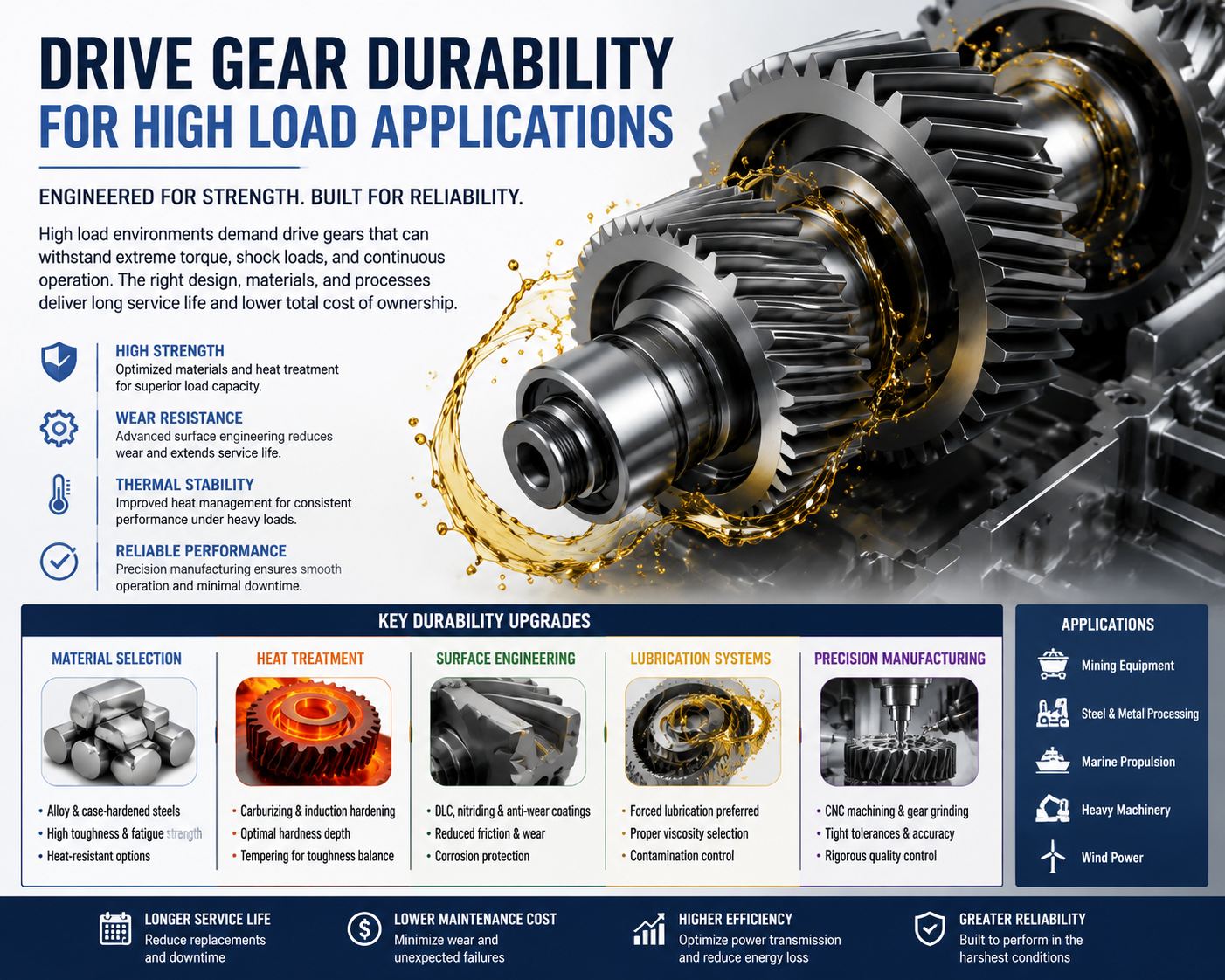
1. Introduction to Drive Gear Durability in High Load Systems
Definition of drive gear in industrial applications
A drive gear is the primary torque-transmitting element in a mechanical powertrain, responsible for converting rotational energy into usable mechanical output across meshing components. In industrial setups, it typically acts as the “workhorse gear” that keeps the whole drivetrain in sync under demanding conditions. Think of it as the gear that never really gets to chill—it’s always in the thick of the action, pushing load after load without complaint.
Importance of durability under extreme torque conditions
Durability under high torque isn’t just a design preference—it’s the make-or-break factor for system reliability. When torque spikes hit, poorly designed gears tend to cry uncle through deformation, pitting, or outright fracture. In heavy-duty OEM applications, a robust drive gear ensures the system doesn’t just run, but runs smooth like butter even when the pressure is turned up.
Common industries requiring high load drive gear performance
Industries such as mining, steel production, marine propulsion, and heavy robotics all demand drive gears that can take a beating and keep on spinning. These environments are unforgiving, often pushing equipment to operate at the edge of mechanical limits. In procurement terms, it’s all about getting “no drama, all performance” hardware that won’t bail out mid-operation.
Reference: Gear - Wikipedia
2. Key Performance Demands for High Load Drive Gears
Torque transmission requirements
High load drive gears must transmit torque efficiently without slippage or excessive energy loss. Any inefficiency here translates directly into heat buildup and accelerated wear. In real-world OEM scenarios, engineers expect near-seamless torque transfer even under fluctuating load curves.
Shock load and fatigue resistance expectations
Shock loads are like sudden punches to the system, and gears need to absorb them without cracking under pressure. Fatigue resistance ensures the gear survives millions of cycles without developing microfractures that grow over time. It’s the classic “slow burn failure” problem that procurement teams absolutely want to avoid.
Continuous duty cycle challenges
Many industrial systems run 24/7, meaning downtime is basically a luxury nobody can afford. Continuous operation leads to cumulative stress, which gradually eats away at material integrity. In this context, a drive gear has to behave like a marathon runner, not a sprinter—it’s all about endurance over time.
3. Common Failure Modes in Drive Gears
Tooth wear and surface pitting
Tooth wear happens when repeated contact slowly erodes the gear surface, especially under insufficient lubrication. Pitting, on the other hand, looks like tiny craters forming due to subsurface stress fatigue. Once these show up, it’s usually a sign the gear is already on the downhill slope.
Gear cracking and fatigue fracture
Cracks often begin at stress concentration points and propagate with each load cycle. Over time, these microcracks join forces and lead to catastrophic failure. In industry terms, that’s the dreaded “unexpected shutdown that ruins your week” scenario.
Lubrication breakdown consequences
When lubrication fails, metal-to-metal contact takes over, and things go downhill fast. Friction skyrockets, heat builds up, and wear accelerates exponentially. It’s basically the mechanical equivalent of running a marathon with no water—nothing good comes from it.
Reference: Lubrication - Wikipedia
4. Material Selection for Enhanced Durability
Alloy steel vs case-hardened steel
Alloy steels offer good toughness and versatility, while case-hardened steels provide a hard exterior with a ductile core. The choice depends on whether the application prioritizes impact resistance or surface wear protection. In OEM procurement, this is often a “balance the spreadsheet vs balance the physics” decision.
Role of surface hardness in load resistance
Surface hardness plays a crucial role in resisting abrasion and contact stress during gear meshing. A harder surface reduces micro-deformation and extends service life significantly. In layman’s terms, it’s what keeps the gear from getting chewed up under pressure.
Heat-resistant material options for heavy-duty use
High-temperature alloys and specially treated steels are used where thermal loads are extreme. These materials maintain structural integrity even when the system is running hot enough to make lesser materials give up. It’s the industrial version of “keeping a cool head under fire.”
5. Heat Treatment Processes for Strength Improvement
Carburizing and case hardening techniques
Carburizing introduces carbon into the surface layer, creating a hardened shell while maintaining a tough core. Case hardening then locks in this gradient structure for improved wear resistance. It is like giving the gear a suit of armor without making it brittle inside.
Reference: Case hardening - Wikipedia
Induction hardening for gear teeth
Induction hardening uses electromagnetic fields to rapidly heat and quench specific gear areas. This localized treatment improves surface strength exactly where it’s needed most. Engineers like it because it’s precise, efficient, and doesn’t waste energy on unnecessary areas.
Tempering for toughness balance
Tempering reduces brittleness introduced during hardening while preserving overall strength. It ensures the gear doesn’t become overly rigid and snap under shock loads. Think of it as the “cool-down phase” that keeps everything stable and balanced.
6. Gear Design Optimization for Load Performance
Tooth profile geometry improvements
Optimized tooth profiles reduce stress concentration and improve load distribution. Even small tweaks in curvature can dramatically enhance performance. In practice, it’s the difference between smooth engagement and noisy, inefficient operation.
Load distribution across gear teeth
Even load sharing across multiple teeth prevents localized overloading. Uneven distribution is often the silent killer behind premature gear failure. Proper design ensures every tooth pulls its weight—no freeloaders allowed.
Stress reduction through optimized design
Finite element analysis helps engineers identify high-stress zones and redesign accordingly. This leads to more resilient geometries that can withstand harsher conditions. It’s basically digital trial-and-error without the expensive physical failures.
Reference: Finite element method - Wikipedia
7. Surface Engineering and Coating Technologies
Anti-wear coating applications
Anti-wear coatings act as protective layers that reduce friction and surface degradation. These coatings are especially useful in high-cycle operations. They’re like sunscreen for gears—small layer, big protection.
DLC and nitriding surface treatments
Diamond-like carbon (DLC) coatings provide extreme hardness and low friction. Nitriding enhances surface hardness through nitrogen diffusion. Both methods significantly extend operational life under heavy loads.
Corrosion protection strategies
Protective coatings and material treatments prevent rust and chemical degradation. This is crucial in humid or chemically aggressive environments. Without it, even the strongest gear can quietly deteriorate over time.
8. Lubrication Systems for Heavy Load Operation
Oil bath vs forced lubrication systems
Oil bath systems rely on passive immersion, while forced systems actively circulate lubricant. Forced lubrication is more effective in high-load, high-speed applications. It’s the difference between “self-care splash” and “full spa treatment” for gears.
Role of viscosity in load handling
Viscosity determines how well the lubricant maintains a protective film under pressure. Too thin, and it breaks down; too thick, and it creates drag. Getting this balance right is where engineering meets practical field experience.
Contamination control in lubrication
Contaminants like dust and metal particles can severely degrade lubrication quality. Filtration systems are essential to maintain oil purity. Otherwise, it’s like feeding sand into a precision machine—not a good idea.
9. Manufacturing Precision and Tolerance Control
CNC machining accuracy requirements
CNC machining ensures tight dimensional control and repeatability. High precision reduces vibration and improves gear meshing efficiency. In procurement terms, consistency is king.
Gear cutting process impact on durability
Processes like hobbing and shaping directly affect tooth quality. Poor cutting leads to uneven surfaces and stress risers. That’s where long-term durability quietly gets decided.
Quality control in mass production
Inspection systems ensure each batch meets strict tolerances. This includes dimensional checks and surface quality analysis. It’s the gatekeeper step that prevents “bad apples” from entering the system.
10. Load Testing and Validation Methods
Torque testing under simulated conditions
Torque tests replicate real-world operating conditions in controlled environments. This helps validate performance before deployment. It’s basically a “stress interview” for gears.
Endurance and fatigue testing standards
Fatigue tests run gears through millions of cycles to simulate long-term use. Standards ensure consistency across manufacturers. If it survives here, it’s usually ready for the field.
Real-world performance validation
Field testing confirms lab results under actual operating conditions. This step often reveals hidden issues that simulations miss. It’s the final reality check before full-scale deployment.
11. Heat Management in High Load Gear Systems
Thermal expansion effects on gear mesh
Heat causes material expansion, which can alter gear alignment. Even slight changes affect meshing accuracy. This is where thermal engineering becomes critical.
Cooling system integration strategies
Cooling systems help maintain optimal operating temperatures. These can include oil cooling or external heat exchangers. Think of it as giving the system a built-in air conditioner.
Heat dissipation design improvements
Design modifications like fins and ventilation improve heat escape. Better dissipation prevents thermal stress buildup. It keeps everything running cool under pressure.
12. Alignment and Installation Best Practices
Shaft alignment accuracy importance
Proper alignment ensures even load distribution across gear teeth. Misalignment leads to uneven wear and vibration. It’s one of those “small mistake, big consequence” issues.
Installation error impact on gear life
Incorrect installation can drastically shorten gear lifespan. Even high-quality gears fail if mounted poorly. In the field, alignment errors are silent troublemakers.
Field calibration and adjustment methods
On-site calibration helps fine-tune system performance. Adjustments ensure optimal meshing under real conditions. It’s the final touch that brings everything into harmony.
13. Maintenance Strategies for Long Service Life
Preventive maintenance scheduling
Regular maintenance prevents unexpected breakdowns. Scheduled inspections catch early signs of wear. It’s the classic “fix it before it breaks” philosophy.
Wear inspection techniques
Visual checks and measurement tools identify early degradation. This includes monitoring tooth surface and backlash. Early detection saves major downtime headaches.
Predictive maintenance using sensors
Sensors track vibration, temperature, and load patterns. Data analytics predicts potential failures before they occur. It’s maintenance getting a serious tech upgrade.
14. Environmental Factors Affecting Durability
Dust and particulate contamination effects
Dust particles accelerate abrasion and wear. They can also contaminate lubrication systems. In harsh environments, sealing becomes absolutely essential.
Moisture and corrosion risks
Moisture leads to rust formation and material degradation. Corrosion weakens structural integrity over time. Protective coatings help keep things stable.
Extreme temperature operating conditions
High and low temperatures both affect material behavior. Thermal cycling can cause expansion fatigue. Gears must be designed to handle both ends of the spectrum.
15. Supplier Selection Criteria for OEM Procurement
Manufacturing capability assessment
Supplier capability determines production consistency and quality. Advanced equipment and skilled technicians are key indicators. It’s about choosing partners who can actually deliver, not just promise.
Quality certification and compliance standards
Certifications ensure adherence to global quality standards. These include ISO and industry-specific requirements. They act as a baseline trust signal.
Consistency in batch production
Repeatability across batches ensures predictable performance. Inconsistent output leads to system variability. Procurement teams value stability above all else here.
Reference: American Gear Manufacturers Association
16. Cost vs Performance Trade-offs in Gear Selection
Initial cost vs lifecycle cost analysis
Cheaper gears may cost less upfront but more over time. Lifecycle cost considers maintenance and replacement. Smart procurement always looks beyond the sticker price.
Impact of premium materials on ROI
Higher-grade materials increase durability and reduce downtime. This improves long-term return on investment. It’s the classic “spend more now, save later” equation.
Procurement decision-making frameworks
Structured evaluation frameworks help balance cost and performance. These include risk assessment and total cost modeling. It keeps decisions grounded and data-driven.
17. Advanced Technologies in Drive Gear Development
Digital twin simulation for gear design
Digital twins replicate real-world gear behavior virtually. This allows optimization before physical production. It’s like test-driving without leaving the computer.
AI-driven predictive wear analysis
AI models predict wear patterns based on operational data. This improves maintenance planning and design iteration. It brings a new level of foresight to engineering.
Smart gear monitoring systems in industry
Embedded sensors provide real-time performance feedback. These systems enhance reliability and operational awareness. It’s gears getting a “digital nervous system.”
18. Future Trends in High Load Drive Gear Engineering
Lightweight high-strength material innovations
New materials aim to reduce weight while increasing strength. This improves efficiency without sacrificing durability. It’s the next step in mechanical evolution.
Integration with Industry 4.0 systems
Smart factories integrate gears into connected ecosystems. Data exchange improves control and efficiency. Everything becomes more synchronized and intelligent.
Sustainability and energy efficiency improvements
Future designs focus on reducing energy loss and environmental impact. Efficient gears contribute to greener industrial systems. It’s engineering with a long-term conscience built in.