Table of Contents
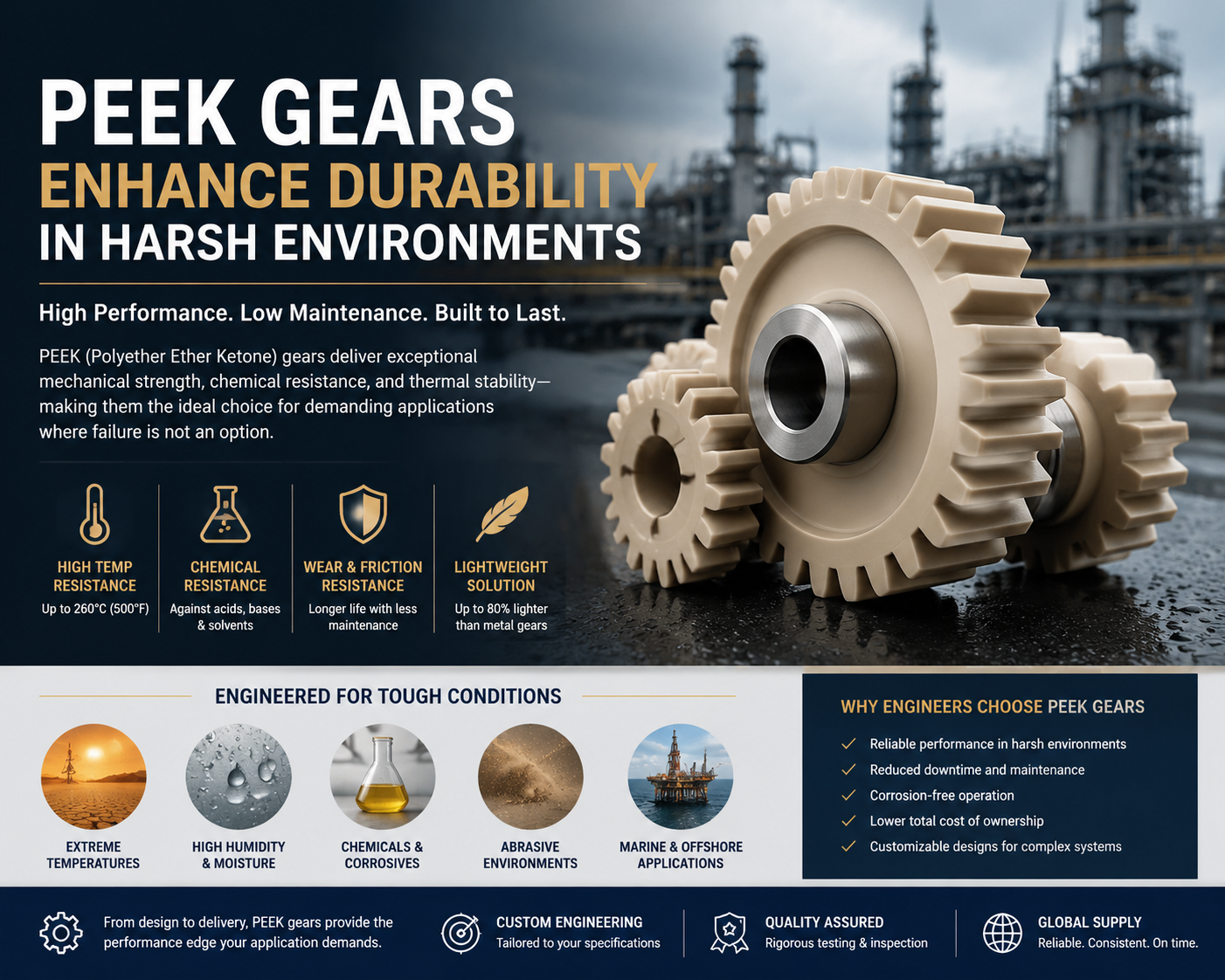
Peek Gears Enhance Durability in Harsh Environments
1. Introduction to Peek Gears
1.1 Overview of PEEK Material
Polyether ether ketone, more commonly referred to in the industry as PEEK, is a high-performance thermoplastic that has become the go-to material for engineers seeking both mechanical robustness and chemical resilience. Unlike standard polymers that falter under heat or mechanical stress, PEEK exhibits an extraordinary balance of tensile strength, modulus, and thermal stability, making it ideal for applications where metal traditionally dominated but weight, corrosion, or lubrication constraints were critical. For procurement engineers, this means sourcing a material that not only meets mechanical specs but also simplifies the supply chain by reducing the need for secondary treatments or coatings. Learn more about PEEK on Wikipedia.
1.2 Importance of Gears in Mechanical Systems
Gears are the unsung heroes of mechanical systems, translating torque, speed, and directional force with precision, and any underperforming gear can send the entire system into a tailspin. From robotics to automotive powertrains, the efficiency, durability, and alignment of gear teeth are paramount, and selecting the wrong material can trigger accelerated wear, unplanned downtime, or catastrophic failure. For engineers, ensuring that the chosen gear material aligns with operational demands is non-negotiable—especially when the stakes involve high-load, high-precision machinery.
1.3 Why Durability Matters in Harsh Environments
Durability in harsh environments isn’t just a buzzword; it’s a survival metric. Systems operating under extreme temperature swings, abrasive conditions, or chemical exposure face accelerated degradation, meaning the cost of downtime, maintenance, and component replacement skyrockets. A durable gear ensures operational continuity, reduces maintenance cycles, and provides engineers and procurement professionals the confidence that their system won’t fail when pushed to the limits. Peek gears excel here, bridging the gap between mechanical reliability and environmental resilience.
2. Understanding Harsh Environments
2.1 Extreme Temperatures
Temperature extremes—whether sub-zero chills in aerospace systems or scorching industrial furnaces—can wreak havoc on conventional materials. Metals expand, contract, and fatigue, while many polymers soften or crack. PEEK maintains dimensional stability across a wide operating range, enabling gears to operate smoothly without warping or seizing, even when the mercury is through the roof or dipping well below freezing.
2.2 High Humidity and Moisture
Condensation, high humidity, or water exposure can corrode metals and degrade conventional polymers, leading to premature failure. PEEK’s inherently low moisture absorption, coupled with its hydrophobic molecular structure, ensures that gears retain strength and functionality, even in marine, chemical, or wet-processing environments.
2.3 Exposure to Chemicals and Corrosives
Harsh chemicals, solvents, and aggressive industrial fluids pose a significant threat to standard gear materials, often necessitating coatings or protective housings. Peek gears, however, can withstand prolonged contact with acids, bases, oils, and cleaning agents without significant swelling, softening, or degradation, eliminating the need for constant maintenance or secondary protective measures.
3. Key Properties of Peek Gears
3.1 High Strength and Stiffness
Peek gears boast impressive tensile strength and modulus values that rival certain metals, allowing them to transmit significant torque while maintaining tooth geometry. This combination of rigidity and resilience ensures that under load, the gears don’t flex excessively, preventing backlash, misalignment, or premature wear.
3.2 Excellent Wear Resistance
The wear resistance of PEEK is particularly noteworthy, with self-lubricating properties that reduce abrasion under repeated motion. Even under continuous high-load operations, peek gears exhibit minimal surface degradation, allowing machinery to perform reliably over extended service periods.
3.3 Low Friction Performance
Low friction coefficients are a game-changer for high-speed and high-load applications, minimizing energy losses and reducing heat generation. PEEK’s tribological properties mean gears can operate smoothly with little to no additional lubrication, simplifying maintenance and increasing overall system efficiency.
4. Comparing Peek Gears to Metal Gears
4.1 Weight Differences and Impact on Systems
One of the most immediately noticeable advantages of peek gears over traditional metal gears is weight reduction. Lighter gears mean lower inertia, faster response times, and decreased energy consumption, which is critical in applications like robotics, aerospace, or precision instrumentation where every gram counts.
4.2 Corrosion Resistance Comparison
Unlike steel or aluminum, which require coatings, plating, or corrosion inhibitors, PEEK inherently resists rust, oxidation, and chemical attack. This property makes peek gears particularly attractive for outdoor, marine, or chemical processing applications where metal gears would otherwise require frequent maintenance or replacement.
4.3 Maintenance Requirements
Maintenance cycles are drastically shortened with peek gears. While metal gears may need periodic lubrication, rust prevention, or alignment checks, peek gears often operate clean and dry, with self-lubricating surfaces that reduce downtime and operational overhead, making them highly cost-effective in the long term.
5. Temperature Resistance of Peek Gears
5.1 Operating Range in Extreme Heat
PEEK maintains structural integrity up to approximately 260°C, which allows gears to operate reliably in high-temperature industrial processes, engine compartments, and aerospace systems. This thermal resilience ensures no softening or deformation under prolonged exposure to heat.
5.2 Performance in Low-Temperature Conditions
Even at sub-zero temperatures, PEEK retains toughness without becoming brittle, unlike many polymers that crack under thermal stress. This ensures reliable operation in refrigerated systems, arctic machinery, or cryogenic applications.
5.3 Thermal Expansion Considerations
With low coefficients of thermal expansion, peek gears maintain tooth alignment across temperature fluctuations, reducing backlash and ensuring consistent meshing, even in systems that cycle between extreme cold and heat.
6. Chemical and Corrosion Resistance
6.1 Resistance to Acids and Bases
PEEK gears resist degradation from strong acids and bases, allowing use in chemical plants, food processing, and laboratory equipment without fear of chemical-induced wear. More details on chemical resistance can be found at ScienceDirect.
6.2 Oil and Lubricant Compatibility
PEEK is compatible with a wide range of lubricants and oils, maintaining dimensional stability and wear resistance, which is critical in engines, pumps, and high-speed rotary equipment.
6.3 Longevity in Industrial Chemicals
Long-term exposure to industrial solvents, cleaners, and process chemicals does not compromise PEEK’s structural integrity, meaning gears last longer and maintenance schedules are less frequent, which keeps systems humming and procurement budgets predictable.
7. Wear and Friction Management
7.1 Reduced Abrasion in High-Load Applications
Peek gears exhibit low abrasive wear even under heavy loading, preventing pitting, scoring, or premature tooth failure, which keeps mechanical systems performing at optimal levels for extended durations.
7.2 Self-Lubricating Properties
The inherent self-lubricating nature of PEEK eliminates dependency on external lubrication in many applications, cutting maintenance costs and reducing downtime, a true win for procurement teams looking for reliability.
7.3 Impact on Gear Lifespan
Together, low friction and high wear resistance translate into markedly longer gear lifespans, ensuring machinery runs longer between overhauls and reducing lifecycle costs—a critical metric for OEMs and brand managers.
8. Load Bearing and Mechanical Strength
8.1 Tensile Strength and Rigidity
Peek gears handle high-torque scenarios without excessive deformation, transmitting power efficiently while maintaining precise gear engagement. This makes them suitable for both medium-duty and high-load applications.
8.2 Fatigue Resistance Under Repeated Loads
Repeated cyclic loading can weaken traditional materials over time, but PEEK’s fatigue resistance ensures that gears withstand thousands of cycles without micro-cracking, which is essential in continuous operation machinery.
8.3 Shock and Impact Absorption
PEEK’s combination of stiffness and resilience allows gears to absorb shocks without catastrophic failure, providing a buffer against sudden load spikes or impact forces, particularly valuable in heavy machinery or automotive transmissions.
9. Applications in Harsh Industrial Settings
9.1 Automotive and Transportation
From timing gears to actuator drives, PEEK gears handle high-temperature engine compartments, exposure to lubricants, and vibration, all while maintaining weight efficiency and longevity.
9.2 Aerospace and Aviation Components
In aerospace, every gram counts. PEEK gears reduce system weight without sacrificing strength, resist chemical attack from fuels and hydraulic fluids, and maintain performance at extreme temperatures.
9.3 Chemical Processing Equipment
PEEK gears are widely used in pumps, mixers, and valves in chemical plants, where exposure to acids, bases, and solvents would quickly corrode metals or compromise other polymers. More details on industrial gear applications can be found at NIST.
10. Designing Peek Gears for Maximum Durability
10.1 Gear Tooth Geometry Optimization
Proper tooth profiling maximizes load distribution and reduces stress concentrations, extending service life even under extreme conditions.
10.2 Material Thickness and Reinforcements
Strategic reinforcement of key sections and optimizing wall thickness ensures that gears can endure high torque while minimizing material use and weight.
10.3 Surface Treatment Options
Polishing, coatings, or blending with reinforcing fibers like carbon or glass can enhance surface hardness, wear resistance, and dimensional stability without compromising inherent PEEK advantages.
11. Manufacturing Considerations
11.1 Injection Molding Techniques
Precision injection molding allows for complex gear geometries, consistent tolerances, and minimal residual stress, essential for high-performance applications.
11.2 Machining and Finishing PEEK Gears
For custom applications, machining PEEK to tight tolerances is feasible, enabling bespoke designs while retaining mechanical integrity.
11.3 Quality Control and Testing
Rigorous inspection and performance testing ensure that every gear meets OEM specifications for load capacity, wear, and dimensional accuracy, a must-have for procurement teams managing quality compliance.
12. Cost-Benefit Analysis
12.1 Initial Manufacturing Costs
PEEK is more expensive than conventional polymers or metals upfront, but its durability and low maintenance offset the initial investment.
12.2 Reduced Maintenance and Replacement Costs
Fewer replacements, longer intervals between service, and reduced downtime deliver tangible savings over the lifecycle of the equipment.
12.3 Long-Term ROI for OEMs
For OEMs, choosing PEEK gears equates to predictable operational costs, extended warranty periods, and increased brand reputation for reliability.
13. Supply Chain and Procurement Strategies
13.1 Sourcing Reliable PEEK Gear Manufacturers
Working with certified suppliers ensures material consistency, precise tolerances, and dependable delivery schedules, critical for maintaining production continuity.
13.2 Lead Times and Inventory Management
Planning for lead times and strategic inventory helps mitigate supply chain disruptions, particularly for high-performance materials like PEEK.
13.3 Ensuring Consistency in Quality
Regular audits, batch testing, and supplier collaboration guarantee uniform gear performance, essential for high-stakes mechanical systems.
14. Case Studies of Peek Gear Performance
14.1 Industrial Machinery in Corrosive Environments
PEEK gears in chemical plant agitators reduced downtime by 40% compared to stainless steel, showcasing superior corrosion resistance and longevity.
14.2 Automotive Components with Extended Lifespan
Timing gears in high-performance vehicles operating at elevated engine temperatures maintained precision alignment and exhibited negligible wear after extended mileage.
14.3 Aerospace Applications Under Extreme Stress
Actuator gears in aerospace systems performed flawlessly under vibration, temperature extremes, and exposure to hydraulic fluids, underscoring PEEK’s unmatched reliability.
15. Common Challenges and Solutions
15.1 Handling High-Load Scenarios
Design reinforcement, fiber blending, and optimized tooth geometry mitigate risks associated with extreme torque applications.
15.2 Mitigating Wear in Abrasive Conditions
Surface finishing, self-lubrication, and protective coatings extend gear life even in dust-laden or abrasive environments.
15.3 Adapting Designs for Complex Systems
Simulation, prototyping, and iterative design help integrate PEEK gears seamlessly into multi-gear assemblies without compromising performance.
16. Future Trends in Peek Gear Technology
16.1 Advanced Material Blends and Composites
Combining PEEK with carbon fiber or glass enhances mechanical strength, wear resistance, and thermal stability, unlocking new application possibilities.
16.2 3D Printing and Additive Manufacturing
Additive manufacturing enables complex geometries, rapid prototyping, and reduced lead times, giving engineers unprecedented design freedom.
16.3 Smart Gears and IoT Integration
Embedding sensors and predictive monitoring into PEEK gears allows real-time condition tracking, predictive maintenance, and smarter, data-driven operations. Learn more about IoT-enabled industrial systems at NIST IoT Resources.
17. Conclusion and Key Takeaways
17.1 Summarizing Benefits of Peek Gears
Peek gears deliver unmatched durability, chemical resistance, low friction, and thermal stability, making them indispensable in harsh industrial environments.
17.2 Best Practices for Harsh Environment Applications
Prioritize material optimization, tooth geometry, and supplier quality to extract maximum performance and lifespan from PEEK gears.
17.3 Recommendations for Procurement Professionals
Focus on sourcing high-quality PEEK gears from reliable manufacturers, plan inventory strategically, and evaluate lifecycle cost benefits to ensure operational excellence and predictable ROI.