Worm Gear: High Torque Self-Locking Mechanism to Boost Machine Efficiency
1. Introduction to Worm Gears
1.1 Definition and Basic Concept of Worm Gears
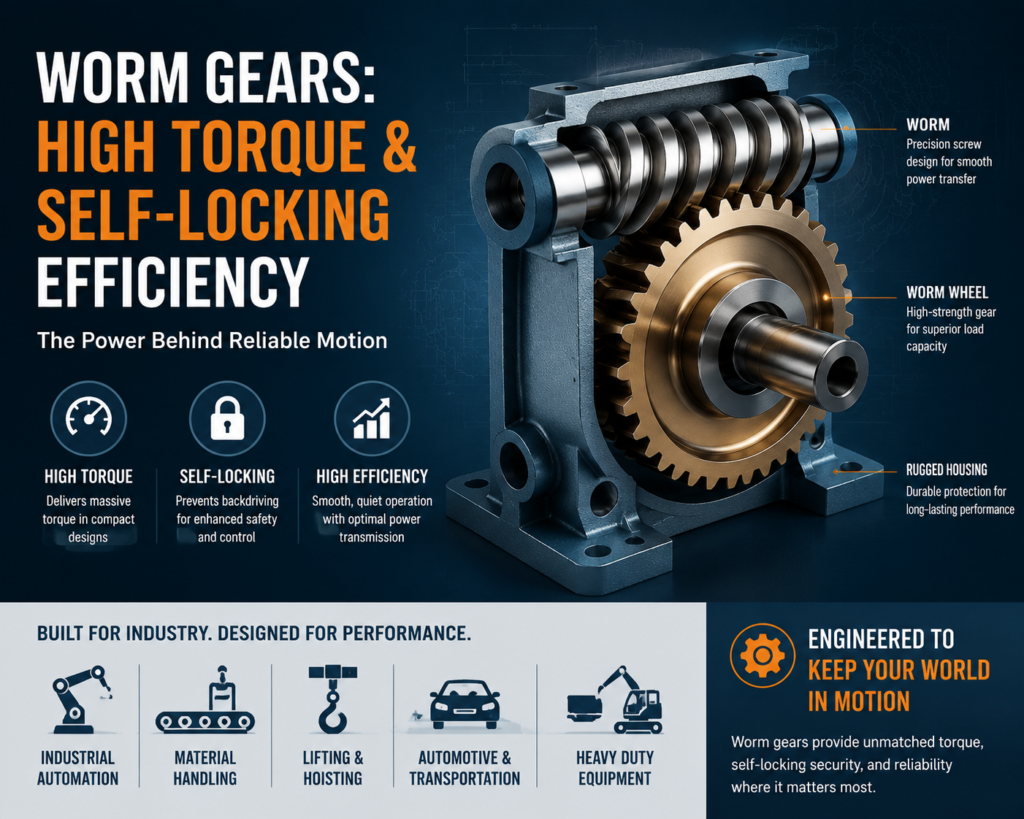
Picture this: a helical screw meshing with a spur gear, turning rotational motion into an almost magical torque multiplier. That’s your worm gear in a nutshell. Essentially, it’s a specialized gear assembly where the worm acts like a threaded cylinder and engages a toothed wheel, creating a motion transmission that’s compact yet astonishingly robust. This design allows for significant speed reduction in a single stage while simultaneously amplifying torque, which is why these little mechanical dynamos are favored in scenarios demanding precision and power.
1.2 Overview of Applications in Modern Machinery
Worm gears aren’t just museum pieces; they’re the unsung heroes in conveyor systems, automotive steering mechanisms, robotics, and even heavy-duty lifts. Anywhere you need controlled, high-torque motion in a confined space, worm gears are your go-to. Think industrial mixers, escalators, and hoisting devices where smooth, continuous operation is critical. They sneakily handle tasks where other gears would buckle or overheat, proving their worth silently but consistently.
1.3 Importance of High Torque and Self-Locking Features
One of the biggest draws is their inherent self-locking nature, which means when the worm stops turning, the gear doesn’t backspin—perfect for safety-critical applications. That high torque allows machines to lift heavier loads with less input energy, reducing strain on motors and extending operational life. Put simply, it’s like having a superhero on your production line who works tirelessly without breaking a sweat.
2. History and Evolution of Worm Gears
2.1 Early Uses in Ancient and Medieval Machinery
Worm gears date back to ancient Greece and Egypt, where they were primarily used in water-lifting devices and rudimentary mills. Early craftsmen exploited the simplicity of the worm’s screw profile to convert rotary motion into controlled linear or rotary output. Even with primitive tools, they managed to build systems capable of astonishingly consistent mechanical advantage.
2.2 Industrial Revolution and Technological Advancements
Fast-forward to the 18th and 19th centuries, the Industrial Revolution elevated worm gears to new heights. Factories cranked out machinery that relied on these gears for precise motion control, and innovations in metallurgy allowed gears to handle higher loads with less wear. It became clear that worm gears were no longer just curiosities—they were industrial necessities.
2.3 Modern Innovations in Worm Gear Design
Today, we see worm gears manufactured with high-precision CNC machines, treated with exotic surface coatings, and even paired with synthetic lubricants to achieve near-frictionless operation. Multi-start worms, advanced materials like bronze alloys, and digitally monitored installations push efficiency and reliability far beyond what our industrial ancestors imagined.
3. Fundamentals of Worm Gear Mechanics
3.1 How Worm Gears Transfer Motion and Torque
Mechanically speaking, the worm threads drive the gear teeth in a unidirectional rotation, converting input speed into multiplied torque output. The angle of engagement—commonly referred to as the lead angle—directly affects torque multiplication. It’s like a mechanical seesaw where the worm’s rotation dictates the gear’s strength, ensuring that a small input produces a surprisingly large output.
3.2 Comparison to Other Gear Types (Spur, Helical, Bevel)
Unlike spur gears, which handle high speeds with efficiency but are bulky, worm gears excel in compact applications and produce smoother, quieter motion. Helical gears share some quiet operation traits but lack the self-locking characteristic, while bevel gears handle angular redirection but cannot match worm gears in torque density. Each has its niche, but worm gears dominate when high torque and safety are priorities.
3.3 Role of Friction and Lead Angle in Performance
Friction isn’t just a side effect—it’s part of the worm gear’s secret sauce. Too much friction reduces efficiency, while too little may compromise the self-locking trait. The lead angle, essentially the pitch of the worm thread, balances rotational speed with torque output. Designers tweak these variables meticulously, turning each worm gear into a highly optimized machine component.
4. Types of Worm Gears
4.1 Single-Start vs Multi-Start Worm Gears
Single-start worms are like the marathon runners of gears—they move slowly but produce maximum torque. Multi-start worms, on the other hand, are sprinters, transmitting motion faster with slightly less torque. Choosing between them depends on whether your application demands brute force or quicker rotational response.
4.2 Standard Versus Non-Standard Profiles
Standard worm gears follow ISO or AGMA guidelines, ensuring interoperability and predictable performance. Non-standard profiles allow engineers to optimize for specialized applications—think custom pitch angles, tooth depths, or helix geometries for niche machinery. The right profile can make or break a system’s efficiency.
4.3 Materials and Manufacturing Methods
Bronze and steel dominate, with heat treatment and surface finishing drastically affecting durability. Additive manufacturing and precision CNC machining have opened doors to complex worm designs that were previously impractical, making durability, strength, and performance more customizable than ever.
5. High Torque Capabilities
5.1 How Worm Gears Generate High Torque
The magic lies in the helical interaction: each revolution of the worm threads gradually drives the gear, distributing the load across multiple teeth simultaneously. This multiplies torque without necessitating a huge motor, making worm gears ideal for lifting, pressing, or rotating heavy components with relative ease.
5.2 Torque vs Speed Trade-Offs
It’s the classic conundrum: higher torque often comes at the cost of rotational speed. Designers need to balance lead angle, worm pitch, and gear ratio to avoid bottlenecks while still delivering sufficient mechanical advantage. Getting this balance right is where the engineering chops really shine.
5.3 Case Studies of High-Torque Applications
From industrial elevators to precision robotics arms, worm gears have demonstrated the ability to handle extreme loads reliably. One notable example is the use in packaging lines, where repeated, high-torque cycles demand both precision and endurance—worm gears consistently deliver.
6. Self-Locking Mechanism Explained
6.1 Definition and Operational Principle
Self-locking means that once the worm stops rotating, the gear cannot drive the worm backward. This is essentially a mechanical one-way street, thanks to the friction and lead angle geometry, providing a built-in fail-safe against accidental backdriving.
6.2 Advantages in Safety and Energy Efficiency
This feature reduces the need for additional braking systems, preventing accidents in lifting applications while conserving energy by minimizing motor load. It’s like having a guardian angel built directly into the mechanical design.
6.3 Industries Benefiting from Self-Locking Worm Gears
Elevators, conveyor systems, robotics, and automotive steering systems all capitalize on this self-locking capability, ensuring safe, controlled operation without excessive reliance on electronic control systems.
7. Efficiency Considerations
7.1 Factors Affecting Worm Gear Efficiency
Friction, lead angle, lubrication, and material selection all play a role. While worm gears inherently have more friction than spur gears, careful design choices mitigate losses, making modern systems surprisingly efficient.
7.2 Minimizing Friction and Heat Loss
Polished surfaces, synthetic lubricants, and optimized thread geometry reduce friction and heat generation, which is crucial for continuous operation in high-load settings.
7.3 Lubrication Techniques for Optimal Performance
Greases, oils, and even specialized synthetic fluids reduce wear, cool surfaces, and maintain performance. Regular lubrication schedules ensure that worm gears maintain their high torque output over years of operation.
8. Material Selection and Durability
8.1 Common Metals and Alloys Used
Bronze, steel, and hardened alloys dominate, each selected based on load, speed, and wear requirements. Bronze worms on steel gears remain a classic combo for durability and quiet operation.
8.2 Impact of Hardness and Surface Treatments
Heat treatment, nitriding, and surface coatings enhance wear resistance, reduce friction, and extend service life, especially in heavy-duty or high-speed applications.
8.3 Wear Resistance and Lifespan Considerations
Proper material choice and maintenance can extend a worm gear’s operational lifespan to decades, even under rigorous duty cycles, reducing downtime and long-term costs.
9. Design Parameters for Worm Gears
9.1 Determining Gear Ratio and Lead Angle
The gear ratio in a worm system is dictated by the number of teeth on the worm wheel relative to the starts on the worm shaft. Lead angle, essentially the pitch angle of the worm thread, is critical—it determines the torque multiplication and the likelihood of self-locking. Engineers often run simulations to pinpoint the optimal combination, ensuring that efficiency, torque, and speed meet operational demands.
9.2 Shaft Alignment and Load Distribution
Precision is king. Even minor misalignments can lead to uneven tooth loading, premature wear, and noise. Worm gears require carefully designed shaft supports and mounting surfaces, often incorporating adjustable bearings or shims to maintain perfect parallelism and correct center distances.
9.3 Customization for Specific Industrial Needs
Every application is unique. Whether it’s a compact conveyor drive, a high-torque hoist, or a robotic actuator, worm gears can be tailored with custom tooth profiles, coatings, or materials to optimize performance, lifespan, and reliability under the exact operating conditions of the machinery.
10. Lubrication and Maintenance Practices
10.1 Types of Lubricants Suitable for Worm Gears
Worm gears thrive on the right lubrication. High-viscosity synthetic oils or greases often reduce friction and heat, while specialized EP (extreme pressure) additives help prevent pitting and scoring under high loads. Selecting the right lubricant depends on speed, temperature, and environmental exposure.
10.2 Maintenance Schedules and Inspection Techniques
Routine inspections are non-negotiable. Checking backlash, tooth wear, and lubricant integrity at scheduled intervals prevents unexpected downtime. Using infrared thermography or vibration analysis adds predictive maintenance capability, ensuring problems are caught before they escalate.
10.3 Troubleshooting Common Wear and Failure Issues
Worm gears are resilient, but issues like pitting, scoring, or misalignment can occur. Addressing wear may involve realigning shafts, replacing worn components, or adjusting lubricant formulations. Proactive intervention keeps efficiency high and operational costs low.
11. Thermal Management in Worm Gear Systems
11.1 Heat Generation and Dissipation Challenges
Friction inevitably produces heat, which can degrade lubricants and reduce efficiency. In high-torque applications, unchecked heat can warp components or accelerate wear. Thermal management, therefore, is a crucial design consideration.
11.2 Cooling Solutions for High-Torque Applications
Air cooling, oil circulation systems, and heat sinks are common solutions. Advanced designs may integrate fins or dedicated cooling jackets to maintain optimal operating temperatures and prevent thermal runaway.
11.3 Monitoring Temperature to Prevent Damage
Temperature sensors, coupled with IoT monitoring, provide real-time alerts if gear temperatures exceed safe limits. This allows operators to pause or throttle operations, protecting both the worm gear and connected machinery.
12. Noise and Vibration Considerations
12.1 Sources of Operational Noise
Noise often stems from tooth impact, misalignment, or insufficient lubrication. The helical nature of worm engagement generally reduces harshness compared to spur gears, but fine-tuning is still essential.
12.2 Reducing Vibration Through Design Adjustments
Optimizing tooth geometry, selecting appropriate materials, and ensuring precise alignment can drastically reduce vibration. Damping mounts or elastic couplings further absorb residual energy.
12.3 Impact on Machine Lifespan and Operator Comfort
Lower noise and vibration not only enhance operator comfort but also prolong component life, reducing maintenance frequency and improving long-term operational reliability.
13. Applications Across Industries
13.1 Automotive and Transportation Machinery
Worm gears are widely used in steering mechanisms, seat adjusters, and automated gates. Their ability to generate high torque in confined spaces makes them perfect for automotive and heavy-duty transportation applications.
13.2 Industrial Automation and Robotics
Robotics arms, CNC machinery, and conveyor systems benefit from precise, self-locking motion. Worm gears ensure that components hold their position reliably even when power is removed, a critical feature in automation safety protocols.
13.3 Heavy-Duty Equipment and Lifting Systems
From cranes to hoists and elevators, worm gears handle extreme loads with consistent, controlled motion. Their compact design allows heavy machinery to maintain a smaller footprint without sacrificing performance.
14. Comparison with Other Gear Systems
14.1 Advantages Over Spur and Helical Gears
Compact size, self-locking ability, high torque output, and quieter operation give worm gears a competitive edge in many industrial applications. While spur and helical gears may excel in speed and efficiency, worm gears dominate when safety, torque density, and space constraints are critical.
14.2 Limitations and When Not to Use Worm Gears
They are less efficient at high speeds due to friction losses and may require more robust lubrication. Applications demanding rapid rotation with minimal torque are better suited for other gear types.
14.3 Cost-Benefit Analysis for Industrial Adoption
Despite higher upfront costs, the longevity, reduced maintenance, and safety features of worm gears often provide superior ROI. Fewer interventions and downtime equate to lower lifecycle costs.
15. Emerging Technologies and Innovations
15.1 Advanced Materials and Coatings
High-performance alloys, ceramic coatings, and surface treatments reduce friction, improve wear resistance, and extend operational life under demanding conditions.
15.2 Precision Manufacturing and 3D Printing
CNC machining, additive manufacturing, and advanced milling techniques allow for ultra-precise worm profiles, customized tooth geometry, and rapid prototyping, making complex designs more accessible.
15.3 Smart Monitoring and IoT Integration
Sensors embedded in gear housings track torque, temperature, and vibration. Real-time analytics predict maintenance needs, improve efficiency, and prevent catastrophic failure before it happens.
16. Installation and Operational Best Practices
16.1 Proper Alignment and Mounting Techniques
Ensuring shafts are parallel and properly spaced is critical. Misalignment leads to uneven load, excessive wear, and noise. Precision mounting hardware and adjustable bearings help maintain ideal geometry.
16.2 Load Management and Torque Monitoring
Continuous monitoring of applied loads prevents over-torquing and maintains optimal efficiency. Torque-limiting devices safeguard against sudden shocks or overloads.
16.3 Safety Protocols and Efficiency Optimization
Integrating mechanical stops, emergency brakes, and load sensors enhances operational safety while optimizing energy usage. Preventative measures safeguard both equipment and personnel.
17. Common Challenges and Solutions
17.1 Handling Backlash and Wear
Backlash is inherent but manageable. Proper tooth geometry, preloading, and periodic adjustment reduce play and maintain precision in motion control.
17.2 Addressing Heat and Lubrication Issues
Heat can be mitigated with better lubricant selection, forced cooling, and surface treatments. Regular inspection ensures the system remains within operational tolerances.
17.3 Improving Efficiency in High-Load Environments
Optimizing lead angles, selecting suitable materials, and using high-performance lubricants maintain efficiency even under extreme torque or prolonged operation.
18. Future Trends in Worm Gear Technology
18.1 Research in Low-Friction Materials
Engineers are exploring composite metals, advanced polymers, and nano-lubricants to minimize friction while preserving torque output and self-locking characteristics.
18.2 Automation and Smart Gear Systems
Integration with robotics, automated maintenance alerts, and predictive analytics will allow worm gears to communicate with digital twins, optimizing operation in real time.
18.3 Sustainability and Energy-Efficient Designs
Lightweight materials, reduced energy consumption, and longer-lasting components are driving sustainable worm gear solutions, helping industries meet efficiency and environmental goals simultaneously.
19. Conclusion and Key Takeaways
19.1 Summary of Worm Gear Advantages
Compact, high-torque, self-locking, and durable, worm gears excel where precision, safety, and efficiency intersect. Their unique combination of traits makes them indispensable in many industries.
19.2 Recommendations for Industrial Use
Prioritize proper material selection, lubrication, and alignment, and leverage self-locking features for safety-critical applications. Evaluate operational conditions to select the ideal worm type and gear ratio.
19.3 Final Thoughts on Boosting Machine Efficiency
By integrating advanced materials, precise design, and proactive maintenance, worm gears can dramatically enhance machine performance, minimize downtime, and provide long-term operational reliability—a true powerhouse quietly revolutionizing industrial machinery.