Table of Contents
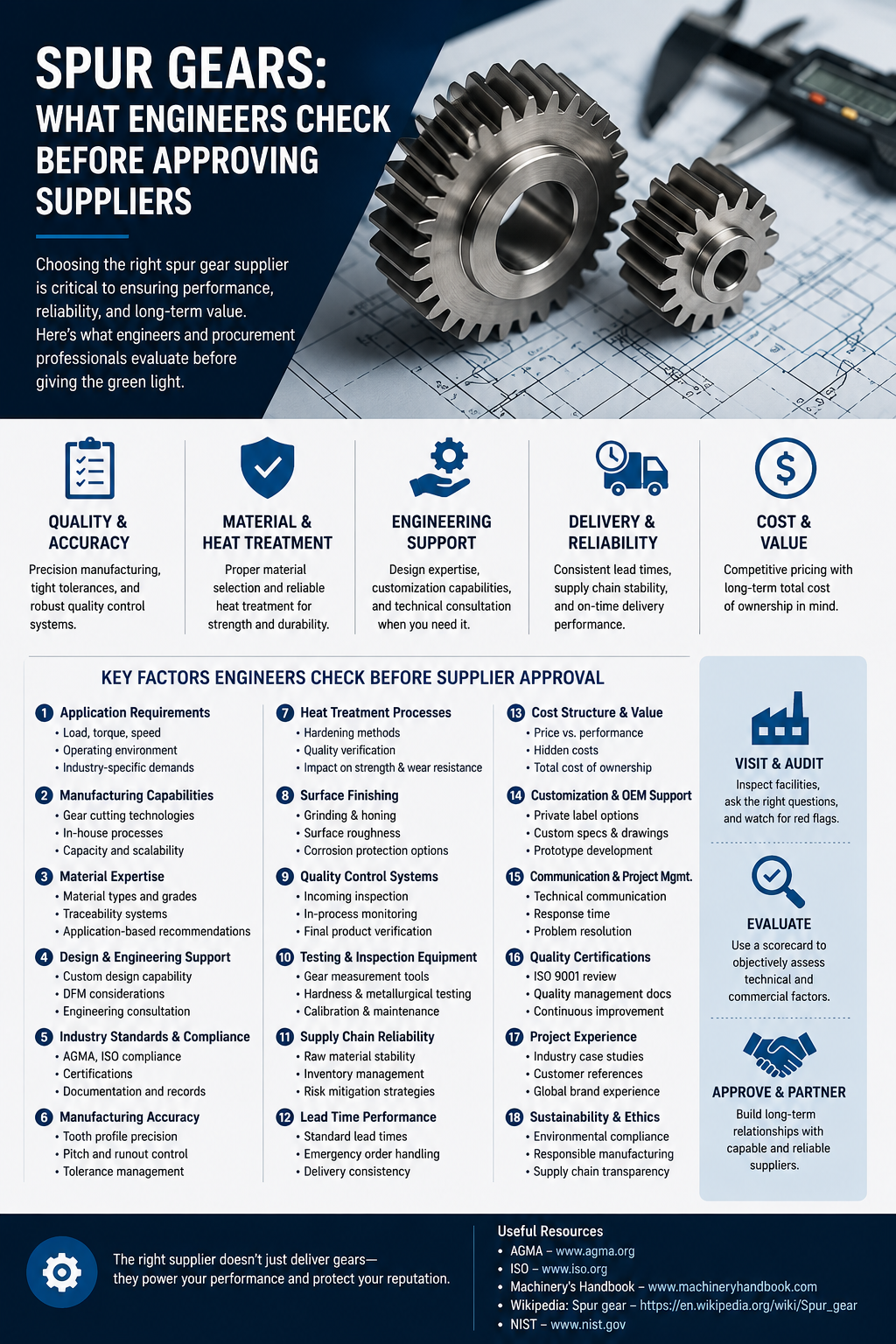
Spur Gear Supplier Approval Guide for Engineers
1. Why Supplier Approval Matters for Spur Gear Procurement
1.1 The Cost of Choosing the Wrong Supplier
Choosing the wrong supplier can lead to unexpected downtime, higher maintenance costs, and suboptimal gear performance. Errors in material selection, manufacturing processes, or delivery reliability can cascade into costly operational issues for OEMs. [Learn more about supplier risk management](https://www.sme.org/).
1.2 How Supplier Quality Impacts Equipment Performance
Supplier quality directly affects gear efficiency, wear resistance, and the lifespan of equipment. Inaccurate gear teeth, poor surface finishing, or improper heat treatment can reduce performance, increase noise, and lead to early failures.
1.3 The Engineer's Role in Supplier Qualification
Engineers are responsible for evaluating technical capabilities, reviewing material selection, and ensuring that manufacturing processes align with operational requirements. Their input is critical in supplier approval and ongoing quality assurance.
2. Understanding Spur Gear Application Requirements
2.1 Load and Torque Conditions
Proper evaluation of load and torque conditions ensures the selected gears can handle the stresses imposed by the application without premature wear or failure.
2.2 Operating Speed Requirements
High-speed applications require precision manufacturing and balanced gears to minimize vibration and noise. Engineers must confirm supplier capabilities to meet these specifications.
2.3 Environmental and Industry-Specific Demands
Application environment—including temperature, humidity, and exposure to corrosive substances—dictates material selection and surface protection methods. Industry-specific requirements, such as aerospace or medical standards, must be considered. [See ISO standards for gears](https://www.iso.org/standard/64897.html).
3. Evaluating Manufacturing Capabilities
3.1 In-House Production vs Outsourced Processes
In-house production provides greater control over quality, while outsourcing may introduce variability. Engineers should review which processes are controlled internally versus subcontracted.
3.2 Available Gear Cutting Technologies
Suppliers must demonstrate expertise in technologies such as hobbing, shaping, and CNC gear cutting. Advanced gear cutting tools enhance precision and reduce defects.
3.3 Production Capacity and Scalability
Capacity and scalability assessments ensure the supplier can handle current orders and future volume increases without compromising quality or lead times.
4. Reviewing Material Selection Expertise
4.1 Common Spur Gear Materials
Engineers should evaluate whether the supplier works with suitable materials such as alloy steels, stainless steel, and high-strength polymers based on the intended application.
4.2 Material Traceability Systems
Traceability ensures that materials can be tracked from source to finished gear, which is critical for safety-critical and regulated applications.
4.3 Material Recommendations for Different Applications
Suppliers should provide material recommendations tailored to load, speed, and environmental conditions, demonstrating engineering knowledge and expertise. [Learn about metallurgical considerations](https://www.asminternational.org/).
5. Assessing Gear Design and Engineering Support
5.1 Custom Design Capabilities
Custom design services allow OEMs to optimize gear performance for specific applications, including modifications to tooth profiles and tolerances.
5.2 Design for Manufacturability Considerations
Designs must be optimized for production efficiency and repeatability. Engineers check if suppliers can identify potential manufacturing challenges early.
5.3 Engineering Consultation Services
Suppliers offering consultation services help optimize gear selection, reduce risk, and ensure compatibility with system-level requirements.
6. Verifying Compliance with Industry Standards
6.1 AGMA and ISO Gear Standards
Compliance with standards such as [AGMA](https://www.agma.org/) and ISO ensures gear performance, safety, and interchangeability.
6.2 Industry-Specific Certifications
Some applications may require aerospace, automotive, or medical certifications, which validate supplier adherence to stringent requirements.
6.3 Documentation and Compliance Records
Suppliers should maintain detailed records of compliance, including material certifications, inspection reports, and process control documentation.
7. Inspecting Gear Manufacturing Accuracy
7.1 Gear Tooth Profile Precision
Precision in tooth geometry ensures uniform load distribution, reduces friction, and prevents premature wear. Suppliers must demonstrate measurement capability with CNC gear analyzers and profile inspection tools.
7.2 Pitch and Runout Control
Accurate tooth spacing and minimal radial runout prevent vibrations, noise, and uneven load transfer, safeguarding connected components.
7.3 Tolerance Management Practices
Robust tolerance control includes statistical process control, capability studies, and continuous monitoring, ensuring consistency across batches.
8. Examining Heat Treatment Processes
8.1 Hardening Methods Used by Suppliers
Techniques such as carburizing, induction hardening, nitriding, and carbonitriding optimize surface hardness and fatigue resistance for diverse applications.
8.2 Heat Treatment Quality Verification
Verification methods include hardness testing, metallography, and residual stress assessment, providing confidence in gear durability.
8.3 Impact on Gear Strength and Wear Resistance
Proper heat treatment enhances load capacity, wear resistance, and service life. Poor treatment increases brittleness and failure risk.
9. Evaluating Surface Finishing Capabilities
9.1 Grinding and Honing Processes
Grinding and honing improve profile accuracy and surface smoothness, critical for high-speed, precision applications such as robotics and automation.
9.2 Surface Roughness Requirements
Optimized roughness enhances lubrication, reduces friction, and improves wear behavior. Engineers verify measurements using Ra, Rz, and waviness parameters.
9.3 Corrosion Protection Options
Protective coatings, including black oxide, zinc plating, and phosphate treatments, preserve gear integrity under harsh environmental conditions.
10. Reviewing Quality Control Systems
10.1 Incoming Material Inspection
Verification of chemical composition, mechanical properties, and certification ensures defects are prevented at the source.
10.2 In-Process Quality Monitoring
Real-time monitoring of dimensions, tool wear, and process capability reduces scrap and ensures consistent product quality.
10.3 Final Product Verification Procedures
Comprehensive final inspections, including dimensional, hardness, and functional testing, guarantee compliance with specifications.
11. Analyzing Testing and Inspection Equipment
11.1 Gear Measurement Instruments
Equipment such as CMMs, gear measuring centers, and profile analyzers provide precise data for verifying gear geometry and accuracy.
11.2 Hardness and Metallurgical Testing Tools
Rockwell, Vickers, and metallographic analyses confirm material properties and heat treatment effectiveness.
11.3 Calibration and Maintenance Programs
Calibrated equipment ensures measurement accuracy and reliable quality control. Suppliers should maintain calibration records and preventive maintenance schedules.
12. Assessing Supply Chain Reliability
12.1 Raw Material Sourcing Stability
Suppliers with diverse and stable sourcing reduce risks associated with shortages, geopolitical issues, or natural disasters.
12.2 Inventory Management Practices
ERP systems, safety stock, and demand forecasting support consistent production and delivery reliability.
12.3 Risk Mitigation Strategies
Contingency planning, dual sourcing, and process redundancy minimize supply chain disruptions. [See supply chain risk management guidelines](https://www.cdc.gov/).
13. Evaluating Lead Time Performance
13.1 Standard Production Lead Times
Evaluating supplier lead times allows planning for production schedules, factoring in throughput, seasonal variations, and workflow efficiency.
13.2 Emergency Order Handling
Top-tier suppliers provide expedited processing, dedicated inventory, and flexible logistics to handle urgent requirements effectively.
13.3 Delivery Consistency Metrics
Consistent on-time delivery, supported by digital tracking and monitoring, indicates operational reliability and proactive communication.
14. Reviewing Cost Structure and Value
14.1 Price vs Performance Analysis
Analyzing cost relative to material quality, manufacturing precision, and lifecycle benefits ensures the best long-term value.
14.2 Hidden Procurement Costs
Freight, customs, inspections, rework, and technical support can add hidden costs beyond the unit price.
14.3 Long-Term Total Cost of Ownership
TCO analysis incorporates purchase price, installation, maintenance, and expected lifespan for a holistic evaluation.
15. Checking Customization and OEM Support
15.1 Private Label Manufacturing Options
Capabilities for branding, part numbering, and packaging integration support OEM identity and customer requirements.
15.2 Custom Specifications and Drawings
Suppliers capable of interpreting unique designs and providing manufacturable solutions reduce iterations and errors.
15.3 Prototype Development Services
Rapid prototyping and short-run production allow validation of design and performance before full-scale manufacturing.
16. Assessing Communication and Project Management
16.1 Technical Communication Efficiency
Clear documentation, prompt responses, and effective cross-functional collaboration minimize errors and delays.
16.2 Response Time Expectations
Timely answers to queries, quotations, and issues indicate an organized, customer-focused supplier.
16.3 Problem Resolution Procedures
Suppliers with structured root-cause analysis, corrective actions, and documentation demonstrate reliability and continuous improvement.
17. Auditing Supplier Quality Certifications
17.1 ISO 9001 Certification Review
Certification scope, validity, and implementation depth confirm systematic quality management. [More on ISO 9001](https://www.iso.org/iso-9001-quality-management.html)
17.2 Quality Management Documentation
Inspection records, SOPs, and non-conformance reports provide tangible evidence of maintained quality processes.
17.3 Continuous Improvement Programs
Lean, Six Sigma, Kaizen, and other initiatives indicate ongoing process optimization and supplier adaptability.
18. Reviewing Previous Project Experience
18.1 Industry Case Studies
Documented projects demonstrate real-world problem-solving, technical competence, and process efficiency.
18.2 Customer References and Testimonials
References validate delivery reliability, quality consistency, and collaboration effectiveness.
18.3 Experience with Global Brands
International experience ensures compliance with global standards, export requirements, and cross-cultural communication.
19. Conducting Factory Audits
19.1 Key Areas to Inspect During a Visit
Assess raw materials, workshops, heat treatment, finishing, inspection labs, packaging, and logistics to gauge operational discipline.
19.2 Questions Engineers Should Ask
Ask about process capability, non-conformance handling, inspection verification, traceability, and corrective actions.
19.3 Red Flags That Indicate Potential Risks
Poor housekeeping, missing records, uncalibrated tools, and excessive downtime signal potential quality issues.
20. Evaluating Sustainability and Ethical Practices
20.1 Environmental Compliance Measures
Evaluate emissions, waste management, energy efficiency, water conservation, and hazardous material control.
20.2 Responsible Manufacturing Practices
Worker safety, fair labor, training, and ethical sourcing influence productivity and quality.
20.3 Supply Chain Transparency
Transparency in materials, subcontractors, quality assurance, and sustainability supports risk management. [See CDC guidance](https://www.cdc.gov/)
21. Common Supplier Approval Mistakes to Avoid
21.1 Focusing Only on Unit Price
Low cost may compromise quality, delivery, and lifespan. Total value should be the key metric.
21.2 Ignoring Technical Validation
Technical assessments prevent approval of suppliers lacking critical capabilities.
21.3 Overlooking Long-Term Partnership Factors
Consider capacity, innovation, financial stability, and communication for sustainable partnerships.
22. Creating an Effective Spur Gear Supplier Scorecard
22.1 Defining Evaluation Criteria
Include quality, capability, delivery, cost, inspection, sustainability, and service metrics.
22.2 Weighting Technical and Commercial Factors
Technical factors often outweigh price in critical applications. Weighting ensures objective evaluation.
22.3 Establishing Approval Benchmarks
Define thresholds for quality, delivery, process capability, and certifications to standardize approvals.
23. Final Checklist Before Approving a Spur Gear Supplier
23.1 Technical Qualification Review
Confirm capabilities in manufacturing, materials, inspection, gear accuracy, heat treatment, and engineering support.
23.2 Commercial and Logistics Assessment
Evaluate pricing, payment terms, shipping, lead times, capacity, and supply chain resilience.
23.3 Long-Term Partnership Readiness
Assess growth support, continuous improvement, communication effectiveness, and strategic compatibility.
24. Conclusion: Building a Reliable Spur Gear Supply Network
24.1 Key Takeaways for Engineers
Thorough supplier evaluation reduces risk, ensures equipment performance, and improves long-term reliability.
24.2 Steps to Improve Supplier Selection
Standardize evaluation, audit factories, use scorecards, validate technical capabilities, and monitor performance continuously.
24.3 Future Trends in Spur Gear Procurement
Digital qualification, smart factories, real-time monitoring, AI-assisted evaluation, sustainability, and supply chain transparency will shape the future.