Performance Comparison and Applications of Helical Gears and Spur Gears
1. Introduction to Gear Types
1.1 Overview of Helical Gears
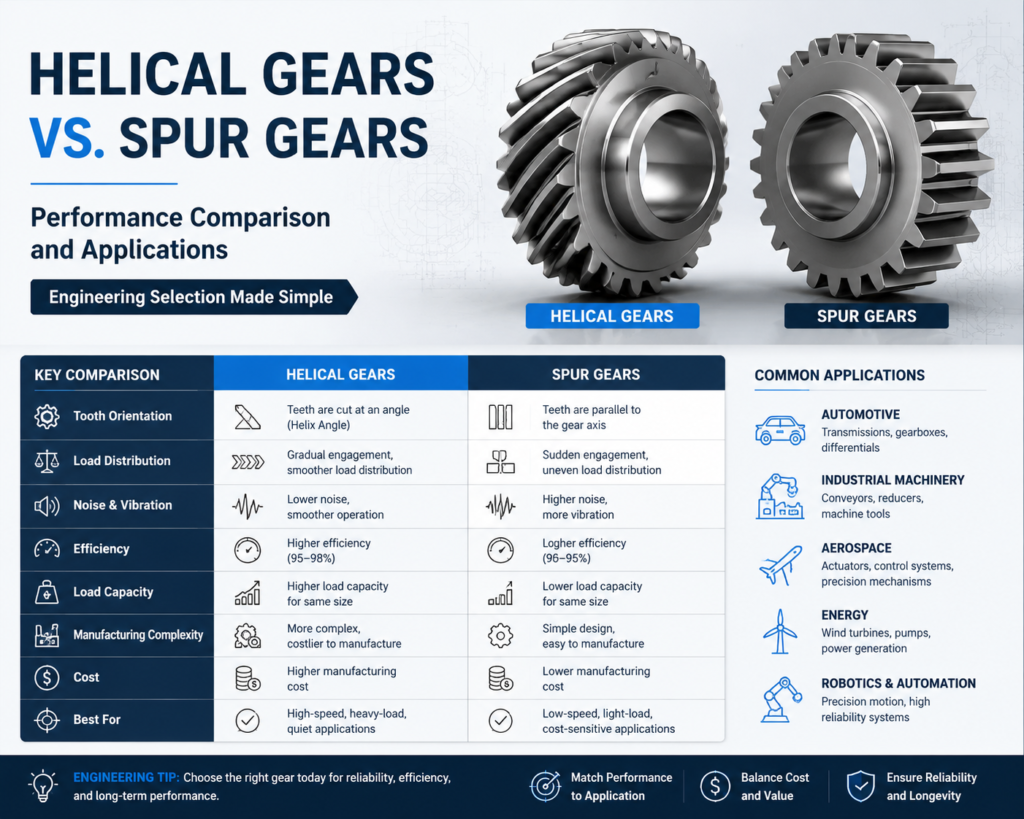
Helical gears are the suave operators in the gear world, sporting teeth cut at an angle to the axis of rotation, which results in a progressive engagement that distributes load more evenly across multiple teeth. This geometry not only enhances torque transmission but also dampens vibrational energy, producing a smoother, whisper-quiet performance, especially in high-speed industrial machinery. Engineers often leverage helical gears when balancing the delicate trifecta of load, speed, and noise control.
1.2 Overview of Spur Gears
Spur gears, the stalwarts of mechanical transmissions, feature teeth aligned parallel to the axis, making them easier to manufacture and inspect. While their engagement is abrupt and creates higher instantaneous loads, they shine in applications where simplicity, reliability, and cost-efficiency trump acoustic finesse. Their straightforward tooth profile is particularly beneficial in mechanical systems where shock loads are predictable and controlled.
1.3 Importance of Gear Selection in Engineering
Selecting the right gear is akin to picking the proper conductor for an orchestra; misalignment in choice can induce catastrophic inefficiencies, accelerated wear, or premature failure. Engineering selection of gears requires a meticulous evaluation of torque, speed, noise, efficiency, and environmental constraints, ensuring the chosen gear type complements the mechanical symphony of the application.
2. Basic Gear Terminology
2.1 Gear Pitch and Module
Gear pitch, the linear distance between corresponding points on adjacent teeth, directly affects load distribution and backlash. Module, the metric equivalent of pitch, standardizes sizing for interchangeability. Precise understanding of these parameters is essential for engineers when designing multi-stage gear trains.
2.2 Gear Tooth Profile
The involute tooth profile remains the gold standard for consistent velocity ratios, minimizing frictional losses during meshing. Subtle deviations in profile can lead to localized stress concentrations, so engineers must scrutinize tooth curvature, addendum, and dedendum during selection.
2.3 Gear Ratio Concepts
The gear ratio dictates rotational speed and torque transformation, serving as the linchpin in motion control. Understanding the interplay between driver and driven gears ensures energy efficiency, prevents overloading, and allows for optimized mechanical advantage across the system.
3. Helical Gears: Structure and Characteristics
3.1 Tooth Geometry and Helix Angle
Helical gear teeth wrap around the gear like threads on a screw, with the helix angle determining the degree of load sharing across teeth. Larger angles reduce stress per tooth but increase axial thrust, which engineers must accommodate with bearings capable of handling this supplementary load.
3.2 Load Distribution and Contact Ratio
The contact ratio—the average number of teeth in simultaneous engagement—enhances torque capacity and reduces surface fatigue. A higher contact ratio in helical gears allows smoother torque transfer and mitigates the risk of tooth breakage under fluctuating loads.
3.3 Noise and Vibration Characteristics
Due to their angled teeth, helical gears engage gradually, creating a more continuous power transfer that significantly dampens noise and vibration. This feature makes them the go-to choice for automotive transmissions and high-speed precision machinery where acoustic performance is critical.
4. Spur Gears: Structure and Characteristics
4.1 Tooth Geometry and Alignment
Spur gears have straight teeth aligned parallel to the axis of rotation. This alignment simplifies manufacturing and inspection but generates sudden load transfer, which can amplify vibration, particularly in high-speed applications.
4.2 Load Distribution
Load in spur gears is concentrated on fewer teeth at any instant, resulting in higher localized stresses. Despite this, spur gears excel in applications with predictable load patterns, where robust design and correct material selection ensure durability.
4.3 Noise and Vibration Characteristics
The abrupt engagement of spur teeth produces characteristic buzzing or clicking sounds at high speeds, which can be mitigated with careful material selection or by limiting rotational velocity. This acoustic signature often acts as a telltale sign for engineers monitoring system health.
5. Material Selection for Helical and Spur Gears
5.1 Common Materials and Alloys
Alloy steels such as 8620 and 4140 dominate industrial gear manufacturing, prized for their tensile strength and fatigue resistance. For high-performance scenarios, engineers may specify case-hardened steels or powdered metal composites, balancing surface hardness with core toughness.
5.2 Surface Treatments and Hardening Techniques
Nitriding, carburizing, and induction hardening bolster wear resistance and fatigue life, crucial for both helical and spur gears. These treatments improve microstructural properties, allowing gears to handle sustained loads without catastrophic pitting or spalling.
5.3 Cost vs. Performance Considerations
Material and treatment selection is a delicate balancing act: premium alloys and advanced hardening elevate performance but increase procurement costs. Engineers must weigh operational longevity against capital expenditure during gear selection.
6. Efficiency and Power Transmission
6.1 Helical Gear Efficiency
Despite a slight loss due to sliding friction from angled teeth, helical gears achieve high efficiency in multi-stage transmissions by distributing load over multiple contact points. This characteristic is particularly advantageous in continuous-duty applications.
6.2 Spur Gear Efficiency
Spur gears boast near-ideal efficiency at moderate speeds since teeth engage directly without axial sliding. This simplicity reduces frictional losses, making them ideal for low-speed, high-torque applications where energy conservation is critical.
6.3 Factors Affecting Gear Efficiency
Lubrication, surface finish, alignment, and operating temperature all influence gear efficiency. Engineers must consider these parameters holistically to optimize system performance and prevent unexpected energy losses.
7. Load Capacity Comparison
7.1 Helical Gear Load Handling
By distributing load across multiple teeth, helical gears exhibit superior load-bearing capacity, reducing stress concentration and extending service life. Proper bearing support is essential to accommodate axial forces introduced by helical angles.
7.2 Spur Gear Load Handling
Spur gears transfer load directly, which can generate higher instantaneous stresses but simplifies bearing design. They perform admirably in systems where axial thrust is undesirable or minimal.
7.3 Impact of Gear Size and Design on Load Capacity
Larger diameter gears reduce tooth stress, while tooth width and module adjustments allow customization of load capacity. Optimal design ensures operational reliability without unnecessary material use, balancing performance with cost-efficiency.
8. Speed and Torque Considerations
8.1 High-Speed Applications
Helical gears excel at high RPMs due to gradual engagement and lower vibration levels. This makes them indispensable in automotive transmissions, turbines, and high-speed industrial machinery.
8.2 Low-Speed, High-Torque Applications
Spur gears thrive in low-speed, high-torque scenarios, where shock loads are predictable. Their robust design and minimal axial force requirements simplify integration with heavy-duty bearing systems.
8.3 Torque Transmission Differences
Torque distribution in helical gears is smoother due to overlapping tooth engagement, whereas spur gears deliver torque in discrete pulses. Engineers must match gear type to application-specific torque profiles to avoid premature wear.
9. Noise and Vibration Performance
9.1 Helical Gear Noise Reduction
The continuous tooth engagement of helical gears translates into lower decibel levels, making them ideal for enclosed or noise-sensitive environments. Engineers often leverage this characteristic to meet stringent industrial noise standards.
9.2 Spur Gear Noise Issues
The abrupt engagement in spur gears generates high-frequency vibration, which may resonate within housings. Noise mitigation requires careful housing design, damping materials, or rotational speed limitations.
9.3 Application-Specific Noise Considerations
High-precision or office-adjacent applications necessitate gears with minimal acoustic footprint. Selecting helical over spur gears can dramatically reduce noise, enhancing both operational comfort and compliance with regulatory standards.
10. Manufacturing and Cost Implications
10.1 Complexity of Helical Gear Manufacturing
Helical gears require advanced machining, precise helix angle generation, and careful alignment, driving up production costs. However, these complexities yield performance benefits that justify the investment in demanding applications.
10.2 Spur Gear Production Simplicity
Spur gears are cost-efficient to manufacture, with simpler milling and hobbing processes. Their uncomplicated geometry allows mass production without sacrificing quality for most standard applications.
10.3 Cost-Benefit Analysis for Large-Scale Production
While helical gears deliver superior performance, spur gears offer significant cost savings in volume manufacturing. Engineers weigh initial investment against operational gains to optimize total lifecycle cost.
11. Maintenance and Lifespan
11.1 Wear Patterns in Helical Gears
Helical gears exhibit gradual tooth wear across multiple contact points, reducing localized fatigue but requiring axial load monitoring. Predictive maintenance programs extend lifespan and minimize unexpected downtime.
11.2 Wear Patterns in Spur Gears
Spur gear teeth experience higher localized wear due to abrupt engagement. Monitoring for pitting and tooth breakage is crucial, particularly in heavy-load or high-speed applications.
11.3 Recommended Maintenance Practices
Regular inspection, precise lubrication, alignment checks, and vibration analysis are essential. A proactive maintenance schedule prevents catastrophic failures and ensures consistent performance over extended operational periods.
12. Lubrication Requirements
12.1 Helical Gear Lubrication Needs
Sliding action in helical gears necessitates high-viscosity lubricants with excellent film strength to prevent scuffing and surface fatigue. Synthetic oils or EP additives often provide superior protection under continuous duty.
12.2 Spur Gear Lubrication Needs
Spur gears require less complex lubrication due to direct tooth engagement. However, high-load scenarios still demand lubricants with anti-wear properties to prolong gear life.
12.3 Selecting the Right Lubricant
Lubricant selection hinges on load, speed, temperature, and environmental exposure. Engineers must optimize oil formulation to balance viscosity, film thickness, and thermal stability for peak performance.
13. Applications in Different Industries
13.1 Automotive Applications
Helical gears dominate transmissions for their smooth operation, while spur gears find roles in differential assemblies or starter motors where simplicity and torque capacity matter.
13.2 Industrial Machinery
Heavy-duty machines benefit from helical gears in multi-stage gearboxes, while spur gears excel in conveyor drives, mixers, and presses where cost-effective reliability is key.
13.3 Aerospace and High-Precision Systems
In aerospace, helical gears are indispensable for minimizing vibration and noise while maintaining torque consistency. Spur gears are used selectively for lightweight, low-complexity mechanisms.
14. Environmental and Operational Considerations
14.1 Temperature and Humidity Effects
Material expansion and lubricant viscosity shifts under temperature variations must be accounted for. Helical gears, with their sliding engagement, are more sensitive to temperature-induced misalignment.
14.2 Contaminant Resistance
Dust, particulates, and other contaminants exacerbate wear. Helical gears may require sealed housings, while spur gears tolerate moderate contamination due to their simpler engagement geometry.
14.3 Operational Noise Restrictions
Noise-sensitive applications, such as office-adjacent machinery or medical equipment, often mandate helical gears for acoustic compliance, whereas industrial settings may accept the higher decibel profile of spur gears.
15. Engineering Selection Criteria
15.1 Performance Priorities
Engineers prioritize torque, speed, and durability when selecting gears. Helical gears suit high-speed, low-noise applications; spur gears cater to predictable, high-load environments.
15.2 Cost and Manufacturing Constraints
Budget, manufacturing complexity, and lead times influence selection. Spur gears often provide cost advantages, while helical gears justify higher costs through performance benefits.
15.3 Application-Specific Selection Guidelines
Each gear type aligns with specific operational contexts: helical gears for transmissions and robotics, spur gears for conveyor systems and heavy-duty drives. Correct alignment with application needs prevents costly reengineering.
16. Case Studies and Real-World Examples
16.1 Successful Helical Gear Implementations
High-speed automotive gearboxes demonstrate helical gear superiority, achieving lower vibration and longer service intervals, validating design investments.
16.2 Successful Spur Gear Implementations
Industrial presses and conveyor drives highlight spur gears’ reliability under heavy, steady loads, emphasizing straightforward, low-maintenance design.
16.3 Lessons Learned from Misapplications
Misaligned gear selection, such as using spur gears in high-speed, noise-sensitive machinery, leads to premature wear and operational headaches, stressing the importance of engineering selection diligence.
17. Future Trends in Gear Technology
17.1 Advances in Materials
Emerging alloys, composite steels, and surface treatments enhance fatigue resistance and reduce weight, expanding operational envelopes for both helical and spur gears.
17.2 Precision Manufacturing Techniques
Additive manufacturing, high-precision hobbing, and automated quality control promise tighter tolerances, reduced backlash, and extended service life.
17.3 Integration with Smart Systems
Sensors embedded in gearboxes enable predictive maintenance, vibration analysis, and real-time performance monitoring, redefining engineering selection processes for modern industrial systems.
18. Conclusion and Recommendations
18.1 Summary of Key Differences
Helical gears provide smoother operation and higher load capacity with minimal noise, while spur gears offer cost efficiency and simplicity, particularly in low-speed, high-load applications.
18.2 Selecting the Right Gear for the Application
Engineering selection depends on speed, torque, noise requirements, environmental factors, and cost constraints. Correct alignment of these parameters ensures optimal performance and longevity.
18.3 Final Engineering Tips for Optimal Performance
Maintain precision alignment, select appropriate materials and lubricants, monitor operational loads, and apply predictive maintenance practices to maximize gear life and system efficiency.