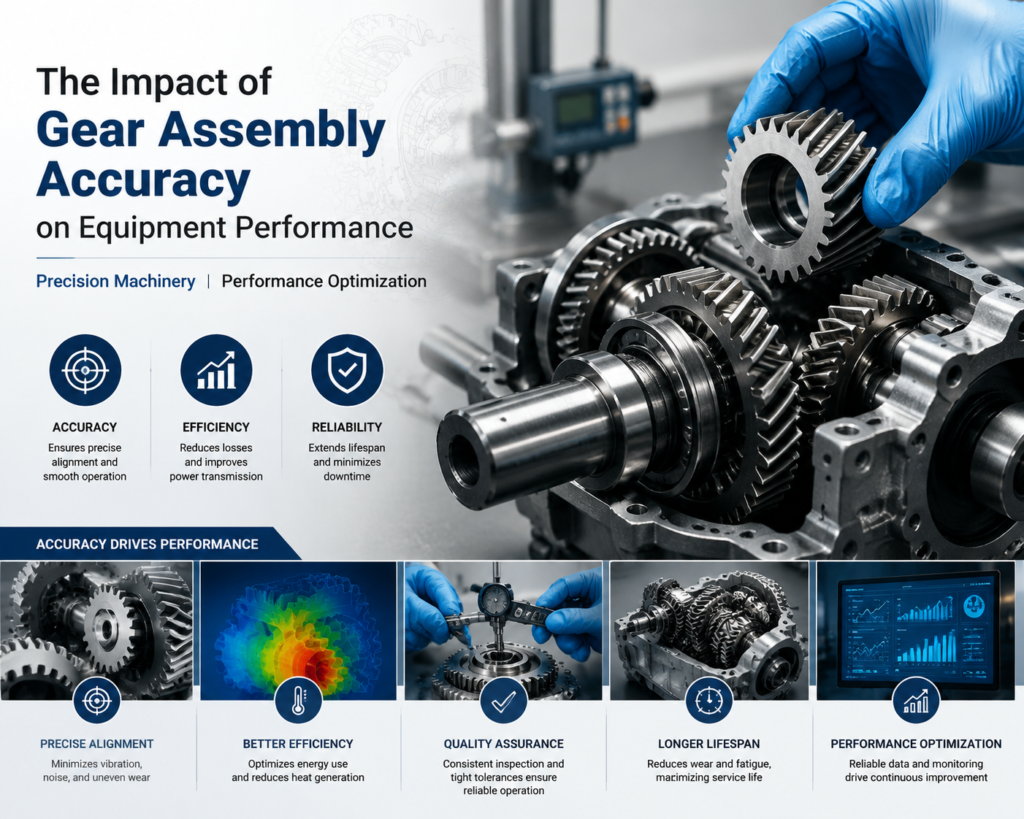
The Impact of Gear Assembly Accuracy on Equipment Performance
1. Introduction to Gear Assembly Accuracy
Definition of Gear Assembly Accuracy
Gear assembly accuracy refers to the meticulous alignment and precise positioning of gears within a mechanical system, where even microscopic deviations can cascade into substantial inefficiencies. In precision machinery, the tolerance for error is measured in microns, and achieving near-perfect meshing is more than a recommendation—it’s a necessity.
Importance in Precision Machinery
In high-performance equipment, from CNC machines to aerospace actuators, gear assembly accuracy dictates not only operational smoothness but also the system’s resilience to vibration, wear, and thermal expansion. Missteps at the assembly stage can amplify downstream issues, triggering unexpected downtime or premature component fatigue.
Overview of Performance Optimization
Performance optimization hinges on minimizing parasitic losses, maintaining consistent torque transmission, and ensuring energy efficiency. When gear assembly is executed with precision, these systems operate near their theoretical peak, translating into lower maintenance costs, extended service life, and a mechanical ballet that runs as silent as a whisper.
2. Types of Gear Assemblies
Spur Gears and Their Assembly Considerations
Spur gears, with their straight teeth, may appear straightforward, but improper assembly can lead to uneven load distribution and localized wear. Ensuring axial alignment and avoiding lateral play are crucial to maintaining both efficiency and lifespan.
Helical Gears and Tolerance Requirements
Helical gears offer smoother operation thanks to their angled teeth, but they demand tighter tolerances during assembly to prevent axial thrust issues and excessive noise. The helical angle introduces complex meshing dynamics, requiring careful calibration of backlash and contact ratio.
Planetary and Bevel Gear Systems
Planetary gear trains and bevel gears introduce compounded geometric challenges. The rotational precision of sun, planet, and ring gears in planetary systems, or the intersecting axes in bevel gears, necessitate meticulous attention to concentricity and angular alignment, particularly in high-torque or high-speed applications.
3. Key Parameters Affecting Assembly Accuracy
Gear Tooth Alignment
Even slight deviations in tooth contact pattern can create hotspots of friction and wear. Accurate alignment ensures load is distributed across the entire tooth surface rather than concentrating stress at one edge.
Shaft Concentricity and Runout
Shaft runout—both radial and axial—can drastically affect meshing precision. Controlled concentricity ensures gears rotate uniformly, minimizing vibration and energy dissipation.
Axial and Radial Clearances
Proper endplay and backlash are essential. Excess clearance may lead to impact loading and noise, whereas insufficient clearance increases friction and thermal stress, undermining performance optimization.
4. Manufacturing Tolerances and Their Role
Standard Tolerance Grades
ISO and AGMA define tolerances that guide gear manufacturing. Adhering to these standards ensures compatibility with precision machinery and predictable operational behavior.
Effects of Tolerance Deviations on Performance
Even within acceptable limits, subtle deviations can magnify through gear trains, causing efficiency drops, uneven wear, and accelerated fatigue cycles.
Measuring and Verifying Tolerances
CMM inspections, laser scanning, and gear tooth calipers verify tolerances pre- and post-assembly. Rigorous measurement ensures the theoretical design translates into real-world performance.
5. Common Assembly Errors
Misalignment Issues
Angular misalignment, parallel offset, and skewed installation can compromise load sharing, increase vibration, and shorten service life.
Improper Torque and Fastener Errors
Over- or under-torqued bolts disrupt gear positioning, affecting backlash and leading to potential catastrophic failures under high load.
Inadequate Lubrication Positioning
Misplaced lubrication paths or insufficient film thickness exacerbate friction, wear, and localized heating, especially in tightly packed assemblies.
6. Effects of Assembly Accuracy on Gear Efficiency
Energy Losses Due to Misalignment
Mechanical energy dissipates as heat when teeth contact unevenly, reducing system efficiency and increasing operational costs.
Friction and Heat Generation
Imprecise assembly elevates friction levels, which not only wastes power but also accelerates wear, potentially triggering thermal expansion that further compounds misalignment.
Impact on Torque Transmission
Torque ripple and backlash variations are directly tied to assembly precision. Optimized gear assembly ensures smooth torque transfer without spikes that could fatigue downstream components.
7. Vibration and Noise Considerations
Sources of Gear Vibration
Gear meshing anomalies, shaft deflection, and bearing misalignment contribute to vibratory phenomena.
Correlation Between Accuracy and Noise Levels
Even minor tooth spacing deviations manifest audibly at high speeds. Achieving high assembly precision dampens noise and prevents resonant amplification.
Mitigation Techniques
Precision mounting, dynamic balancing, and fine-tuning backlash provide effective control over operational noise and vibratory signatures.
8. Wear and Lifespan Implications
Surface Wear Patterns from Poor Assembly
Inaccurate assembly leads to localized pitting, scuffing, and uneven wear tracks, undermining the gear’s surface integrity.
Accelerated Fatigue and Failure Modes
Misalignment and improper loading introduce cyclic stresses, which reduce the material’s fatigue life and increase failure risk.
Predicting Lifespan with High-Precision Assembly
Analytical modeling and empirical testing demonstrate that meticulous assembly can extend operational life by 20–40%, particularly in high-speed or high-load machinery.
9. Case Studies in Precision Machinery
High-Speed Motors
Motorized gear assemblies operating at tens of thousands of RPMs reveal that even micron-scale misalignment drastically amplifies vibration and heat.
Industrial Robotics
Robotic actuators demand exact gear positioning for repeatable motion; small deviations can propagate into positional errors and reduced cycle life.
Aerospace Gear Systems
Aerospace applications tolerate virtually no error; precision gear assembly is critical for flight safety, fuel efficiency, and longevity of mechanical subsystems.
10. Assembly Techniques for Optimal Accuracy
Pre-Assembly Gear Inspection
Verification of tooth profile, runout, and material integrity prior to assembly prevents compounding errors.
Alignment Tools and Fixtures
Specialized jigs, laser guides, and dial indicators ensure axial and radial alignment before permanent fastening.
Controlled Torque Application
Torque wrenches and hydraulic tensioners achieve consistent clamping forces, maintaining positional stability and minimizing distortion.
11. Measurement and Verification Methods
Coordinate Measuring Machines (CMM)
CMMs deliver high-precision 3D measurements to verify gear geometry and assembly integrity.
Laser Alignment and Gear Inspection Systems
Laser systems detect sub-millimeter misalignments in real-time, enabling corrective action before operational deployment.
Tactile and Visual Inspection Techniques
Hand-held micrometers, feeler gauges, and visual inspection complement automated methods, catching subtle anomalies that might escape machines.
12. Material Considerations in Gear Assembly
Hardness and Wear Resistance
High-hardness alloys reduce wear, while softer materials may deform under load, altering assembly precision.
Thermal Expansion Effects
Differential thermal expansion between shafts and gears can alter backlash and meshing under operational conditions.
Compatibility with Lubrication
Material selection must ensure chemical compatibility with lubricants to prevent degradation, corrosion, and seizure.
13. Lubrication and Its Interaction with Accuracy
Lubrication Strategies for Precision Gears
Grease or oil film thickness must be calibrated to balance friction reduction and gear backlash, preserving assembly accuracy.
Influence on Friction and Heat Dissipation
Proper lubrication mitigates energy loss and thermal distortion, maintaining alignment under heavy operational loads.
Maintenance Schedules to Maintain Performance
Routine inspection and replenishment prevent the gradual degradation of gear mesh quality, which directly impacts performance optimization.
14. Advanced Technologies Improving Assembly Accuracy
Automated Assembly Systems
Robotic assemblers achieve repeatable, micron-level precision unattainable by manual assembly, reducing human error.
Digital Twin Simulations
Virtual replicas of gear systems allow engineers to predict the influence of assembly tolerances on real-world performance.
Adaptive Feedback and Monitoring
Sensors embedded in critical assemblies provide continuous feedback, enabling predictive adjustments to maintain optimal performance.
15. Troubleshooting Performance Issues
Diagnosing Alignment and Assembly Errors
Vibration analysis, thermal imaging, and tooth contact inspections reveal hidden misalignments that degrade performance.
Common Signs of Underperformance
Excessive noise, irregular torque delivery, and rapid wear often indicate assembly inaccuracies.
Corrective Actions and Reassembly Practices
Re-torquing fasteners, realigning shafts, and adjusting backlash can restore efficiency without replacing entire gear trains.
16. Future Trends in Gear Assembly Optimization
Nanotechnology and Material Advancements
Surface coatings and nano-textured materials promise reduced friction, wear, and tolerance sensitivity.
AI-Assisted Assembly and Predictive Maintenance
Artificial intelligence algorithms can guide assembly and anticipate maintenance needs, minimizing unplanned downtime.
Integration with Industry 4.0 Standards
Connected machinery, real-time monitoring, and smart diagnostics integrate gear assembly accuracy into holistic industrial performance optimization, setting a new benchmark for precision machinery.