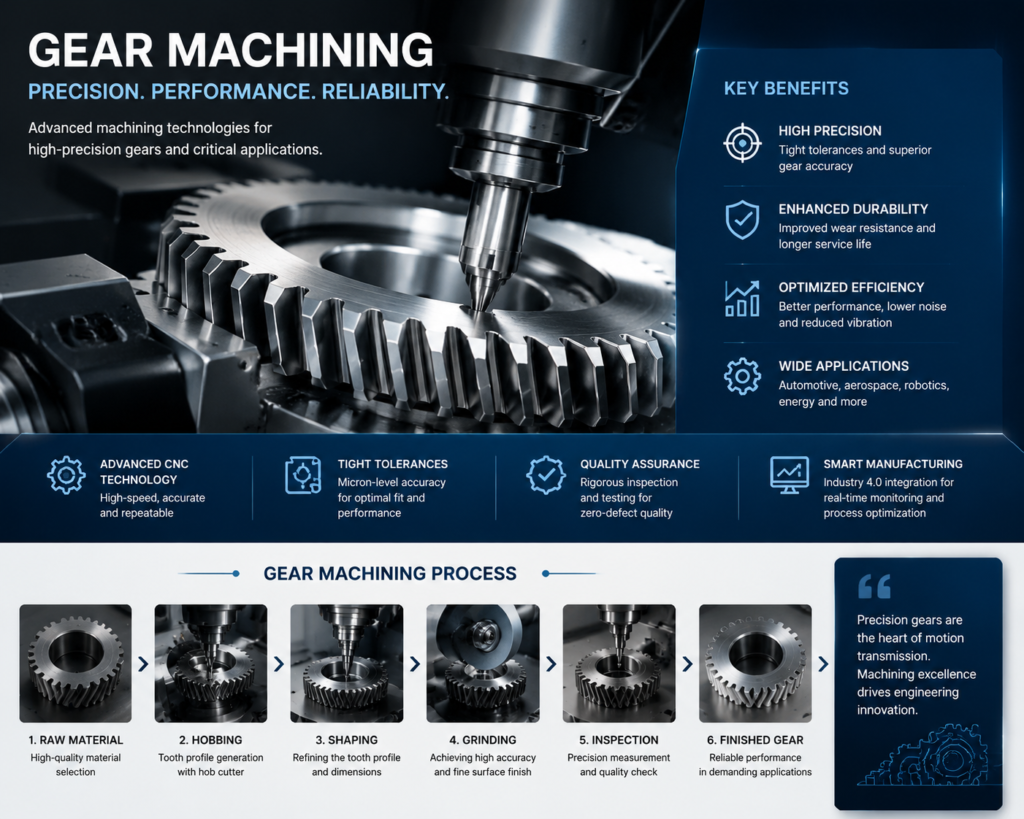
Detailed Explanation of Gear Machining Technology and Its Applications
1. Introduction to Gear Machining Technology
1.1 Definition and importance of gear machining
Gear machining, in its essence, is the art and science of fabricating the toothed wheels that translate motion and torque in mechanical systems. It is the backbone of countless industries—from automotive drivetrains to robotic actuation—and mastering this craft ensures machines operate with minimal backlash, maximum efficiency, and extended service life. In practice, precision and reliability in gear machining directly influence machine performance, safety, and operational cost, making it indispensable to mechanical engineers and procurement specialists alike.
1.2 Overview of gear types and applications
Gears come in myriad configurations: spur, helical, bevel, worm, and planetary systems, each with unique machining demands. Spur gears, straightforward yet critical, drive conveyor systems and industrial gearboxes, whereas helical gears, with their angled teeth, provide quieter operation in automotive and aerospace sectors. Bevel and worm gears enable right-angle transmission and high reduction ratios, expanding applications in turbines, robotics, and precision machinery. Understanding these differences informs both manufacturing strategy and material selection.
1.3 Role of precision machinery in modern engineering
Precision machinery ensures gears are not just functional but optimized for high-load and high-speed conditions. CNC centers, honing machines, and gear grinders bring micron-level accuracy to the production floor, minimizing deviation and enhancing efficiency. Engineers rely on this machinery to produce components that meet stringent ISO or AGMA standards, which is particularly crucial in high-stakes environments like aerospace, where tolerances are unforgiving.
2. Historical Development of Gear Machining
2.1 Early manual gear manufacturing techniques
Before the advent of modern machining, gears were painstakingly hand-cut, filed, and inspected—a labor-intensive process where skill dictated performance. Wooden gears in early clocks and simple iron cogs for industrial mills illustrate the humble beginnings of this field. The reliance on artisans meant production volumes were limited, and precision was variable.
2.2 Transition to automated and CNC processes
The industrial revolution introduced hobbing machines, shaping devices, and early lathes, automating gear cutting and standardizing production. The modern era, however, owes much to CNC machining, which allows for programmable, repeatable, and scalable operations. CNC gear mills, with their multi-axis capability, provide consistency across batch production, significantly reducing errors and post-processing.
2.3 Evolution of precision standards over time
From rudimentary fit-and-tolerance methods, gear standards evolved into highly codified systems like ISO 1328 and AGMA 2101, defining allowable pitch deviations, tooth profile errors, and surface roughness. These standards enable global interoperability, allowing engineers to specify, procure, and integrate components confidently across borders.
3. Types of Gears and Their Machining Requirements
3.1 Spur gears and their machining methods
Spur gears, with straight-cut teeth parallel to the axis, are straightforward to hob, shape, or grind. Machining focuses on minimizing pitch error and achieving a smooth surface finish to reduce noise and wear. Their simplicity belies the importance of exact tolerances, especially in high-speed or high-torque applications.
3.2 Helical gears: challenges and solutions
Helical gears, with oblique teeth, require complex setups to maintain accurate helix angles. Specialized hobbing machines, synchronized with CNC indexing, ensure proper tooth engagement. Lubrication and surface finishing also become critical to compensate for axial thrust forces and maintain operational longevity.
3.3 Bevel and worm gears: precision considerations
Bevel gears, particularly hypoid variants, demand exact conical tooth alignment, while worm gears necessitate precision flank geometry to prevent backlash and heat buildup. Grinding is often employed post-cutting, and CNC simulation tools are used to validate geometry before committing to production.
4. Material Selection for Gears
4.1 Common metals used in gear machining
Steel, cast iron, and brass are staple materials due to their machinability, wear resistance, and cost-effectiveness. Carbon steel is often chosen for high-load automotive applications, while stainless steel is preferred for corrosion resistance in marine or chemical industries.
4.2 High-performance alloys and composites
Alloy steels, such as 20CrMnTi or 17-4PH stainless, offer superior fatigue resistance, while modern composites and powdered metal gears reduce weight without sacrificing strength. Engineers must balance machinability with application-specific demands, as harder materials can increase tool wear and cycle times.
4.3 Impact of material properties on machining strategy
Hardness, ductility, and thermal conductivity dictate cutting speed, feed rates, and lubrication strategy. For instance, high-carbon steels may require slower feeds and diamond-coated tools to maintain accuracy, while softer alloys permit faster throughput but necessitate careful stress management to avoid deformation.
5. Gear Machining Methods Overview
5.1 Hobbing: process and advantages
Hobbing remains the workhorse of gear production. A rotating hob progressively cuts teeth into a blank, producing high-quality gears efficiently. Its versatility allows machining of spur, helical, and worm gears with minimal setup changes, making it ideal for medium to large batch production.
5.2 Shaping and broaching techniques
Shaping employs reciprocating cutters for precise tooth formation, often preferred for internal gears. Broaching is used for complex profiles and high-precision internal splines, enabling tight tolerances and repeatable results. Both techniques complement hobbing in specialized scenarios.
5.3 Grinding and finishing processes
Gear grinding, typically using form or profile grinders, achieves surface finishes within microns, crucial for high-speed, high-accuracy applications. Lapping and honing remove residual burrs and stress, reducing friction and noise while extending component life.
6. CNC Machining in Gear Manufacturing
6.1 Introduction to CNC gear machining
CNC machining provides unparalleled flexibility, allowing multi-axis operations that integrate cutting, grinding, and inspection. Programmable paths ensure consistency and reduce human error, delivering gears that meet strict performance criteria while maintaining production efficiency.
6.2 Programming strategies for precision gears
Advanced CNC programming involves simulating tooth contact patterns, compensating for tool deflection, and fine-tuning helix angles. Engineers often employ macro programming and parametric code to automate complex sequences, minimizing downtime and maximizing throughput.
6.3 Integration with CAD/CAM software
CAD models define exact tooth geometry, while CAM software generates optimal tool paths and machining sequences. Integration reduces iterative prototyping, facilitates error detection before cutting, and allows engineers to predict machining stresses, improving both quality and production speed.
7. Precision and Tolerances in Gear Machining
7.1 Understanding gear accuracy standards
AGMA and ISO standards classify gear accuracy from basic to precision grades. Pitch deviation, profile error, and runout influence operational noise, efficiency, and wear. Precision gears in aerospace or medical applications often demand tolerances below a few microns.
7.2 Measurement techniques for precision verification
Coordinate measuring machines (CMMs), optical comparators, and gear testers quantify tooth geometry, backlash, and pitch consistency. Metrology tools are essential in maintaining quality across production batches, preventing costly failures in assembly lines.
7.3 Effects of tolerances on performance and longevity
Tighter tolerances reduce vibration, noise, and energy losses, extending gear life. However, ultra-precision machining requires longer cycle times and advanced tooling, representing a trade-off between cost and performance that engineers must navigate.
8. Cutting Tools and Tool Materials
8.1 Types of cutting tools for gear machining
Cutting tools are the unsung heroes of gear production. Hobs, shaper cutters, form tools, and broaches each serve specific machining strategies. Hobs with multiple flutes expedite spur and helical gear production, while specialized broaches achieve intricate internal gear profiles. Gear grinders often use vitrified-bonded wheels to maintain tight profile tolerances. Selecting the right tool geometry ensures that each tooth meets the functional requirement without introducing residual stress or surface defects.
8.2 Tool material selection and coating options
Tool material can make or break a machining operation. High-speed steel (HSS) remains popular for versatility, whereas tungsten carbide excels under high-speed, high-feed conditions. Coatings like TiN, TiAlN, or diamond-like carbon enhance wear resistance and reduce friction. These coatings also improve chip evacuation and minimize heat buildup, critical for maintaining tight tolerances on hard alloys.
8.3 Tool wear and life management
Tool wear affects dimensional accuracy, surface finish, and production cost. Engineers employ predictive maintenance schedules, real-time monitoring, and rotation of multi-flute tools to extend life. Cutting parameters must be continually optimized to balance material removal rate and tool longevity, especially when machining tough alloys or composite gears.
9. Surface Finishing and Heat Treatment
9.1 Grinding and polishing for high precision
Post-machining finishing, particularly gear grinding, ensures that tooth surfaces meet micron-level accuracy. Fine polishing reduces friction, mitigates vibration, and improves noise performance. Engineers frequently combine form grinding with lapping to achieve the ideal surface microgeometry for demanding applications.
9.2 Heat treatment processes and their purpose
Heat treatment, such as carburizing, nitriding, or induction hardening, adjusts surface hardness, core toughness, and wear resistance. These processes prevent premature pitting, scuffing, and deformation under cyclic loads, thereby extending operational life while preserving the machined geometry.
9.3 Effects on hardness, wear resistance, and noise reduction
Hardening enhances contact strength, reduces plastic deformation, and maintains pitch accuracy over time. When paired with precision grinding, heat treatment results in quieter operation, lower energy loss, and minimal maintenance—a trifecta that mechanical engineers and procurement teams covet for high-performance machinery.
10. Gear Machining Process Optimization
10.1 Reducing cycle time without sacrificing quality
Cycle time reduction demands a delicate balance. Engineers implement multi-flute tools, high-speed feeds, and optimized cutting sequences while ensuring vibration and deflection are controlled. Effective process simulation and load analysis prevent shortcuts from compromising dimensional precision.
10.2 Optimizing feed rates and cutting parameters
Feed rate, spindle speed, depth of cut, and coolant application must be meticulously tuned. Too aggressive, and tool wear skyrockets; too conservative, and production suffers. Dynamic CNC adjustments allow in-process corrections to account for material inconsistencies or thermal expansion.
10.3 Strategies for reducing tool wear and downtime
Proper lubrication, automated tool change systems, and real-time tool monitoring reduce wear and downtime. Predictive analytics, coupled with historical wear data, help engineers preemptively replace tools before failures impact quality or delivery schedules.
11. Automation and Smart Manufacturing in Gear Production
11.1 Role of robotics in gear machining
Robotic arms and automated loaders reduce human intervention and enhance repeatability. From blank handling to part inspection, automation maintains consistent cycle times while minimizing contamination and operational error.
11.2 Real-time monitoring and predictive maintenance
Sensors embedded in spindles, hobs, and grinders provide real-time feedback on vibration, temperature, and torque. Predictive algorithms detect early anomalies, allowing engineers to intervene before tool failure or deviation affects the entire batch.
11.3 Integration with Industry 4.0 technologies
Modern gear factories leverage IoT networks, digital twins, and AI analytics. These systems track every stage of production, provide process optimization insights, and allow remote control, creating a connected ecosystem where gear quality and throughput are maximized.
12. Inspection and Quality Control Techniques
12.1 Coordinate measuring machines (CMM) applications
CMMs verify gear geometry with unparalleled accuracy. By probing multiple tooth surfaces and reference points, they generate detailed deviation maps, highlighting any discrepancies from the CAD design. This ensures that every gear leaving the shop floor meets performance expectations.
12.2 Gear tooth verification methods
Specialized gear testers assess backlash, tooth profile, and lead angle. Optical comparators and laser scanners provide high-resolution surface scans, while functional checks under load simulate real-world operating conditions.
12.3 Non-destructive testing for structural integrity
Magnetic particle inspection, dye penetrant, and ultrasonic testing detect subsurface cracks, inclusions, or voids that could compromise reliability. For high-torque or safety-critical applications, NDT ensures that gears withstand operational stress without catastrophic failure.
13. Common Challenges in Gear Machining
13.1 Handling complex geometries
Intricate tooth forms, such as double helical or hypoid gears, present alignment and cutting challenges. Engineers must carefully simulate tool paths and employ specialized fixtures to maintain accuracy throughout the machining process.
13.2 Avoiding vibration and chatter during cutting
Vibration and chatter reduce surface finish quality and accelerate tool wear. Proper fixturing, spindle speed optimization, and damping technologies mitigate these issues, ensuring smooth engagement of gear teeth.
13.3 Mitigating thermal deformation issues
Heat generated during high-speed cutting can distort the blank, altering tooth geometry. Cryogenic cooling, advanced lubricant delivery, and thermal modeling help maintain dimensional stability during production.
14. Applications of Machined Gears in Industry
14.1 Automotive and aerospace applications
High-performance gearboxes in vehicles and aircraft demand precise torque transmission with minimal noise. CNC-machined helical, bevel, and hypoid gears are critical to fuel efficiency, reliability, and passenger comfort.
14.2 Industrial machinery and robotics
Robotic arms, CNC lathes, and conveyors rely on precision gears for accurate motion control. Any deviation can result in misalignment, production defects, or mechanical failure, making high-precision machining non-negotiable.
14.3 Renewable energy and high-precision devices
Wind turbines, hydroelectric generators, and micro-mechanical devices rely on gears that operate reliably under cyclic and high-load conditions. Machined gears ensure maximum efficiency, reduced maintenance, and extended service life in these critical systems.
15. Advanced Technologies in Gear Machining
15.1 Laser-assisted and additive manufacturing approaches
Laser-assisted machining preheats materials for better machinability, while additive manufacturing enables complex geometries impossible with conventional methods. These technologies reduce post-processing and allow rapid prototyping for new gear designs.
15.2 Micro-gear machining for miniature devices
Medical instruments, precision robotics, and micro-electromechanical systems (MEMS) require gears with micron-scale tolerances. Advanced micro-CNC and lithography techniques produce these components with astonishing accuracy.
15.3 High-speed and high-efficiency machining techniques
High-speed milling, multi-axis hobbing, and continuous-grinding setups dramatically reduce cycle times while maintaining quality. Engineers often employ adaptive control systems to balance speed with tooth surface integrity.
16. Cost and Efficiency Considerations
16.1 Balancing precision with production costs
Ultra-precision gear machining increases tool, energy, and labor costs. Engineers must find the sweet spot where tolerances meet application requirements without inflating production budgets unnecessarily.
16.2 Energy consumption and sustainability in machining
Energy-efficient spindles, optimized cutting paths, and advanced lubrication systems reduce the carbon footprint of gear production. Sustainability initiatives also encompass material recycling and waste reduction.
16.3 Lifecycle cost analysis of machined gears
Initial production cost is only one factor. Maintenance intervals, operational efficiency, and potential downtime significantly affect total cost of ownership. High-precision gears, although more expensive upfront, often yield long-term savings.
17. Future Trends in Gear Machining
17.1 AI-driven machining optimization
Artificial intelligence algorithms can analyze production data to optimize cutting paths, predict tool wear, and adjust parameters dynamically. This reduces scrap, improves cycle time, and ensures consistent quality.
17.2 New materials and composites for gear manufacturing
Lightweight alloys, carbon-fiber reinforced composites, and engineered polymers are expanding gear applications. These materials demand specialized machining strategies and precision controls.
17.3 Emerging global standards and best practices
Harmonization of ISO, AGMA, and regional standards ensures gears can be designed, produced, and certified globally. Engineers must stay abreast of these evolving standards to remain competitive.
18. Case Studies of Gear Machining Success
18.1 Automotive gearbox precision improvement
A major OEM achieved 30% noise reduction and improved torque transfer by implementing CNC-hobbed helical gears with post-grinding finish, reducing warranty claims and enhancing brand reputation.
18.2 High-torque industrial gear solutions
A heavy machinery manufacturer switched to alloy steel with induction-hardened surfaces and diamond-coated hobs, resulting in a 40% increase in gear life under extreme loading conditions.
18.3 Aerospace gear reliability enhancement
By integrating CNC multi-axis grinding and laser-assisted cutting, an aerospace supplier produced hypoid gears with micron-level tolerances, ensuring performance under high-altitude, high-vibration environments.
19. Summary and Key Takeaways
**19
.1 Critical factors for effective gear machining**
Success hinges on material selection, precise machining, accurate tool use, and rigorous inspection. Engineers must balance production speed, cost, and precision to meet modern machinery demands.
19.2 Best practices for precision and efficiency
Leveraging CNC technology, smart tooling, real-time monitoring, and heat treatment ensures gears meet operational requirements while reducing waste and downtime.
19.3 Future opportunities for engineers in gear manufacturing
Emerging technologies—AI optimization, additive manufacturing, and novel materials—present unprecedented opportunities. Engineers who integrate these trends with traditional precision methods will shape the next generation of high-performance machinery.