1. Introduction to Gears
1.1 Definition and Basic Function of Gears
Gears are mechanical powerhouses that transmit torque and rotational motion between shafts, serving as the unsung heroes in everything from industrial machinery to precision robotics. Think of them as the nervous system of mechanical devices—without them, motion becomes chaotic and energy goes to waste. They come in all shapes and sizes, but fundamentally, they function to control speed, direction, and force in a reliable and repeatable manner.
1.2 Importance of Gears in Mechanical Systems
From the grinding hum of a milling machine to the smooth purr of a high-end automotive transmission, gears are the linchpin of mechanical efficiency. They allow engineers to fine-tune performance, balance torque, and reduce wear across the system. A well-designed gear can save energy, minimize maintenance, and extend the lifespan of the machine, while a poorly chosen gear can result in catastrophic failure and downtime.
1.3 Overview of Spur and Helical Gears
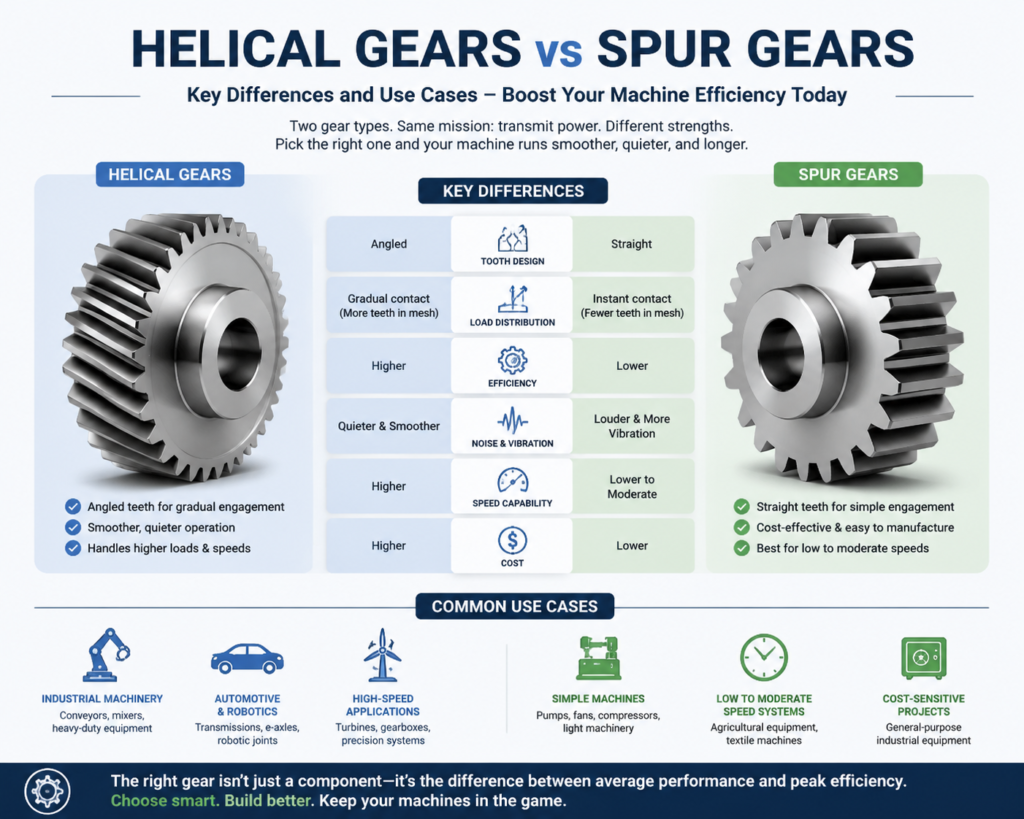
Spur and helical gears are the two most ubiquitous forms, each bringing a unique personality to the mechanical table. Spur gears are straightforward and robust, delivering torque with a no-nonsense linearity, whereas helical gears are the elegant, smooth operators, designed to handle higher loads quietly and efficiently. Understanding their subtle differences is essential for maximizing your machinery’s potential.
2. Understanding Spur Gears
2.1 Design and Structure of Spur Gears
Spur gears feature straight teeth mounted parallel to the gear axis, making them simple to design and manufacture. Their teeth engage instantaneously across the entire face, resulting in direct power transmission without any fancy obliqueness or twist. The geometry is easy to calculate, which is why they’re often the go-to for straightforward power transfer applications.
2.2 Applications of Spur Gears in Industries
These gears are everywhere: conveyor systems, simple robotic actuators, electric motors, and even the timing mechanisms in classic automotive engines. Anywhere torque needs to be transmitted efficiently with minimal design complexity, spur gears hold the line.
2.3 Advantages and Limitations of Spur Gears
The simplicity of spur gears offers lower production costs and high reliability, but the trade-off is noise and vibration at higher speeds. They don’t distribute load gradually like helical gears, making them less ideal for high-speed or high-torque applications where smooth operation is critical.
3. Understanding Helical Gears
3.1 Design and Structure of Helical Gears
Helical gears take the spur gear’s blueprint and give it a twist—literally. The teeth are cut at an angle to the axis, creating a gradual, rolling engagement that spreads load across multiple teeth simultaneously. This clever geometry allows them to transmit torque more quietly and efficiently, at the cost of slightly higher manufacturing complexity.
3.2 Applications of Helical Gears in Industries
You’ll find helical gears in automotive transmissions, heavy-duty industrial machinery, and precision robotics. They’re ideal for applications demanding smooth torque delivery, minimal vibration, and long-term durability under high-load conditions.
3.3 Advantages and Limitations of Helical Gears
Helical gears excel in noise reduction, operational smoothness, and load distribution. However, their angled teeth create axial thrust, necessitating bearings that can handle the additional stress, and manufacturing costs are higher than their spur counterparts.
4. Key Differences Between Helical Gears and Spur Gears
4.1 Differences in Tooth Design and Contact Pattern
Spur teeth engage all at once, while helical teeth make contact progressively, like a handshake rather than a slam dunk. This distinction is crucial for applications that require gradual power transmission versus instantaneous torque bursts.
4.2 Differences in Load Distribution and Efficiency
Helical gears distribute load across multiple teeth, reducing localized wear and enhancing efficiency. Spur gears, by contrast, concentrate load on single teeth, which can accelerate wear but simplifies the design and reduces backlash.
4.3 Differences in Noise, Vibration, and Operational Smoothness
Noise is the Achilles’ heel of spur gears at high speeds, producing a harsh, mechanical clatter. Helical gears glide more like a well-oiled pickleball paddle slicing through air, translating to smoother, quieter operation.
5. Material Considerations for Spur and Helical Gears
5.1 Common Materials Used in Spur Gears
Spur gears often rely on hardened steel, brass, or even high-performance polymers for lightweight applications. Material choice affects wear resistance, durability, and thermal tolerance.
5.2 Common Materials Used in Helical Gears
Helical gears frequently employ alloyed steels with surface treatments, such as carburizing or nitriding, to handle high stress and reduce fatigue over extended operational cycles.
5.3 How Material Affects Performance and Lifespan
The synergy between gear geometry and material selection dictates load capacity, wear rate, and noise generation. A high-quality steel helical gear can outlast multiple spur gears in the same application, especially under continuous high-load operation.
6. Torque and Load Handling Comparison
6.1 Torque Transmission Efficiency of Spur Gears
Spur gears excel in transferring torque efficiently at moderate speeds but struggle with shock loads because teeth engage abruptly, which can stress shafts and bearings.
6.2 Torque Transmission Efficiency of Helical Gears
Helical gears absorb shock loads better due to the progressive engagement of their teeth, offering smoother torque transmission and improved longevity under continuous stress.
6.3 Selecting Gears Based on Load Requirements
Engineers must weigh torque demands against speed, noise tolerance, and space constraints when choosing between spur and helical gears, balancing raw power with operational refinement.
7. Speed and RPM Considerations
7.1 Spur Gears at Varying Speeds
Spur gears are dependable at low to moderate RPMs but generate significant vibration at high speeds, potentially causing premature failure or fatigue.
7.2 Helical Gears at Varying Speeds
Helical gears handle high RPMs gracefully, converting rotational energy with minimal vibration and a whisper-quiet hum, perfect for high-speed machinery.
7.3 Impact on Machine Performance
The choice of gear type affects thermal loads, operational stability, and energy efficiency, ultimately influencing the lifespan and reliability of the entire mechanical system.
8. Noise and Vibration Analysis
8.1 Noise Generation in Spur Gears
The straight-tooth design creates abrupt engagement that echoes through the chassis, producing mechanical noise akin to a rowdy pickleball tournament on a metal court.
8.2 Noise Generation in Helical Gears
Helical gears’ angled teeth generate a rolling contact, dramatically reducing acoustic output and vibration, creating smoother and more predictable power delivery.
8.3 Techniques to Reduce Vibration and Noise
Proper lubrication, alignment, and precision manufacturing can mitigate noise and vibration for both gear types, but helical gears naturally have the edge for quiet operation.
9. Gear Efficiency and Power Loss
9.1 Efficiency Ratings of Spur Gears
Spur gears are highly efficient under moderate loads, often exceeding 95%, but their efficiency drops under high-speed, high-load scenarios due to energy lost in vibration and tooth impact.
9.2 Efficiency Ratings of Helical Gears
Helical gears maintain slightly lower nominal efficiency due to axial thrust losses but offset this with smoother torque transmission and less wear, leading to long-term energy savings.
9.3 Factors Affecting Gear Efficiency
Tooth profile, lubrication, alignment, and material hardness collectively determine efficiency, and even minor miscalculations can reduce performance noticeably.
10. Cost Comparison Between Spur and Helical Gears
10.1 Manufacturing Costs of Spur Gears
Simpler geometry makes spur gears cheaper to produce and easier to replace, making them a cost-effective solution for budget-conscious operations.
10.2 Manufacturing Costs of Helical Gears
Helical gears demand precision machining and surface treatment, resulting in higher upfront costs but improved operational efficiency and longevity.
10.3 Cost vs Performance Trade-Offs
The decision often comes down to whether smooth, quiet, high-load operation justifies the higher price point, which in many industrial applications, it absolutely does.
11. Durability and Wear Resistance
11.1 Common Wear Mechanisms in Spur Gears
Spur gears suffer from pitting, tooth breakage, and accelerated wear due to sudden load application, especially in high-torque environments.
11.2 Common Wear Mechanisms in Helical Gears
Helical gears experience gradual wear, often along the flanks of the teeth, which reduces catastrophic failure risk but requires careful management of axial forces.
11.3 Maintenance Practices to Extend Gear Life
Regular inspection, proper lubrication, and precise alignment are essential, with helical gears benefiting even more due to their complex engagement pattern.
12. Applications in Industry
12.1 Spur Gears in Industrial Machinery
Conveyors, packaging equipment, and low-speed actuators are prime examples where spur gears shine due to their simplicity and reliability.
12.2 Helical Gears in Automotive and Robotics
High-performance vehicles, industrial robots, and CNC machines leverage helical gears for their ability to deliver smooth, quiet, and high-torque motion.
12.3 Choosing the Right Gear for Specific Applications
Application requirements, environmental factors, and budget constraints guide the choice, often resulting in a hybrid approach within complex systems.
13. Design Considerations for Engineers
13.1 Tooth Geometry and Pitch Selection
Fine-tuning tooth thickness, helix angle, and pitch ensures optimal load distribution, minimal backlash, and longevity under continuous operation.
13.2 Alignment and Assembly Considerations
Misalignment can drastically reduce gear life and efficiency, making precision assembly crucial, particularly for helical gears with axial thrust.
13.3 Balancing Performance and Cost
Engineers must juggle efficiency, noise, and manufacturing costs, aiming for a sweet spot where operational benefits outweigh expenses.
14. Impact on Machine Efficiency
14.1 How Spur Gears Affect Energy Consumption
Efficient at moderate speeds, spur gears can waste energy under high-load or high-speed conditions due to vibration and uneven load transfer.
14.2 How Helical Gears Improve Operational Smoothness
Progressive tooth engagement reduces energy spikes, smooths rotational flow, and enhances overall efficiency, particularly in demanding, high-speed operations.
14.3 Optimizing Gear Selection for Efficiency Gains
Matching gear type to application parameters—load, speed, environment—can yield measurable improvements in machine uptime and energy consumption.
15. Troubleshooting Common Gear Problems
15.1 Misalignment and Backlash Issues
Tooth misalignment can cause vibration, excessive noise, and premature wear, often requiring realignment or replacement to restore efficiency.
15.2 Excessive Wear and Failure Causes
Overloading, poor lubrication, or material fatigue can accelerate tooth degradation, particularly in spur gears under high-speed conditions.
15.3 Solutions and Preventive Maintenance Tips
Scheduled inspections, proper lubrication, and load management reduce the risk of catastrophic failure, ensuring gears perform optimally over their service life.
16. Future Trends in Gear Technology
16.1 Advanced Materials for High-Performance Gears
Novel alloys, composites, and surface treatments promise higher strength, lighter weight, and superior wear resistance.
16.2 Innovations in Gear Manufacturing Techniques
Additive manufacturing, precision hobbing, and grinding technologies enable complex geometries with higher tolerances and improved efficiency.
16.3 Emerging Applications in Robotics and Automation
Smart factories, autonomous vehicles, and collaborative robots are driving demand for gears that combine durability, smoothness, and precision.
17. Conclusion
17.1 Recap of Key Differences
Spur gears: simple, robust, cost-effective; Helical gears: smooth, efficient, higher-load capable. Choosing wisely affects performance, noise, and longevity.
17.2 Guidelines for Selecting the Right Gear Type
Consider load, speed, noise tolerance, and budget. Spur for simplicity, helical for refinement and efficiency.
17.3 Maximizing Machine Efficiency Through Proper Gear Choice
Optimal gear selection, proper alignment, and consistent maintenance amplify productivity, reduce energy loss, and extend machine life.
18. FAQs
18.1 Can Spur Gears Handle High-Speed Applications?
They can, but efficiency drops and noise increases; helical gears are preferred for sustained high-speed use.
18.2 Are Helical Gears Noisier Than Spur Gears?
No—helical gears are quieter due to gradual tooth engagement and better load distribution.
18.3 Which Gear Type Offers the Longest Lifespan?
Helical gears generally outlast spur gears under high-load, continuous-operation conditions due to smoother load transfer and reduced stress concentration.