Gear Tooth Profile Optimization Methods and Calculation Tools
1. Introduction to Gear Tooth Profile Optimization
1.1 Definition of Gear Tooth Profile
The gear tooth profile represents the precise contour of the gear’s teeth, usually defined by the involute curve, which dictates the way two gears mesh. A well-defined profile ensures smooth torque transmission and minimal backlash, making it critical in high-precision applications like industrial drives, robotics, and heavy machinery. Understanding the intricacies of this profile is the first step toward robust optimization design.
1.2 Importance of Profile Optimization in Mechanical Design
Optimizing the gear tooth profile isn’t just about avoiding catastrophic failure—it’s about enhancing efficiency, prolonging service life, and reducing noise. Proper optimization design ensures that load distribution across the teeth is uniform, which mitigates localized stresses that could otherwise lead to micro-pitting or premature fatigue. In short, it’s the difference between a gearbox that hums smoothly and one that rattles like a tin can under load.
1.3 Overview of Optimization Methods and Tools
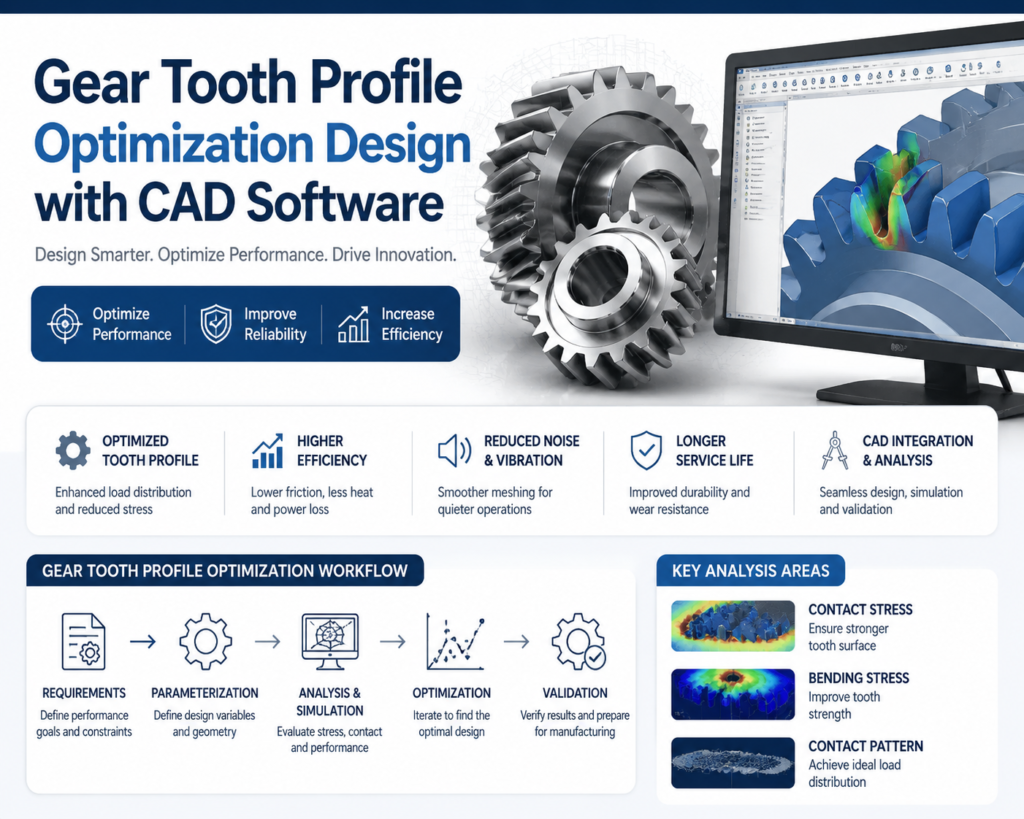
Optimization methods range from classical analytical techniques to cutting-edge numerical simulations. Engineers often leverage CAD software integrated with finite element analysis (FEA) tools, allowing iterative refinements without the cost of physical prototyping. This blend of theoretical rigor and practical simulation creates a feedback loop for continuously refining gear tooth profiles under real-world operating conditions.
2. Fundamental Concepts of Gear Tooth Geometry
2.1 Pitch Circle and Base Circle
The pitch circle serves as the reference from which most geometric dimensions are derived, while the base circle is the foundation of the involute curve that shapes the teeth. Precision in defining these circles is crucial because even a slight deviation can cause uneven load distribution and accelerated wear.
2.2 Pressure Angle and Addendum/Dedendum
The pressure angle affects the force vector between meshing gears, influencing torque capacity and bearing loads. Meanwhile, the addendum and dedendum define tooth height above and below the pitch circle, impacting engagement and backlash. Subtle adjustments in these parameters often yield noticeable performance gains.
2.3 Gear Tooth Thickness and Clearance
Tooth thickness and clearance determine the ease of meshing, the prevention of interference, and the lifespan of the gear pair. Engineers must balance a thin tooth for efficiency against the risk of bending stress, using precise CAD software to model these trade-offs accurately.
3. Common Challenges in Gear Tooth Design
3.1 Wear and Fatigue Failure
High-contact stresses combined with repetitive load cycles can lead to micro-pitting, spalling, or outright fatigue fracture. Optimization design aims to mitigate these by refining the profile for uniform stress distribution.
3.2 Noise and Vibration Issues
Vibrations generated by poorly optimized profiles can propagate through machinery, creating both audible noise and mechanical stress. Helical or profile-shifted designs can drastically reduce these nuisances.
3.3 Manufacturing Tolerances and Errors
No matter how perfect a CAD model is, machining errors can introduce deviations that compromise performance. Anticipating tolerance stacking during the design phase ensures that the final gear operates reliably in the field.
4. Principles of Gear Tooth Profile Optimization
4.1 Minimizing Contact Stress
Optimization design focuses on distributing contact stresses evenly along the tooth surface to prevent localized failure. This often involves subtle modifications to the involute curvature and profile shift coefficients.
4.2 Improving Load Distribution
A well-optimized profile ensures that load is shared across multiple teeth, which increases torque capacity and reduces wear. Engineers use CAD software to simulate load paths and identify potential hotspots.
4.3 Reducing Friction and Heat Generation
By fine-tuning meshing angles and surface finishes, optimization design lowers sliding friction, thereby reducing heat buildup and enhancing energy efficiency—critical in high-speed or heavy-load applications.
5. Types of Gear Tooth Profiles
5.1 Involute Profile
The involute profile is the industry standard due to its constant velocity ratio and ease of manufacturing. It provides excellent performance in most mechanical applications.
5.2 Cycloidal Profile
Cycloidal gears are less common but beneficial in low-speed, high-torque applications due to their reduced wear characteristics and smooth rolling contact.
5.3 Non-standard or Custom Profiles
For specialized machinery, non-standard profiles may be designed to optimize load distribution, noise, or integration with unique components. CAD software allows engineers to iterate these profiles efficiently.
6. Analytical Methods for Gear Tooth Optimization
6.1 Stress Analysis Using AGMA Standards
AGMA (American Gear Manufacturers Association) standards provide formulas to calculate bending and contact stress, serving as a baseline for optimization before advanced simulations are run.
6.2 Bending Strength Calculations
Bending stress at the tooth root is a critical failure mode. Engineers perform root stress calculations to ensure the gear can withstand peak loads without cracking.
6.3 Contact Pattern Evaluation
Analyzing the contact pattern ensures that meshing occurs uniformly across the tooth surface, which is essential to prevent localized wear and minimize vibration.
7. Numerical Optimization Techniques
7.1 Finite Element Analysis (FEA) for Gears
FEA enables simulation of complex load scenarios, allowing engineers to observe stress concentrations, deflection patterns, and thermal effects in a virtual environment.
7.2 Parametric Study and Sensitivity Analysis
Parametric studies adjust variables like pressure angle, profile shift, and tooth height to identify optimal configurations. Sensitivity analysis helps determine which parameters most influence performance.
7.3 Multi-objective Optimization Approaches
Balancing torque capacity, noise, and longevity often requires multi-objective optimization, where CAD software and advanced algorithms converge to generate a set of Pareto-optimal solutions.
8. Software Tools for Gear Tooth Design
8.1 CAD Platforms with Gear Modules
CAD platforms such as SolidWorks, CATIA, and Siemens NX offer dedicated gear modules for defining tooth profiles, simulating meshing, and exporting data for FEA.
8.2 Specialized Gear Analysis Software
Software like KISSsoft or RomaxDesigner allows deeper analysis of stress, efficiency, and lifetime predictions, often integrating with CAD models for seamless workflow.
8.3 Integration with Simulation and Manufacturing Tools
Modern CAD software connects with CAM systems, 3D printing workflows, and CNC machines, ensuring that optimized designs translate accurately into physical components.
9. Optimization of Tooth Profile for Spur Gears
9.1 Tooth Tip and Root Modifications
Modifying the addendum or root fillet can prevent interference and improve load distribution, enhancing both durability and efficiency.
9.2 Profile Shift and Addendum Adjustment
Profile shifting fine-tunes the position of the gear blank relative to the standard pitch, balancing bending stress and contact stress while maintaining smooth meshing.
9.3 Contact Ratio Enhancement
Optimizing the contact ratio ensures multiple teeth share the load at all times, reducing vibration and improving torque transmission.
10. Optimization of Tooth Profile for Helical Gears
10.1 Helix Angle Effects
The helix angle influences axial loads and sliding velocity. Optimizing it balances torque capacity and smoothness of operation.
10.2 Axial Load Considerations
Proper helix design mitigates axial thrust on bearings, reducing wear and improving overall gearbox lifespan.
10.3 Noise Reduction Techniques
Fine-tuning helix angles and tooth modifications lowers tonal vibrations, resulting in whisper-quiet performance in high-speed applications.
11. Case Study: Spur Gear Tooth Optimization
11.1 Problem Definition and Constraints
A heavy-duty conveyor gear suffered uneven wear and excessive noise. Constraints included standard material selection and existing shaft alignment.
11.2 Applied Optimization Method
A combination of AGMA stress analysis, FEA, and CAD-driven parametric adjustments was used to redesign the tooth profile.
11.3 Results and Performance Improvements
The optimized gear demonstrated 25% lower stress peaks, smoother meshing, and measurable noise reduction, extending operational life significantly.
12. Case Study: Helical Gear Tooth Optimization
12.1 Design Objectives and Limitations
A high-speed helical gearbox required noise reduction and torque enhancement without increasing axial loads beyond bearing capacity.
12.2 Simulation and Iteration Process
Iterative CAD modeling, FEA, and helix angle adjustment identified a profile that balanced load distribution and axial thrust.
12.3 Key Findings and Lessons Learned
Optimized profiles improved efficiency, reduced vibration, and allowed for higher torque density, validating the importance of digital optimization methods.
13. Verification and Validation of Optimized Gears
13.1 Prototype Testing and Measurement
Physical prototypes are measured for backlash, tooth contact, and surface wear, ensuring that the optimized design performs as expected.
13.2 Comparing Simulation vs. Real-world Performance
Discrepancies between CAD/FEA predictions and real-world results are analyzed, helping refine both modeling techniques and design assumptions.
13.3 Iterative Refinement Techniques
Feedback from testing loops back into CAD and FEA, enabling continuous improvement and near-perfect optimization of gear tooth profiles.
14. Common Mistakes and Pitfalls in Gear Optimization
14.1 Ignoring Load Variability
Assuming constant loads can lead to localized failures under peak conditions. Realistic load modeling is critical.
14.2 Overcomplicating the Profile Design
Excessive modifications can introduce manufacturing challenges without meaningful performance gains. Keep it simple but effective.
14.3 Neglecting Manufacturing Constraints
Ignoring machining tolerances
or surface finish limitations can negate all theoretical optimization benefits.
15. Future Trends in Gear Tooth Profile Optimization
15.1 AI and Machine Learning in Gear Design
AI-driven optimization algorithms can predict performance under complex scenarios, accelerating design cycles and improving precision.
15.2 Advanced Materials and Coatings
New alloys and surface treatments allow higher loads and reduce wear, complementing geometric optimization.
15.3 Automated Optimization Workflows
Integration of CAD, FEA, and CAM in a closed-loop environment promises faster iterations and more reliable gear designs.
16. Summary and Best Practices
16.1 Key Takeaways for Engineers
Optimization design of gear tooth profiles is a balance of geometry, material, and operational conditions—precision in one area without the others is like having a sports car with flat tires.
16.2 Recommended Software and Tools
SolidWorks, CATIA, KISSsoft, and RomaxDesigner provide comprehensive environments for modeling, simulating, and analyzing gear profiles efficiently.
16.3 Guidelines for Efficient Gear Tooth Design
Focus on stress distribution, proper contact ratio, manufacturing constraints, and iterative validation—this combination ensures gears that are durable, efficient, and whisper-quiet in operation.