The Influence of Gear Materials on Performance: A Comparison of Steel, Cast Iron, and Copper Alloys
1. Introduction to Gear Materials
1.1 Definition and Importance of Gear Materials
Gears are the unsung heroes in almost every mechanical assembly, quietly transmitting torque and synchronizing motion. The gear materials from which they are fabricated dictate not only their strength but also their longevity, wear behavior, and operational efficiency. Selecting the right gear materials is akin to picking the right player for a championship team—get it wrong, and the entire system suffers. Beyond just strength, factors like machinability, thermal stability, and vibration damping heavily influence performance, making material choice a critical engineering decision.
1.2 Overview of Commonly Used Materials
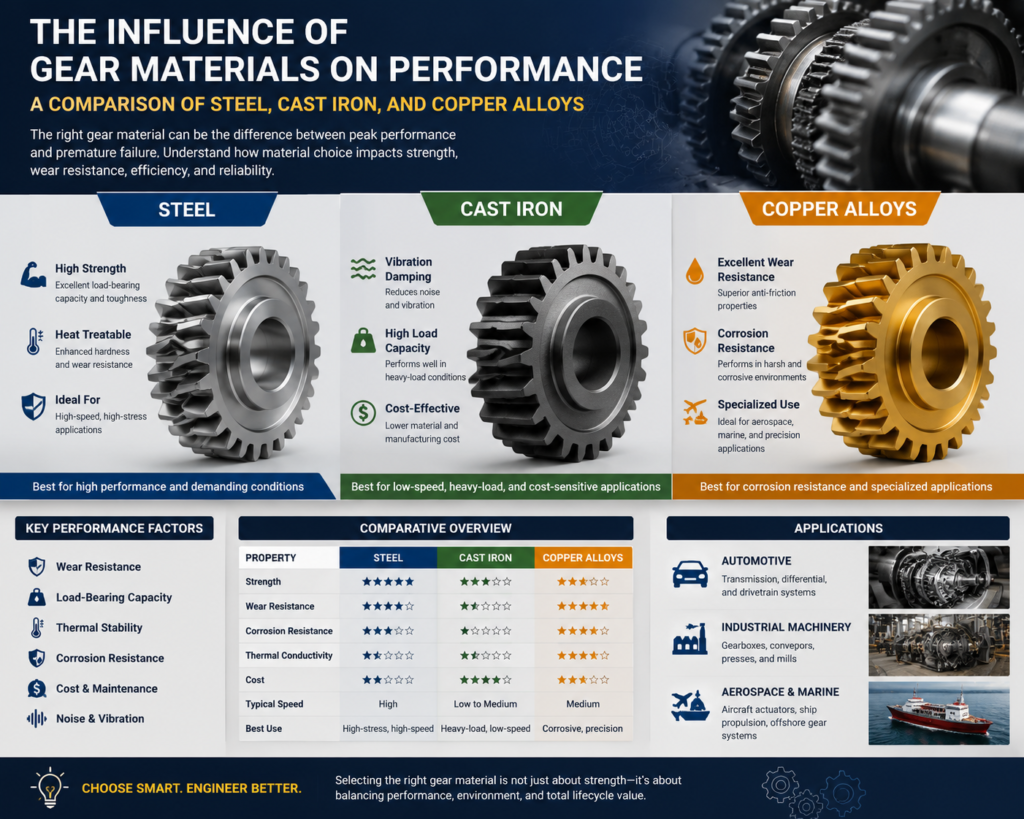
Traditionally, steel, cast iron, and copper alloys dominate the gear landscape. Steel offers high tensile strength and versatility, cast iron provides inherent damping and cost efficiency, while copper alloys bring corrosion resistance and low friction to the table. Each material comes with a unique cocktail of mechanical properties and trade-offs, making the selection process a balancing act between durability, cost, and application-specific requirements.
1.3 Impact on Mechanical Performance
The material choice dramatically impacts the gear’s operational envelope. For instance, a steel gear may withstand high torque but may transmit higher vibrational noise if not damped properly, whereas a cast iron gear might sacrifice a bit of strength but excel in vibration attenuation. Copper alloys, while softer, can extend service life in corrosive or lubricated environments. Ultimately, material directly dictates fatigue life, wear resistance, and overall system efficiency.
2. Key Performance Metrics in Gear Engineering
2.1 Wear Resistance and Longevity
Wear resistance is the bellwether for gear durability. Gears encountering abrasive particles or cyclic contact stresses must maintain tooth geometry to avoid efficiency losses. Materials with higher hardness or favorable surface characteristics reduce pitting and scuffing, extending operational life—think of it as the difference between a rugged hiking boot and a flimsy sneaker navigating rocky terrain.
2.2 Load-Bearing Capacity
Load-bearing capacity, often quantified by the material’s yield and tensile strengths, dictates how much torque a gear can transmit without permanent deformation. Steel gears dominate in high-stress zones, whereas cast iron, though strong in compression, may crack under dynamic loads. Copper alloys, although limited in load-bearing, excel in specialized applications requiring moderate torque with minimal friction.
2.3 Thermal and Corrosion Resistance
Temperature swings and corrosive environments can silently sabotage gear performance. Materials like stainless steels and certain copper alloys resist oxidation and maintain structural integrity under heat cycling, while cast iron performs admirably in moderate thermal ranges but may corrode in acidic or saline environments. Engineers must weigh operational temperatures and environmental exposure when specifying gear materials.
3. Steel Gears: Properties and Advantages
3.1 Mechanical Strength and Toughness
Steel gears are prized for their exceptional tensile strength, ductility, and fatigue resistance. High-carbon and alloy steels, often alloyed with chromium or molybdenum, provide a robust backbone capable of withstanding cyclic loads without micro-cracking—a crucial feature in automotive and industrial machinery.
3.2 Heat Treatment Benefits
Heat treatments, including carburizing, quenching, and tempering, transform steel’s microstructure to optimize hardness at the surface while retaining a tough, resilient core. This dual-character approach is critical for high-speed, high-torque applications where surface wear and core integrity must coexist.
3.3 Applications in High-Stress Environments
From gearboxes in heavy-duty trucks to high-speed turbines, steel gears are ubiquitous where performance cannot be compromised. They thrive under extreme loads, temperature fluctuations, and dynamic stress cycles, making them a go-to for engineers who value reliability over economy.
4. Cast Iron Gears: Characteristics and Applications
4.1 Material Composition and Microstructure
Cast iron’s carbon-rich matrix provides inherent hardness, while graphite inclusions act as stress absorbers. This combination imparts excellent compressive strength, making it suitable for gears exposed to high static loads rather than high-speed dynamic stress.
4.2 Vibration Damping Properties
One of cast iron’s crown jewels is its vibration damping ability. The microstructural graphite particles absorb energy that would otherwise propagate as noise or oscillation—a property highly valued in industrial machinery where smooth operation is non-negotiable.
4.3 Suitability for Low-Speed and Heavy-Load Applications
Cast iron gears excel in applications like conveyor drives, presses, and hoisting mechanisms, where loads are substantial but speeds remain moderate. Engineers often favor cast iron here for its low maintenance demands and cost-effective production.
5. Copper Alloy Gears: Features and Use Cases
5.1 High Wear Resistance and Lubrication Properties
Copper alloys, particularly bronze, exhibit impressive resistance to seizure and galling, partly due to their lubricious properties. These gears are less prone to surface fatigue, making them ideal for high-friction or lightly lubricated systems.
5.2 Corrosion Resistance in Harsh Environments
Copper-based alloys shine in corrosive environments, resisting degradation from saline, acidic, or humid conditions. This makes them the material of choice in marine gear applications and chemical processing equipment.
5.3 Niche Applications in Aerospace and Marine Engineering
In aerospace, where weight, corrosion resistance, and operational smoothness matter, copper alloys are often the secret weapon. Similarly, marine gear systems benefit from their corrosion resistance and anti-friction characteristics, allowing maintenance cycles to stretch significantly longer than steel or cast iron counterparts.
6. Comparative Analysis: Steel vs. Cast Iron vs. Copper Alloys
6.1 Strength-to-Weight Ratios
Steel boasts the highest strength-to-weight ratio, while copper alloys, though lighter, carry limited load capacity. Cast iron, while heavy, offers exceptional damping but lags in tensile strength. Engineers must evaluate operational demands to balance robustness against mass.
6.2 Thermal Conductivity and Expansion
Copper alloys lead in thermal conductivity, ensuring heat dissipation, whereas steel balances moderate thermal expansion with high structural integrity. Cast iron, with low thermal expansion, reduces the risk of warping under fluctuating temperatures but requires careful lubrication management.
6.3 Cost Efficiency and Maintenance
Cast iron wins in initial cost efficiency, steel offers longevity at moderate maintenance costs, and copper alloys, though pricey, reduce downtime in corrosive or lubricated systems. Decision-makers must weigh capital expenditure against lifecycle cost savings.
7. Wear Mechanisms in Gears
7.1 Abrasive Wear
Abrasive wear occurs when hard particles or debris scour gear surfaces, leading to material removal. Material hardness, surface finish, and lubrication all dictate susceptibility, with steel performing best under severe conditions.
7.2 Fatigue Wear
Fatigue wear results from cyclic stress, causing micro-cracks and eventual pitting. Steel’s toughness and cast iron’s compressive strength mitigate fatigue differently, while copper alloys rely on ductility and surface properties to resist micro-cracking.
7.3 Corrosive Wear
Corrosive wear arises in chemically aggressive environments, attacking the gear surface and weakening structural integrity. Copper alloys excel here, forming protective oxide layers, while steel requires coatings or alloying elements for similar protection.
8. Influence of Microstructure on Performance
8.1 Grain Size and Hardness
Finer grains in steel enhance yield strength and fatigue resistance, while coarse grains in cast iron provide vibration damping but reduce tensile capacity. Grain size manipulation through thermal or mechanical treatment is a powerful tool in material engineering.
8.2 Alloying Elements and Their Effects
Chromium, molybdenum, and nickel can elevate steel’s hardness and corrosion resistance, whereas silicon enhances cast iron’s fluidity and damping. Copper alloys benefit from tin, aluminum, or nickel additions for improved strength and wear behavior.
8.3 Surface Treatments and Coatings
Techniques like nitriding, phosphating, and PVD coatings tailor surface hardness, reduce friction, and improve corrosion resistance. These treatments can elevate base materials beyond their inherent properties.
9. Heat Treatment Effects on Steel Gears
9.1 Case Hardening
Case hardening forms a wear-resistant surface layer while maintaining a tough core, a must for high-torque gear teeth subject to surface pitting.
9.2 Quenching and Tempering
Quenching locks in hardness, while tempering alleviates brittleness. Together, they create a gear that can handle repeated loading without catastrophic failure.
9.3 Surface Hardening Techniques
Induction and flame hardening selectively strengthen tooth flanks, improving durability without compromising the gear’s overall flexibility or shock absorption.
10. Lubrication Considerations for Different Materials
10.1 Oil and Grease Compatibility
Lubricant choice must complement gear materials; copper alloys need oils that won’t react chemically, while steel benefits from additives that enhance anti-wear performance.
10.2 Friction Reduction and Efficiency
Effective lubrication reduces frictional losses, heat generation, and energy consumption. Materials like bronze may require lighter greases, whereas steel often pairs with high-performance oils.
10.3 Impact on Gear Lifespan
Proper lubrication can double or triple gear life by mitigating wear mechanisms, highlighting the importance of material-lubricant synergy in design.
11. Environmental Factors Affecting Gear Performance
11.1 Temperature Extremes
High temperatures can soften steel and accelerate corrosion in copper alloys. Material selection must account for operational thermal ranges to prevent premature failure.
11.2 Humidity and Corrosive Atmospheres
Cast iron may rust rapidly
in humid or saline environments, whereas copper alloys develop protective patinas. Protective coatings often supplement steel in challenging environments.
11.3 Contaminants and Abrasives
Dust, metal shavings, and chemical particulates exacerbate wear. Choosing materials with inherent hardness or self-lubricating properties can mitigate abrasive damage.
12. Noise and Vibration Characteristics
12.1 Material Influence on Sound Levels
Hard steel gears can produce sharper, higher-pitched noises, whereas cast iron muffles sound through damping. Copper alloys, though softer, generate minimal tonal resonance in lightly loaded systems.
12.2 Vibration Dampening Properties
Graphite inclusions in cast iron act like tiny shock absorbers, reducing vibration transmission. Steel may require auxiliary dampening solutions to achieve similar smoothness.
12.3 Strategies to Minimize Gear Noise
Gear design modifications, precision machining, and material pairing can collectively mitigate noise, enhancing operational comfort and system reliability.
13. Manufacturing Techniques and Material Selection
13.1 Casting, Forging, and Machining
Each material has optimal fabrication routes: steel is often forged for strength, cast iron is molded, and copper alloys are machined. Process selection influences final microstructure and mechanical behavior.
13.2 Precision Tolerances and Surface Finish
Surface roughness and dimensional tolerances dictate friction, efficiency, and wear. High-precision steel gears require CNC machining, while cast iron tolerances may be slightly looser due to its damping advantages.
13.3 Cost vs. Performance Trade-offs
Engineers must balance upfront manufacturing costs against long-term performance. Sometimes paying more for steel or specialized alloys saves maintenance and downtime costs.
14. Failure Analysis and Reliability Considerations
14.1 Common Gear Failures by Material
Steel may crack under fatigue, cast iron may fracture under shock, and copper alloys may deform under high loads. Recognizing material-specific failure modes is essential in design.
14.2 Predictive Maintenance Approaches
Vibration monitoring, oil analysis, and thermal imaging help preempt failures, especially for steel and cast iron gears in high-load systems.
14.3 Material Selection for Reliability
Reliable operation requires choosing a material aligned with load, speed, and environmental conditions, ensuring long-term service without costly unscheduled maintenance.
15. Case Studies in Engineering Applications
15.1 Automotive Gear Systems
Steel dominates gearboxes and transmissions due to high torque handling, while bronze bushings reduce friction in low-load areas.
15.2 Industrial Machinery
Cast iron gears drive conveyors, presses, and mixers, offering cost-effective durability with excellent vibration damping.
15.3 Aerospace and Marine Applications
Copper alloys resist corrosion and minimize friction in aerospace actuators and marine propeller gearboxes, ensuring reliability in extreme environments.
16. Future Trends in Gear Materials
16.1 Advanced Alloys and Composites
High-performance composites and novel alloys promise lighter, stronger gears with improved wear resistance and fatigue life.
16.2 Additive Manufacturing of Gears
3D printing enables complex geometries, integrated lubrication channels, and rapid prototyping, revolutionizing gear design flexibility.
16.3 Sustainability and Recyclability
Eco-conscious engineering increasingly drives material selection, emphasizing recyclability, energy-efficient manufacturing, and reduced environmental impact.
17. Conclusion and Recommendations
17.1 Summary of Material Impacts
Material selection profoundly affects gear performance, wear, noise, and operational efficiency. Each material carries distinct advantages and trade-offs tailored to specific applications.
17.2 Guidelines for Material Selection
Engineers must weigh load, speed, environment, and cost considerations when specifying gear materials, leveraging steel, cast iron, and copper alloys judiciously.
17.3 Final Thoughts on Performance Optimization
Optimizing gear performance demands a holistic view encompassing material properties, manufacturing, lubrication, and environmental factors—making the difference between a system that just works and one that outperforms expectations.