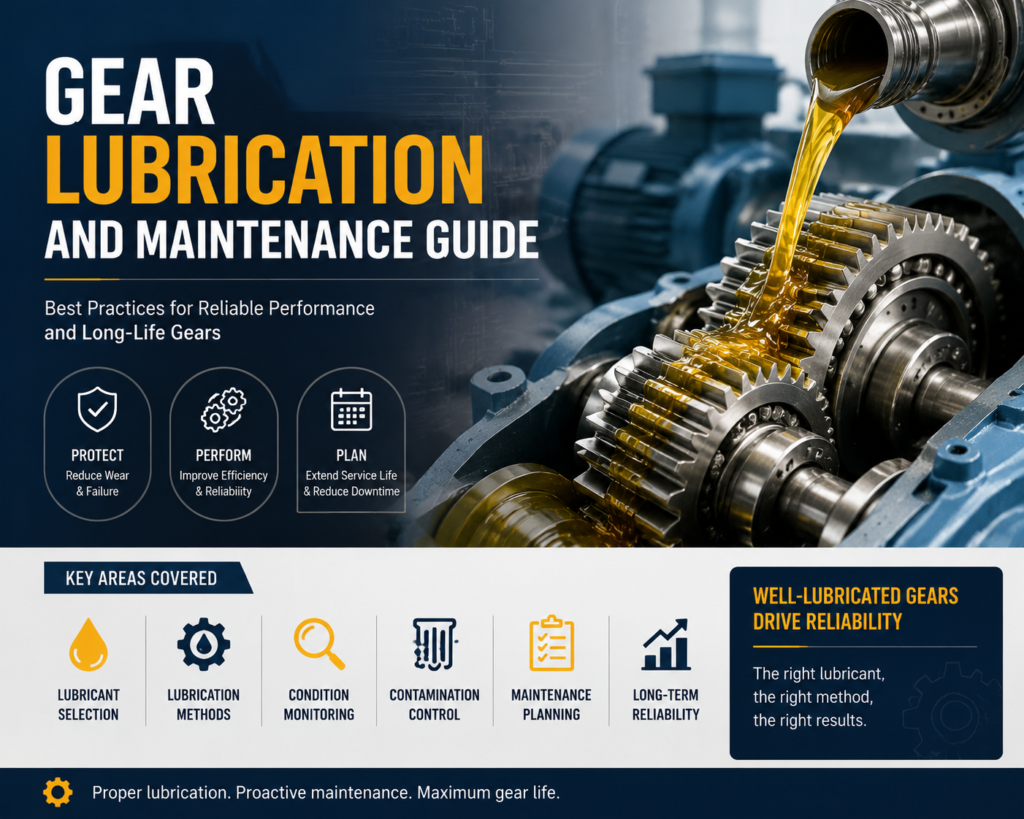
Gear Lubrication and Maintenance Guide
1. Introduction to Gear Lubrication
1.1 Importance of Proper Lubrication in Gear Systems
In the world of mechanical engineering, gear lubrication is far more than a perfunctory oiling routine; it is the lifeblood of power transmission systems, ensuring that meshing teeth glide smoothly without friction-induced failures. Proper lubrication mitigates wear, reduces energy loss, and enhances efficiency, translating into lower operational costs and fewer unplanned shutdowns—something any engineer or purchasing manager knows can make or break production schedules.
1.2 Common Consequences of Inadequate Lubrication
Insufficient gear lubrication is tantamount to suicide.: accelerated pitting, scuffing, and abrasive wear can occur within hours, especially in high-load, high-speed gear assemblies. Over time, this leads to catastrophic failures, unplanned downtime, and expensive replacements, often cascading into production delays that ripple through the supply chain. For anyone in procurement, the indirect cost of downtime frequently outweighs the modest price of high-quality lubricants.
1.3 Overview of Maintenance Best Practices
Effective maintenance begins with a structured plan—inspection intervals, lubricant type selection, and condition monitoring all integrated into a single protocol. Employing predictive maintenance alongside reactive strategies ensures gears operate at peak efficiency while preventing minor anomalies from escalating into major failures, establishing a culture of proactive mechanical stewardship.
2. Types of Gear Lubricants
2.1 Mineral Oils and Synthetic Oils
Mineral oils, refined from crude oil, are time-tested staples for general-purpose lubrication, providing reliable viscosity and thermal stability. Synthetic oils, on the other hand, are engineered for extreme environments, offering superior oxidative stability, enhanced low-temperature fluidity, and reduced friction coefficients. In high-performance machinery, synthetics often outperform mineral counterparts, especially under continuous heavy load.
2.2 Greases and Solid Lubricants
Grease serves as an indispensable lubricant for enclosed gear systems where leakage is a concern, delivering extended service life and adhesion under high-pressure conditions. Solid lubricants, including molybdenum disulfide and graphite, are invaluable for extreme temperatures or vacuum applications where traditional oils cannot survive, providing a dry-film barrier that minimizes wear even under metal-to-metal contact.
2.3 Specialized High-Performance Lubricants
High-performance lubricants, often containing anti-wear (AW) and extreme-pressure (EP) additives, are tailored for demanding industrial applications, from aerospace gearboxes to steel mill drives. These formulations reduce micro-pitting, prevent scuffing under heavy loads, and extend maintenance intervals, providing a competitive advantage in operations where uptime is king.
3. Gear Material Considerations
3.1 Steel Gears vs. Cast Iron Gears
Steel gears exhibit superior strength, wear resistance, and fatigue life but require lubrication strategies that account for higher contact stresses and potential scuffing under boundary conditions. Cast iron gears, while more forgiving in load peaks, are prone to brittle fractures, necessitating consistent lubrication to mitigate abrasive wear and avoid premature surface damage.
3.2 Non-Metallic Gear Materials and Lubrication Needs
Engineering polymers and composite gears offer advantages in noise reduction, weight savings, and corrosion resistance, yet their lubrication demands are nuanced. Selecting compatible lubricants prevents chemical degradation and excessive swelling, which could compromise tooth geometry and torque transmission efficiency.
3.3 Impact of Surface Treatments on Lubrication
Surface treatments like nitriding, carburizing, or DLC coatings alter friction characteristics and hardness profiles, influencing lubricant behavior. Understanding the interplay between coatings and lubricants ensures optimal film formation, reducing friction and extending service life even in high-torque applications.
4. Gear Lubrication Mechanisms
4.1 Boundary Lubrication Principles
Boundary lubrication occurs when the lubricant film is thin and metal asperities intermittently contact one another, demanding additives like EP and AW compounds to prevent seizure. Engineers must carefully select lubricants that maintain molecular film strength under stress while minimizing wear.
4.2 Hydrodynamic and Elastohydrodynamic Lubrication
Hydrodynamic lubrication relies on a continuous oil film generated by relative motion, while elastohydrodynamic lubrication accounts for elastic deformation at contact points under high loads. Both mechanisms are critical in helical and bevel gears, where surface geometry and contact pressures dictate film thickness and load-carrying capacity.
4.3 Mixed Lubrication Conditions
Most real-world applications operate under mixed lubrication, where portions of the contact surface experience boundary conditions while others are fully fluid-lubricated. Understanding this hybrid state allows engineers to optimize lubricant viscosity, additive selection, and application methods to prevent localized wear hotspots.
5. Factors Affecting Lubricant Selection
5.1 Operating Temperature Ranges
High temperatures accelerate oxidation and viscosity loss, while low temperatures increase fluid resistance, compromising flow and film formation. Engineers must match lubricant thermal characteristics to expected operating envelopes, often requiring viscosity modifiers or synthetic formulations.
5.2 Load and Speed Considerations
Heavily loaded gears and high-speed shafts impose conflicting demands: EP additives are needed for load endurance, yet low-viscosity oils are preferred for fast rotation to reduce churning losses. Selecting a lubricant that balances these factors is crucial for operational efficiency.
5.3 Environmental and Contamination Factors
Ambient dust, water ingress, and corrosive atmospheres challenge lubricant integrity, making environmental protection and additive packages vital. Engineers must consider filtration, seals, and lubricant compatibility to maintain consistent gear performance.
6. Gear Lubrication Methods
6.1 Splash Lubrication Systems
Splash systems, often found in gearboxes, rely on mechanical rotation to fling oil across teeth, providing a simple, cost-effective approach. Despite their simplicity, careful oil level management is critical to ensure all surfaces are adequately coated.
6.2 Circulating Oil Systems
Circulating oil systems provide continuous lubrication, cooling, and contaminant removal, ideal for high-power industrial gearboxes. Pumps, heat exchangers, and filtration circuits work together to maintain optimal viscosity and cleanliness.
6.3 Grease-Based Lubrication Systems
Grease is indispensable where oil leakage is unacceptable, forming a thick film that adheres to gear surfaces. It’s particularly useful in slow-speed or intermittently operated gears, where splash or circulation might be impractical.
7. Lubricant Application Techniques
7.1 Manual Application Methods
Manual lubrication, though labor-intensive, allows engineers to visually inspect gears during application. This method is particularly effective in small-scale or custom machinery, where precision and adaptability outweigh automation.
7.2 Automatic Lubrication Systems
Automated systems reduce human error, delivering precise amounts of lubricant at programmed intervals. These systems are advantageous in continuous-process industries, maintaining consistent film thickness across all gears.
7.3 Metered and Precision Delivery Approaches
Metered systems allow for exact dosage to each gear component, optimizing lubricant use while preventing over-application, which could lead to churning losses and foam formation.
8. Monitoring Lubricant Condition
8.1 Visual Inspection and Color Changes
Discoloration or particulate presence often signals oxidative degradation or contamination. Engineers use this simple but effective method to detect early signs of lubricant failure.
8.2 Viscosity and Particle Analysis
Regular laboratory tests, including viscosity measurement and ferrographic particle analysis, provide quantitative data on wear and lubricant health, allowing preemptive maintenance decisions.
8.3 Online Monitoring Sensors and Technologies
Advanced sensors offer real-time monitoring of temperature, vibration, and lubricant condition, enabling predictive maintenance strategies that prevent catastrophic failures before they occur.
9. Lubricant Maintenance Schedules
9.1 Recommended Inspection Frequency
Inspection frequency depends on gear duty cycles, environmental conditions, and lubricant type. Standard practice involves routine visual checks combined with periodic laboratory testing for high-value assets.
9.2 Replacement vs. Top-Up Strategies
Top-ups may suffice for minor consumption or evaporation losses, but full replacement is necessary when contamination or viscosity degradation reaches critical thresholds.
9.3 Seasonal and Operational Adjustments
Lubricant behavior shifts with temperature and load variations; engineers must account for seasonal changes, adapting oil grades or additives accordingly to maintain consistent protection.
10. Gear Wear and Damage Indicators
10.1 Signs of Pitting and Scoring
Pitting manifests as small craters on gear teeth, often linked to inadequate lubrication or excessive load, while scoring indicates metal-to-metal contact. Both require immediate attention to avoid accelerated degradation.
10.2 Noise and Vibration Monitoring
Abnormal noise, chatter, or vibration frequently precede visible damage. Engineers leverage spectrum analysis and accelerometers to pinpoint failing components.
10.3 Thermal Patterns and Overheating Detection
Localized hotspots signal frictional inefficiencies. Infrared thermography and embedded temperature sensors provide early warning, allowing timely maintenance interventions.
11. Contamination Control
11.1 Common Contaminants in Gear Systems
Particulates, water, and chemical contaminants compromise lubrication, leading to wear, corrosion, and oxidation. Understanding contamination sources is the first step toward mitigation.
11.2 Filtration and Separation Techniques
High-efficiency filters, centrifuges, and magnetic separators remove particles and water, preserving lubricant integrity and extending gear life.
11.3 Preventive Measures to Reduce Contamination
Sealing, controlled storage, and clean handling protocols minimize ingress of dirt, moisture, and debris, maintaining optimal gear operation.
12. Storage and Handling of Lubricants
12.1 Proper Storage Conditions
Lubricants must be stored in cool, dry, and well-ventilated areas to prevent degradation and moisture absorption. Temperature extremes accelerate oxidative processes, reducing efficacy.
12.2 Avoiding Cross-Contamination
Segregation of incompatible oils, correct labeling, and dedicated tools prevent chemical interactions that could compromise performance.
12.3 Safe Handling and Disposal Practices
Proper PPE, spill containment, and environmentally responsible disposal safeguard personnel and the environment while complying with regulations.
13. Gear Maintenance Planning
13.1 Creating a Maintenance Log
Documenting lubrication schedules, inspection results, and replacement activities enables trend analysis and facilitates audits.
13.2 Scheduling Preventive Maintenance
Aligning lubrication with machine downtime ensures minimal disruption while maximizing efficiency and longevity.
13.3 Aligning Maintenance with Operational Cycles
High-demand periods may require more frequent monitoring, while off-peak intervals can accommodate deep maintenance and thorough inspections.
14. Advanced Gear Protection Techniques
14.1 Use of Anti-Wear Additives
AW additives form protective films, reducing friction and mitigating micro-pitting even under extreme loads.
14.2 Surface Coatings for Enhanced Durability
Techniques like PVD coatings and nitriding increase surface hardness, improving wear resistance and maintaining film integrity.
14.3 Condition-Based Maintenance Technologies
Integration of IoT sensors, predictive analytics, and AI-assisted diagnostics ensures that intervention occurs precisely when necessary, avoiding both over-maintenance and catastrophic failure.
15. Troubleshooting Common Lubrication Problems
15.1 Overheating and Excessive Friction
Excessive temperature often stems from insufficient lubricant, wrong viscosity, or high loading. Addressing root causes is critical before simply topping up oil.
15.2 Lubricant Degradation and Oxidation
Oxidized oil loses protective properties and becomes acidic, accelerating gear wear. Timely replacement prevents compounding damage.
15.3 Inadequate Coverage or Distribution Issues
Misaligned nozzles, blocked channels, or poor circulation create uneven film thickness, exposing gear teeth to wear. Correcting distribution is essential for uniform protection.
16. Long-Term Strategies for Gear Longevity
16.1 Optimizing Gear Design for Lubrication
Design features like optimized tooth geometry, oil grooves, and reservoir sizing improve lubricant retention and film stability.
16.2 Continuous Improvement Through Monitoring
Regularly analyzing operational data allows for iterative refinements in lubrication strategies and maintenance intervals, extending gear life.
16.3 Training Personnel in Best Maintenance Practices
Well-trained staff understand the nuances of lubricant behavior, inspection techniques, and failure modes, reducing human error and enhancing operational reliability.
17. Case Studies and Real-World Applications
17.1 Industrial Gearboxes and Lubrication Challenges
Heavy-duty gearboxes in steel mills or wind turbines highlight the importance of selecting the right lubricant under extreme loads and fluctuating temperatures.
17.2 Lessons Learned from Maintenance Failures
Numerous studies show that neglecting contamination control and lubricant monitoring leads to premature failures, costing millions in lost production.
17.3 Success Stories of Extended Gear Life
Companies that integrate high-quality lubricants, automated delivery systems, and condition monitoring report significantly extended gear life, fewer breakdowns, and improved ROI.
18. Conclusion and Best Practices
18.1 Key Takeaways for Mechanical Engineers
Lubrication is the unseen backbone of gear reliability. Prioritizing lubricant selection, monitoring, and maintenance planning ensures maximum efficiency and longevity.
18.2 Integrating Lubrication into Overall Maintenance Strategy
Gear lubrication should not be treated as an afterthought; integrating it into the broader preventive and predictive maintenance plan optimizes uptime and reduces total cost of ownership.
18.3 Future Trends in Gear Lubrication and Maintenance
Emerging technologies such as AI-driven predictive maintenance, advanced synthetic lubricants, and smart monitoring sensors will continue to elevate gear system reliability, pushing operational efficiency to unprecedented heights.