1. Introduction to Bevel Gears
1.1 Definition and Basic Concept of Bevel Gears
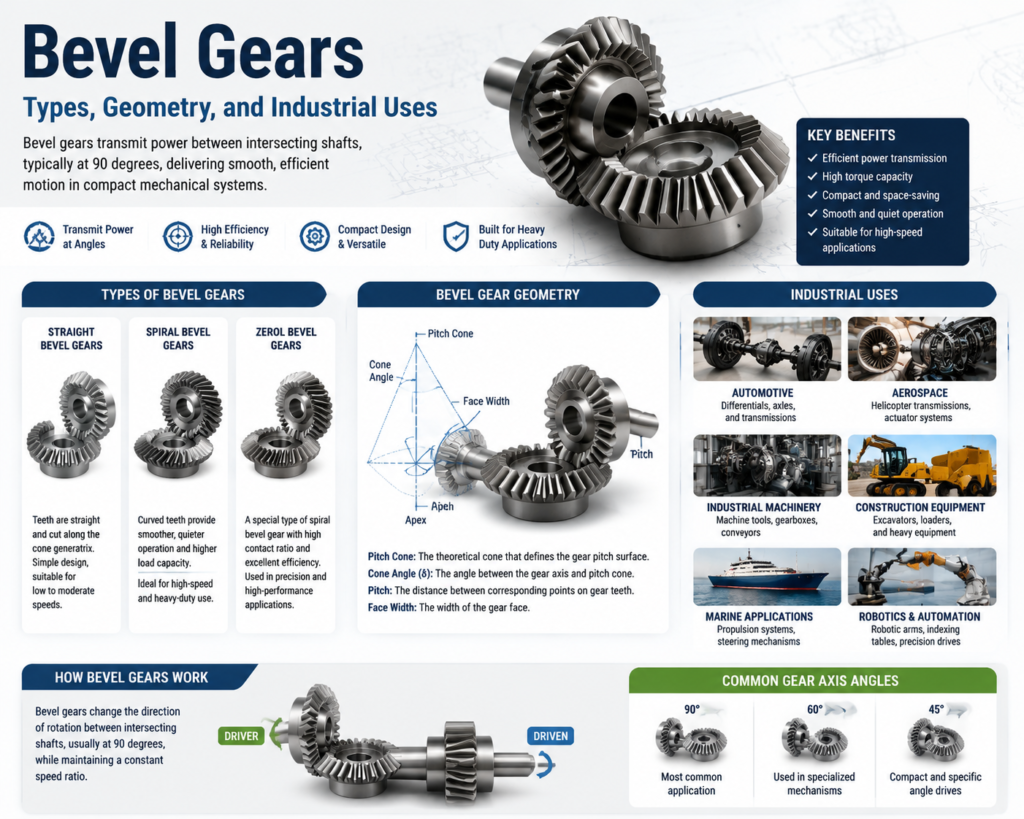
Bevel gears are mechanical marvels that allow rotational motion to change direction, typically intersecting at an angle, often 90 degrees, which is a game-changer when you need to transfer power between non-parallel shafts. Unlike your everyday spur gears, bevel gears flaunt a conical geometry, which isn’t just for show—it optimizes torque distribution and reduces backlash in demanding mechanical environments. Imagine them as the Swiss Army knife of rotary power transfer, capable of pivoting the direction of force without breaking a sweat.
1.2 Importance in Industrial Machinery
These gears are not just mechanical ornaments; they’re the workhorses in industries ranging from automotive drivetrains to massive industrial presses. Without bevel gears, the intricate ballet of power transmission in complex machines would be clunky at best. They enable engineers to pack power, speed, and precision into confined spaces, making them indispensable when space constraints and efficiency are non-negotiable.
1.3 Overview of Bevel Gear Design
Designing a bevel gear isn’t just slapping teeth onto a cone. It requires precision in defining the pitch angle, selecting the right tooth profile, and ensuring that material strength aligns with load requirements. A good design balances mechanical robustness with the nuanced art of smooth engagement, preventing catastrophic failures and keeping machines humming like a finely tuned drumline.
2. History and Evolution of Bevel Gears
2.1 Early Applications in Mechanical Systems
The roots of bevel gears can be traced back to early clockworks and textile machinery, where they turned rotary motion in ways that defied simple linear constraints. In these early applications, rudimentary materials and hand-forged teeth still managed to deliver surprisingly consistent performance, showcasing the brilliance of early mechanical ingenuity.
2.2 Innovations in Bevel Gear Manufacturing
Over the decades, bevel gear manufacturing saw a revolution: precision hobbing, gear shaping, and CNC technology allowed for unmatched accuracy. No longer confined to artisanal craftsmanship, gears became standardized, repeatable, and far more capable of handling high torque applications without succumbing to fatigue.
2.3 Modern Industrial Relevance
Today, bevel gears underpin everything from high-performance race cars to industrial robotics. Their evolution isn’t just historical trivia; it informs the design of gears that can withstand extreme torque, temperature fluctuations, and operational stress while maintaining pinpoint precision. Modern industries rely on them for speed control, torque multiplication, and space-saving designs that keep operations efficient.
3. Key Components of Bevel Gears
3.1 Gear Teeth and Pitch
The teeth of a bevel gear are a masterpiece of engineering—they’re cut at precise angles to mesh perfectly with their counterparts, minimizing backlash and distributing loads evenly across surfaces. Pitch defines the spacing, which directly influences torque capacity, noise, and efficiency. Mess with pitch, and you’ll get clunky engagement and premature wear faster than a paddle hitting the court in a serve-and-volley match.
3.2 Gear Axes and Shafts
Bevel gears rely on well-aligned axes; even minor misalignments can create catastrophic stress points. Proper shaft design ensures smooth rotational transfer, reducing vibrations and extending operational life. Think of it like aligning a pickleball paddle with your wrist—it seems minor, but misalignment can throw everything off.
3.3 Gear Hubs and Mounting
The hub and mounting system hold the gear in place, transmitting torque while preventing lateral shifts. A robust hub design ensures that the gear doesn’t wobble under heavy loads, maintaining smooth engagement and reliable power transfer even under harsh industrial conditions.
4. Types of Bevel Gears
4.1 Straight Bevel Gears
Straight bevel gears feature teeth that are cut straight along the pitch cone. They’re simpler and cheaper to produce but tend to be noisier under high-speed operation. Despite their simplicity, they’re still effective in low-speed, high-torque applications like agricultural machinery or conveyor systems.
4.2 Spiral Bevel Gears
Spiral bevel gears have curved teeth that mesh gradually, reducing shock loads and noise while increasing torque capacity. This design makes them ideal for automotive differentials, where smooth power transfer is critical, and they can handle higher speeds without generating ear-splitting clatter.
4.3 Zerol Bevel Gears
Zerol bevel gears are essentially spiral bevels with zero spiral angle, offering a compromise between straight and spiral designs. They maintain smoother engagement than straight bevels but are easier to manufacture than fully spiraled designs, making them an elegant solution for specific mechanical needs.
5. Materials Used in Bevel Gear Manufacturing
5.1 Steel and Alloy Options
High-grade alloy steels are the go-to for bevel gears that must withstand high torque and repeated stress cycles. Chrome, nickel, and molybdenum-alloyed steels enhance strength and wear resistance, ensuring the gears don’t fail under industrial strain.
5.2 Hardened and Treated Surfaces
Case hardening, carburizing, and nitriding increase surface hardness, improving wear resistance without compromising the ductility of the gear core. This duality—hard outside, tough inside—is essential for longevity, particularly in high-speed applications.
5.3 Non-Metallic Alternatives
In lighter-duty or specialized applications, polymers and composites offer reduced weight, corrosion resistance, and quieter operation. While not suitable for heavy industrial loads, these alternatives can reduce energy consumption and operational noise in smaller mechanical assemblies.
6. Bevel Gear Geometry
6.1 Pitch Cone and Cone Angle
The pitch cone is the imaginary cone that defines the location and spacing of teeth, while the cone angle dictates how the shafts intersect. Miscalculations here can lead to catastrophic inefficiencies, so precise geometric planning is paramount.
6.2 Tooth Profile and Curvature
Tooth curvature determines how smoothly gears mesh, influences load distribution, and affects noise. Spiral profiles spread contact over multiple teeth, reducing localized stress and increasing overall gear life.
6.3 Gear Ratio and Angular Velocity Considerations
Gear ratio governs torque multiplication and rotational speed conversion. Understanding angular velocity interactions ensures that the power transfer aligns with machine requirements, avoiding bottlenecks and overloading components.
7. Design Principles for Bevel Gears
7.1 Load Capacity and Torque Requirements
Every bevel gear must be designed to handle specific torque and load conditions. Overloading leads to tooth fracture, misalignment, or catastrophic gear failure, so engineers carefully model expected forces.
7.2 Minimizing Friction and Wear
Material selection, tooth geometry, and lubrication strategies all play a role in reducing friction, ensuring longevity, and maintaining efficiency even under continuous operation.
7.3 Noise and Vibration Reduction Strategies
Smooth engagement, precise alignment, and dampening treatments help reduce the screeching, rattling, and vibrations that often plague mechanical systems.
8. Bevel Gear Calculations
8.1 Calculating Pitch and Tooth Dimensions
Pitch and tooth dimensions are calculated using specialized formulas that account for load, speed, and material properties, ensuring optimal engagement and minimal backlash.
8.2 Determining Center Distance
Center distance—the spacing between gear axes—is critical for correct meshing. Even minor deviations can compromise efficiency and increase wear.
8.3 Efficiency and Power Transmission Calculations
Power loss due to friction, misalignment, and deflection is analyzed to predict operational efficiency, helping engineers maximize energy transfer while minimizing mechanical losses.
9. Manufacturing Processes
9.1 Gear Cutting Techniques
From hobbing to shaping, precise cutting ensures correct tooth profiles. Modern CNC machines allow repeatable, high-precision production for consistent quality.
9.2 CNC Machining for Precision
Computer-controlled machining provides the micron-level accuracy needed for high-performance gears, ensuring smooth engagement under demanding conditions.
9.3 Heat Treatment and Finishing
Post-machining treatments harden surfaces, relieve internal stresses, and enhance durability, creating a gear that can take abuse without failing prematurely.
10. Quality Control and Testing
10.1 Visual and Dimensional Inspection
Every gear undergoes meticulous inspection for flaws, dimensional accuracy, and surface integrity to prevent field failures.
10.2 Performance Testing Under Load
Gears are subjected to operational loads in testing rigs to simulate real-world conditions, ensuring they perform reliably before deployment.
10.3 Durability and Lifespan Assessment
Fatigue tests predict long-term behavior, helping engineers estimate maintenance cycles and replacement schedules.
11. Industrial Applications of Bevel Gears
11.1 Automotive and Transportation Machinery
Differentials, steering mechanisms, and drivetrain components rely heavily on bevel gears for efficient, quiet, and reliable power transfer.
11.2 Aerospace and Defense Equipment
High-performance bevel gears handle extreme torque and rotational speeds, ensuring precise operation in aircraft actuators and defense machinery.
11.3 Heavy Machinery and Construction Tools
Excavators, cranes, and presses use bevel gears to translate rotational power into precise motion under heavy loads, maintaining productivity in demanding environments.
12. Advantages of Using Bevel Gears
12.1 Efficient Power Transmission
Bevel gears excel in transferring torque with minimal losses, ensuring mechanical energy is utilized effectively.
12.2 Compact and Versatile Design
Their conical structure allows gear trains to fit into tight spaces, enabling innovative machine layouts.
12.3 High Torque Handling Capability
Spiral and Zerol bevel gears can endure significant torque loads without deformation or failure, ideal for
industrial applications.
13. Challenges in Bevel Gear Design
13.1 Complex Manufacturing Requirements
Precision geometry and specialized machining make bevel gear production more complex and costly compared to simpler gear types.
13.2 Alignment and Installation Issues
Misaligned shafts or improper mounting can drastically reduce gear life, increase noise, and create operational hazards.
13.3 Maintenance and Lubrication Considerations
Regular lubrication and inspection are essential to prevent wear, overheating, and eventual gear failure.
14. Innovations in Bevel Gear Technology
14.1 Advanced Materials and Coatings
Surface coatings, high-performance alloys, and hybrid materials extend lifespan and reduce friction in modern bevel gears.
14.2 3D Printing and Additive Manufacturing
Additive manufacturing opens possibilities for complex geometries, lightweight designs, and rapid prototyping in custom applications.
14.3 Smart Sensors and Predictive Maintenance
Integrated sensors monitor vibration, temperature, and load in real time, enabling predictive maintenance and reducing unplanned downtime.
15. Tips for Optimizing Bevel Gear Performance
15.1 Proper Lubrication and Cooling
Choosing the right lubricant and maintaining thermal balance ensures smooth operation and prevents premature wear.
15.2 Correct Installation Techniques
Alignment, mounting torque, and shaft positioning are critical for operational longevity. Mistakes here can be disastrous.
15.3 Regular Inspection and Replacement Schedule
Scheduled maintenance prevents minor wear from escalating into catastrophic failure, safeguarding machinery and operators.
16. Case Studies
16.1 Successful Implementation in Automotive Systems
High-performance differentials demonstrate how spiral bevel gears optimize power distribution, improve handling, and enhance vehicle efficiency.
16.2 Efficiency Improvements in Industrial Machinery
Bevel gears in conveyor systems and presses highlight measurable gains in torque transmission and reduced downtime through precise design.
16.3 Lessons Learned from Design Failures
Analyzing gear failures teaches critical lessons in alignment, material selection, and load calculations, shaping better future designs.
17. Future Trends in Bevel Gear Design
17.1 Automation and Robotics Integration
Robotic systems increasingly rely on high-precision bevel gears for accurate motion control and compact power transmission.
17.2 Lightweight and High-Strength Materials
Emerging alloys and composite materials aim to reduce weight while maintaining torque capacity, revolutionizing machine efficiency.
17.3 AI-Driven Design Optimization
AI algorithms can optimize tooth profiles, load distribution, and material usage, taking bevel gear design to new levels of sophistication.
18. Conclusion
18.1 Summary of Bevel Gear Types and Applications
Bevel gears—straight, spiral, and Zerol—play a pivotal role in industrial machinery, automotive systems, and aerospace applications, translating rotational power with precision.
18.2 Key Takeaways for Industrial Efficiency
Optimized design, material selection, and proper maintenance can significantly enhance machine efficiency, reduce downtime, and extend operational life.
18.3 Encouragement to Implement Design Best Practices
By embracing advanced manufacturing techniques, innovative materials, and predictive maintenance strategies, engineers can ensure bevel gears continue to drive industrial progress with reliability and precision.