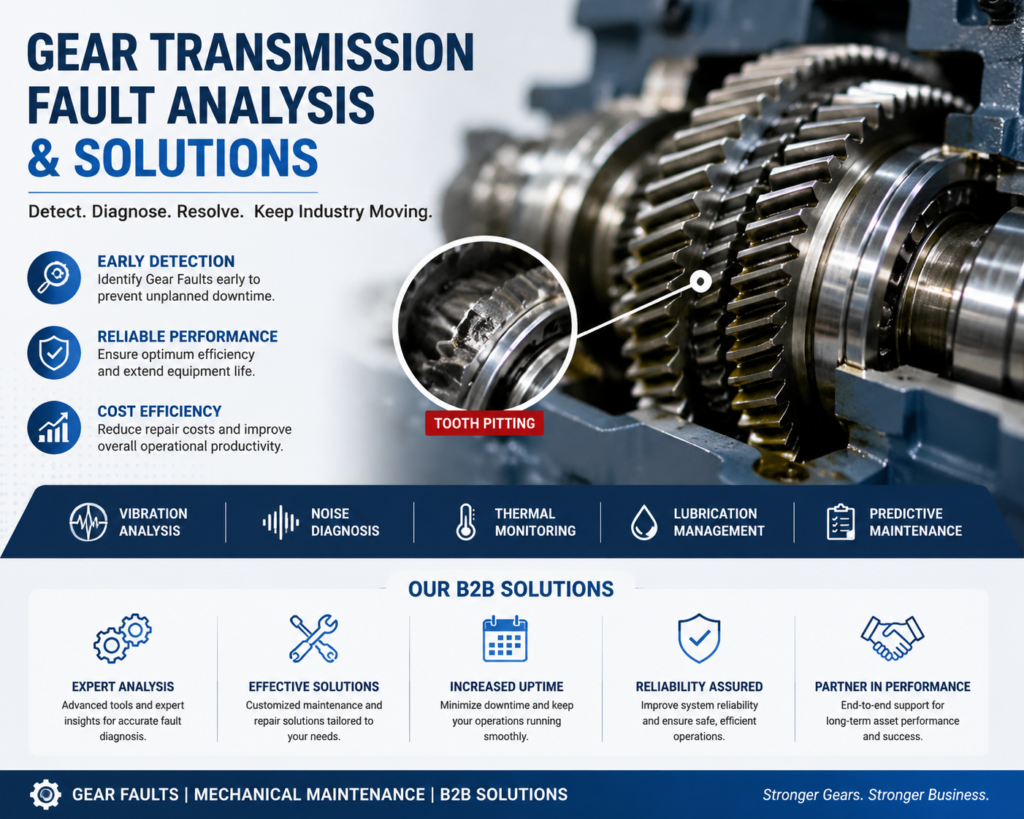
Gear Transmission Fault Analysis and Solutions
1. Introduction to Gear Transmission Faults
1.1 Definition of Gear Transmission Faults
Gear transmission faults represent any deviation from the designed operational integrity of a gear system, including wear, misalignment, pitting, or fracturing of gear teeth. These anomalies can compromise torque transmission efficiency, cause excessive vibration, and escalate mechanical stress across the drivetrain, which can ultimately lead to catastrophic failures in heavy industrial machinery.
1.2 Importance of Early Fault Detection
Catching gear faults early is like spotting a hairline crack before it turns into a canyon—you save time, money, and operational headaches. Proactive fault detection prevents unplanned downtime, reduces repair costs, and ensures reliability in high-demand mechanical systems. For B2B operations, where machinery uptime directly impacts supply chains, early detection is not optional—it’s mission-critical.
1.3 Impact on Industrial Operations
Unchecked gear faults can create cascading failures, affecting everything from assembly lines to energy transmission systems. Even minor tooth wear can generate efficiency losses, vibration-induced fatigue in surrounding components, and ultimately expensive production stoppages. In industries relying on precision engineering, every misaligned gear can ripple through operations like a pebble in a pond.
2. Common Types of Gear Faults
2.1 Tooth Wear and Pitting
Tooth wear occurs when the gear surfaces gradually erode under frictional stress, often compounded by inadequate lubrication or contaminant particles. Pitting manifests as micro-cavities on tooth surfaces, reducing load-carrying capacity and increasing surface roughness, which amplifies vibration and noise.
2.2 Gear Misalignment
Misalignment arises when gears are improperly mounted or experience shaft deflection. Even slight misalignment can accelerate wear and introduce stress concentrations, often leading to premature failure.
2.3 Crack Formation and Fractures
Cracks often initiate at stress concentration points, such as gear roots or sharp edges, and propagate under cyclic loading. Once a fracture develops, the gear’s structural integrity is compromised, risking abrupt failure and equipment downtime.
3. Causes of Gear Tooth Wear
3.1 Inadequate Lubrication
Improper or insufficient lubrication removes the protective oil film that reduces friction between teeth, accelerating abrasive and adhesive wear. Contaminated lubricants introduce metal particles, further eroding gear surfaces.
3.2 Overloading and Shock Loads
Operating gears beyond their rated torque or subjecting them to sudden impact loads can deform teeth, initiate micro-cracks, and amplify wear patterns. Overloaded gears are a common culprit in high-capacity industrial settings.
3.3 Material Fatigue and Surface Hardness
Even high-grade alloys succumb to fatigue over repeated cycles. Surface hardness inconsistencies can promote localized stress concentrations, making teeth vulnerable to wear, pitting, or spalling.
4. Gear Misalignment Issues
4.1 Causes of Misalignment
Misalignment often results from improper shaft installation, thermal expansion differences, foundation settlement, or bearing wear. Poor alignment creates uneven load distribution, accelerating failure.
4.2 Detection Methods for Misalignment
Laser alignment tools, dial indicators, and vibration trend monitoring are industry-standard methods to detect misalignment before serious damage occurs.
4.3 Long-term Consequences
Persistent misalignment leads to increased vibration, accelerated bearing and gear wear, and a spike in maintenance costs, which directly affects B2B operational reliability.
5. Crack Formation in Gears
5.1 Stress Concentration Factors
Stress tends to concentrate at gear roots, keyways, or surface imperfections, creating hotspots for crack initiation under cyclic loading conditions.
5.2 Detection Techniques
Techniques such as dye penetrant testing, ultrasonic inspection, and magnetic particle inspection allow early detection of micro-cracks before they propagate.
5.3 Preventive Measures
Optimizing tooth geometry, ensuring proper load distribution, and implementing predictive maintenance routines reduce the likelihood of cracks developing in service.
6. Vibration Analysis for Fault Detection
6.1 Principles of Vibration Monitoring
Every gear fault has a characteristic vibration signature. Monitoring amplitude, frequency, and harmonics allows engineers to pinpoint anomalies before they escalate.
6.2 Tools and Sensors for Vibration Analysis
Accelerometers, piezoelectric sensors, and portable spectrum analyzers are deployed to capture dynamic mechanical behavior and identify gear faults.
6.3 Interpreting Vibration Data
Signal processing, envelope analysis, and frequency domain interpretation help differentiate between tooth wear, misalignment, or bearing defects, enabling precise maintenance actions.
7. Noise Diagnosis in Gear Systems
7.1 Identifying Fault-Related Noise
Gear systems “speak” through noise: whines, clatters, and hums often indicate specific fault types. Experienced engineers learn to decode these auditory clues.
7.2 Sound Analysis Techniques
Acoustic emission sensors and spectral analysis allow engineers to detect faults invisible to visual inspection, revealing micro-pitting, chatter, or misalignment.
7.3 Differentiating Between Normal and Abnormal Noise
Understanding baseline gear noise versus abnormal tonal patterns is crucial to avoid false positives and unnecessary downtime.
8. Thermal Analysis in Gear Maintenance
8.1 Temperature Monitoring Methods
Infrared thermography, thermocouples, and embedded sensors track gear temperature in real-time, identifying overheating and lubrication failures early.
8.2 Overheating Causes and Risks
Frictional heat from worn teeth, poor lubrication, or high load conditions can degrade lubricant viscosity, accelerate wear, and increase the risk of catastrophic failure.
8.3 Using Thermal Data for Predictive Maintenance
Temperature trends combined with operational load data allow predictive maintenance algorithms to forecast potential gear failures, improving uptime for B2B operations.
9. Lubrication Failures and Their Effects
9.1 Types of Lubrication Issues
Contamination, oxidation, insufficient oil, and incorrect viscosity all contribute to accelerated wear and pitting.
9.2 Impact on Gear Lifespan
Lubrication failures increase friction and surface fatigue, reducing operational life and increasing maintenance costs.
9.3 Selecting the Right Lubricant
Choosing synthetic oils, EP additives, and grease compatible with operating temperatures and loads ensures maximum protection for gear systems.
10. Inspection Methods for Gear Systems
10.1 Visual and Manual Inspections
Routine inspections catch obvious wear, pitting, or cracks. Engineers often rely on borescopes to view hard-to-reach components.
10.2 Non-Destructive Testing Techniques
Ultrasonic testing, magnetic particle inspection, and X-ray imaging detect internal defects without dismantling gear assemblies.
10.3 Scheduled vs Condition-Based Inspections
Integrating time-based and condition-based inspections maximizes reliability while optimizing maintenance costs.
11. Predictive Maintenance Strategies
11.1 Advantages of Predictive Maintenance
Reduces unplanned downtime, prolongs equipment life, and improves ROI, all of which are pivotal for B2B operational efficiency.
11.2 Implementation Techniques
Utilizing sensors, vibration monitoring, and thermal imaging in tandem with historical data allows real-time decision-making for mechanical maintenance.
11.3 Integration with B2B Maintenance Solutions
Predictive maintenance can be bundled as a B2B service, offering clients uptime guarantees, maintenance scheduling, and cost transparency.
12. Root Cause Analysis of Gear Failures
12.1 Step-by-Step Investigation Process
Systematically evaluating operational history, load conditions, lubrication, and environmental factors identifies the primary failure cause.
12.2 Identifying Systemic Issues
Recurring failures often indicate design flaws, material inconsistencies, or procedural gaps that need corrective action.
12.3 Documentation and Reporting
Accurate documentation ensures lessons are captured for engineering knowledge bases and B2B client trust.
13. Repair and Replacement Techniques
13.1 Gear Reconditioning Methods
Grinding, shot peening, and surface hardening restore worn gears to operational standards, delaying full replacement.
13.2 Replacement Guidelines and Standards
Adhering to ISO and AGMA standards ensures replacement gears meet load, torque, and durability requirements.
13.3 Minimizing Downtime During Repairs
Strategic planning, pre-fabrication, and modular gear assemblies reduce operational downtime during maintenance.
14. Advanced Monitoring Technologies
14.1 IoT-Enabled Gear Sensors
Wireless sensors provide real-time condition monitoring, integrating with centralized control systems for predictive insights.
14.2 Machine Learning for Fault Prediction
ML algorithms analyze historical vibration, temperature, and load data to anticipate gear faults before they occur.
14.3 Remote Monitoring Solutions
Cloud-based platforms allow engineers to monitor multiple sites simultaneously, enabling proactive B2B solutions.
15. Case Studies of Gear Fault Solutions
15.1 Industrial Gear Failure Examples
Real-world examples highlight catastrophic tooth failures, misalignment consequences, and pitting progression under high loads.
15.2 Applied Solutions and Results
Showcases successful implementations of predictive maintenance, lubrication optimization, and alignment correction.
15.3 Lessons Learned for Future Prevention
Key takeaways emphasize early detection, adherence to maintenance protocols, and data-driven B2B mechanical maintenance solutions.
16. Best Practices for Gear Maintenance
16.1 Regular Inspection Schedules
Consistent inspection cycles catch wear patterns before they become critical, maintaining gear performance and reliability.
16.2 Training and Skill Development
Equipping
maintenance teams with specialized knowledge on gear fault diagnosis ensures long-term operational stability.
16.3 Cost-Benefit Analysis of Preventive Actions
Investing in predictive and preventive maintenance pays off by reducing unplanned downtime, repair costs, and B2B client disputes.
17. Conclusion and Recommendations
17.1 Summarizing Key Fault Types
From tooth wear to misalignment and crack propagation, understanding gear faults is essential for robust mechanical maintenance.
17.2 Recommended Maintenance Practices
Combining vibration analysis, thermal monitoring, proper lubrication, and predictive strategies enhances system reliability.
17.3 Future Trends in Gear Fault Management
Emerging IoT, AI-driven analytics, and remote B2B maintenance solutions are transforming how industries detect, prevent, and address gear faults proactively.