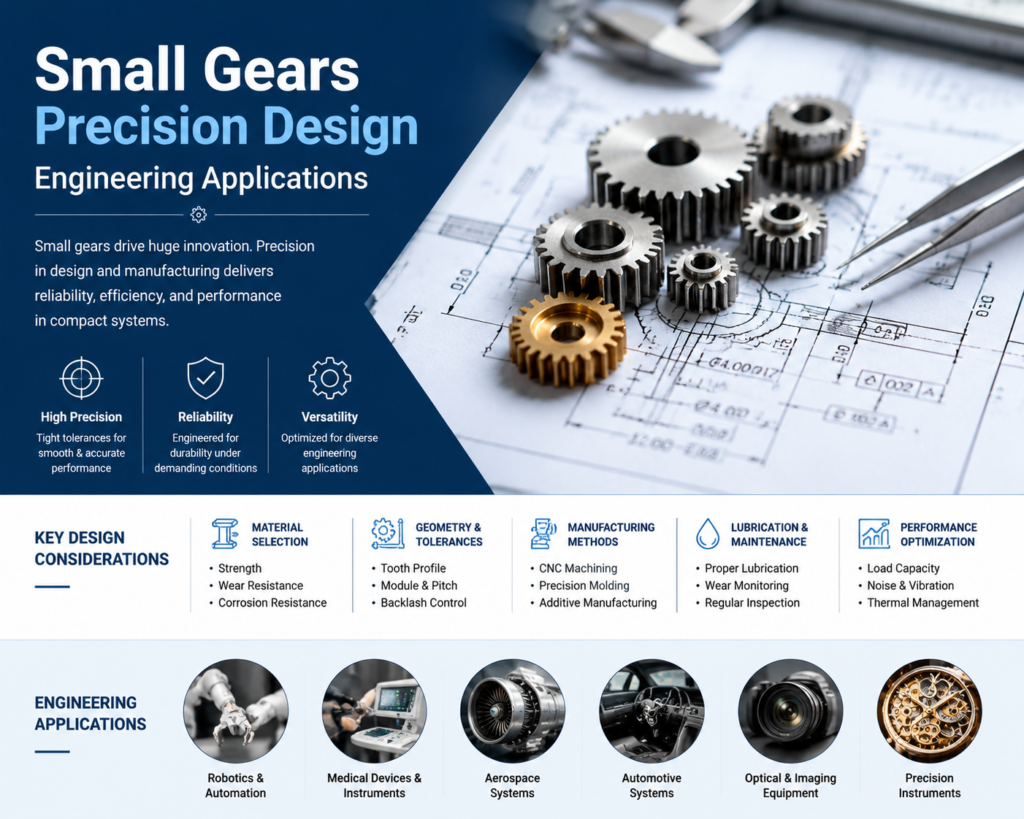
Design Considerations for Small Mechanical Gears: A Comprehensive Guide
1. Introduction to Small Mechanical Gears
1.1 Definition and Scope of Small Gears
Small gears, often tucked away in the guts of complex machinery, are the unsung heroes that transmit motion and torque with surgical precision. Unlike their larger counterparts, these diminutive components operate in constrained spaces where every micron of clearance and every fraction of a tooth angle can make or break performance. From micro-actuators in robotics to precision instrumentation, their scope spans virtually every engineering application requiring compact, reliable, and durable rotational motion.
1.2 Importance in Modern Engineering Applications
In modern engineering, small gears are far from trivial. They are pivotal in systems where accuracy is non-negotiable—think surgical robots performing millimeter-precise procedures or aerospace micro-drives navigating minute tolerances. The ripple effect of even a minor misalignment can cascade into catastrophic inefficiencies, which is why understanding their nuanced behavior is essential for engineers designing high-stakes systems.
1.3 Overview of Precision Design Requirements
Precision design for small gears demands meticulous attention to tooth geometry, backlash control, and material homogeneity. Engineers must account for micro-scale frictional losses, surface finish quality, and thermal expansion effects. In essence, precision design is not just about machining to spec; it’s a holistic approach that integrates mechanical theory, material science, and predictive analysis to ensure long-term reliability.
2. Historical Evolution of Small Gears
2.1 Early Mechanical Applications
The use of small gears traces back centuries, from intricate clockwork mechanisms to early automata. These early designs required ingenuity to manufacture with the rudimentary tools of the time, highlighting the longstanding engineering fascination with compact, efficient gear systems.
2.2 Advancements in Miniaturization
The industrial revolution and later microfabrication technologies propelled miniaturization. Techniques like precision milling and hobbing allowed smaller, more consistent gears to be produced, laying the groundwork for modern high-precision applications in micro-mechanics and instrumentation.
2.3 Modern Trends in Micro and Precision Gears
Today, trends gravitate toward ultra-lightweight, high-strength materials, and integration with electronic systems. Miniature planetary gear sets, micro-harmonic drives, and silicon-based MEMS gears are pushing the boundaries of what small gears can achieve, often blending mechanical ingenuity with digital control systems.
3. Fundamental Gear Terminology
3.1 Pitch, Module, and Pressure Angle
The pitch defines the spacing of teeth, while the module provides a scale-independent measure, essential when scaling designs up or down. Pressure angle influences the load distribution across teeth and, by extension, the efficiency and lifespan of the gear pair. These parameters are the bread and butter of precision engineering.
3.2 Tooth Profile and Geometry
The involute profile dominates, but non-involute and specialized tooth forms still find applications in noise-sensitive or high-load scenarios. Accurate tooth geometry ensures even load sharing, reduces vibration, and extends service life, all critical for small gears in compact systems.
3.3 Gear Ratios and Speed Considerations
Gear ratios dictate torque multiplication and rotational speed. Selecting the right ratio involves balancing torque requirements, backlash tolerances, and rotational efficiency, especially when dealing with multi-stage micro-transmissions where cumulative errors can escalate quickly.
4. Material Selection for Small Gears
4.1 Metals: Steel, Brass, and Aluminum
Steel remains the standard for high-load micro-gears due to its strength and fatigue resistance. Brass offers machinability and low friction, while aluminum provides lightweight alternatives for weight-sensitive designs, albeit with trade-offs in wear resistance.
4.2 Polymers and Composites
Engineering polymers, such as PEEK or acetal, are increasingly employed in small gears for low-load, high-speed applications. Composites can offer a combination of low mass and vibration damping, essential in applications like precision robotics.
4.3 Coatings and Surface Treatments
Surface engineering, including nitriding, phosphating, or DLC coatings, dramatically improves wear resistance, friction performance, and load tolerance, extending operational life in even the harshest micro-environments.
5. Manufacturing Methods for Small Gears
5.1 Traditional Machining Techniques
Hobbing, broaching, and shaping remain prevalent, offering tight tolerances and reliable profiles, particularly for metal gears. Precision fixturing is critical to avoid deflection errors that can compromise tooth accuracy.
5.2 Precision Molding and Casting
Injection molding for polymers and investment casting for metals allow mass production of small gears with consistent geometry. Attention to shrinkage and warpage is crucial to maintain dimensional fidelity.
5.3 Advanced Additive Manufacturing
Additive manufacturing opens doors to complex geometries, internal features, and rapid prototyping. Metal 3D printing allows micro-gears with internal lattice structures, reducing weight while retaining strength.
6. Tolerances and Precision Standards
6.1 ISO and AGMA Standards
Standards like ISO 1328 and AGMA 2101 set benchmarks for allowable pitch error, runout, and surface finish, providing a shared framework for evaluating micro-gear quality.
6.2 Measuring Gear Accuracy
Coordinate measuring machines (CMMs), gear testers, and optical profilometry ensure compliance with tolerances, detecting minute deviations invisible to the naked eye but catastrophic at micro-scale.
6.3 Implications of Tolerance on Performance
Even small deviations affect efficiency, noise, and lifespan. In precision applications, tolerances are often tighter than conventional macroscale gears, making meticulous inspection non-negotiable.
7. Gear Tooth Design Considerations
7.1 Involute vs Non-Involute Profiles
Involute teeth simplify engagement and minimize stress concentrations. Non-involute forms, such as cycloidal, are preferred in specialized scenarios where reduced backlash or unique load distribution is required.
7.2 Tooth Thickness and Root Fillets
Optimal thickness ensures load capacity without sacrificing space. Root fillets alleviate stress concentrations, reducing the risk of micro-cracking, a critical consideration for small, high-speed gears.
7.3 Minimizing Stress Concentrations
Finite element analysis aids in identifying hotspots, allowing engineers to tweak geometry, fillets, and contact ratios to prevent premature failure.
8. Load and Stress Analysis
8.1 Static Load Calculations
Static load analysis ensures that gears can handle expected operational forces without yielding. Considerations include tooth bending stress and surface contact pressure.
8.2 Dynamic Load Considerations
Dynamic conditions introduce fluctuating forces, misalignment, and resonance effects. Accurate modeling is essential to avoid fatigue-related failures over long operational cycles.
8.3 Fatigue and Wear Predictions
Surface fatigue, pitting, and wear mechanisms dominate small gear failures. Predictive models and accelerated testing help forecast lifespan and maintenance intervals.
9. Lubrication and Maintenance
9.1 Selecting Lubricants for Small Gears
Micro-gears often operate with minimal clearances, so low-viscosity oils or solid lubricants are preferred to reduce drag while maintaining protective films.
9.2 Lubrication Methods: Oil, Grease, Solid Film
Methods include micro-droplet oiling, thin grease films, or solid-film coatings. Choice depends on speed, load, temperature, and environmental factors.
9.3 Maintenance Schedules for Longevity
Regular inspection, re-lubrication, and predictive monitoring ensure consistent performance, particularly in high-cycle, high-precision applications.
10. Noise and Vibration Control
10.1 Sources of Gear Noise
Noise originates from tooth meshing errors, backlash, and resonance. In sensitive environments like medical devices, even faint vibrations are unacceptable.
10.2 Damping Techniques
Damping can be achieved via material selection, compliant mounts, or optimized tooth profiles to absorb vibrational energy without compromising efficiency.
10.3 Impact of Precision on Vibration
Higher precision reduces micro-misalignment and chatter, improving quiet operation, which is critical in compact assemblies where noise propagates easily.
11. Thermal Management
11.1 Heat Generation in Small Gears
Friction and high-speed operation generate localized heat, potentially altering material properties or causing expansion misalignments.
11.2 Thermal Expansion Effects
Even minor thermal expansion can lead to interference, backlash changes, or stress amplification. Engineers must account for material coefficients of expansion in design.
11.3 Cooling Solutions and Material Choices
Passive cooling, high-thermal-conductivity materials, or micro-channel lubrication systems help dissipate heat, preserving gear integrity and performance.
12. Assembly and Mounting Techniques
12.1 Shaft Alignment and Tolerances
Precise alignment prevents uneven load distribution and minimizes wear. Micro-adjustments during assembly can mean the difference between smooth operation and premature failure.
12.2 Bearing Selection and Integration
Bearings support shafts and influence backlash, load capacity, and vibration. Choice of miniature ball bearings or bushings depends on speed and torque demands.
12.3 Ensuring Minimal Backlash
Backlash affects accuracy and torque transmission. Controlled clearance and preloading techniques maintain operational fidelity in high-precision applications.
13. Gear Performance Testing
13.1 Bench Testing Protocols
Simulated loading and rotational testing verify tooth strength, noise characteristics, and efficiency under controlled conditions before field deployment.
13.2 Field Testing for Real-World Applications
Operational testing identifies unforeseen challenges such as thermal spikes, contamination
, or vibration that could compromise performance in situ.
13.3 Analyzing Test Data for Optimization
Data-driven adjustments refine geometry, lubrication, and material choices, ensuring reliability and extending service life.
14. Miniaturization Challenges
14.1 Manufacturing Limitations
Ultra-small gears push the limits of machining and molding precision. Tool deflection, burr formation, and handling challenges are non-trivial obstacles.
14.2 Material Strength at Small Scales
Scaling down can amplify stress concentrations, requiring careful selection of high-strength alloys or engineered polymers to avoid premature failure.
14.3 Balancing Precision and Cost
Miniaturization often increases manufacturing costs exponentially. Striking a balance between precision, functionality, and budgetary constraints is a persistent challenge.
15. Application-Specific Design Strategies
15.1 Robotics and Automation Systems
Small gears enable precise actuation, repeatable positioning, and compact integration, critical in robotic joints, grippers, and automated assembly lines.
15.2 Medical Devices and Instruments
Applications like endoscopic tools or prosthetic actuators demand silent, wear-resistant, and sterile-compatible micro-gear systems.
15.3 Aerospace and Automotive Micro-Gears
High-performance vehicles and aircraft systems leverage small gears for auxiliary drives, instrumentation, and adaptive control mechanisms where weight and reliability are paramount.
16. Emerging Technologies and Innovations
16.1 Smart Gears with Embedded Sensors
Integration of strain gauges, temperature sensors, and micro-actuators enables real-time monitoring and predictive maintenance, pushing mechanical design into the IoT realm.
16.2 Nano-Scale Gear Applications
Research into nano-gears opens potential for molecular machinery, advanced MEMS, and high-frequency resonators, expanding the frontiers of small-scale engineering.
16.3 Future Trends in Precision Mechanical Design
Expect further integration with electronics, additive manufacturing breakthroughs, and materials science innovations to deliver smaller, lighter, and more robust gear systems.
17. Case Studies of Successful Small Gear Designs
17.1 High-Precision Robotic Actuators
Robotic manipulators in semiconductor fabrication rely on micro-gears for nanometer-level positional control and smooth torque transfer.
17.2 Miniature Transmission Systems
Micro-transmissions in drones or precision instruments illustrate how multi-stage gear systems can achieve high torque density in confined spaces.
17.3 Medical Micro-Mechanisms
Surgical robots and diagnostic devices employ micro-gears for high-precision motion, where even minor deviations could compromise patient safety.
18. Summary and Best Practices
18.1 Key Design Takeaways
Material selection, precision manufacturing, tolerance management, and careful lubrication are pillars of small gear reliability and performance.
18.2 Common Pitfalls to Avoid
Ignoring thermal effects, backlash control, or assembly precision can lead to catastrophic failures, even in low-load applications.
18.3 Guidelines for Future Projects
Leverage simulation, predictive maintenance, and advanced materials, while always balancing cost, manufacturability, and operational requirements to maximize the impact of small gears in engineering applications.