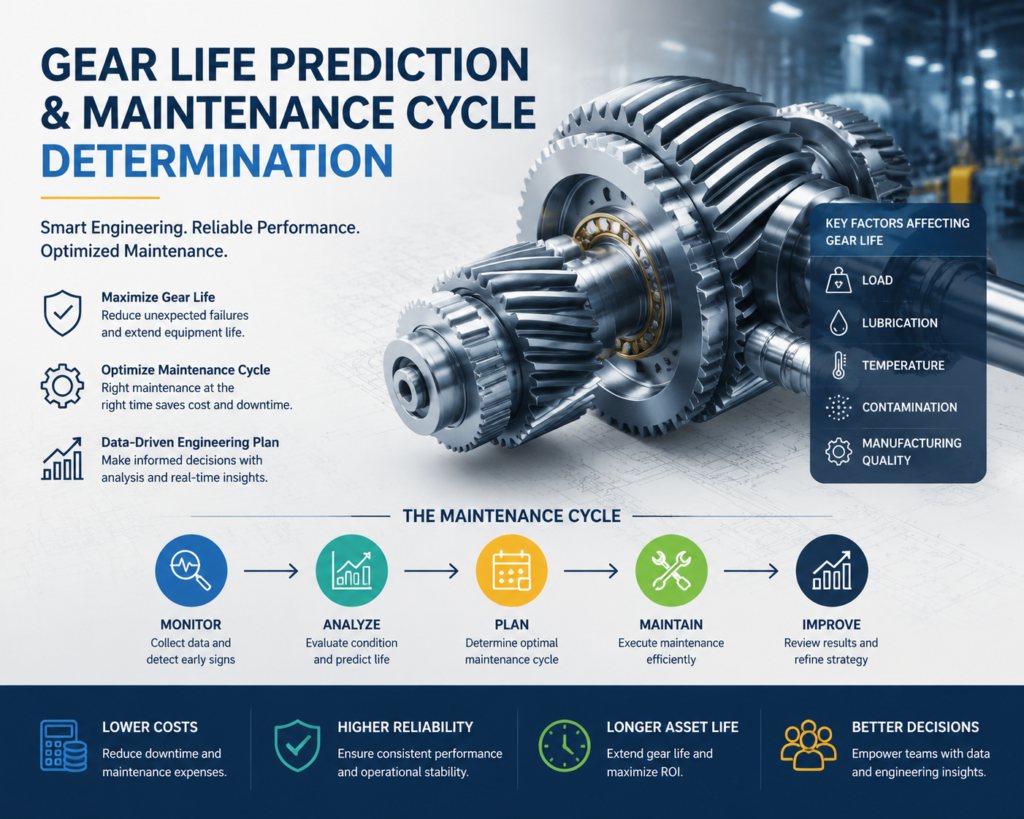
Gear Life Prediction and Maintenance Cycle Determination: A Complete Guide
1. Introduction to Gear Life Prediction
Importance of predicting gear life in industrial applications
Predicting gear life isn’t just an academic exercise; it’s the linchpin of operational reliability in any industrial setting. Gears underpin everything from conveyor systems to high-torque machinery, and unexpected failures can bring production lines to a screeching halt, resulting in costly downtime and potential safety hazards. By accurately forecasting gear life, engineers can implement proactive maintenance cycles that minimize interruptions, optimize resource allocation, and extend the overall service life of mechanical assemblies.
Overview of maintenance cycles and operational efficiency
Maintenance cycles, when properly scheduled, act like the heartbeat of a well-oiled operation. They ensure that every critical gear is inspected, lubricated, or replaced before failure occurs, thereby reducing unscheduled outages. Efficient cycles balance operational uptime with the expenditure of labor and materials, preventing over-maintenance while mitigating the risk of catastrophic failures. It’s not just about time-based routines; it’s about engineering an adaptable maintenance plan that aligns with real-world stresses and workloads.
Role of engineers and purchasing companies in gear management
Engineers and purchasing teams are the unsung heroes in maintaining gear longevity. Engineers provide the technical acumen to monitor performance metrics and predict failure points, while purchasing departments ensure that replacement parts meet stringent quality standards and arrive on schedule. Together, they craft a synergy where informed decisions about gear procurement and maintenance cycles directly affect machinery reliability and cost-effectiveness.
2. Understanding Gear Life
Definition of gear life in mechanical engineering
Gear life is defined as the operational duration a gear can sustain acceptable performance levels under specified load conditions before failure occurs. This incorporates fatigue, wear, pitting, and other mechanical degradations. In essence, it’s the sum total of a gear’s ability to transfer torque reliably over time without compromising safety or efficiency.
Factors affecting gear longevity
Several factors dictate gear longevity, including load magnitude, rotational speed, lubrication quality, material properties, and environmental influences. Even subtle misalignments or manufacturing inconsistencies can dramatically accelerate wear. It’s a complex interplay where a single weak link can shorten an entire assembly’s functional lifespan.
Common failure modes of gears
Gears typically fail through surface pitting, tooth breakage, wear, and scuffing. Pitting arises from high-contact stresses over repeated cycles, whereas scuffing occurs when lubrication fails and friction generates excessive heat. Understanding these failure modes is critical in designing an engineering plan that mitigates risk and ensures operational continuity.
3. Types of Gears and Their Lifespan
Spur gears: characteristics and life expectancy
Spur gears, the stalwarts of mechanical simplicity, are widely used due to their efficiency and ease of manufacturing. They generally exhibit predictable wear patterns, but their straight teeth can generate high stress concentrations under heavy loads, potentially limiting their service life if misapplied.
Helical gears: wear patterns and durability
Helical gears feature angled teeth, allowing smoother engagement and load distribution. This design enhances durability and reduces noise, but the axial thrust they generate requires precise bearing support. Correctly managed, their lifespan often surpasses spur gears, especially under continuous, high-speed applications.
Bevel and worm gears: unique lifespan considerations
Bevel and worm gears are invaluable for altering torque direction or achieving high reduction ratios. However, their complex geometry makes them more susceptible to misalignment and localized stress, which can accelerate wear if maintenance cycles aren’t carefully calibrated to operational demands.
4. Materials and Gear Life
Steel and alloy gears: pros and cons
Steel and alloy gears dominate industrial applications due to their high strength, toughness, and fatigue resistance. Heat treatment enhances hardness and surface endurance, but susceptibility to corrosion and higher costs require careful material selection.
Plastic and composite gears: applications and limitations
Plastic and composite gears offer quieter operation, corrosion resistance, and reduced weight, making them ideal for low-torque, high-precision applications. Yet, they may deform under high loads or elevated temperatures, shortening their effective gear life.
Surface treatments and coatings to extend gear life
Advanced surface treatments, such as nitriding, carburizing, and DLC coatings, dramatically improve wear resistance and reduce friction. Implementing these measures can extend gear life significantly and optimize the maintenance cycle, particularly in high-load or abrasive environments.
5. Load Conditions and Gear Durability
Impact of dynamic and static loads
Dynamic loads induce fluctuating stresses, which accelerate fatigue and micro-cracking, while static loads contribute to permanent deformation. Accurate load characterization is vital to predict gear life and prevent unforeseen failures.
Torque variations and their effect on gear wear
Torque fluctuations, especially sudden spikes, increase contact stress and exacerbate tooth fatigue. Engineers must monitor operational torque to ensure maintenance cycles are adjusted accordingly, preventing premature wear and catastrophic failures.
Importance of load distribution analysis
Even load distribution is key to prolonging gear life. Misalignment or uneven contact causes localized overloading, drastically reducing operational lifespan. Simulation and precision manufacturing help engineers plan for uniform stress distribution.
6. Gear Manufacturing Quality and Its Impact
Precision in gear cutting and finishing
Precision gear cutting reduces surface roughness and ensures uniform tooth geometry, directly influencing operational reliability. Inconsistent machining introduces stress risers that can initiate fatigue failures sooner than expected.
Heat treatment processes and hardness testing
Heat treatment enhances core toughness while hardening the surface, a delicate balance that extends gear life. Post-treatment hardness testing ensures the process was effective and consistent, providing an early checkpoint for expected performance.
Tolerances and their effect on operational life
Tighter tolerances minimize backlash and improve load distribution but require higher manufacturing costs. Engineers must weigh tolerance requirements against operational demands to optimize both gear life and budget.
7. Lubrication Strategies for Gear Longevity
Types of lubricants and their selection
Choosing the right lubricant—be it mineral oil, synthetic, or solid film—depends on load, speed, and temperature. The wrong choice accelerates wear, increases friction, and shortens gear life.
Lubrication intervals and monitoring
Regular lubrication, supplemented by real-time monitoring of viscosity and contamination, ensures gears operate in a low-friction regime. Engineers often adopt proactive maintenance cycles based on lubricant condition rather than fixed schedules.
Effects of improper lubrication on gear failure
Insufficient lubrication leads to scuffing, micro-pitting, and thermal degradation, while over-lubrication can trap contaminants. Both extremes undermine gear life, emphasizing the need for precise maintenance planning.
8. Environmental Factors Affecting Gear Life
Temperature extremes and thermal cycling
Extreme heat accelerates material fatigue, while cold can induce brittleness. Repeated thermal cycling compounds stress, making temperature management a key component of any engineering plan.
Contaminants and corrosion issues
Dust, moisture, and chemical contaminants foster corrosion and abrasive wear, drastically reducing gear life. Effective sealing, filtration, and material selection mitigate these risks.
Moisture, dust, and abrasive particles
Mechanical environments are rarely pristine; particles trapped in lubricants or between teeth exacerbate wear. Predictive maintenance cycles should account for environmental cleanliness to preserve operational longevity.
9. Monitoring Gear Condition
Vibration analysis for early fault detection
Vibration signatures reveal incipient misalignments or tooth damage long before catastrophic failure occurs. Engineers rely on these metrics to fine-tune maintenance cycles and extend gear life.
Temperature and noise monitoring
Elevated temperatures or abnormal noise often precede visible damage. Continuous monitoring enables data-driven maintenance strategies, preventing costly downtime.
Wear debris analysis and inspection methods
Analyzing metallic particles in lubrication provides insights into wear progression, guiding engineers in optimizing both the maintenance cycle and operational load management.
10. Predictive Modeling for Gear Life
Mathematical models for wear and fatigue
Gear life prediction leverages fatigue equations, Hertzian contact analysis, and wear coefficients to estimate remaining service life. These models quantify risks, allowing engineers to schedule maintenance with surgical precision.
Simulation tools in gear life prediction
Finite element analysis (FEA) and multibody dynamics simulations replicate operational stresses, providing insights impossible to obtain from empirical observation alone.
Case studies of predictive modeling success
Real-world case studies demonstrate that predictive modeling can double gear service life, optimize spare part inventory, and prevent unplanned downtime, validating its inclusion in modern engineering plans.
11. Determining Maintenance Cycles
Calculating optimal inspection intervals
Inspection intervals are calculated based on predicted fatigue life, operational load, and environmental conditions. Properly timed cycles prevent both over-maintenance and premature failures.
Balancing preventive maintenance with cost efficiency
Overzealous preventive maintenance can be costly, while insufficient oversight risks catastrophic failures. Balancing cost, downtime, and operational reliability is a hallmark of sound engineering planning.
Adjusting cycles based on operational data
Real-time monitoring allows dynamic adjustment of maintenance schedules, ensuring resources are allocated efficiently and gear life is maximized.
12. Preventive Maintenance Strategies
Routine inspections and scheduled replacements
Regular inspections catch early signs of wear, while scheduled replacements prevent failure in high-criticality systems. Both are essential components of a robust maintenance cycle.
Lubrication and cleaning schedules
Lubrication and cleaning prevent contamination buildup, reduce friction, and extend gear life, forming a cornerstone of preventive strategies.
Documentation and record-keeping practices
Maintaining detailed records ensures trends are identified, informs future engineering plans, and enhances procurement decisions by highlighting parts with consistent longevity.
13. Condition-Based Maintenance
Real-time monitoring systems
Condition-based maintenance leverages sensors and IoT devices to monitor temperature, vibration, and lubrication quality, triggering interventions only when necessary.
Data-driven decision-making
Analyzing operational data enables predictive decisions, reducing unnecessary downtime while safeguarding gear life.
Benefits over traditional
preventive maintenance
Condition-based strategies often yield cost savings, higher uptime, and optimized maintenance cycles, representing the future of engineering plans.
14. Corrective Maintenance and Failure Analysis
Identifying root causes of gear failure
Root cause analysis examines stress concentrations, material defects, or operational missteps to prevent recurrence.
Repair vs. replacement decisions
Engineers weigh repair feasibility against replacement costs and remaining gear life, ensuring interventions align with both maintenance cycle efficiency and budget.
Lessons learned for future maintenance planning
Failure analysis informs updated engineering plans, refines predictive models, and improves supplier selection criteria, strengthening overall reliability.
15. Cost Considerations in Gear Maintenance
Balancing downtime and maintenance expenses
Effective maintenance cycles minimize downtime while avoiding excessive expenditures on unnecessary inspections or replacements.
ROI of predictive maintenance programs
Investments in predictive technologies often pay for themselves by preventing costly failures and extending gear life, creating tangible ROI for engineering teams.
Selecting cost-effective engineering solutions
Choosing materials, suppliers, and monitoring technologies requires balancing performance, reliability, and cost, forming a pragmatic approach to maintenance planning.
16. Future Trends in Gear Life Prediction
AI and machine learning in predictive maintenance
AI algorithms analyze vast datasets to forecast gear failure with unprecedented accuracy, optimizing maintenance cycles and extending gear life.
Advanced materials and coatings
Emerging alloys, composites, and surface treatments promise increased durability, reduced friction, and extended operational life in demanding environments.
Industry 4.0 and smart gear systems
Integration with smart factory systems enables real-time monitoring, predictive analytics, and fully automated maintenance scheduling, redefining engineering plans for the modern industrial era.
17. Practical Tips for Engineers and Purchasing Teams
Key metrics to track for gear performance
Metrics like vibration amplitude, wear particle count, and lubrication viscosity provide actionable insights into gear health.
Vendor selection and quality assurance
Choosing reputable suppliers with consistent quality ensures replacement gears meet stringent operational standards, directly impacting maintenance cycle effectiveness.
Integrating maintenance strategy into procurement planning
Coordination between engineering and purchasing ensures timely availability of critical components, streamlining preventive maintenance and reducing unexpected downtime.
18. Conclusion and Key Takeaways
Summarizing gear life prediction benefits
Predicting gear life mitigates failures, enhances operational reliability, and allows for more precise maintenance cycles, safeguarding both machinery and bottom line.
Importance of maintenance cycle optimization
Optimized maintenance cycles balance operational efficiency, cost-effectiveness, and gear longevity, forming the backbone of any effective engineering plan.
Strategic recommendations for engineering teams and purchasers
Investing in predictive tools, monitoring systems, and high-quality materials, while fostering close coordination between engineers and purchasing teams, ensures gears perform reliably over extended service life, maximizing both productivity and ROI.