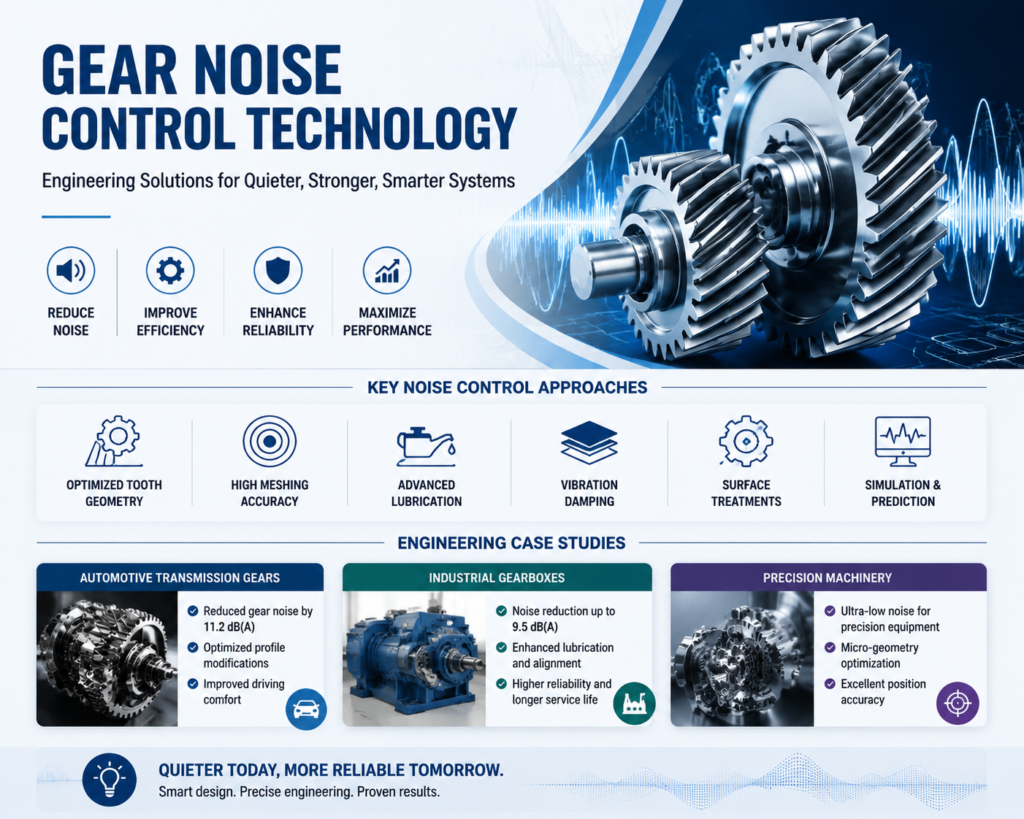
Gear Noise Control Technology and Engineering Case Studies
1. Introduction to Gear Noise
1.1 Definition of Gear Noise
Gear noise refers to the audible or vibratory disturbances emitted by meshing gears during operation. While some hum or whine is inevitable in mechanical systems, excessive gear noise indicates inefficiencies or misalignments that can compromise longevity. Engineers often describe it as the unwanted acoustic signature of torque transfer.
1.2 Sources of Gear Noise in Mechanical Systems
Noise can originate from multiple sources: microscopic surface irregularities, gear misalignment, shaft deflection, or even gear tooth interference patterns. High-speed rotations amplify these minor imperfections, translating them into audible disruptions. Lubrication inconsistencies or thermal expansion can further exacerbate these effects.
1.3 Impact of Gear Noise on Machinery Performance and User Experience
Excessive gear noise isn’t just a nuisance; it signals energy losses, higher vibration levels, and potential component fatigue. In precision machinery, it can reduce operator confidence, while in industrial equipment, it might hint at impending maintenance issues, causing production delays or customer dissatisfaction.
2. Types of Gear Noise
2.1 Torsional Vibration Noise
This arises from fluctuating torque during rotation, often due to gear teeth stiffness variation or fluctuating load conditions. It manifests as rhythmic thumping or chattering, particularly noticeable in high-torque applications.
2.2 Meshing Frequency Noise
Generated by the periodic engagement of gear teeth, this type of noise correlates directly with gear speed and tooth count. Misalignment or surface roughness amplifies meshing frequency noise, creating high-pitched whines or whining harmonics.
2.3 Structural and Resonance Noise
Resonance occurs when gear vibrations excite the natural frequencies of shafts, housings, or supporting structures. The result can be amplified acoustic emission, often mistaken for gear tooth issues when the root cause is structural.
3. Importance of Low-Noise Gear Design
3.1 Regulatory Requirements and Industry Standards
Various ISO and AGMA standards dictate allowable noise levels in mechanical systems. Compliance isn’t optional, especially for automotive, aerospace, and high-precision industrial applications. Designing for low-noise performance ensures regulatory adherence.
3.2 Customer Expectations in Precision Machinery
Purchasing engineers increasingly prioritize silent operation. Customers equate low-noise design with premium quality, smoother performance, and reduced operational stress on downstream components.
3.3 Long-Term Maintenance and Reliability Benefits
Minimized noise often translates to reduced vibration, lower wear rates, and extended service intervals. Gearboxes designed with acoustic efficiency in mind reduce unexpected downtime, protecting both the investment and brand reputation.
4. Factors Affecting Gear Noise
4.1 Gear Material Properties
Hardness, elasticity, and damping characteristics of gear materials significantly influence noise generation. Steel alloys, bronze, and composite polymers each offer unique acoustic profiles, demanding careful material selection.
4.2 Tooth Geometry and Surface Finish
Subtle variations in tooth shape, helix angle, and surface roughness can exponentially amplify sound emissions. Optimized tooth micro-geometry reduces impact stresses and improves load distribution.
4.3 Lubrication and Operating Conditions
Viscosity, film thickness, and lubricant additives play critical roles in noise suppression. Inadequate lubrication creates metal-to-metal contact, resulting in harsh clatter and accelerated wear.
5. Gear Tooth Profile Optimization
5.1 Involute vs. Modified Tooth Profiles
Standard involute teeth provide predictable engagement, but modified profiles—such as tip relief or crowning—allow smoother transitions and lower meshing shock. These modifications are subtle yet profoundly impact acoustic behavior.
5.2 Profile Shifting and Backlash Adjustment
Adjusting tooth thickness and backlash can control contact ratio, reducing sudden load transfers and mitigating whine or chatter. Too tight, and you get friction-induced squeal; too loose, and impact noise rises.
5.3 Tooth Tip and Root Modifications
Edge rounding, root fillets, and micro-polishing minimize stress concentration points, reducing both vibration and noise. Even micro-scale geometry alterations can yield measurable acoustic improvements.
6. Gear Meshing Accuracy
6.1 Alignment and Assembly Tolerances
Precise mounting and shaft alignment are critical. Misalignment amplifies gear noise exponentially, producing tonal peaks at resonance frequencies. High-precision assembly tools and jigs are indispensable.
6.2 Pitch Error Reduction Techniques
Minimizing pitch errors through advanced grinding or hobbing reduces harmonic noise components. Engineers often employ coordinate measuring machines (CMM) for verification.
6.3 Influence of Gear Shaft Deflection
Even slight shaft deflection under load changes the effective tooth engagement, producing intermittent impact noise. Reinforced shafts or optimized bearing placement can stabilize meshing dynamics.
7. Surface Treatments and Coatings
7.1 Case Hardening and Nitriding
Heat treatments improve surface hardness, reduce wear, and smooth engagement, indirectly lowering noise. Nitriding, in particular, provides residual compressive stresses that damp vibration.
7.2 Anti-Friction Coatings
Graphite, MoS₂, or PTFE coatings reduce friction-induced chatter. These coatings complement low-viscosity lubricants for a quieter operational envelope.
7.3 Micro-Geometry Corrections for Noise Reduction
Laser-assisted finishing and precision honing adjust microscopic tooth profiles to enhance contact uniformity, reducing high-frequency whines.
8. Lubrication Strategies
8.1 Selection of Low-Viscosity Oils
Light oils reduce fluid drag and viscous damping, minimizing acoustic resonance. Correct viscosity selection balances lubrication efficiency with noise suppression.
8.2 Solid Lubricants and Greases
In high-load or low-speed applications, solid lubricants can maintain a friction-reducing film where conventional oils fail, mitigating intermittent clatter.
8.3 Lubrication System Design for Consistent Coverage
Spray, splash, or pressurized systems ensure uniform film thickness, preventing localized metal contact that causes transient noise spikes.
9. Vibration Damping Techniques
9.1 Gear Housing Vibration Absorption
Thicker casings, composite housings, and internal damping pads absorb vibration energy, preventing transmission to the environment.
9.2 Use of Dampers and Isolators
Viscoelastic mounts, tuned mass dampers, and elastomeric isolators reduce structural resonance that amplifies gear noise.
9.3 Dynamic Balancing of Gear Assemblies
Correctly balancing rotating gear sets prevents harmonic vibrations, reducing tonal noise and improving mechanical longevity.
10. Advanced Manufacturing Techniques
10.1 Precision Hobbing and Grinding Methods
Ultra-fine hobbing and cylindrical grinding create uniform tooth surfaces, minimizing deviation-induced noise. Modern CNC machines allow sub-micron tolerances.
10.2 3D Gear Printing for Complex Geometries
Additive manufacturing enables topologies that reduce gear noise by optimizing tooth engagement angles and damping pathways previously impossible with traditional machining.
10.3 Surface Finishing Techniques for Smoother Operation
Polishing, lapping, and electrochemical finishing reduce asperities that generate high-frequency acoustic emissions.
11. Noise Prediction and Simulation
11.1 Finite Element Analysis (FEA) of Gear Vibrations
FEA predicts stress, deformation, and vibration patterns under load, allowing engineers to anticipate noise hotspots before prototyping.
11.2 Computational Fluid Dynamics (CFD) for Lubrication Effects
CFD models the dynamic behavior of lubricants in tooth engagement zones, helping optimize film thickness for quiet operation.
11.3 Acoustic Modeling and Noise Forecasting
Simulating acoustic propagation through housings and structures allows preemptive design adjustments to mitigate gear noise before manufacturing.
12. Case Study: Automotive Transmission Gears
12.1 Problem Identification and Noise Source Analysis
High-speed whine in compact transmissions was traced to micro-pitch errors and inadequate shaft support.
12.2 Implemented Low-Noise Design Solutions
Modified tooth crowning, hardened surfaces, and precision alignment techniques were employed, combined with optimized synthetic lubricants.
12.3 Results and Performance Improvements
Noise levels dropped by 8 dB, with vibration reduction improving both durability and driver comfort.
13. Case Study: Industrial Gearboxes
13.1 Challenges in Heavy-Duty Gear Applications
High-torque environments caused torsional vibration noise and structural resonance in gear housings.
13.2 Design Modifications for Noise Reduction
Micro-geometry refinements, reinforced shafts, and dynamic dampers reduced impact and harmonic noise.
13.3 Evaluation of Operational Efficiency and Noise Levels
Operational testing demonstrated smoother torque transmission, lower decibel readings, and extended maintenance intervals.
14. Case Study: Precision Machinery
14.1 Gear Noise Issues in High-Precision Equipment
Micron-level vibrations in CNC machinery produced detectable noise affecting tolerances and operator perception.
14.2 Micro-Geometry and Material Interventions
Advanced surface finishing, tooth tip relief, and composite polymer inserts reduced meshing impact and acoustic emissions.
14.3 Measured Outcomes and Client Feedback
Noise levels decreased significantly, precision tolerances were maintained, and client satisfaction increased markedly.
15. Best Practices for Low-Noise Gear Design
15.1 Material Selection and Treatment Considerations
Choosing high-damping alloys and applying appropriate heat treatments ensures inherent noise suppression.
15.2 Precision Manufacturing and Assembly Practices
Tight tolerances, alignment jigs, and controlled assembly processes prevent noise caused by mechanical deviations.
15.3 Routine Maintenance and Monitoring
Scheduled lubrication, alignment checks, and vibration analysis maintain low-noise performance over the gear’s lifecycle.
16. Future Trends in Gear Noise Control
16.1 Smart Sensors for Real-Time Noise Monitoring
Embedded sensors enable predictive maintenance by detecting acoustic anomalies before failure occurs.
16.2 AI-Assisted Gear Design Optimization
Machine learning algorithms analyze simulation data to propose tooth modifications that minimize gear noise.
16.3 Emerging Materials and Coatings for Ultra-Low Noise Gears
Advanced composites, nano-coatings, and engineered polymers promise quieter engagement without sacrificing load capacity.
17. Conclusion
17.1 Summary of Effective Noise Reduction Strategies
Combining tooth profile optimization, precise assembly, surface treatments, and advanced lubrication creates a synergistic effect in noise suppression.
17.2 Benefits of Adopting Low-Noise Gear Technologies
Enhanced reliability, regulatory compliance, improved user experience, and reduced maintenance costs are tangible outcomes of a low-noise design philosophy.
17.3 Encouraging Continuous Innovation in Gear Engineering
Ongoing R&D, adoption of simulation tools, and attention to acoustic performance ensure that gears of the future are quieter, more efficient, and highly reliable.