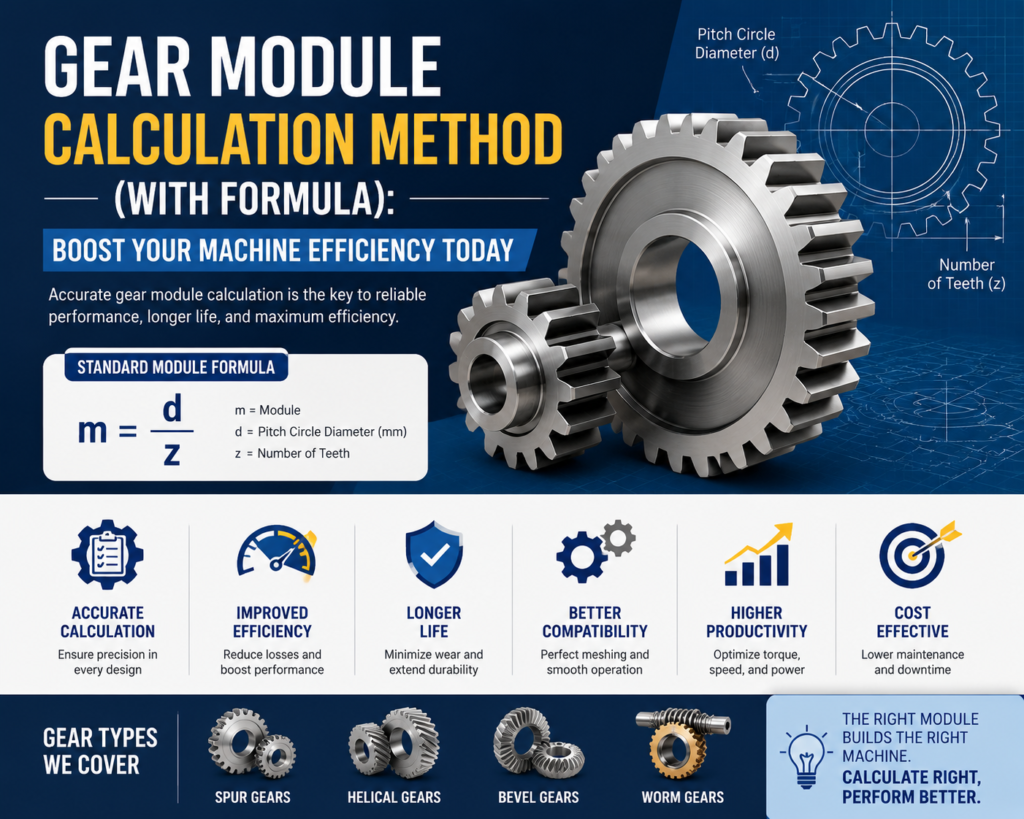
Gear Module Calculation Method (with Formula): Boost Your Machine Efficiency Today
1. Introduction to Gear Module Calculation
1.1 Definition of Gear Module
Alright, let’s kick things off by laying down the basics: the gear module, often dubbed the “unsung hero” of gear engineering, is essentially the ratio between the pitch circle diameter (PCD) and the number of teeth. Think of it as the DNA of your gear—it defines tooth size and spacing, setting the stage for every smooth rotation and torque transfer. Without this measurement, gears might as well be bumping around like kids in a dodgeball game, all chaos and no precision.
1.2 Importance of Gear Module in Mechanical Design
Gear module isn’t just a number—it’s a performance driver. Selecting the right module ensures your gear teeth mesh seamlessly, reducing vibrations, minimizing noise, and extending component life. In high-load industrial setups or precision robotics, an improper module can spell disaster, turning an otherwise slick mechanical symphony into a grinding nightmare.
1.3 Overview of Gear Efficiency
Gear efficiency isn’t merely about how fast your machine runs—it’s about how well it converts input energy into output motion. Correct gear module directly influences this efficiency by controlling backlash, reducing slippage, and harmonizing torque transmission. In short, the right module keeps your machines humming like a finely tuned pickleball paddle hitting a perfect dink.
2. Understanding Gear Terminology
2.1 Pitch Circle Diameter (PCD)
Pitch Circle Diameter, or PCD, is the imaginary circle that runs through the center of each tooth. It’s the reference diameter where gear engagement is measured, and if you get this wrong, your gears won’t mesh properly, leading to premature wear or catastrophic failure.
2.2 Number of Teeth
The number of teeth on a gear affects not just speed ratio, but also load distribution and noise characteristics. More teeth mean smoother engagement and less stress per tooth, while fewer teeth allow faster rotation but higher impact loads—a balancing act that separates amateur designs from professional-grade engineering.
2.3 Pressure Angle
Pressure angle is the angle between the line of action (where teeth actually contact) and the gear tangent. Common angles like 20° or 14.5° dictate how forces are transmitted. Misjudging this angle can increase friction and wear, basically turning your machine into a squeaky, groaning mess.
3. Basic Gear Module Formula
3.1 Standard Module Formula
The standard formula for module (m) is straightforward:
[
m = \frac{PCD}{Number \ of \ Teeth}
]
It’s elegant in its simplicity, yet profoundly impactful. This tiny ratio governs the tooth geometry, load-bearing capacity, and even lubrication requirements.
3.2 Units and Conversion Considerations
Metric modules are expressed in millimeters, while diametral modules (popular in the US) use inches. Never mix them unless you enjoy recalculating every part in your design—trust me, it’s a headache you don’t want.
3.3 Example Calculation
Suppose a gear has a PCD of 120 mm and 40 teeth. Using the formula:
[
m = \frac{120}{40} = 3 \ mm
]
Boom—that’s your module. It may seem trivial, but this number dictates everything from torque capacity to surface stress.
4. Types of Gear Modules
4.1 Metric Module
Metric modules dominate global machinery standards. Easy to compute and widely standardized, they’re the go-to in European and Asian industrial setups.
4.2 Diametral Module
Diametral modules, expressed as teeth per inch of pitch diameter, are more common in the US. They provide an alternative lens for designing gears in imperial-based systems.
4.3 Module in Custom Applications
Sometimes, off-the-shelf standards don’t cut it. Custom modules allow engineers to tweak tooth size for unique load or space constraints, often in high-performance or miniature machinery.
5. Calculating Gear Module for Spur Gears
5.1 Step-by-Step Calculation Process
Measure or determine the pitch circle diameter.
Count the teeth precisely.
Apply the standard module formula.
This stepwise method ensures consistency and repeatability in design.
5.2 Common Pitfalls in Spur Gear Calculations
Miscounting teeth, rounding PCD values prematurely, or ignoring tolerance can all skew results. Even a 0.1 mm discrepancy can induce vibrations in high-speed applications.
5.3 Example Scenario
A 60-tooth spur gear with a 180 mm PCD yields:
[
m = \frac{180}{60} = 3 \ mm
]
This module aligns perfectly with industry standards, ensuring seamless meshing with a mating gear.
6. Calculating Gear Module for Helical Gears
6.1 Helix Angle Considerations
Helical gears introduce a helix angle, which distributes load across multiple teeth simultaneously. The larger the angle, the smoother the engagement, but also the greater the axial thrust.
6.2 Adjusted Module Formula
To account for the helix angle ((\beta)):
[
m_n = m \cdot \cos(\beta)
]
Where (m_n) is the normal module. This adjustment keeps torque and load balanced along the helical path.
6.3 Sample Calculation
For a 3 mm module with a 15° helix angle:
[
m_n = 3 \cdot \cos(15°) \approx 2.9 \ mm
]
Tiny difference, huge impact on performance and wear patterns.
7. Calculating Gear Module for Bevel Gears
7.1 Understanding Bevel Gear Geometry
Bevel gears operate on conical surfaces, transmitting motion at various angles. Tooth geometry changes along the cone, demanding precise calculations for consistent meshing.
7.2 Module Adaptation for Conical Surfaces
Module calculations require accounting for the pitch cone angle and face width. Failure to adjust leads to misalignment and excessive localized wear.
7.3 Worked Example
A bevel gear with 20 teeth and a PCD of 100 mm at a 45° cone angle yields an effective module requiring trigonometric adjustment:
[
m_{effective} = \frac{PCD \cdot \cos(\theta)}{Number \ of \ Teeth} = \frac{100 \cdot \cos(45°)}{20} \approx 3.54 \ mm
]
8. Calculating Gear Module for Worm Gears
8.1 Worm and Worm Wheel Relationship
Worm gears transform rotational motion at right angles with significant speed reduction. The worm’s lead and wheel’s teeth must synchronize perfectly to avoid friction hotspots.
8.2 Module Formula Adjustments
The wheel’s module is linked to the worm’s pitch and lead angle. This ensures a smooth helical engagement, distributing load along the worm thread.
8.3 Example Calculation
For a worm with a 10 mm lead and a wheel with 30 teeth, the module calculation aligns both components, maintaining consistent torque transmission without overheating.
9. Selecting the Correct Gear Module
9.1 Factors Affecting Module Selection
Load magnitude, operating speed, available space, and material properties all influence module choice. It’s like picking the right paddle for a pickleball match—size and strength matter.
9.2 Matching Gear Module to Load Requirements
Higher load applications require larger modules to distribute stress, while precision instruments often favor smaller modules for finer control.
9.3 Using Module to Optimize Gear Life
Correct module reduces wear, limits backlash, and prolongs gear life, minimizing maintenance downtime and operational headaches.
10. Influence of Gear Module on Machine Efficiency
10.1 Reducing Friction Losses
Proper module selection ensures teeth mesh smoothly, decreasing friction and heat, which otherwise sap energy like a sneaky leaky faucet.
10.2 Balancing Torque and Speed
A well-chosen module balances torque delivery and rotational speed, preventing energy losses and enhancing system responsiveness.
10.3 Case Studies of Efficiency Improvements
Industries from automotive to industrial conveyors have documented energy savings of 5–15% simply by optimizing gear modules—a testament to the power of this seemingly humble number.
11. Gear Module Tolerances and Standards
11.1 ISO and AGMA Standards
International standards like ISO 1328 and AGMA 2015 provide guidance on module tolerances, ensuring consistency across global gear suppliers.
11.2 Tolerance Classes and Their Impact
Tolerance affects vibration, noise, and stress distribution. Choosing the wrong class is like playing pickleball with a warped paddle—it just doesn’t work.
11.3 Ensuring Compatibility in Gear Pairs
Matching tolerances between mating gears guarantees smooth engagement, preventing premature tooth failure and operational inefficiencies.
12. Common Mistakes in Gear Module Calculations
12.1 Miscounting Teeth
One tooth off can ruin the mesh ratio, leading to increased wear or catastrophic failure in high-load setups.
12.2 Ignoring Pressure Angle
Ignoring pressure angle shifts contact forces, amplifying stress on teeth edges and potentially causing deformation.
12.3 Using Incorrect Units
Mixing metric and imperial units is a surefire way to end up with incompatible gears—a mistake more costly than any missed
serve on the pickleball court.
13. Advanced Gear Module Calculations
13.1 High-Precision Applications
Medical devices, aerospace, and robotics often require sub-millimeter precision in module calculation, where even minor deviations can compromise performance.
13.2 Compound Gear Trains
Complex gear trains demand careful module coordination to maintain overall speed ratios and torque balance across multiple stages.
13.3 Software Tools for Module Calculation
Modern CAD and FEA software can automate module calculations, simulate stresses, and optimize designs for load, speed, and efficiency.
14. Optimizing Gear Design Using Module
14.1 Selecting Lightweight Gears
Optimizing module allows for lighter gears without sacrificing strength, reducing energy consumption and material costs.
14.2 Minimizing Wear and Tear
Proper module selection spreads load across more teeth, reducing contact stress and extending operational lifespan.
14.3 Enhancing Load Capacity
Bigger or customized modules enhance load-bearing ability, crucial for industrial machines, cranes, and high-torque applications.
15. Real-World Examples and Case Studies
15.1 Automotive Gear Systems
From transmissions to differentials, module optimization ensures smooth acceleration, better fuel efficiency, and less maintenance.
15.2 Industrial Machinery Applications
Conveyor systems, milling machines, and presses benefit from precise module selection, avoiding costly downtime.
15.3 Robotics and Automation
Small modules in robotic arms allow high precision movement, while larger modules provide strength for heavy payloads, balancing speed and power like a champion pickleball serve.
16. Conclusion and Key Takeaways
16.1 Summary of Gear Module Importance
The gear module is more than a number—it’s the backbone of mechanical efficiency, affecting torque, speed, wear, and longevity.
16.2 Practical Tips for Accurate Calculation
Always verify tooth counts, PCD measurements, and pressure angles. Stick to standards, double-check units, and use software for complex designs.
16.3 Boosting Machine Efficiency with Correct Module
A correctly calculated module transforms your machinery, reducing energy losses, enhancing reliability, and keeping your operations running smoother than a perfectly executed pickleball rally.