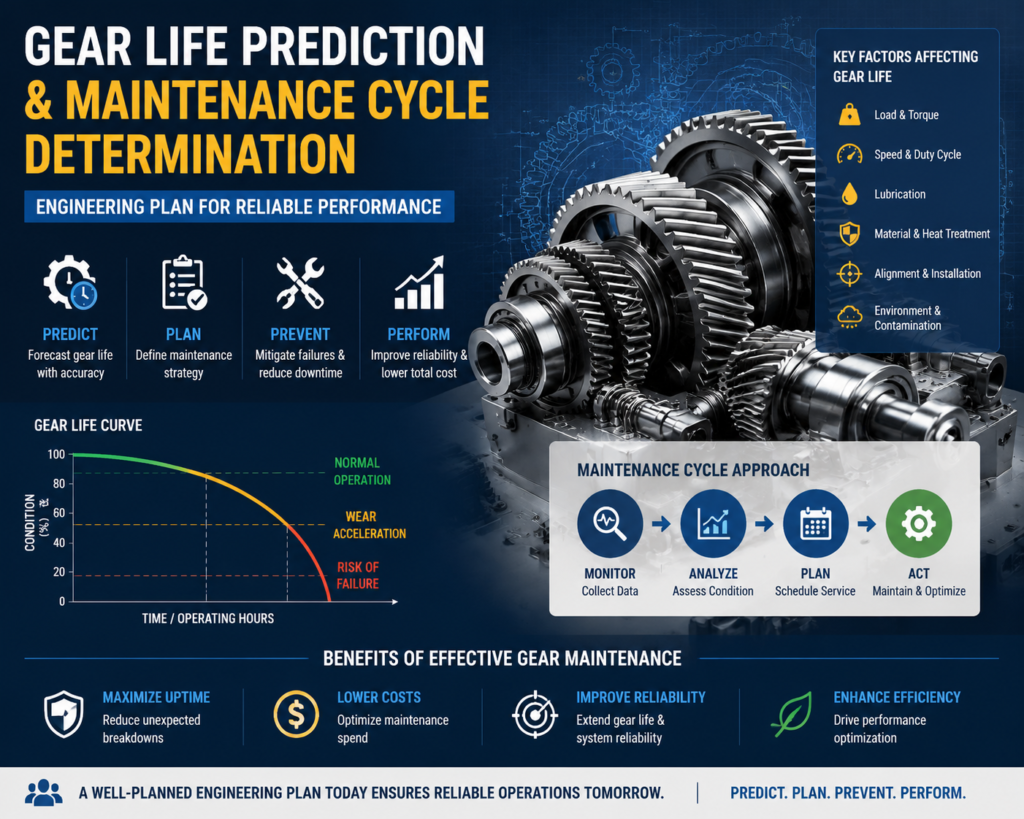
Gear Life Prediction and Maintenance Cycle Determination: A Comprehensive Engineering Guide
1. Introduction to Gear Life Prediction
1.1 Importance of Accurate Gear Life Forecasting
Predicting gear life is not just a box-ticking exercise; it’s the bedrock of industrial reliability. Accurate forecasts prevent untimely shutdowns, avoid catastrophic mechanical failures, and allow engineers to make informed decisions that preserve both equipment integrity and financial outlay. In high-stakes environments where precision machinery underpins production, understanding the longevity of each gear component is akin to knowing the pulse of the entire system.
1.2 Impact on Operational Efficiency
A gearbox that’s running close to its wear threshold can silently throttle throughput. By accurately predicting gear life, operations can maintain peak efficiency, reducing unplanned downtime and avoiding the costly domino effect of delayed production. When engineers plan maintenance with foresight, the machinery hums along like a well-oiled symphony, rather than sputtering under stress.
1.3 Role in Maintenance Planning
Integrating gear life predictions into an engineering plan transforms maintenance from a reactive chore into a strategic function. With reliable estimates, maintenance cycles can be optimized, spare parts allocated judiciously, and labor resources deployed efficiently, creating a robust framework that keeps operations smooth while controlling costs.
2. Fundamentals of Gear Life
2.1 Material Properties and Wear Resistance
The metallurgical composition of gears dictates their wear thresholds, fatigue limits, and susceptibility to micro-pitting. High-alloy steels with superior hardness and surface treatment—like carburizing or nitriding—extend gear life by enhancing wear resistance under cyclical loads. Selecting materials that match operational demands is not just smart; it’s indispensable.
2.2 Gear Design and Load Distribution
Load distribution across gear teeth affects stress concentration and, ultimately, longevity. Precision in tooth geometry, pressure angles, and profile modifications reduces localized stress, mitigates premature failure, and maximizes the operational lifespan. Proper design is the invisible shield that prevents small flaws from cascading into catastrophic damage.
2.3 Environmental Factors Affecting Gear Life
Temperature swings, humidity, dust, and particulate contamination can significantly accelerate gear degradation. Even perfectly designed gears will suffer if exposed to corrosive or abrasive environments without mitigation. Environmental considerations are essential components of any accurate gear life forecast.
3. Common Types of Gear Failures
3.1 Abrasive Wear and Pitting
Abrasive wear gradually erodes gear surfaces, while pitting creates micro-craters that weaken teeth. Both phenomena are exacerbated by poor lubrication and high surface loads, often serving as early indicators that the maintenance cycle needs adjustment.
3.2 Fatigue Cracks and Tooth Breakage
Fatigue cracks originate from repetitive stress cycles that exceed material endurance. Once initiated, they propagate rapidly, sometimes culminating in sudden tooth breakage—a classic “silent assassin” scenario that highlights the importance of predictive maintenance.
3.3 Lubrication-Related Failures
Inadequate or contaminated lubrication is responsible for a significant percentage of gear failures. Oil degradation, viscosity breakdown, and foreign particle contamination accelerate wear, highlighting the interconnection between lubrication management and gear life.
4. Methods for Predicting Gear Life
4.1 Analytical Calculation Approaches
Classical methods such as the Lundberg-Palmgren and AGMA calculations allow engineers to quantify fatigue life using stress, load, and material properties. These methods provide a baseline, often augmented by safety factors, to ensure conservative and reliable predictions.
4.2 Empirical and Industry Standards
Industry standards like ISO 6336 offer empirically derived formulas and guidelines. Adhering to these ensures predictions align with globally recognized benchmarks, minimizing risk while providing traceable documentation for quality assurance.
4.3 Simulation and Software Tools
Modern predictive modeling leverages finite element analysis (FEA) and specialized gear design software to simulate real-world conditions. These digital twins allow engineers to stress-test designs virtually, providing actionable insights without physically wearing down expensive components.
5. Key Parameters Affecting Gear Longevity
5.1 Torque and Load Cycles
High torque spikes and variable loading accelerate fatigue. Monitoring and managing these forces ensures that gears operate within safe limits, prolonging life and reducing unplanned failures.
5.2 Operating Speed and Duty Cycles
Rotational speed affects contact stress and heat generation, while duty cycles determine cumulative wear. Both must be accounted for when establishing a realistic maintenance cycle to prevent premature downtime.
5.3 Lubrication and Contamination Factors
Lubricants form a protective barrier; contamination erodes it. Dirt, water ingress, or chemical exposure can drastically shorten gear life, emphasizing the need for vigilant monitoring and high-quality lubricants.
6. Gear Life Testing Techniques
6.1 Laboratory Bench Testing
Controlled bench tests provide empirical data on wear, stress tolerance, and fatigue limits. Engineers use this data to validate calculations and refine maintenance schedules.
6.2 Field Performance Monitoring
Real-world conditions often diverge from theory. Sensors and telemetry capture operational parameters such as vibration, temperature, and torque, offering a practical lens into actual gear life.
6.3 Accelerated Life Testing Methods
Accelerated tests stress components beyond normal operating limits to simulate long-term wear in a fraction of the time. These tests highlight failure modes that might not emerge during standard testing periods.
7. Understanding Maintenance Cycles
7.1 Definition and Purpose of Maintenance Cycles
A maintenance cycle is a preplanned interval during which inspections, lubrication, or replacements are performed to ensure uninterrupted operation. The goal is to strike a balance between resource expenditure and operational reliability.
7.2 Time-Based vs Condition-Based Maintenance
Time-based maintenance follows strict intervals, while condition-based maintenance adapts to real-time gear health. A hybrid approach often delivers the best combination of cost-efficiency and reliability.
7.3 Predictive Maintenance Strategies
Predictive strategies leverage monitoring data and gear life predictions to preempt failures. This proactive approach reduces unexpected downtime and extends overall equipment life.
8. Integrating Gear Life into Maintenance Planning
8.1 Aligning Maintenance with Operational Schedules
Scheduling maintenance during low-demand periods minimizes production disruption, making planning as much about timing as technical necessity.
8.2 Prioritizing Critical Gear Components
Not all gears are created equal; identifying critical components ensures resources are focused on parts whose failure would have the most severe operational impact.
8.3 Cost-Benefit Analysis of Maintenance Timing
Optimizing maintenance cycles involves weighing intervention costs against potential downtime. Strategic planning maximizes return on investment while preserving gear life.
9. Data Collection for Gear Health Assessment
9.1 Vibration and Noise Monitoring
Changes in vibration patterns or unexpected acoustic signatures can indicate early-stage gear wear, making regular monitoring essential for early intervention.
9.2 Oil Analysis and Contaminant Detection
Analyzing lubricant samples for metallic particles, viscosity, and acidity provides insight into internal gear wear before it becomes critical.
9.3 Temperature and Load Tracking
Continuous measurement of operational temperatures and loads helps identify stress anomalies, guiding timely maintenance interventions.
10. Predictive Analytics for Gear Maintenance
10.1 Trend Analysis and Life Forecasting
Tracking historical data enables predictive models to estimate remaining useful life, allowing engineers to make maintenance decisions with confidence rather than guesswork.
10.2 Machine Learning Models for Gear Life
Advanced AI can identify patterns too subtle for human observation, predicting failures before they manifest and fine-tuning maintenance cycles dynamically.
10.3 Early Warning Systems for Failure Prevention
Integrating sensor data with predictive analytics creates automated alerts, allowing rapid response to conditions that could compromise gear life.
11. Developing an Engineering Plan
11.1 Establishing Maintenance Objectives
Clearly defined goals—minimizing downtime, maximizing gear life, and controlling costs—form the backbone of an actionable engineering plan.
11.2 Defining Inspection Intervals
Inspection intervals are based on predictive modeling, empirical data, and operational criticality, ensuring maintenance is neither excessive nor insufficient.
11.3 Documentation and Reporting Procedures
Accurate record-keeping allows trend analysis over time, supports compliance, and informs continual improvements to maintenance strategies.
12. Lubrication Management and Its Impact
12.1 Selecting the Right Lubricant
Choosing the correct viscosity, additive package, and base oil is critical. Inappropriate selection accelerates wear and undermines predictive maintenance plans.
12.2 Lubrication Scheduling and Monitoring
Routine oil top-ups, changes, and condition monitoring ensure the lubrication regime supports maximum gear life under operating stresses.
12.3 Lubricant Degradation Analysis
Testing for oxidation, contamination, and viscosity drop allows early detection of lubrication issues, preventing consequential gear failures.
13. Case Studies of Gear Life Optimization
13.1 Industrial Machinery Applications
Large-scale manufacturing equipment demonstrates how predictive maintenance and engineering plans can cut downtime by up to 40%, showcasing practical benefits.
13.2 Automotive and Heavy Equipment Examples
In automotive transmissions and heavy-duty earth movers, precision maintenance schedules have been shown to prevent catastrophic gear failure, underscoring the value of data-driven planning.
13.3 Lessons Learned from Failed Systems
Analyzing failures reveals common pitfalls—overlooked monitoring, improper lubrication, and design flaws—informing future strategies to maximize gear life.
14. Cost Considerations in Gear Maintenance
14.1 Balancing Maintenance Cost vs Downtime
The cheapest intervention is often the one that prevents an expensive shutdown
, reinforcing that strategic maintenance planning pays dividends.
14.2 Lifecycle Cost Analysis
Considering total cost of ownership, including repair, replacement, and lost production, provides a holistic view of gear investment.
14.3 Budget Planning for Maintenance Programs
Resource allocation based on predictive maintenance and gear life forecasts ensures financial prudence without compromising reliability.
15. Risk Management in Gear Operations
15.1 Identifying Critical Failure Points
Mapping the system to highlight high-risk gears enables focused attention and risk mitigation, preventing cascading failures.
15.2 Mitigation Strategies for Gear Damage
Proactive reinforcement, advanced lubrication, and load management reduce the probability and severity of gear failures.
15.3 Contingency Planning and Spare Parts Management
Stocking critical components and having clear replacement protocols ensures operations remain resilient when failures occur.
16. Future Trends in Gear Life Prediction
16.1 Advances in Smart Sensors and IoT Integration
Next-generation sensors provide real-time, high-resolution data, enabling more precise maintenance cycles and enhancing the fidelity of engineering plans.
16.2 AI-Driven Predictive Maintenance
Artificial intelligence will increasingly automate decision-making, forecasting gear life with unprecedented accuracy and minimizing human error.
16.3 Sustainable and Long-Life Gear Materials
Emerging alloys, surface treatments, and composite materials promise extended gear life while supporting sustainable manufacturing practices.
17. Conclusion and Strategic Recommendations
17.1 Key Takeaways for Engineers and Purchasers
Gear life prediction is no longer optional; it’s a strategic imperative that enhances operational efficiency, minimizes downtime, and ensures cost-effective maintenance.
17.2 Implementing an Effective Maintenance Cycle
A carefully crafted maintenance cycle, guided by predictive insights and engineering plans, transforms operations from reactive firefighting to proactive reliability management.
17.3 Continuous Improvement in Gear Life Management
Monitoring, analyzing, and refining maintenance strategies over time ensures gears remain reliable, costs are controlled, and production schedules stay on track.