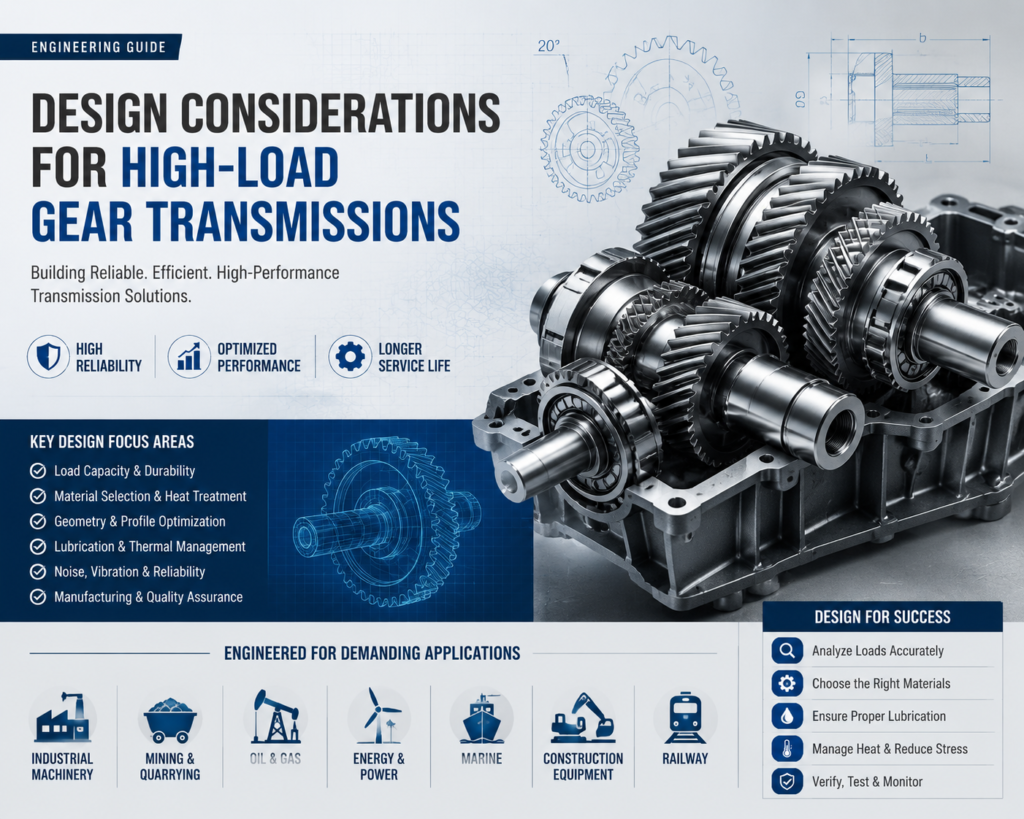
Design Considerations for High-Load Gears Transmissions
1. Introduction to High-Load Gears Transmissions
1.1 Definition and Scope of High-Load Gears
High-load gears are the backbone of any machinery that demands consistent torque transmission under extreme conditions. These components are designed to withstand forces that would instantly cripple standard gears, often operating in applications ranging from heavy industrial presses to mining equipment, where miscalculations in load capacity can lead to catastrophic failure.
1.2 Importance in Industrial and Mechanical Applications
In the industrial landscape, the reliability of gear transmissions directly correlates to operational uptime. A gearbox carrying erratic loads or subjected to frequent torque spikes without proper design considerations can jeopardize entire production lines, causing cascading delays, hefty repair bills, and a fair share of headaches for purchasing engineers juggling budgets and performance requirements.
1.3 Overview of Transmission Challenges
High-load applications introduce unique challenges: excessive wear, fatigue, thermal expansion, and alignment sensitivities. Every mechanical element—from the smallest bearing to the largest spur gear—needs meticulous attention. Ignoring factors such as tooth flank stress, backlash, or lubrication pathways is a recipe for recurring downtime and expensive maintenance cycles.
2. Fundamental Principles of Gear Design
2.1 Gear Types and Their Load Capacities
Be it spur, helical, bevel, or planetary, each gear type presents a unique load profile. Helical gears, for instance, distribute contact forces more evenly than spur gears, reducing noise but increasing axial thrust, which must be mitigated through appropriate bearing selection.
2.2 Material Selection Considerations
Material choice is not just a checkbox—it’s a strategic decision impacting fatigue resistance, thermal conductivity, and wear patterns. Alloy steels, often augmented with carbon and chromium, remain industry staples, while composite or titanium variants are entering specialized high-performance applications.
2.3 Basic Mechanical Design Parameters
Core design parameters include module, pressure angle, face width, and pitch diameter. Proper optimization ensures a balance between torque capacity, durability, and operational smoothness, often requiring iterative calculations to reconcile performance with manufacturability.
3. Load Analysis and Capacity Calculations
3.1 Static vs Dynamic Load Assessment
Static loads give an initial indication of gear strength, but dynamic assessments reveal real-world performance. Engineers must factor in shock loads, torque ripple, and operational cycles to prevent premature fatigue or catastrophic failure.
3.2 Torque and Power Transmission Calculations
Torque and power calculations form the foundation of gear specification. Accurate analysis must consider not only the nominal torque but transient peaks, efficiency losses, and potential overloading scenarios to ensure a robust and reliable transmission.
3.3 Safety Factors and Design Margins
In high-load applications, adopting conservative safety factors is crucial. These margins account for unforeseen overloads, manufacturing tolerances, and material inconsistencies, effectively acting as a buffer against operational surprises.
4. Material Selection for High-Load Gears
4.1 Steel Alloys and Heat Treatments
High-carbon alloy steels, nitrided or carburized, provide a hardened surface while maintaining a tough core to resist crack propagation. Heat treatment processes are meticulously controlled to balance hardness, ductility, and fatigue resistance.
4.2 Surface Hardening and Coatings
Techniques such as induction hardening, flame hardening, and PVD coatings extend service life by improving surface durability, reducing friction, and mitigating micro-pitting under high cyclic stresses.
4.3 Lightweight Materials for Specific Applications
In aerospace or robotic applications where weight is critical, engineers often turn to titanium or high-strength aluminum alloys, which offer a favorable strength-to-weight ratio but require precise machining to achieve acceptable tolerances.
5. Gear Geometry and Profile Optimization
5.1 Tooth Shape and Pressure Angle Selection
Selecting the correct tooth profile is critical for load distribution. Involute profiles remain prevalent, but for high-load cases, modifications such as crowning or tip relief help reduce edge stresses and mitigate noise.
5.2 Gear Module and Pitch Considerations
A larger module increases tooth thickness and load-bearing capacity, but comes at the cost of larger gear size. Engineers must find the sweet spot between strength, space constraints, and manufacturability.
5.3 Minimizing Stress Concentration Points
Fillet radii, root reliefs, and surface finish optimization help reduce stress risers that often become nucleation points for cracks under cyclic loading, enhancing overall durability.
6. Lubrication and Friction Management
6.1 Lubricant Types and Viscosity Requirements
Choosing between mineral oils, synthetic lubricants, or solid films depends on operating temperature, load cycles, and contamination levels. High-load gears benefit from lubricants with high film strength to prevent scuffing.
6.2 Gearbox Design for Optimal Lubrication
Oil channels, splash lubrication, and pressurized systems ensure uniform film coverage across the contact surfaces, mitigating wear even under fluctuating loads.
6.3 Reducing Wear Through Surface Treatments
Surface treatments like shot peening or phosphate coatings create compressive residual stresses and reduce friction, significantly extending the operational lifespan of gears.
7. Thermal Considerations in High-Load Gears
7.1 Heat Generation During Operation
High-speed or high-torque gears generate substantial heat due to friction and hysteresis. Excessive temperature can degrade lubricants, soften materials, and accelerate wear.
7.2 Cooling Strategies for Continuous Performance
Oil coolers, forced-air ventilation, and integrated heat exchangers are employed to maintain thermal equilibrium, ensuring that performance remains stable over prolonged operation.
7.3 Material Thermal Expansion and Tolerance Management
Differential expansion between mating gears or shafts can lead to misalignment. Engineers must design for thermal growth, accounting for expansion coefficients and operational temperature ranges.
8. Noise, Vibration, and Harshness (NVH) Control
8.1 Sources of Gear Noise in High-Load Applications
Tooth meshing, misalignment, and backlash contribute to acoustic emissions. Noise not only affects comfort but is an indicator of stress and potential failure zones.
8.2 Vibration Damping Techniques
Dynamic dampers, compliant mounts, and precise tooth profile corrections reduce vibrational peaks, extending the service life of gears and associated components.
8.3 Impact on Equipment Longevity and Reliability
Persistent NVH issues correlate with faster wear rates, bearing fatigue, and eventual transmission failure, making early mitigation a cost-saving strategy.
9. Gear Assembly and Alignment
9.1 Shaft Positioning and Bearing Selection
Accurate shaft alignment and selecting bearings with appropriate radial and axial capacities prevent uneven load distribution and premature tooth or bearing failure.
9.2 Backlash and Tolerances
Controlled backlash is essential to allow for thermal expansion while preventing excessive slop that can induce shock loads and noise, requiring precise machining and assembly.
9.3 Assembly Procedures to Avoid Premature Wear
Methodical torque sequencing, lubrication pre-coating, and post-assembly checks ensure that gears start their operational life free from stress concentrations and misalignment.
10. Failure Modes and Mitigation Strategies
10.1 Common Gear Failures Under High Loads
Scuffing, pitting, tooth bending, and micro-cracks are prevalent failure modes in high-load gears, often accelerated by inadequate lubrication or poor material selection.
10.2 Fatigue and Surface Pitting Analysis
Fatigue cracks initiate at stress concentrators, while surface pitting occurs under repeated contact stress. Advanced FEM simulations help predict and prevent these issues before production.
10.3 Preventive Design Solutions
Redundant safety factors, optimized tooth geometry, and surface treatments serve as proactive measures, reducing the likelihood of unexpected failures.
11. Advanced Manufacturing Techniques
11.1 Precision Machining for High-Load Applications
CNC hobbing, gear grinding, and broaching enable micron-level tolerances that maintain tooth integrity under extreme loads.
11.2 Additive Manufacturing for Complex Gears
Selective laser melting or electron beam melting allows creation of intricate gear geometries that traditional machining cannot achieve, particularly useful for custom high-load applications.
11.3 Quality Control and Inspection Methods
Non-destructive testing, 3D scanning, and hardness mapping ensure that every gear meets stringent performance criteria, minimizing field failures.
12. Transmission System Integration
12.1 Coupling Gears with Motors and Drives
Seamless integration requires torque matching, shaft alignment, and consideration of inertia effects to prevent resonance and uneven load distribution.
12.2 Load Distribution Across Multiple Gear Stages
Planetary or compound gear arrangements distribute loads evenly across multiple teeth, reducing individual stress and enhancing system durability.
12.3 Monitoring System Performance
Condition monitoring via vibration sensors, thermography, and torque tracking allows predictive maintenance and early fault detection, keeping machinery in peak condition.
13. Cost Considerations in High-Load Gear Design
13.1 Material vs Manufacturing Trade-offs
High-performance alloys and surface treatments improve durability but increase upfront costs. Engineers must balance longevity with budgetary constraints.
13.2 Lifecycle Cost Analysis
Evaluating energy efficiency, downtime, maintenance frequency, and replacement costs provides a holistic view of the total cost of ownership.
13.3 Budgeting for Maintenance and Replacement
Allocating capital for scheduled inspections, lubrication systems, and gear replacement ensures operational reliability without breaking the bank.
14. Case Studies of High-Load Gears Solutions
14.1 Industrial Machinery Applications
Mining conveyors, steel rolling mills, and hydraulic presses demonstrate how optimized gear design sustains heavy loads for extended periods without failure.
14.2 Automotive and Heavy Equipment Examples
High-torque transmissions in construction vehicles and off
-road trucks illustrate the importance of precise material selection, heat treatment, and assembly discipline.
14.3 Lessons Learned from Failures and Successes
Analyzing past failures uncovers critical insights: improper heat treatment, misaligned shafts, or inadequate lubrication can devastate performance, while proactive engineering practices dramatically increase uptime.
15. Emerging Trends in Gear Design
15.1 Smart Gears and Condition Monitoring
Embedded sensors and IoT integration enable real-time performance tracking, predictive maintenance, and data-driven optimization of gear systems.
15.2 Advanced Materials and Coatings
High-entropy alloys, diamond-like carbon coatings, and self-lubricating composites are revolutionizing high-load gear longevity and performance.
15.3 Simulation and AI-Assisted Design
Finite element analysis, machine learning algorithms, and digital twins allow engineers to simulate complex load scenarios, reducing prototype iterations and accelerating design cycles.
16. Best Practices for Engineers and Purchasing Clients
16.1 Selecting the Right Supplier and Manufacturer
Reliability, certifications, and experience in high-load gears production are essential criteria when vetting suppliers to ensure quality components.
16.2 Design Verification and Prototyping
Prototype testing under realistic load conditions validates material selection, tooth geometry, and lubrication strategies before full-scale deployment.
16.3 Maintenance Planning and Operational Guidelines
Routine inspections, lubrication schedules, and torque monitoring create a framework for sustained performance, helping purchasing engineers maximize ROI while minimizing unscheduled downtime.